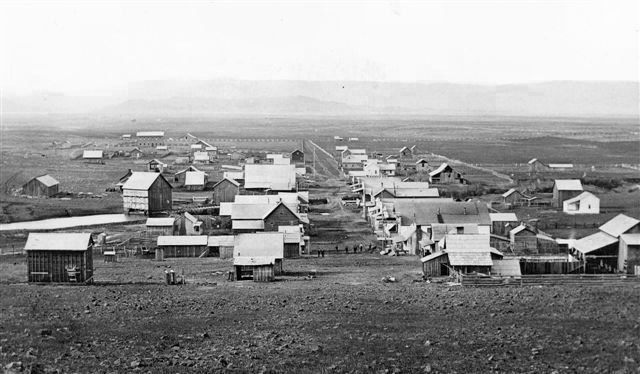
Adin, 1879. Herman Brince Photographer. Courtesy of Nevada Historical Society
Herman Brince (1831-1882) was photographer of Lassen, Modoc and Plumas Counties during the late 1870s. He is a person of interest to me, I appreciate the photographs he took, though I have only see about a half dozen. Newspaper accounts stated he was quite active in taking local scenes.
For instance, Brince first arrived on the scene in the summer of 1878 to set up a studio at Prattville, now Lake Almanor. He took an expedition in what would later became Lassen Park. He set as a base camp at Malgin’s Sheep Camp, known today as Drakesbad. He created a portfolio on 25 images that trip. He sold those images at his studio at Prattville. I have not been able to locate them. Of note, these were probably some of earliest photographs in the park.
In 1879, Brince relocated to Susanville. His photographic scenes were well documented in the newspaper, yet only a few are known to exist. This pattern repeats itself during his forays in Modoc County. In 1881, he pulled up stakes and went to Australia. He died in September 1882 at Dunedin, New Zealand.
Lassen Lodge #149 F.&A.M., 1879. A Brince photograph
In September 2025, a distant relative Dr. Ron Brinitzer sent this information: Herrman Brince was born as Heimann Brinitzer on 01. November 1831 to Samuel Brinitzer and Rosel Aufrichtig probably in Colonie Dupine or Paulsdorf close to Landsberg in Upper Silesia as oldest son into a Jewish family. He had three younger siblings: Caroline, Hirsch (or Herman) and Louis. In 1844 his mother died and his father remarried to Bertha Matzdorf with whom he had another 12 children (at least the ones I know of), among them Max (born in 1851) and Laura (born in 1861). Hirsch/Hermann is my direct ancestor. Louis emigrated to the US as well around 1869 with his wife Auguste and their daughter Rosalie where he worked as a tinsmith. He changed his name into Brince as well.
In 1914 there two Thanksgiving Balls locally, I thought I would provide back-to-back articles. After all, during holiday weekends readership is down.
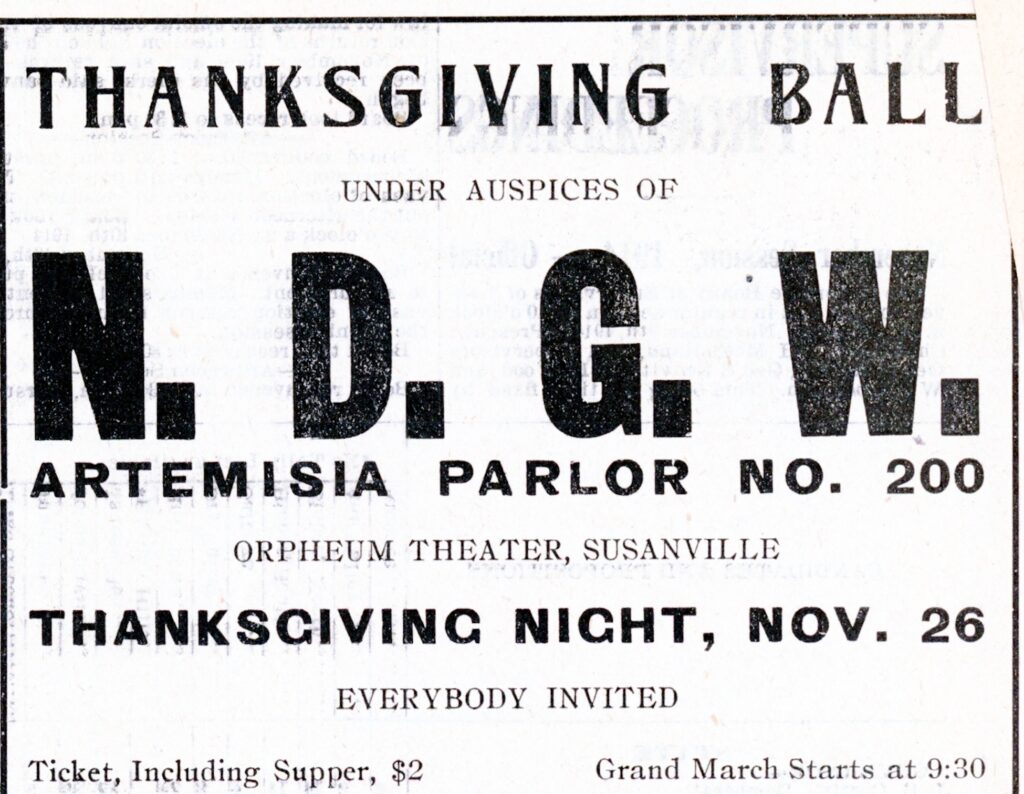
Those not familiar to the Native Daughters of the Golden West, is a fraternal organization dedicated to preserve the history of California and related goals. There is still local chapter of Native Daughters, the Nataqua Parlor.,which had its origins at Standish. The Artemisia Parlor of Susanville was short-lived and absorbed by Nataqua.
There was an organizational problem with this particular event.. The fliers had the wrong date. So a word of mouth campaign ensued. One has to remember this was in 1914, when few people even had a telephone. The attendance was slightly less than anticipated, but a good time was had by all.
The event took place at the Orpheum, on the 800 block of Main Street, Susanville. At midnight, the dancers sauntered down the street to the St. Francis Hotel for midnight chicken supper. Afterwards,they returned to the Orpheum to dance the light fantastic to the wee hours of the morning.
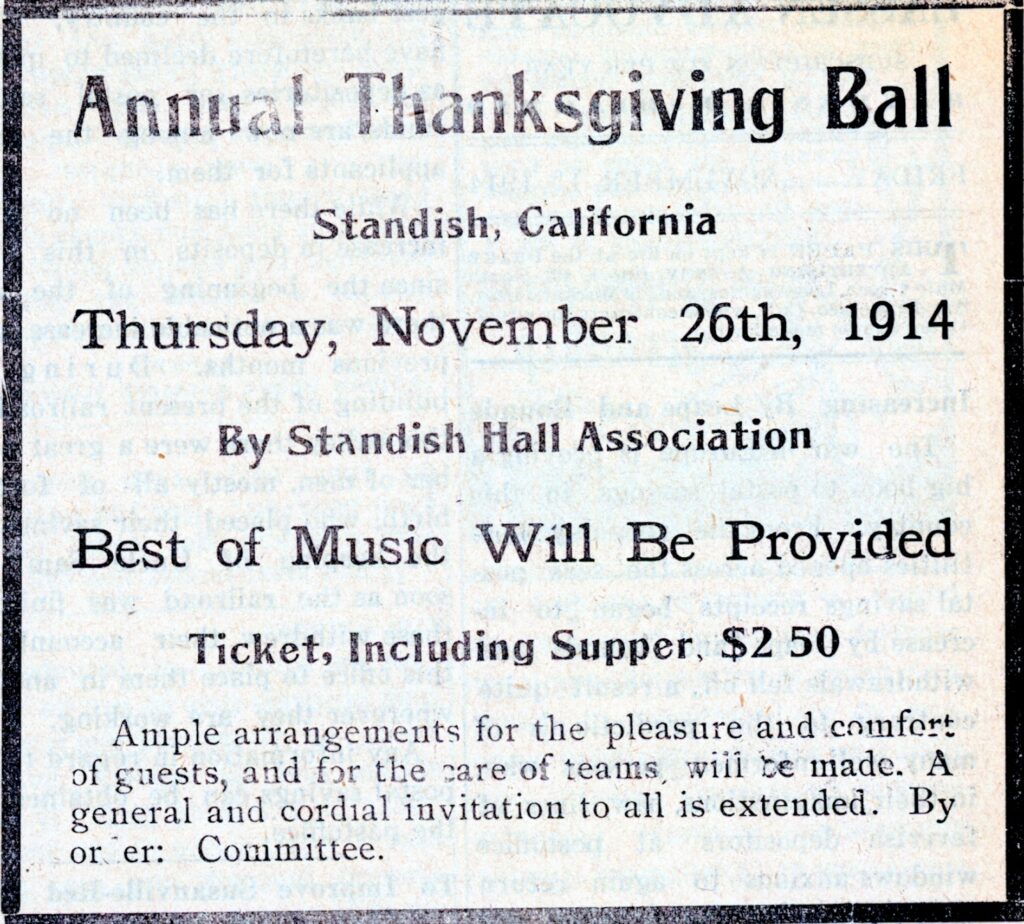
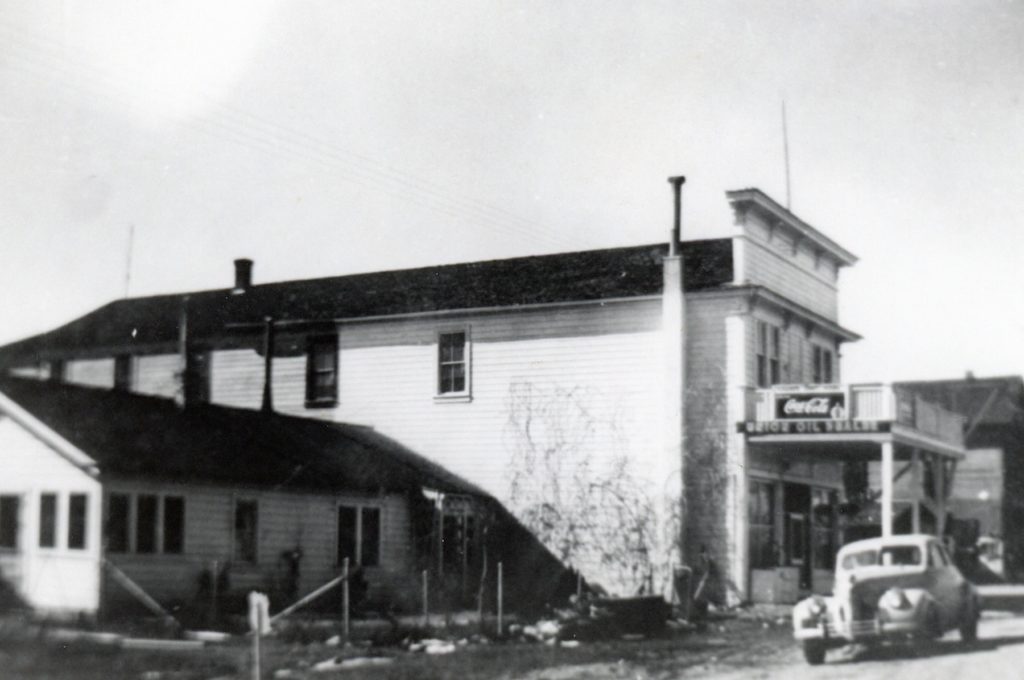
A major fundraiser for the Standish Hall Association was its annual Thanksgiving Ball. The Association owned a two-story building in that community, and a prominent one at that. Seasoned residents will remember as Niel’s Mercantile. Built in 1907, the second story was a hall that many organizations utilized. The first floor was rented to a commercial enterprise to assist with payment and upkeep of the building.
Niel’s Mercantile Standish,, no date. Courtesy of Camilla Moody.
The Association reported that the ball was a successful event, both in terms financially and socially. Standish was gaining notoriety for its social scene, as the Odd Fellows Lodge would be holding a Christmas Ball next month.
Note: While this repeat, I thought worthwhile since this Lassen College’s centennial year.
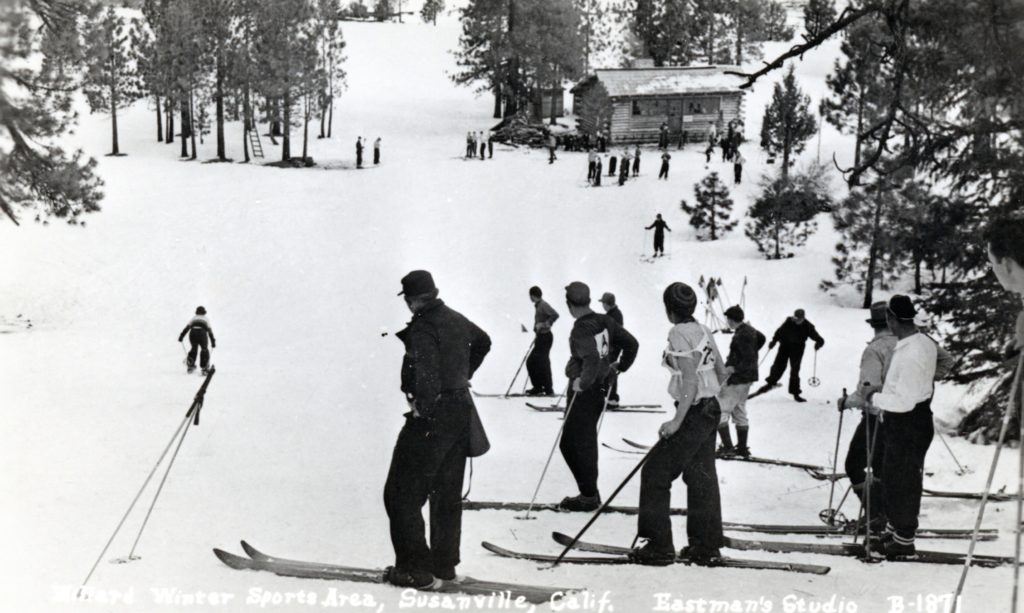
Willard Hill located some six miles west of Susanville was a popular winter sports venue. Its initial development came about through Lassen College’s Forestry Program inconjunction with the National Youth Administration. The latter provided each forestry student with not only academic training but to work in related forestry jobs. For their part-time work the students were paid $30 a month, however $20 a month was deducted for room and board in the converted Alpine Hotel dormitory. Continue reading Willard Ski Hill, Lassen County→
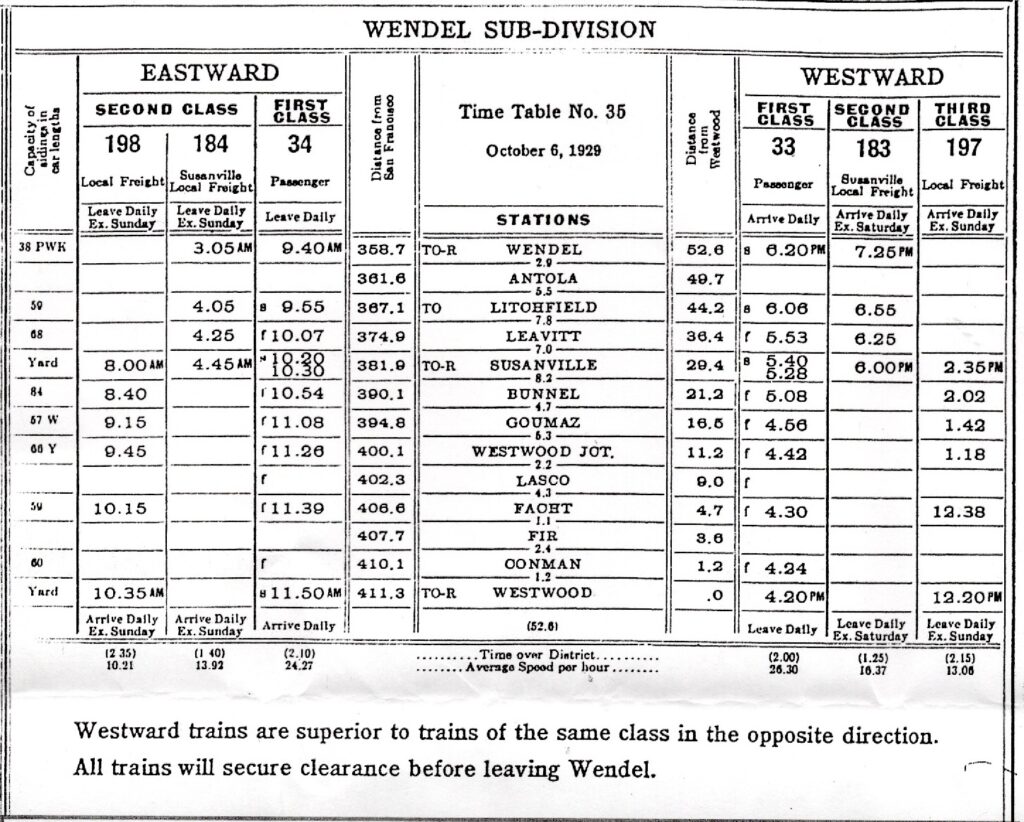
This is your Tuesday Tidbit. It is Thanksgiving week and for many it is busy time for travelers. I thought some might be interested Southern Pacific’s railroad timetable between Wendel and Westwood.
Personally, as a youngster, we did not travel that far. The family gathering was at Murrer Ranch, Willow Creek Valley. Attendance is those years was mandatory! Times change, and my grandmother became ill, and the Murrer Thanksgiving tradition ended in 1971. Just remember whether you attend a family or friend gathering for Thanksgiving time is fleeting, enjoy the moment and a safe journey..
World War II ushered in a new architectural style, that after the War it was adopted by the civilian population–the quonset hut. They were prefabricated, and a ten men crew with hardly any skills could assemble one.
The two most notables quonset huts was the old Naef Electric building in the 1800 block of Main Street. After it closed its doors circa 1977, it has been home to numerous enterprises. In the fall of 1978, it is where the Lassen County Times made its debut.
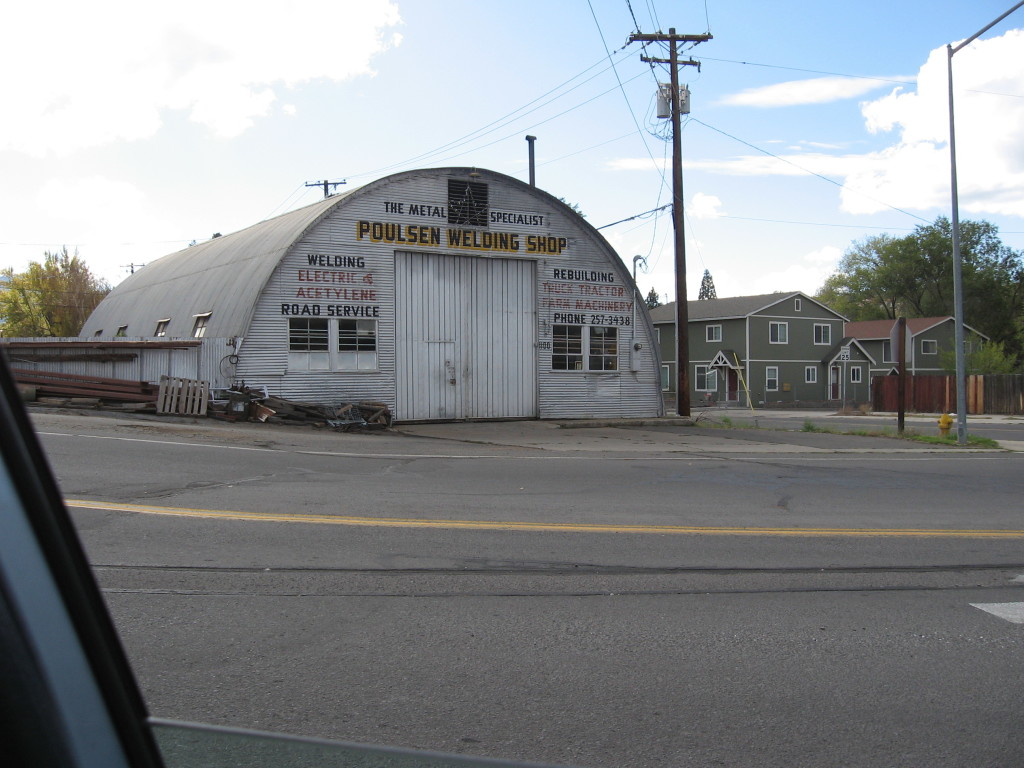
Paulsen Welding hop, October 18, 2015
The other is Poulsen Welding Shop located on Richmond Road and Riverside Drive, and carries with it, an important historic significance.
In the 1930s, Bigelow and Poulsen operated a blacksmith shop at this location, in which Poulsen would take over the business and branching out into welding. On July 11, 1946 a fire destroyed Poulsen’s shop and provided the catalyst for city annexation. The City was unable to respond to the fire as the city limits stopped on the north side of the Susan River, while Poulsen’s was on the south side, and outside the City. Efforts over the years to annex areas to the east of Weatherlow and south of Susan River had failed. The Red River Lumber Company which owned the Milwood subdivision fought efforts for fear of property tax hikes. Residents of the outlying areas wanted services such as fire protection.
Thus, the movement for “unification” was born. On April 8, 1947 a special annexation was approved by the voters. Susanville’s Main Street now extended from Weatherlow to Fairfield Avenue. The City’s land mass quadrupled in size.
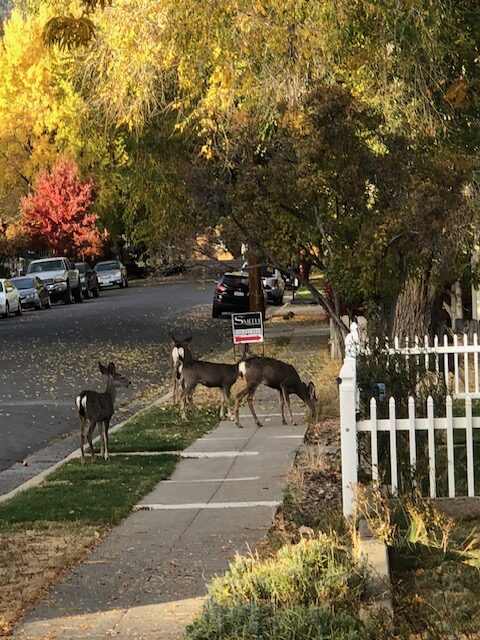
Deer grazing along Maple Street, Susanville-Courtesy of Jim Chapman
There was a time that to spot a deer in Susanville was a rarity. Those days are long gone. The deer population in the community is plentiful is an understatement. Some attribute the deer population with the passage in 1990 of the California Wildlife Protection Act. This law protects mountain lions from being hunted etc. With the increased mountain lion population, it would only make sense for deer to seek refuge inside the city from this predator. With that in mind the following is an account of a deer sighting years ago, that certain residents might find quaint.
Lassen Advocate, 16 February 1917 – It isn’t very often that deer wander into Susanville from our surrounding country, but a beautiful doe came in to see the sights last Wednesday. The animal was first seen in the Taylor fields north of town, and various persons living on North Street had a glimpse of it as made its way west to the hills.
Crater Lake is located seven miles east of the Bogard Rest Area on Highway 44. In 1907, Lassen National Forest Supervisor, Louis A. Barrett, included this lake in his inventory of proposed National Monuments, the other two being Lassen Peak and Cinder Cone. The lake remained inaccessible for years, except for hardy hikers who climbed the mountain. In 1952, the Fruit Growers Supply Company constructed a logging road to the 35-acre lake that is situated in a volcanic crater, on lands owned by the Lassen National Forest. The Forest Service originally proposed to offer summer home sites, but established a campground instead.
Initially, how the local wild horse population came to be was in the mid1800s. At that time, the Honey Lake Valley had few fences and the settlers allowed their livestock, both cattle and horses, to roam freely during the winter months. Annual spring round ups, that became the origin of today’s rodeos were to capture and brand the animals. There were always some stray horses escaped from being caught, thus began the local wild horse population.
George Wrede’s winter homestead remain at Bull Flat, where he would catch and break wild horses., June 1977
Yet, back then the wild horse population was kept under control by out of work wranglers. During the winter months, it was not unusual for ranches to let go extra help, especially single men. A number of these men, would take up a 160 acre desert homestead to make a home, especially properties with unclaimed springs. To make some extra money, they would catch wild horses and break them. By spring they would sell the horses, and pocket the money.
The Marr Brothers of the Madeline Plains turned that into a fine art of rounding up wild horses. In the 1930s, they would gather wild horses to be used in rodeos, which made for wild times. By 1940, the demand for horses dramatically decreased, thus allowing for the wild horse population to grow unchecked. More about. that later.
Thought some might be interested of on accounts of the lizard that was relayed by a Big Meadows Maidu and published in 1883:
“Speaking of Indians, reminds of a curious legend of theirs that I drew a few days ago from Dick, an Indian, an intelligent Big Meadows buck. Accidentally, I spoke of the arrowheads occasionally found everywhere over the country, and he remarked ‘they were no account, as they were made by lizards.’ This excited my curiosity, and with a little questioning I obtained the following, which in a tradition they have the appearance of religiously believing, as it is told them by their fathers.
“A long time ago the lizard was a little man, very little man indeed, and he was very much afraid of the grizzly bear, who was the ‘hi[yu’ boss-the right bower-the four aces so to speak, of all beasts, and what is more could talk. Well, these ugly bears seemed to hanker after these little lizard men and would think nothing of making a lunch of whole family, with mother-in-laws thrown in as dessert. The lizard were mortally afraid of them, but would shoot arrows at them without doing any harm, only making the grizzlies laugh. (These arrowheads are the ones we find.) At last there was a smart little cuss of a lizard who had had all his relatives eaten except his grandmother, with whom he lived, and resolved to make at a bow and arrow that would kill the bear. So he set himself to work and when questioned he told them all what he was doing at which they would laugh. When he got his bow completed his grandmother would not let him leave the campooda, for fear he would meet the fate of the others. At one last evening, while the old lady was gone after a basket of water, he took his new bow and quiver of arrows and stole away to a valley where the bears congregated to hold their meetings and all over the prospects of yellow jackets crop. Arriving at the valley, he soon saw a number of bears, among was the old boss himself-a monster that had grown fat on lizard men. Climbing a small sapling, he made a noise by shouting, whistling and other means, to attract the attention of the bears, which soon did, and the old boss bear walked growling up to the tree, and savagely inquired what Mr. Lizard wanted. The little fellow up and told him what he had made, and that he was going to kill him, at which the bear laughed and told the little fellow to come down and he would go home with him and they would have would have big spree that night. But lizard declined the bear’s invitation to his own home and told him he meant business, and if the old grizzly did not believe him, to just shut his eyes and open his mouth and he would show how it was done. To this the bear laughingly consented, when the little fellow fired away, the arrow entering the bear’s mouth, killing him on the spot. He then hastened to his grandmother, whom he found weeping, thinking that he, too, had been a made a lizard angel, just like the rest of his relatives. He told the old woman to ‘dry up’ and then told her what he had done, and it took him some time make her and the other lizards believe him, although he had never been known to tell a lie. At the last the truth became known, he was made a big chief, a great feast of crickets, acorns and suckers was given, and he lived long to enjoy the honors he had achieved by his daring act, while the bears, having found their match, became frightened and sought the darkest shades of the forest, where they have ever since remained, only when forced by hunger to seek food in the valleys.”