Tag Archives: Weather

A Healthy Climate?

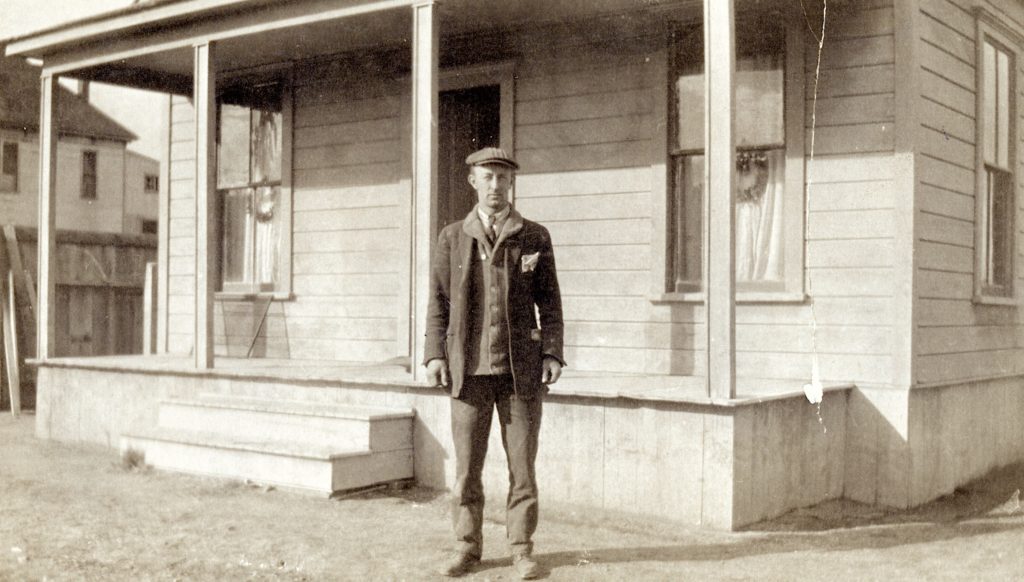
J. St. Clair Riesenman, Amedee, 1914

While the last two days were focused on Sylvester Daniels rodeo observation, it was duly noted that his sole purpose to be in the Honey Lake Valley was to see if this climate versus Iowa would be beneficial for his health. It was not long after the gold rush of 1849, that California possessed many virtues other than minerals—weather being one. For Daniels, he was a firm believer. After only spending a year in Northeastern California, he returned to Iowa, to move his family to Lake City, Modoc County. Daniels passed away at Lake City on January 20, 1908, at the age of 79.

There were others who were not so fortunate. For example, J. St. Clair Riesenmen. This Pennsylvania native was lured to California, in 1914, to the Lassen County town of Amedee, known for its hot springs and their supposed healing qualities, coupled with the dry climate would be beneficial. What he found was romance. On August 14, 1915, Riesenman married Alda Callahan, whose parents owned the Amedee Hotel.

In 1920, they moved from Amedee to Wendel and owned and operated the Wendel Cash Grocery. By 1922, whatever his health infliction had returned. He carried on for several years with a sunny disposition. Riesenman died on March 18, 1927 at the age of 39.

Subscribe

June Snowstorms

North Roop Street, Susanville, 1931. Courtesy of B.R. Zimmerman Collection

While we do have the tendecy to think that winter is behind with the official start of summer, weather wise in these parts anything can and does happen. After all, many have encountered snowstorms over Memorial Day during the opening of fishing season at Eagle Lake. As a general rule of thumb, that is usually the last snow of the season. However, freak snowstorms can occur in the region during June, like 1907 and 1931.

Constantia, June 21, 1907

Support

Spring Is Here, Tra La!

A view of Diamond Mountain, from Lassen High School’s agriculture fields, 1916. Courtesy of D.M. Durst Collection

Spring in this part of California is an elusive creature. The current state of almost winter like conditions is nothing unusual. Then one day, the weather turns hot, summer is here with no real transition from winter to spring.

The above title was a headline story of the Lassen Mail of March 22, 1935. Some may appreciate the tale:

“Spring is here!

“On Thursday of this week Lassen County threw off its mantle of gloom and welcomed the sweet scented breezes of gentle Spring with a howling blizzard, a wind storm and six inches of fresh snow all combined with a drop in temperature that would make an Eskimo run for the furnace room.

“As befits an integral part of ‘sunny California,’ Lassen hailed the new season as chilly winds howled mournfully through the canyons bringing flurries of snow and rain. Indications at present are that the spring season here will be about the same as usual—which is enough bad news for one week.

Subscribe

The Spring Run-off of 1938

Honey Lake, 1938

For many, it was a spring to rejoice, the region having endured a twenty-year drought. Water was flowing everywhere. Lakes and reservoirs were being restored to their former glory. This was especially true in the case of Honey Lake that went dry in 1919. It should be noted when the lake is full, it takes about two drought years on the average for the lake to go dry. Of course, all that water in Honey Lake made for an excellent setting to go boating. In April 1938, John Berglund, Howard Thornhill, Kenneth Doyle and Leon Millsap spent the day traversing lake in an outboard motor boat owned by Berglund and Thornhill. However, the former glory days on boating on Honey Lake never returned. With improvements to the automobile and roads, made mountain lakes more accessible, thus more preferable than the shallow Honey Lake.

Support

Eagle Lake’s High Water Level

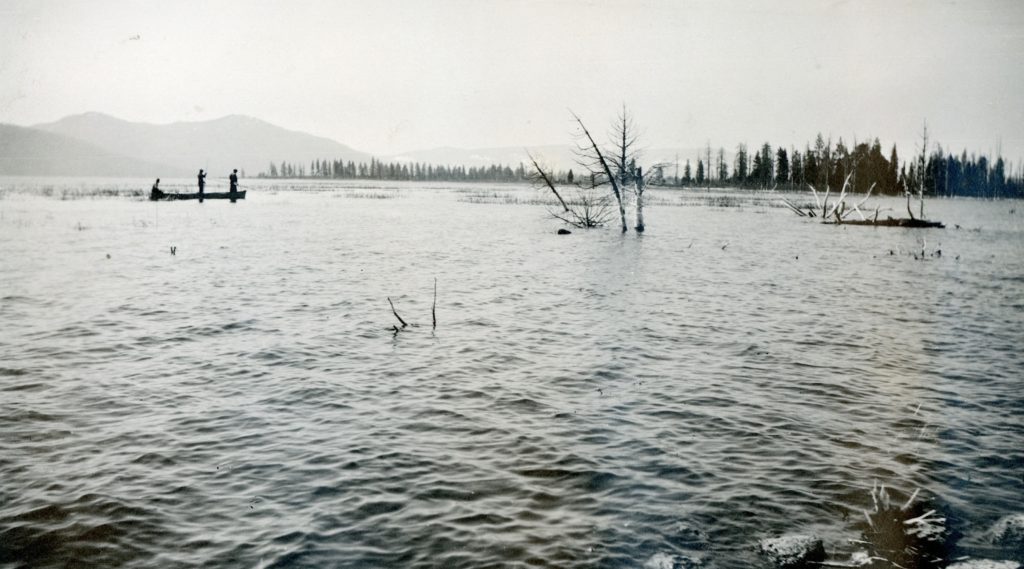
A view of Eagle Lake, looking towards Spaldings, 1921. Courtesy of Lola L. Tanner

While there are numerous citations that Eagle Lake had reached its highest level at 5,125.2 feet in 1917, though what is peculiar was that this benchmark occurred in late March. One would think that a final observation would have been made in May, after the spring run-off. Then again, no one knew what the future had in store. First of all, 1917 marked the beginning of a twenty-year drought. That would be a rude awakening for many as nothing like that had happened since the Anglo settlement of the region. Then there would be another culprit to greatly affect the dropping of the lake’s level to historic lows. In 1923, water started to flow out of Eagle Lake to the Honey Lake Valley for irrigation through the Bly Tunnel.

To provide a better comprehension just how high the lake was in 1917, is that of March 1, 2019 the level of the lake is pegged at 5095, that is a difference of some thirty feet!

Support

January Snowstorms

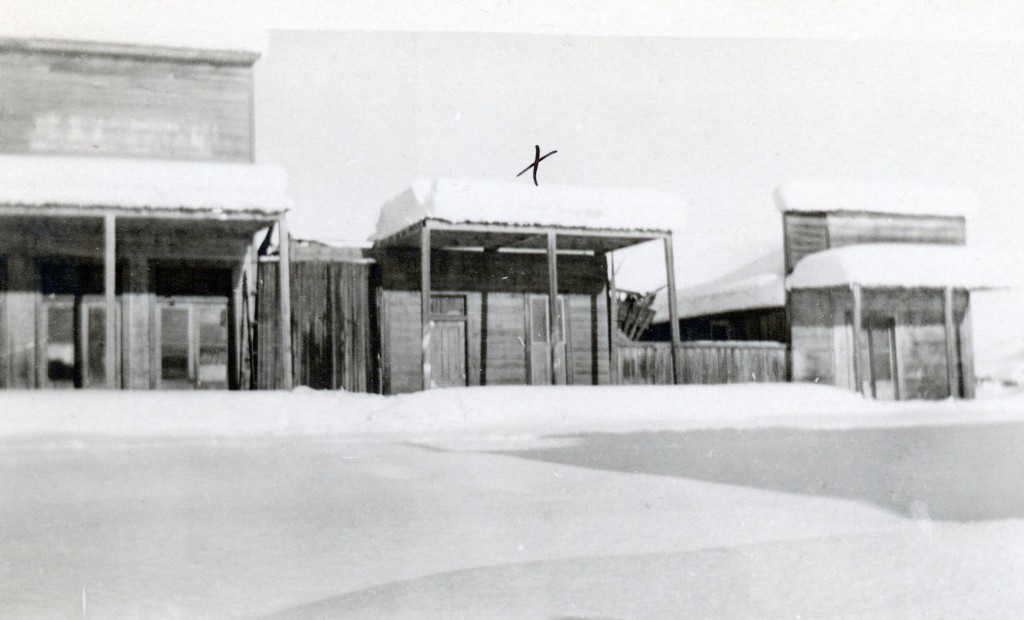
Amedee, January, 1911. The “x” indicates the town’s old dance hall. Courtesy of Madelyn Mapes Dahlstrom

According to the weather gurus, this week we may experience a decent storm. January, typically, is when some of the record breaking storms occur. Take for instance in 1911, when in one storm Susanville received eight feet of snow. What was truly remarkable was Amedee, on the desert east side of Honey Lake received the same amount. Johnstonville resident, Robert E. Trussell, who was fourteen at the time, recalled you could not see a single fence post in the valley.

Construction of the Fernley & Lassen Railroad, west of Susanville in eight feet of snow.

In January 1914, snow pummeled the region. This caught Southern Pacific Railroad officials off guard. Talk about panic mode, and they recruited  1,000 men to shovel eight feet of snow, so as to not hinder the construction of the railroad to Westwood, to honor the contract with the Red River Lumber Company.

North Pine Street, Susanville, January 1916

In January 1916, single storm dumped four feet of snow in Susanville. Westwood on the other hand had eight feet of snow. This storm was followed with bitter sub-zero temperatures. The snowstorm paralyzed the NCO railroad in eastern Lassen County that resulted in a twenty-one day blockade.

Subscribe

Pogonip Season Is Here

fog
A pogonip as seen from Antelope Grade

Over the last couple of days a pogonip had been trying to form over the region. So far we have had two of three contributing factors. High pressure over the region forcing a persistent cloud cover to near the valley floor, and some fog. A true pogonip is when the fog freezes coating everything with ice crystals. The name is from the Native American community when translated means white death, due to the number of Indians who would contract pneumonia from this weather condition.

There are varying types of pogonips. The most common form is when the high pressure holds down the cloud inversion. Thus, in many instances, one only has to travel a few hundred feet above the valley floor to bask in the sunshine. The pogonip season usually runs through December and January. The longest recorded duration, locally, lasted for six weeks in the winter of 1859-60.

On a final note, the National Weather Service states that there is a weak storm front headed our way today. There should be enough winds to break up the inversion, and may be we will see a little sun shine in the afternoon.

Subscribe

Winter Weather Prophets

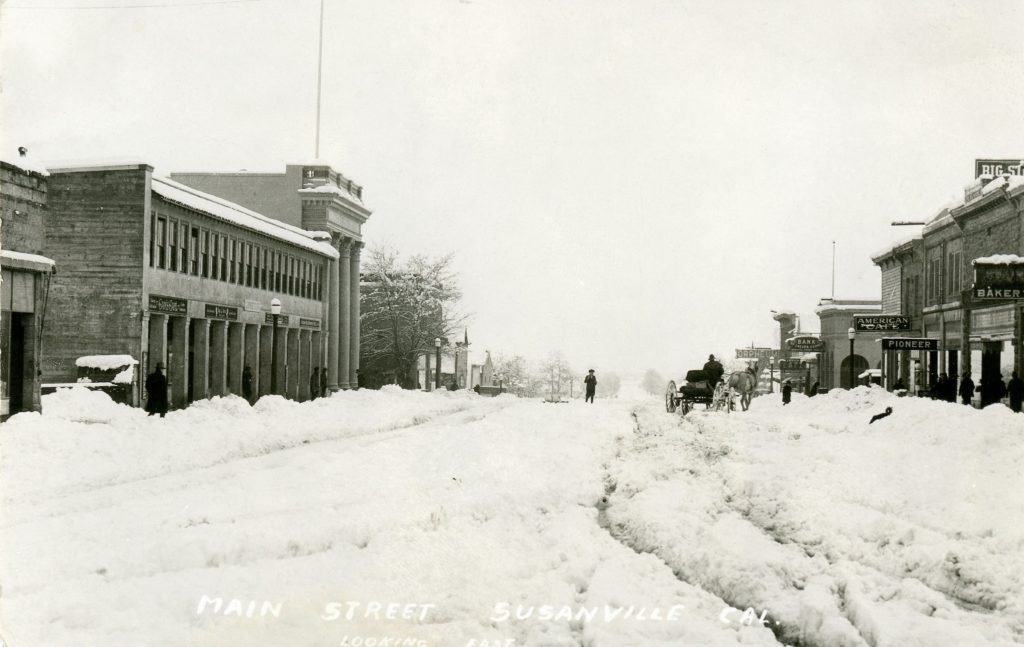
Main Street, Susanville, 1922.

In 1904, one weather observerer noted that the acorn crop was very light and predicted a mild weather.  It turns out it was.

In the fall of 1909, it was reported, “The weather prophets say if a thin coating of snow on the summit of Diamond Mountain last any considerable time without melting, we may expect a light snowfall this winter. Some of the wiset weather prophets have been watching this indicator for thirty years or more, and ought to know.” The result—it turn out to be a dry cold winter, most of January was fogged in.

Whatever the case may be, I have a new set of snow shoes that I am anxious to try.

Subscribe

Pine Creek, Lassen County

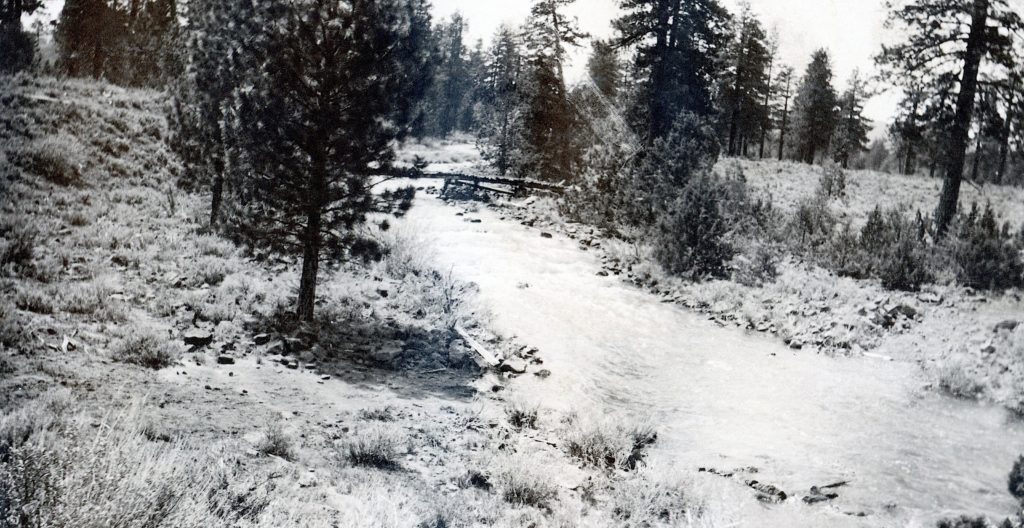
Pine Creek, 1921. Courtesy of Lola L. Tanner

In 1938, Ernst Antevs research on the Rainfall and Tree Growth in the Great Basin was published. A segment concerns Lassen and Modoc Counties. The following is an interesting footnote from that study:  “The sources of Pine Creek, the only large tributary of Eagle Lake, are less than a mile from those of the Susan River, the main feeder of Honey Lake. The seasonal runoff in these streams may therefore undergo similar fluctuations, and with undisturbed conditions, the lakes should do the same. Actually, Honey Lake has fluctuated  in harmony with the known precipitation of the region, but this has not been the case with Eagle Lake. The moistest times since 1850 have been 1868, 1890-93 and 1904-07, and since 1907 the measured rainfall and runoff have on the whole decreased, while the highest recent stand in Eagle Lake was recorded in 1917. The fact that from 1801 to 1821 a thicker wood mantle was formed in the Susanville trees than during any two later decades prevents us from concluding from the stump at the 82 foot level that the precipitation from 1760 to 1860 was continuously light and much smaller than it has been since 1860. In short, the levels of Eagle Lake cannot be used as a basis for conclusions about the rainfall before 1850. A reasonable explanation of this controversial problem was given the writer in 1931 by Mr. G.N. McDow, president of Lassen County Abstract Co., Susanville, who expressed the opinion that the rise of Eagle Lake was due to a closing of its subterranean outlet about 1890 by an earthquake.”

Subscribe!

1876 – Extreme Weather

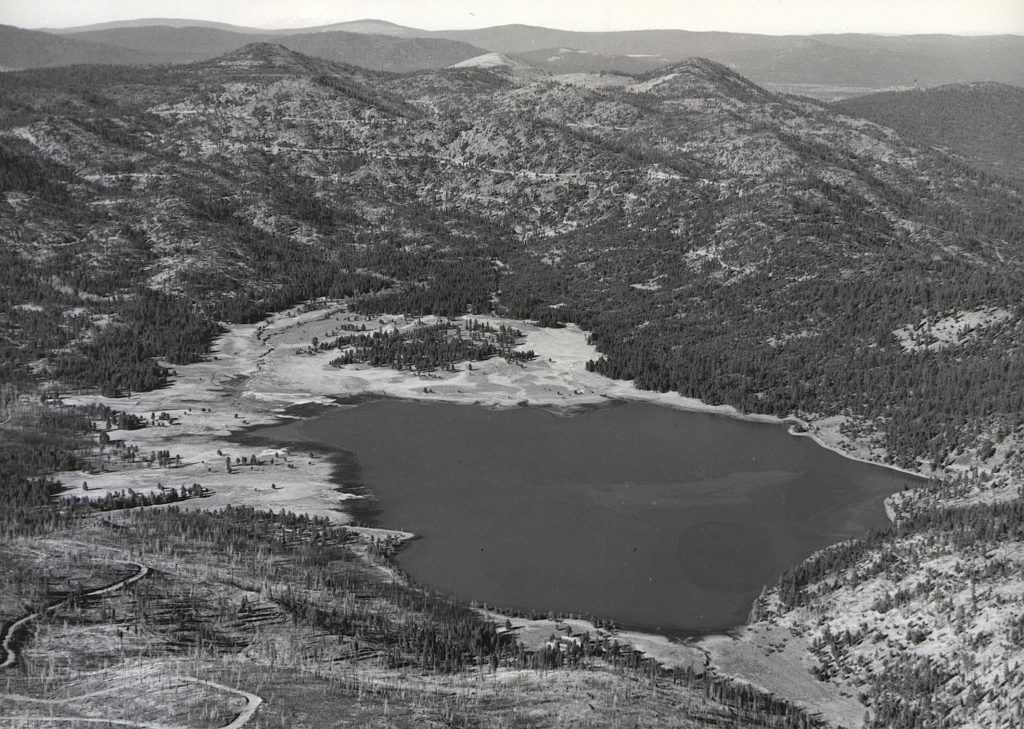
Round Valley Reservoir, 1958.

Anyone who has spent any time in Northeastern California, knows that its weather can be finicky.  An interesting example of weather extremes was the year 1876. On March 25, 1876 there was eight feet of snow at Round Valley, just a short distance north of Susanville, yet that town was clear of snow. When July arrived, it turned hot, the highest temperature that month was 108 in Susanville.

Subscribe