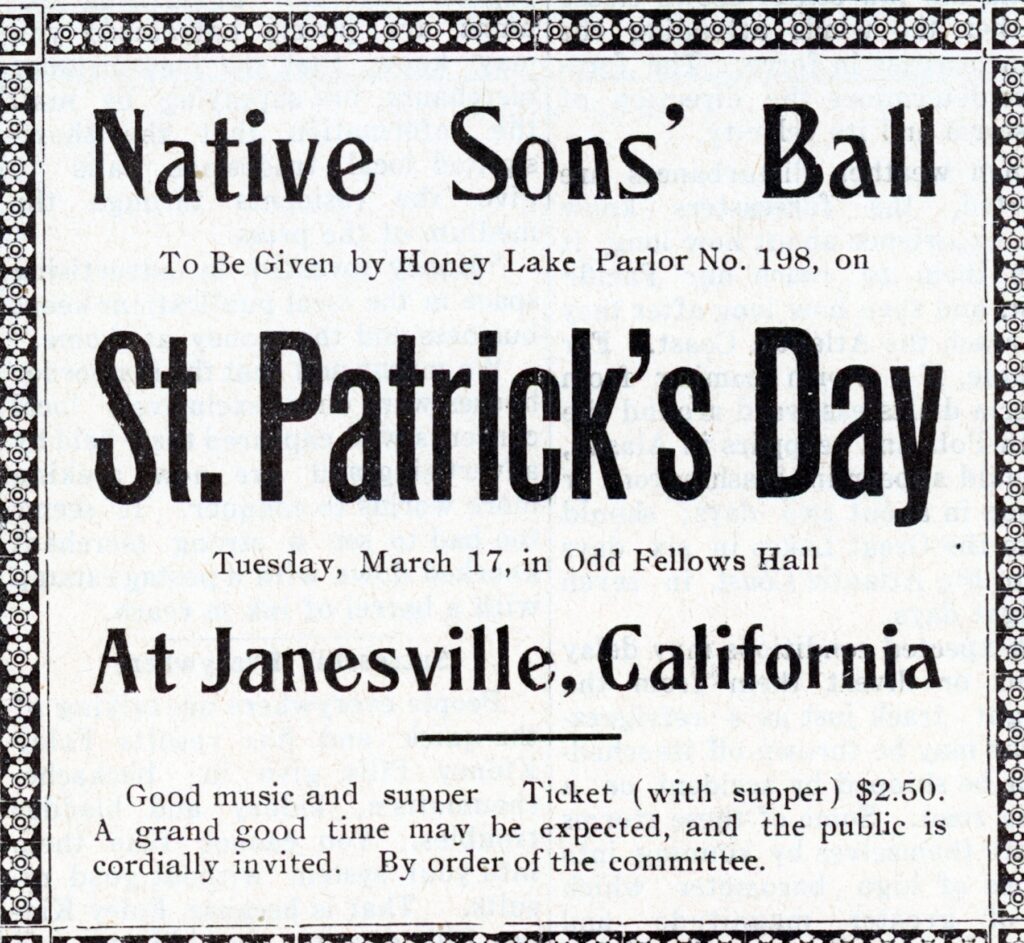
On March 17, 1914, the Native Sons of the Golden West, Parlor. #198 held a St. Patrick’s Ball and midnight supper. Reports were rather vague about the festivities. It was held at the Janesville Odd Fellows Hall, with the Swain Orchestra providing the music. The attendance was better than expected. In fact, forty people from Susanville attended. As one newspaper reporter noted, “That ball was certainly a very pleasant affair.”
Of note, the local Native Sons was organized in Susanville in 1898. They were a very active bunch. Their hall was located on the corner of Lassen and Nevada Streets, the current site of the Masonic Hall. That hall caught fire on November 7, 1921 which was a complete. loss, but destroyed Susanville’s combination city/fire hall that was located next door. According to M.E. “Mul” Mulroney, he was under the impression that the local Native Sons had disbanded by 1930.
Susanville was getting a metropolitan airs since the railroad arrived in 1913. Prior to the Suanville Fire Department there was the Susanville Hose Company. In the spring of 1914, C.C. Hampton, the Foreman of the Hose Company issued the following statement and was widely distributed throughout the community:
“Use Your Telephone. Hereafter, in case of fire in town or in the suburbs, telephone calls may be direct to the Hose House in Susanville at any hour night and will be promptly responded to.”
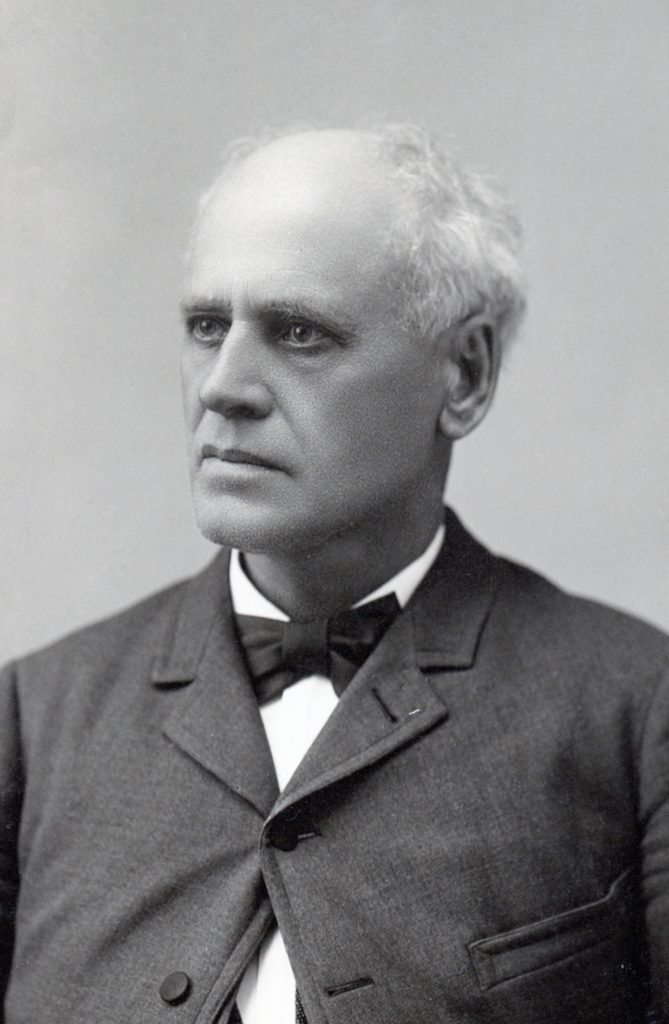
Ephraim Van Buren Spencer (1836 -1904) was a fascinating individual. In his 1906 biography, as a testament this is the beginning sentence, “No name is more intimately associated with the history of Lassen County than that of Judge Spencer.” I am going highlight four aspects of his life.
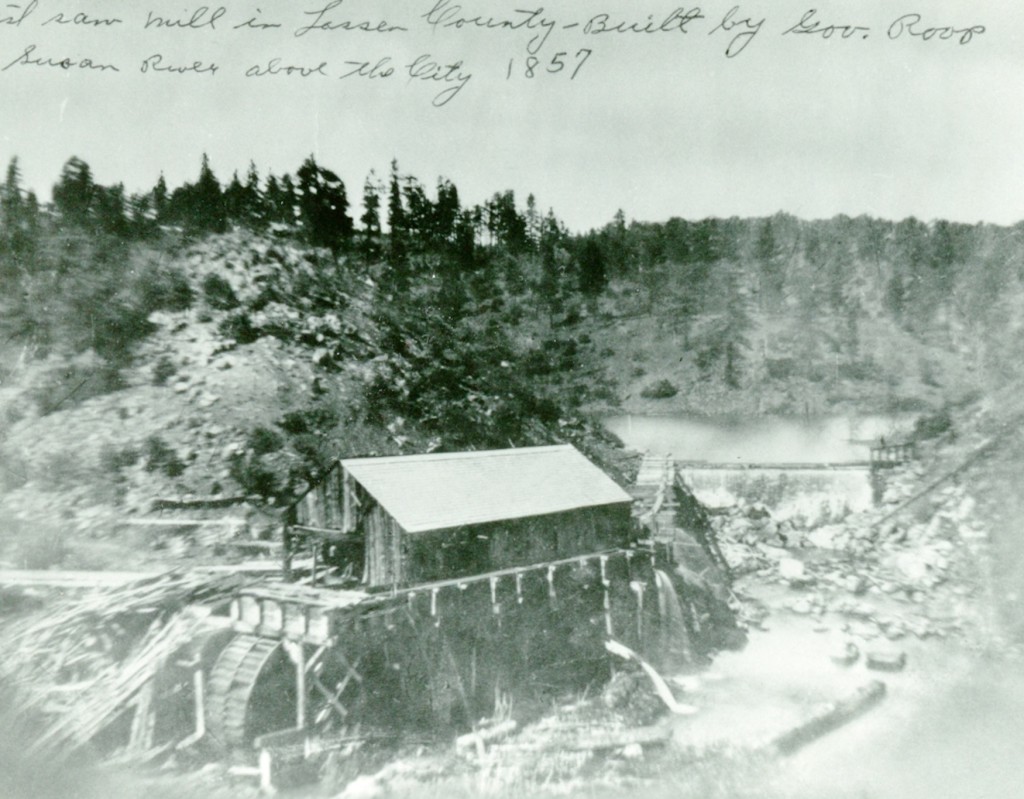
Roop’s mill taken in the early 1860s
The Lumberman. In 1859, E.V. and his brother, Luther Spencer, settled in Susanville. An opportunity arose, and they purchased the Roop Sawmill on the Susan River, just below Hobo Camp. Very little known as to mill’s operation. It should be noted that it burned down in 1868. What really intrigued me was one of the mill’s employee-Lemericus Wyatt. In April 1859, Wyatt along with Edward Clapper and Peter Lassen were on a prospecting trip in the Black Rock Desert. There was an early morning ambush that claimed the lives of Clapper and Lassen, and Wyatt escaped. Wyatt confided to E.V. Spencer what happened.
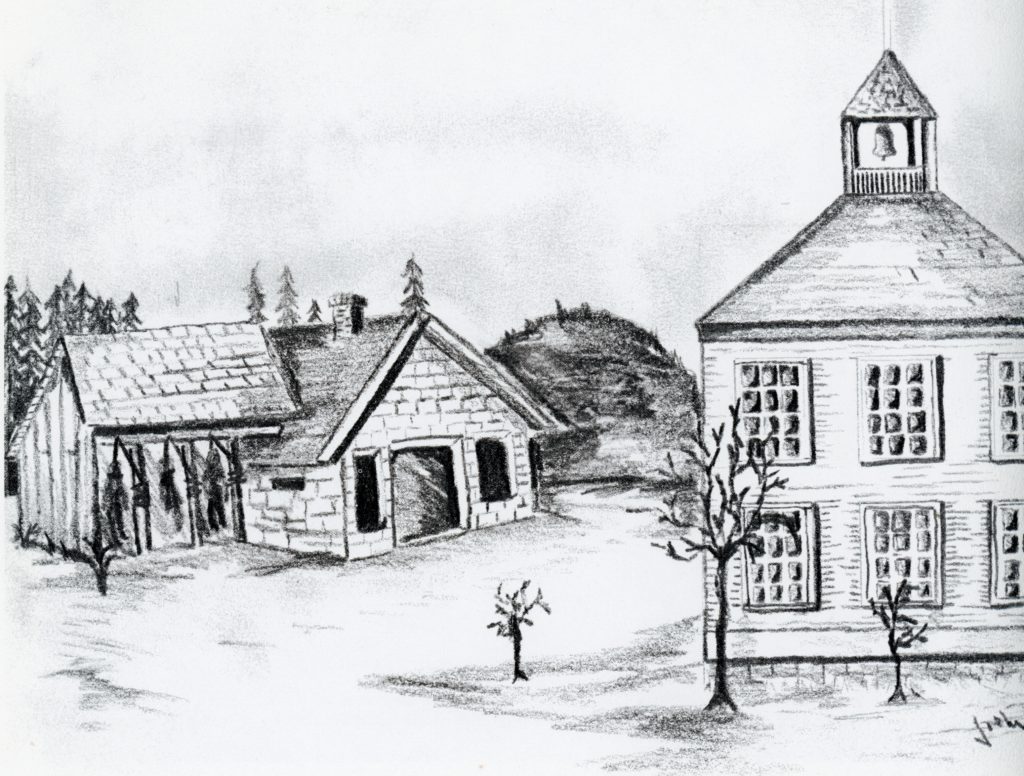
An artist sketch of the lynching of Holden Dick and Mexican Ben.
The Attorney. Spencer was a sawyer at the mill. He suffered a major arm injury that resulted in a career change. He became a lawyer. In 1864, he was elected the first Lassen County District Attorney. He only served one term. He was proud of the crackdown of gambling, and while it subsided, it never went away. As an attorney he was noted for his eloquent speaking abilities. He had an illustrious career as an attorney. One of his clients was the infamous Holden Dick who was accused of the gruesome murder of Samuel Shaw in 1883. Thus, the legend of the Holden Dick Mine was born. It was purported that Dick gave Spencer a map to the mine’s location. A bit of trivia, Dick’s first name came from Thomas Holden, who was Spencer’s wife’s relations..
The Assemblyman. In 1894, Spencer was elected to the California Assembly. While he only served one term, he was admired by his colleagues who referred to him the as “Lassen County’s Grand Old Man.” One of his causes was the suffragette movement. He was instrumental in getting Amendment 6 on the ballot in 1896 to approve women’s rights in California, but the measure failed.
The Railroad Man. Spencer was the probably the strongest advocate to have Susanville serviced by a railroad. It was his contention that Susanville would be just another “sleepy hollow” without one. In 1885, the residents of Susanville raised $500 to send Spencer negotiate with the Morans, the new owners of the Nevada & California Railroad (later to become the NCO). to build the line to Susanville. The Moran’s informed Spencer that they did not have the money to extend the line north. Spencer was optimistic, since the railroad did a preliminary survey along the west side of Honey Lake to Susanville. On March 31, 1887 Edgar Heriot the new general manager of the railroad announced they would commence work of 45 mile extension from Junction House to Brubeck’s Ranch on the east side of Honey Lake. Spencer did not sit idly by about the news of the bypass. It’s an interesting story for another time. In 1899, Spencer lobbied the railroad to build a branch line from Hot Springs (Wendel) to Susanville. It would be a most interesting dinner discussion about Spencer on this topic.
Summation. Spencer’s life was hardly dull. For instance, in the late 1880s his family would vacation at Drake’s Springs, today known as Drakesbad. The seed for creation of Lassen Volcanic National Park was planted via his son-in-law Congressman John Raker.
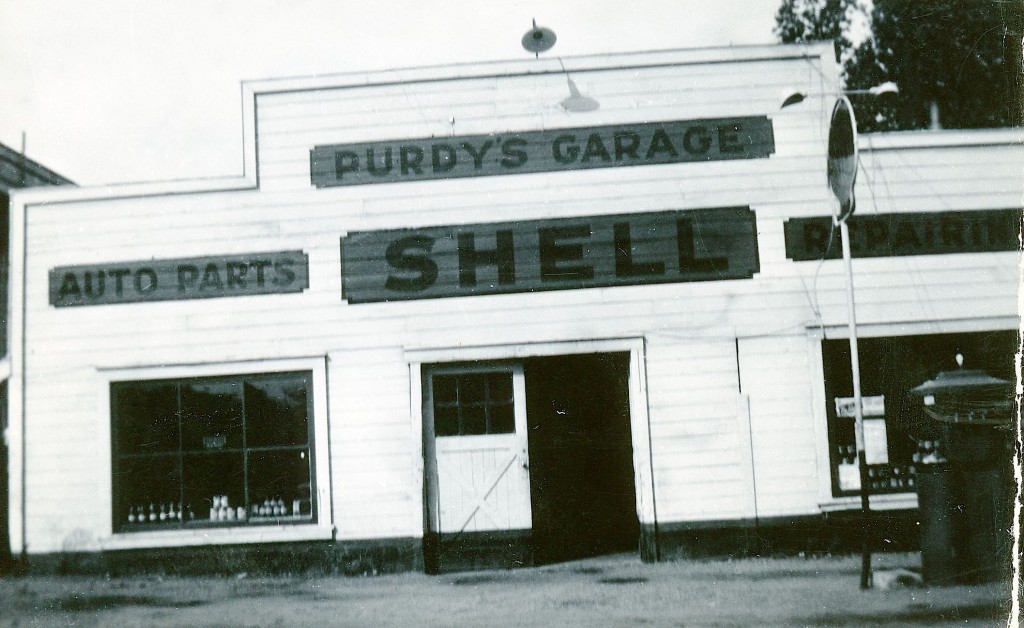
Purdy’s Garage, date unknown. Courtesy of Margaret Purdy
In June 1926, my grandfather and my name sake, Ira I. Purdy drove up from Sacramento to Susanville in search of employment. He was a mechanic by trade, a master one at that, which I may have inherited his name but not his mechanic skills. He found employment at Doyle & Hunsinger’s, operators of the local Ford car dealership. Once settled in he moved his wife, Margaret and young son, James, to Susanville. My father, Leroy, was born the following year on March 7, 1927 at Riverside Hospital, so hence this post on the annivasry of his birth.
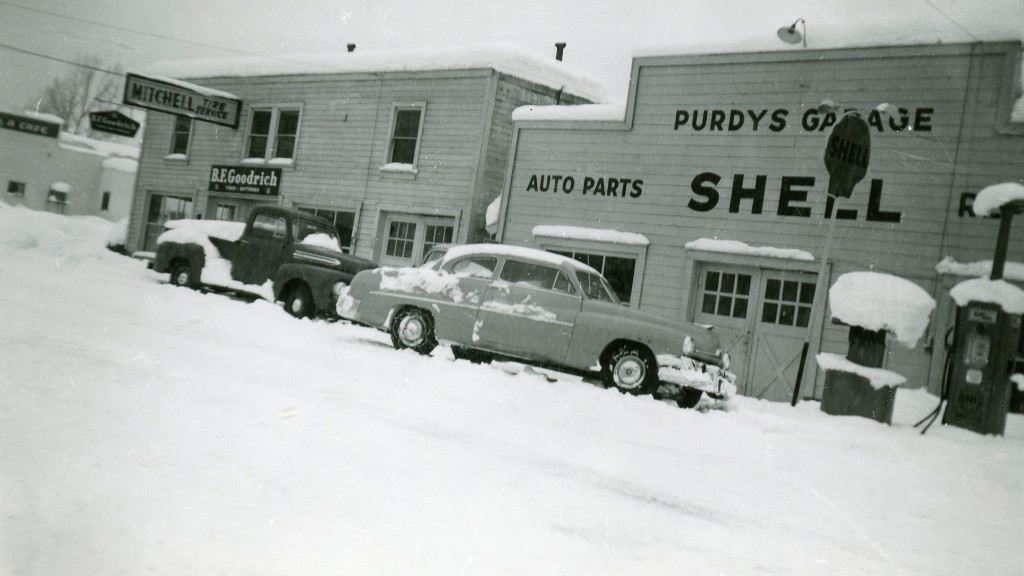
Purdy’s Garage, no date. Courtesy of Margaret Purdy
Like so many others Ira yearned to have his own operation. In 1939 he left Doyle Motor Company, (Hunsinger had moved to Reno), to establish his own service station. He purchased several lots on the north side of Main Street, between Sacramento and Spring Streets and established Purdy’s Garage. It remained in operation until the mid-1950s, when health conditions forced him to retire. The property, that was Purdy’s Garage, would later become the home of the Lassen Advocate and that building sits vacant.
Of note, in 1989 Caltrans did a major reconstruction of Main Street. Caltrans consulted me as gas tanks were. It should be noted that by 1960 there were some 17 plus service (gas) stations on Main Street. Caltrans removed some, though Purdy’s Garage gas tank was actually located underneath Main Street, Caltrans even aware of that fact, did not remove it. Will it become a future sink hole?
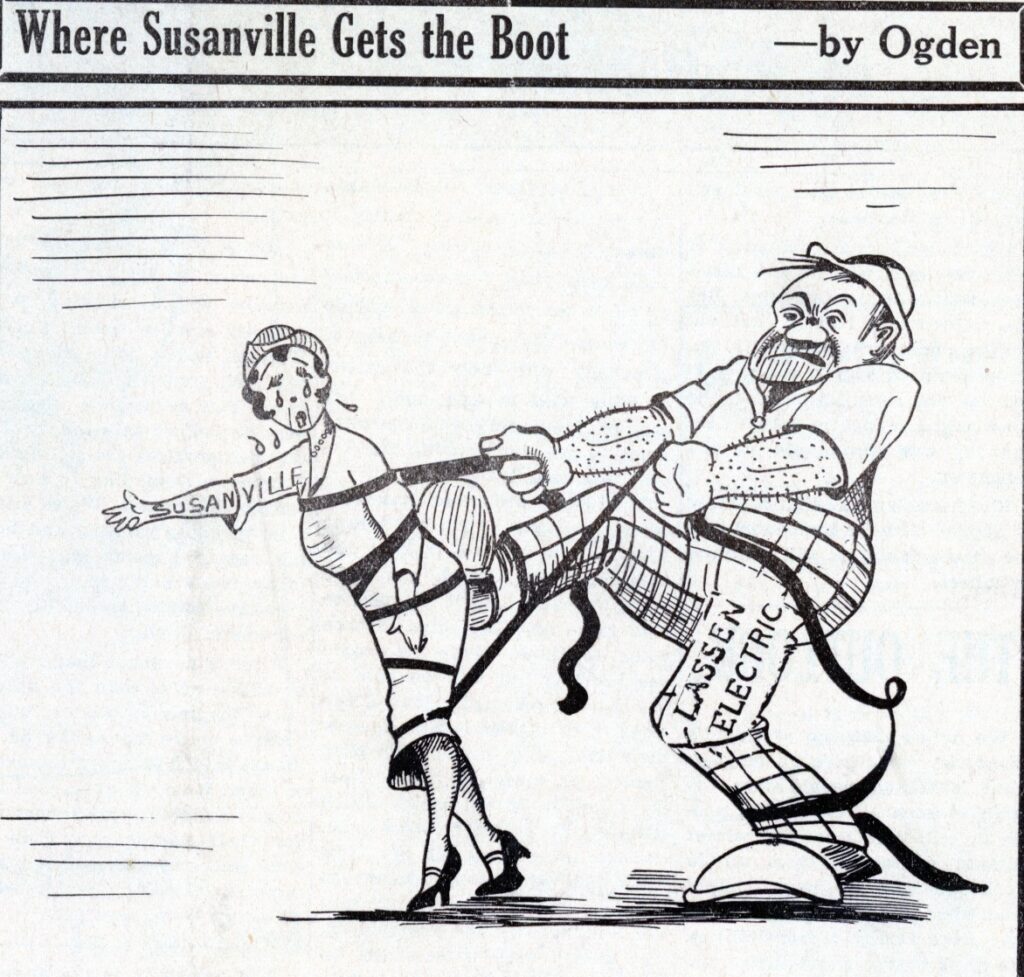
The editorial cartoon of the Lassen Mail, September 16, 1931
In the summer and fall of 1931 the heated and controversial topic was the formation of a public utility district-Lassen Municipal Utility District. Robert Cook, editor and publisher of the Lassen Mail newspaper was an ardent supporter for the district. The Mail used a lot ink on the subject. In the September 21, 1931 issue a front page article titled Electric Prices for Bieber Half Susanville Rates:
“The Pacific Gas and Electric Company is rushing the construction of its line from Fall River Valley to Bieber.. The new line is 20 miles in length and will serve about 400 hundred people. The rates that will be in effect as soon as the line is established has been announced as follows:
“For the first 30 K.W.H the rate is 5 1/2 cents per K.W.H. and 3 cents thereafter. Greater reductions are made for large users of power.
“Susanville with its population of 4000 is paying 10 cents per K.W.H. and eight cents thereafter to the Lassen Electric Company.
“Just across the Susan River the employees of the two mills enjoy a still lower rate than the people of Bieber. The same condition prevails in Westwood. The only users of electricity in Lassen County that do not receive a decent electric light rate are the residents of Susanville and the Honey Lake Valley.”
Notes of note; The Cady family not only owned the Lassen Electric, but the water company and had an financial interest in the Lassen Advocate newspaper. That publication opposed the formation of a public utlity district.
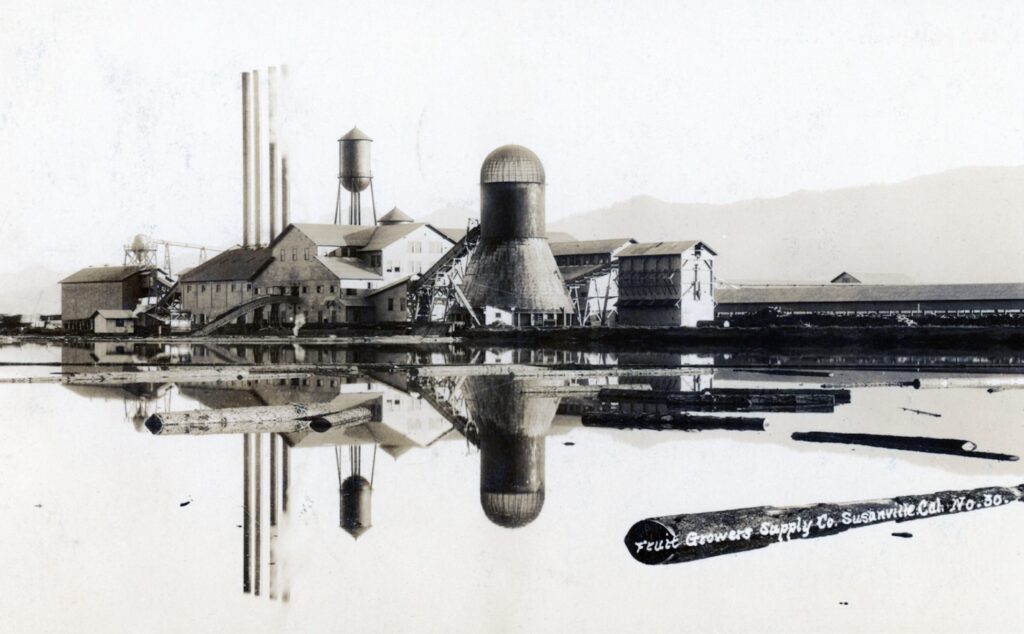
Fruit Growers Supply Company mill, Susanville, 1921
Awhile back we explored the closure of the Lassen Lumber Box & Company mill. It was acquired by its neighbor, Fruit Growers. That company purchased Lassen Lumber for its water rights, in case Fruit Growers wanted to convert its mill to a cardboard plant. While that event had never happened, Fruit Growers did operate a cardboard plant in Southern California.
The question posed was whatever became of those water rights. I would assume, and that can be dangerous, that when Fruit Growers sold their mill in 1963, the water rights would have been included. This is where it gets tricky. One can with hold the water rights, and its done more often than one could think. Title companies do not include water rights in their property search. If water rights are in an adjudicated system, like the Susan River watershed, there is. a water master to oversee it. The water master fee is included in the county tax bill. I use of have list of the water users, but I am not sure how I filed it away.
Back of the question at hand. It would be interesting to know who possesses those water rights, since there is no mill, let alone a millpond.
Today, marks the beginning of meteorological spring. If you have lived around these parts for very long, winter and spring are very unpredictable.
This past winter was of no exception. It was a very rainy November and December, followed a by cold, dry January. The first half of February was a weird. Take for instance, February 6. The forecast, high elevation snow. In Susanville, by 8 a.m. it was snowing ever so lightly. By noon, it was still snowing. However, at the same time, it was not only raining in Truckee, but on Donner Summit. By late afternoon, it was still snowing in Susanville, but snow conditions to our north got worse. By 4 p.m. Interstate 5 was closed at Yreka due to snow, while it was still raining on Donner!
Yesterday, it was spring like in Susanville and the temperature broke 60F, the first time since early November. Today, the forecast is a repeat, and then a stormy pattern resumes. Appreciate the good weather wherever you live.
In 1860, Zenas J. Brown (1812-1895), a pharmacist, received the nickname of Dr. Eight Square when he constructed an octagonal building in Susanville. Brown, in the scheme of things is known for a lot of things.
In 1861, Brown created Susanville’s first subdivision, located in the vicinity of Lassen High School and aptly named Browntown. In my opinion this just weird. First, the nearby mining town Richmond rivaled Susanville. Secondly, it was not until in 1863, that Susanville plot map had been surveyed and recorded. However, Isaac Roop the questionable owner of said property, did not prevent him in sale of said lots that would become officially known as Susanville. It should be noted that in 1920, what would comprised Browntown was legally subdivided and known as the Armstrong Addition. Furthermore, most that property today is the Lassen High School Campus.
Brown’s lasting legacy, that he is credited with the planting of the area’s first orchard of apple and peach trees. In 1863, one of Brown’s peach trees produced the area’s first peach crop —four peaches devoured by Susan Roop and Mrs. C.W. Fuller. In the fall of 1864, Brown sold his subdivision and left the region.
The grave of Isaac N. Roop, Susanville Cemetery, circa 1966.
It was on Valentine’s Day 1869, that Susanville’s founder Isaac N. Roop passed away from pneumonia. He was only 47 years old. One of the unique contribution that Roop did for Susanville, does not that garner much attention. Susanville which one of the oldest communities of the western Great Basin, has an extra ordinarily wide Main Street. This was a fire prevention measure. Thus, should a fire break out, it could be contained to either the north or south sides of Main Street. It worked very well, and only time it failed during destructive fire of 1893. in which all of the business district was reduced to ashes.
A distant view of the Kirmess-Courtesy of Dolores Gasperoni
One of the more disastrous fires in Susanville occurred in August 1915, when a large portion of the block containing the Emerson Hotel, the Hyer House Hotel and the Methodist Church were destroyed. The losses were heavy, none of the buildings were fully covered by insurance.
Members of the Methodist Church were determined to rebuild their church that was constructed in 1901. The skeletal walls were deemed fit for re-use. While insurance covered a large percentage of costs to rebuild, more funds were needed. It was decided to hold a Kirmess Festival. Those not familiar with the term, is of Dutch origins. While it has several meanings one is that it involves an outdoor fair/festival for charitable causes, usually affiliated with a church.
In early March 1916, members of the church announced a four day Kirmess festival to raise funds to rebuild their church. The kirmess was scheduled for March 28-31. On the first day, it took on air of Mardi Gras with a parade that included the majority of the community. Entertainment was held every night at the Orpheum Theater. On Thursday night Guy P. Johnson won the election and was crowned Kirmess King. A good time was had by all and nearly $1,000 was raised for the Methodist Church.