Tag Archives: Susanville

The Meadows

The Meadows. Courtesy of Darryl Hattenhauer

For those who have have been enjoying skiing at Coppervale this season, you need to thank Bert and Mary Bain who established it.

First a little background. Back in the 1930s several road houses were established along highway 36 between Susanville and Westwood. They initially started out simple first with a gas station and restaurant, and later expanding. You can find a complete account of these in Red River: End of an Era.

At the same time, skiing, and more particularly ski jumping was all the rage throughout Northern California, where numerous professional events were staged. In 1934, the Paul Bunyan Ski Club even sponsored one which they built a ski jump on Fredonyer.  In the spring of 1935, Bert and Mary Bain purchased The Meadows. First they expanded operations with an enlarged restaurant, but added a bar and dance floor. To attract amateur skiers, Bain had a ski jump constructed across the highway from The Meadows. Bain recruited noted skiers Sid Knudson and Phil Brown to design and build a small jump for his guests, and thus the Coppervale Ski Hill was born.

Never miss a story, click here.


Roop vs. Worley Mountain

FGS barn
The old Fruit Growers barn, June 2, 2015, with the mountain in question. in the background.

Asa M. Fairfield lamented that the only item named after Susanville’s founder, Isaac Roop, was a street. Incidentally, Roop himself named that street when the town was plotted. Fairfield idolized  Roop. If Fairfield and Roop had been Roman Catholic, he would had petitioned the Vatican to make Roop a saint. Continue reading Roop vs. Worley Mountain

Lassen County’s First Zoo

Elk, with the Wingfield residence in the background. Courtesy of Alphozene Terrill

In 1910, George Wingfield established a summer residence south of Susanville, and more about that in a future article. He had a special interest in wildlife and established his own little preserve. That fall, he fenced off eighty acres for an elk and deer park. In 1914, he added four buffalo to his collection. This became a major attraction to local residents to view these creatures.

Wingfield also brought in such “exotic” species as peacocks and mammoth size frogs imported from New Orleans. He had two small lakes constructed on the property to plant with a wide variety of fish.

Where the buffalo and elk roam at Wingfield Ranch. Courtesy of Lola L. Tanner

In 1923 Wingfield sold the property to the Lassen Lumber & Box Company who were primarily interested in the timberland he owned there. The buffalo were shipped to Wingfield Park in Reno where they were on display for many years. The fenced enclosure to keep the elk in was no longer maintained and the animals began to roam the region, with spottings from nearby Bald Mountain to Willow Creek Valley. The elk were poached by hunters over the years, and were wiped out by the early 1940s.

Never miss a story and support this site, click here.

The Grand Cafe & The Sargents

The partially collapsed Grand Cafe.
The partially collapsed Grand Cafe. Courtesy of Helen Sargent

The restaurant business is a tough one that requires shear amount of work and dedication. When the Grand Cafe was first established in 1909, it would go through several owners during the next twelve years until it found some stability with the duo of Sam Vucanovich and Steve Sargent, former operators of the New Brunswick Cafe. In 1928, saw the addition of Helen Zalac, Steve’s new bride, and who became an iconic fixture of the Grand for over a half century. Continue reading The Grand Cafe & The Sargents

Westwood’s Rumor Mill

Westwood Mill, 1946. Courtesy of Hank Martinez
Westwood, 1946. Courtesy of Hank Martinez

Yesterday’s photograph featured the dynamiting of the Westwood millpond and the freeze of 1949. There was a side affect of that freeze. The freeze reduced California’s citrus crop, and in turn reduced the need of wooden boxes and Fruit Growers box factories in Susanville and Westwood were temporarily closed. In May when the Westwood box factory re-opened, it was only with one shift. Continue reading Westwood’s Rumor Mill

Abraham Farris, Richmond Road Merchant

Abraham Farris in front of his store, 1937. Courtesy of Calvin Farris

While many may have fond memories of Borghi’s store on Richmond Road, there was another store near there and before Borghi’s. The store I am referring to was operated by Lassen County’s best-known Syrian, Abraham Farris.

In September 1912, Farris, who was operating a store in Clio, Plumas County, paid Susanville a visit to relocate. He liked what he saw and made arrangements to move. The Lassen Advocate duly noted, “Mr. Farris impresses us as a man of enterprise and business ability, and as one who will do his share in the up building of Susanville.”

Farris, set up shop on the southeast corner of Main and Roop Streets. All went well in the beginning until the owner of the property, O.M. Doyle evicted him. Doyle made arrangements to have a two-story brick building on the lot, that seasoned Susanville residents will know as the Del Mar.

The business district was booming with the advent of the railroad, and Farris could not find a suitable location. He opted to purchase property in the Lassen Townsite on Richmond Road. Yet, this was problematic. Lassen Townsite was owned by several influential Susanville businessmen. They limited commercial development near the depot and it would be kept to a minimum, mainly for businesses affiliated with rail services. To get around this predicament, Farris hired contractor Louis Dimon to build him a house large enough for his family, but with enough space to carry a large stock of merchandise. The store operated until his death in April 1940. In 1942, the store front was remodeled. The building it should be noted burned down in 2013.

Remnants of the Farris building, June 20, 2015

Never miss a story, click here.

Spalding/Arnold Residence

The Spalding/Arnold residence in 1991.

In June 1887, John B. Spalding, his wife Nell, and two small children, Blanche and Wright moved into their new home at 80 S. Pine Street, Susanville. The Spaldings had two more children, Wright and Zella, who were born in the home. In 1938, Zella with her husband, Med Arnold moved into the family residence and it remained in the family until it was sold in 1974.

The house as it appears in 2015.  Courtesy of Annie Henriques Blank
The house as it appears in 2015. Courtesy of Annie Henriques Blank

In 1992, the home was moved to Lake Forest Estates to make way the realignment of the highway curve into Susanville.

Never miss a story, click here.

Spalding (Williams) Building

mmmmm
Main Street, Susanville, January 1907. To the left one can see the uncompleted Williams Spalding building.

In 1903, an ambitious young jeweler by the name of Joseph B. Williams arrived in Susanville and set up shop in the Emerson Hotel. Business was so good, that three years later, he decided to build a store of his own, just a few doors down from the Emerson in the 700 block. In March 1906, Andy Buchler started hauling stones from the local quarry. A month later, there was a change of plans. Local druggist, John B. Spalding bought the vacant lot on the west side of Williams. By summer, a new set of plans had been drawn for one large stone buildings for the Williams and Spalding properties.  By October, the second story had been completed and work was at a frantic place to put a roof before the winter storms set in.

It was not until the spring of 1907, when the structure was completed and was commonly known as the Williams Building. After Williams departure in 1910, it gradually became known as the Spalding Building, home to the Spalding Drug Company that operated there until 1967, when after a century of business in Susanville closed its doors.

Never miss a story, click here.

Main Street Fire, 2005

January 7, 2005
January 7, 2005

It is hard to believe how time quickly marches on. It was on this date, eleven years ago, that an iconic uptown Susanville landmark was destroyed by fire. Fortunately, for me, I had moved out of the second floor  of the building only seven months before the fire.

The building was the home to the Spalding Drug Store for many years, from the time it was built in 1907, until it closed in 1967. Looks can be deceiving for it is actually two buildings. How everything came to be was accidental in nature, which we explore its origins in the near future.

Never miss a story, click here.


Sacred Heart Parish Established

Parish Register front page with writings by Father P.J. O'Rielly
Parish Register front page with writings by Father P.J. O’Reilly

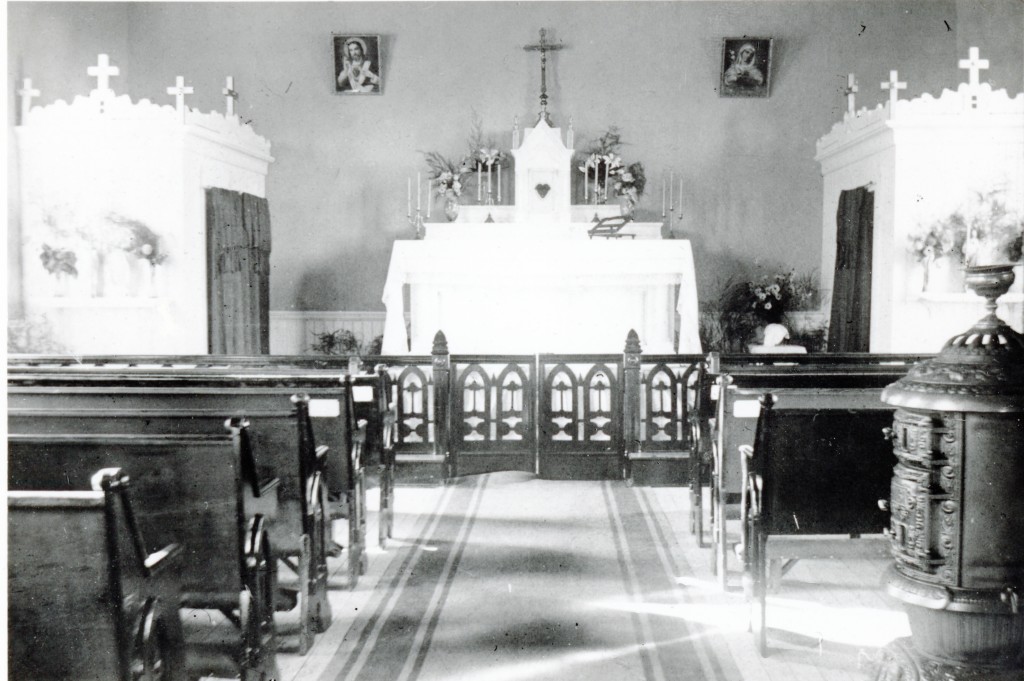
In the fall of 1911 the Sacramento Diocese created a new parish from the Truckee Parish to be known as Sacred Heart. It would encompass two counties—Lassen and Modoc—a region comprising some 8,500 square miles (equivalent to size of the State of Maryland).

Father Philip J. O’Reilly was the first priest assigned arriving from Marysville. Father O’Reilly first established residence at Alturas, were a parish briefly existed in the 1880s. On December 17, 1911, Father O’Reilly held his first Mass in Susanville, and brought welcomed news that Mass would be held in Susanville on the last Sunday of each month. It should be noted that prior to this, Mass was held maybe once or twice a year, with Father Thomas Horgan riding circuit over a five county area making a 600 mile round trip.

On January 2, 1912, Father O’Reilly chose the date to open the Parish of Sacred Heart. He marked the event when he inscribed it by writing in front of the Baptismal, Marriage and Death Registers. He would later write in each one, that on December 2, 1915, Modoc County became a separate parish, except for Likely, which was added to Modoc exactly a year later.

Never miss a story, click here.