Tag Archives: Susanville

Susanville’s Potter’s Maternity Home

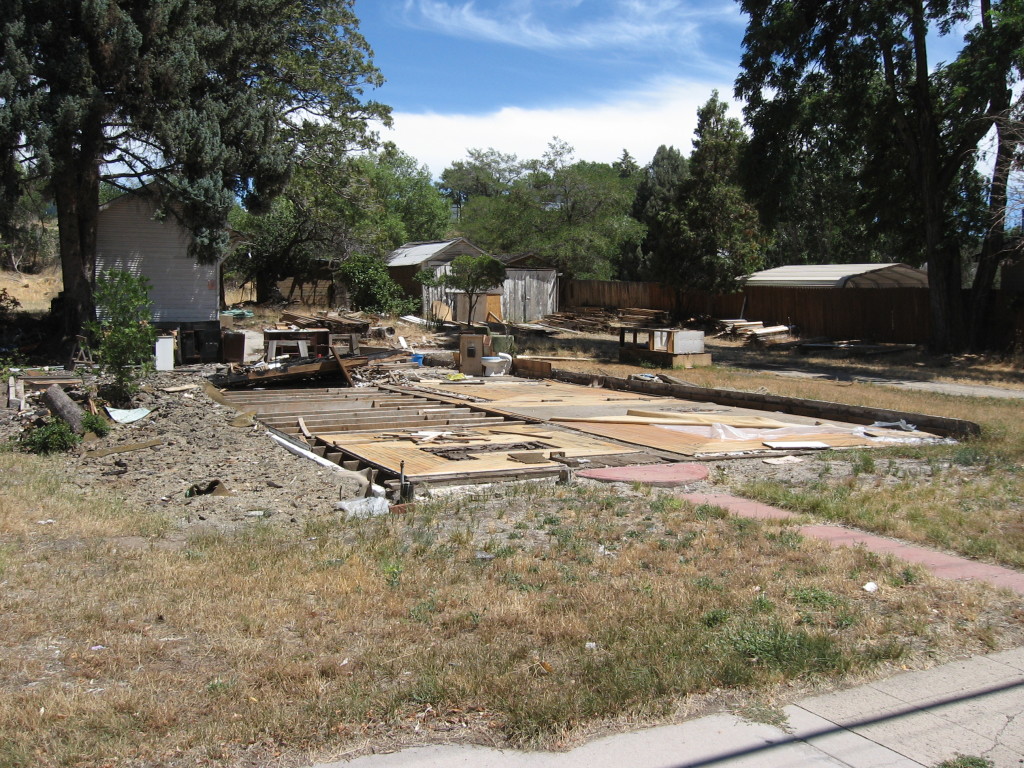
Potter's Maternity Home
Pottter’s Maternity Home, 1600 Main  Street, Susanville

Ruth “Ma” Potter (1886-1965) was a Susanville institution of sorts. In the early 1930s, the Utah native, opened a maternity home at Main and Park Streets, the current location of the closed  Rite Aid. She continued on until 1963, when she finally retired. It should be noted that her home was moved to South Street in 1966 to make way for United California Bank. There is a plaque in the sidewalk marking the site.

During the time when Potter’s was in operation, one was either born there or at Riverside Hospital, the latter no longer exists. While my three siblings were born at Potter’s, I decided to be different or difficult, whatever the case may be, and was born at Riverside Hospital.

Tim

P.S. – There was the Lassen County Hospital. My Aunt Irene Bengoa Purdy worked there in the 1950s and the 1960s, She referred it as “County.”  Births there were rare, and basically it those that were indigent. This would all change in 1963, when Lassen County built the Memorial Hospital which replaced Potters and Riverside.
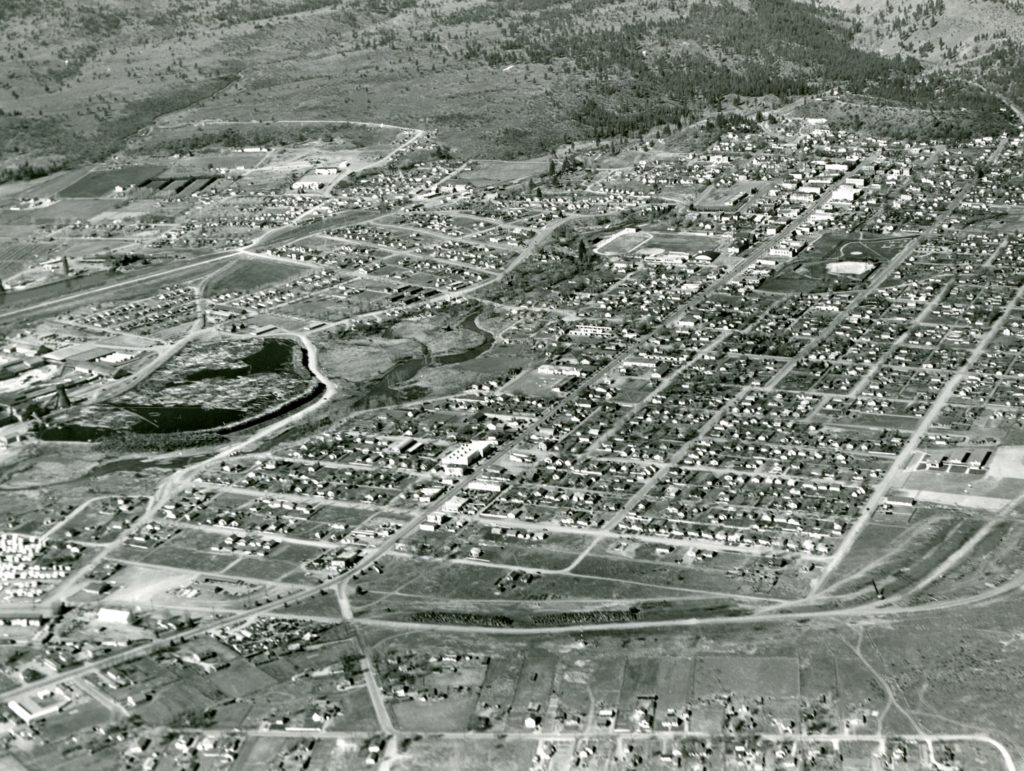
 

Susanville, 1958

Susanville, circa 1950

Awhile ago, I referenced the 1958 Standard industrial Survey for Susanville. I thought some may like to have peek of some information in the report. Times have certainly changed.

Of course, lumber was still king in Susanville. Here is some employment figures: Fruit Growers Supply Company, 350 employees; Paul Bunyan Lumber Company, 300; Susanville Logging Company, 150;  Wirth Lumber Products, 50; Lassen Lumber Products, 15 and Orr Wood Products, 5.

Housing Availability, Prices and Rentals. The housing census as of April 1950 showed 1,721 dwelling units, of which 22 percent in structures built since 1940 and 1,687 were occupied. Of these 1024 were owner occupied, or 61 percent and had a median value of $9,000. Of the renter dwellings, 14 precent rented for less $20 per month., 42 percent for $20 to $39 per month, 35 percent for $40 to $59 per month and 8 percent from $60 to $74 per month, with 2 percent in excess of $75  per month. Since 1950 rents have risen about 25 percent and permits have been issued for 106 new dwelling units.

Community Facilities. Susanville has 2 general hospitals with a bed capacity of 74. Other medical facilities include 7 physicians and surgeons, 5 dentists, and 1 chiropractor, new 25-bed County Hospital in planning stage. Education facilities include 4 elementary schools. 1 high school and 1 junior college–1 parochial school. There are 28 churches, 1 library, 1 newspaper, and 2 banks. Recreational facilities include 1 theater, 2 parks, 6 playgrounds and Roosevelt Swimming Pool.,

Tim

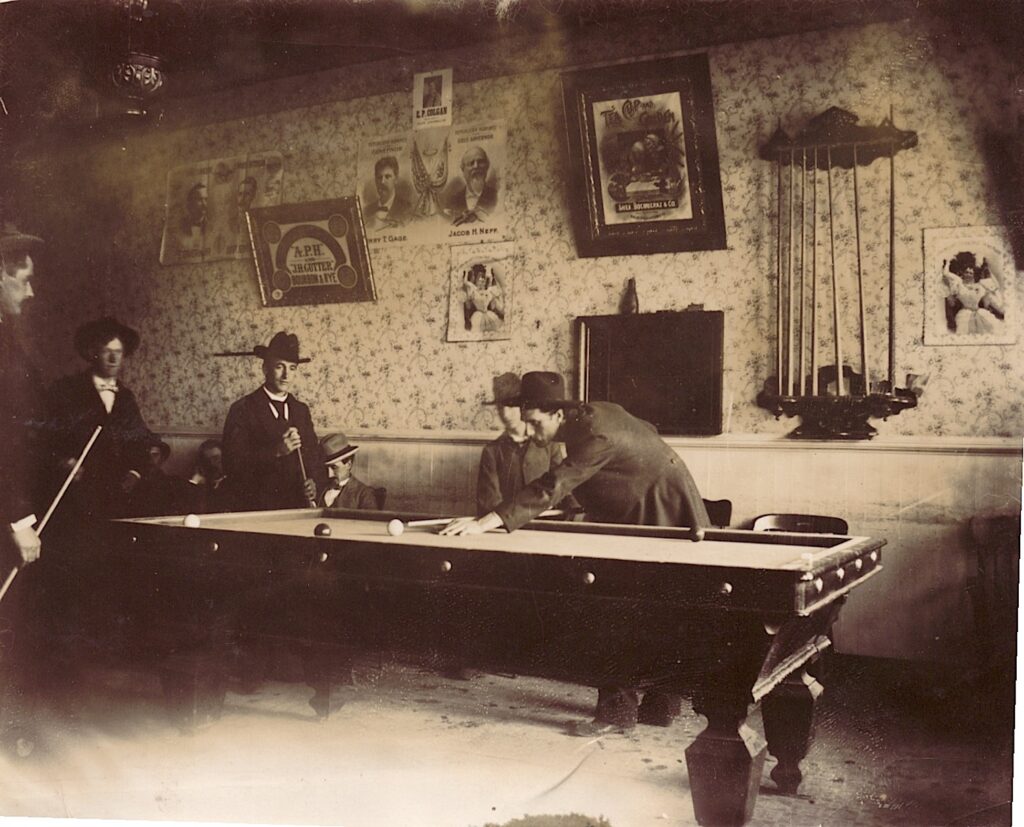
Billiards . . .

From unknown photograph files

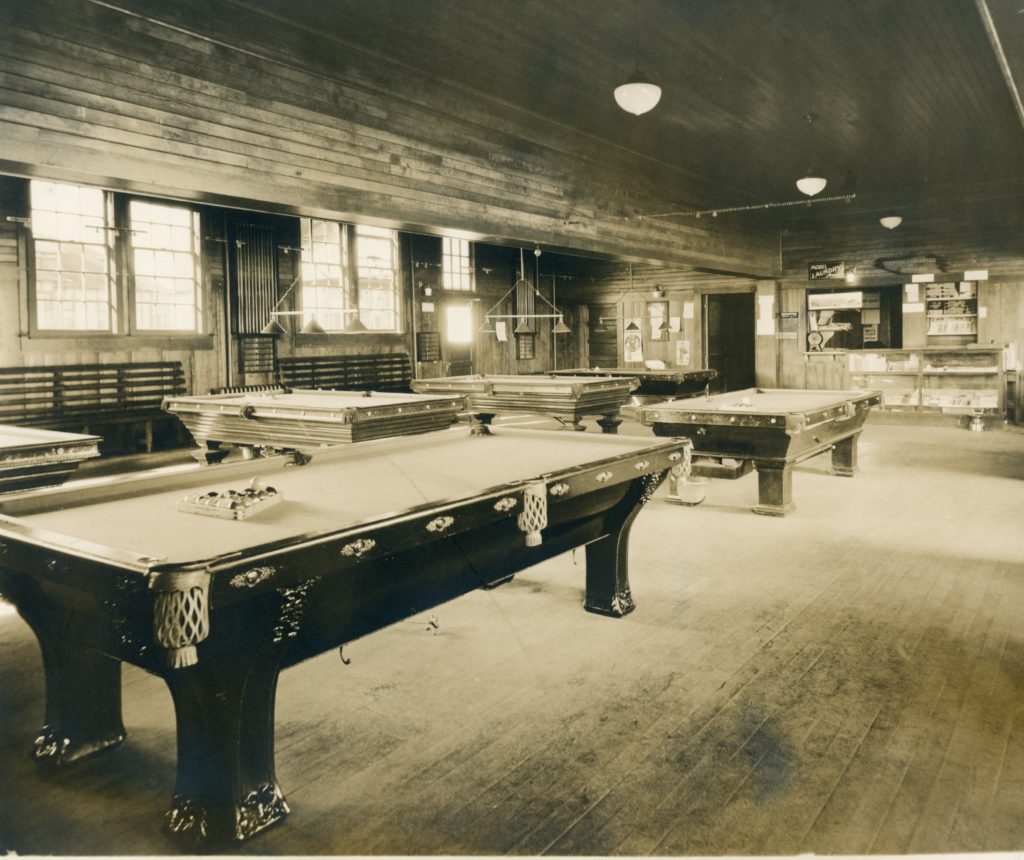
First, I have had this photograph in my archives for decades. It is frustrating because its unidentified. A great photograph., though.

There is some rich untold stories about the game of billiards and the discussions that took place during the games. . It is a facet locally, that has not been well chronicled. The Pioneer had a large billiard room with assorted snooker and pool tables. Those days are gone. In fact, I do not believe there is any public establishment that has a pool table in Susanville.

The billiard room, Story Club, Susanville, 1923. Courtesy of the Fruit Growers Supply Company

Tim

Susanville’s East Addition

North and Spruce Streets, Susanville, 1912-Mary Dale Folsom

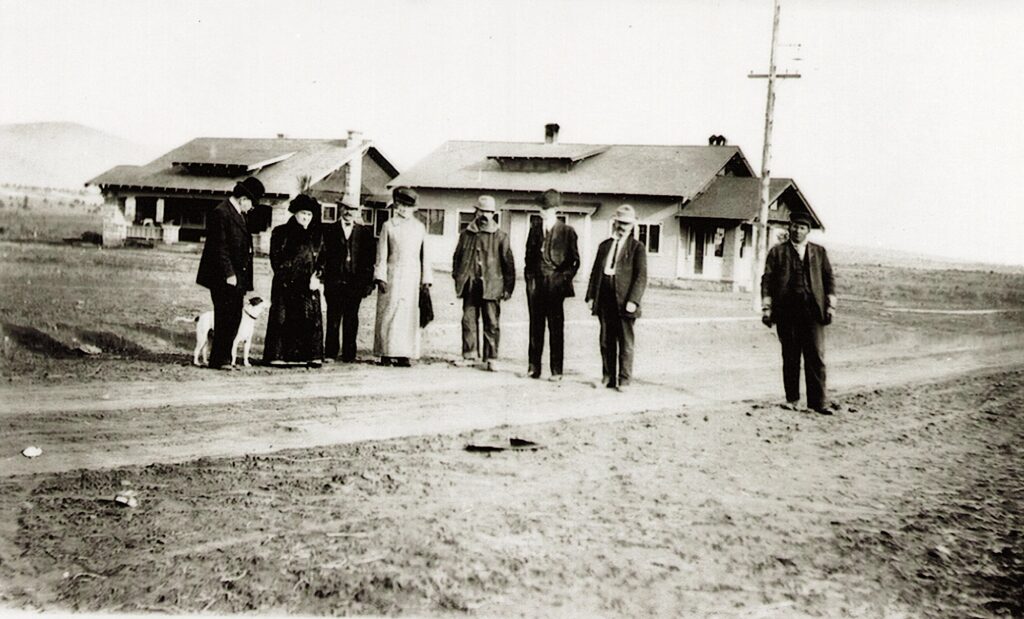
On January 16, 1911, M.O, Folsom filed his map for the East Addition subdivision to Susanville. It was located east of the town and north of Halls Addition. The property was familiar to many, since it was the location of the racetrack and fairgrounds that had long since been abandoned. In the summer of 1912 work began to clear the property of sagebrush and grade streets. In addition, two speculative houses were built at North and Spruce Streets. The 300 lot subdivision created the following streets–First, Second, Third, Fourth, Fifth, Grand Avenue, Oak, Fir, Cedar, Spruce, Park and Ash. Folsom had North Street extended to his subdivision. The street had previously terminated at Weatherlow.

The East Addition contained a number of covenants. No property could be sold or transferred to foreigners, i.e. “Chinese, Japanese, negroes, Hindus or other objectionable races,” or as the Lassen Mail noted, “This addition will be for the Caucasian race only.” The East Addition promoted its healthy environment–one with a sewer system and which prohibited stables for livestock. Finally, and, what was important for property values, each house. constructed must cost at least $1,000, though in certain blocks that requirements was raised to $1,500.

To Support, Please Donate or Subscribe

The Williams Brothers–Morgan & William

The first Lassen County Courthouse and Hall of Records, 1908–David Zoller

These Welsh Brothers came to Susanville in the mid-1860s. The first to arrive William “Bill” in 1866, and followed by his brother, Morgan in 1867. The brothers, it should be noted, were carpenters. In February 1867, Bill Williams was awarded the contract to build Lassen County Courthouse at  cost of $9,850. The two men were kept busy, and the courthouse was completed on October 28, 1867. The brothers  dabbled in other pursuits including homesteading, Morgan filed on 160 acres, adjoining the Goodrich Ranch at Mountain Meadows, His brother, claimed land at Devils Corral along the Susan River, There is a small stream located there and is known as Williams Creek.

The documentation of their lives in the Susanville region is sporadic. For instance in fall of 1875, Morgan took his family on an extended trip to Europe. In 1877, the Williams Brothers were busy constructing rental houses in Susanville. By 1880, William Williams relocated to Sacramento where he died in 1883. In 1888, Morgan Williams sought greener pastures in New Mexico. He died in 1893.

Tim

A Susanville Teacher Retires

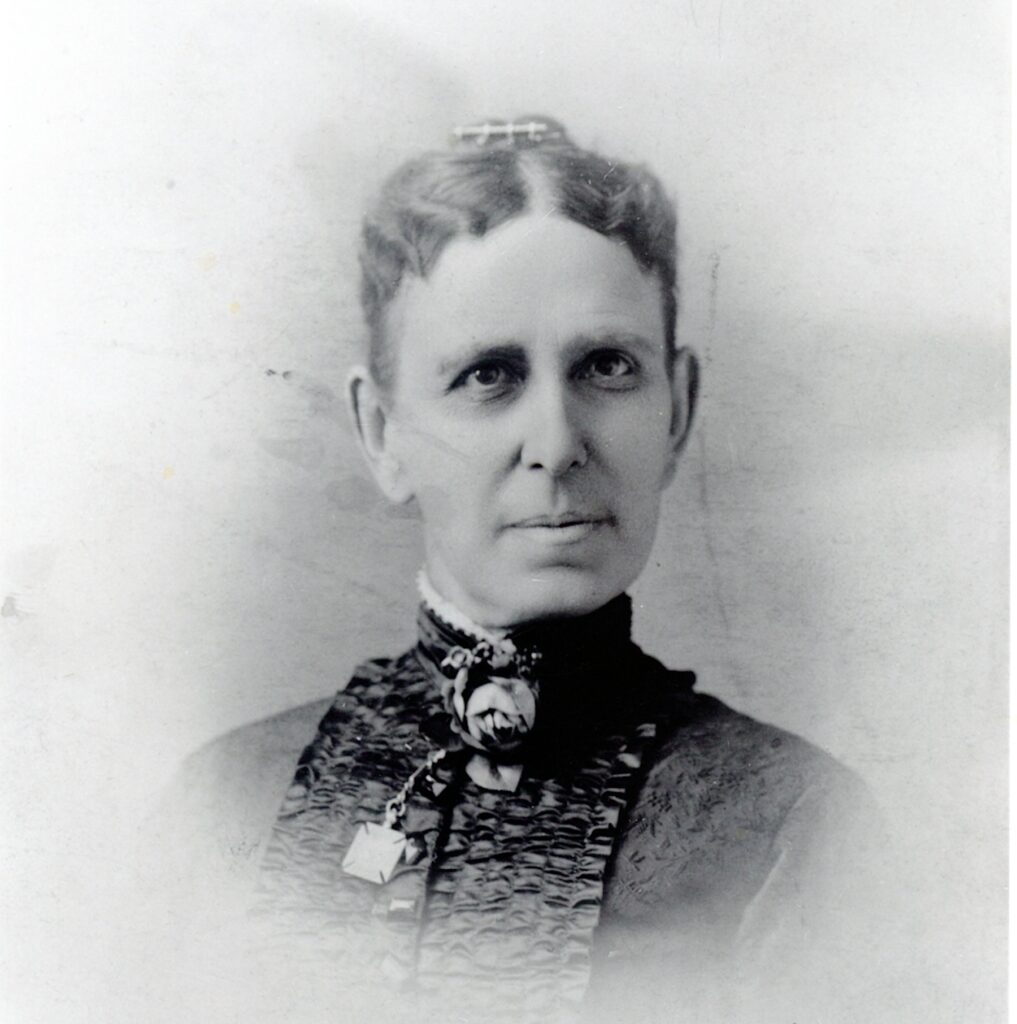
Mary Hurley-Courtesy of Betty Barry Deal

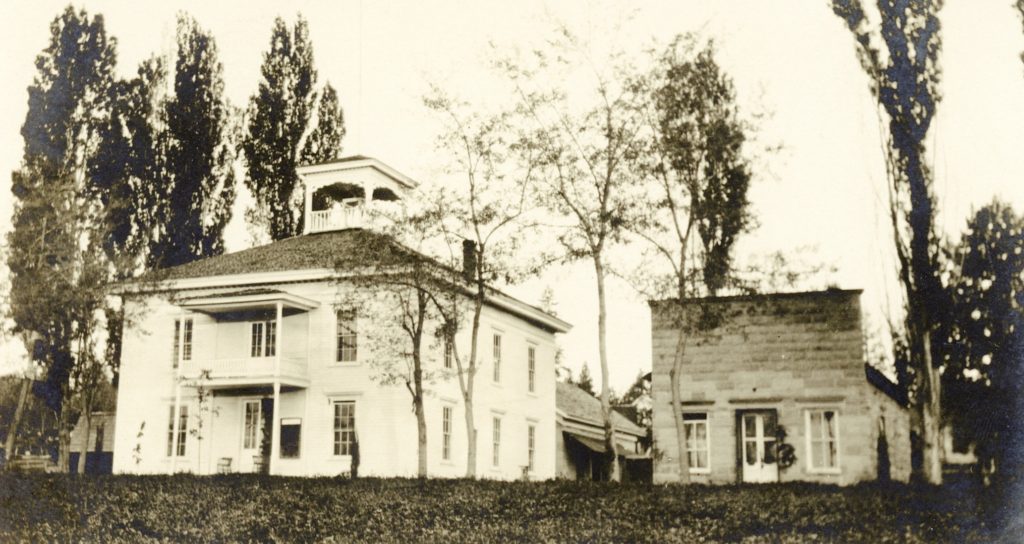
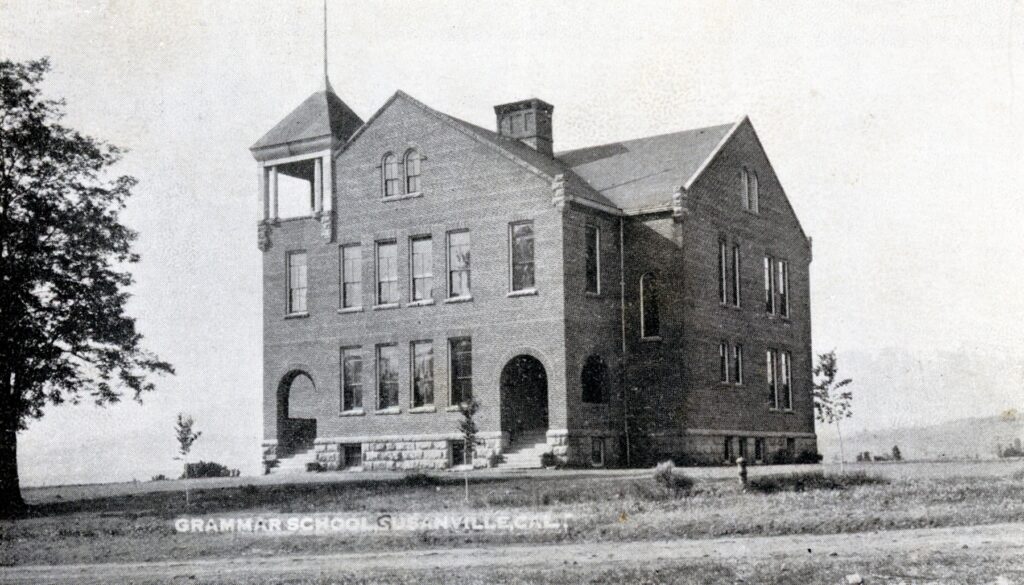
In 1913, Susanville teacher, Mary Hurley retired at the age of 69. In 1880, twice widowed at the age of 36, she was accepted as a teacher at the Susanville Grammar School. She taught there for four years, and briefly relocated to Los Angeles. In 1887, she returned to Susanville and was hired at her old teaching job in Susanville, where she taught for twenty-six years.

Susanville Grammar School, circa 1905- Courtesy Betty Barry Deal

But her retirement was different than others. She was the first Lassen County teacher to receive a pension from the Teachers’ Retirement Fund of the State of California. Her quarterly retirement  check was for $125.00. In 1924, she moved to San Francisco where she passed away on February 15, 1929. She is buried in the Susanvillw Cemetery, but has no headstone. While the Hurley name is not known these days, she has lots of relatives, her one sister,  Cetera  married Ben Leavitt and the other Florence married Clinton DeForest

Tim

Susanville Elk’s Lodge Original Floor Plan

Main floor plan sketch by Frances Swain

It is official that iconic Susanville Elk’s Lodge is up for sale. If the new owner wants to convert it a residence, that it once was, I do have some information on the matter. In 1908, J. Henry & Annie Swain purchased the building and they moved their family there. It needed a lot of work, since a portion of it was never finished. Improvements were made to the six bedroom house, that would featured not one, but two bathrooms which was unheard at the time.

Top floor sketch by Frances Swain

For years, I corresponded with Frances Swain who grew up in the house. She provided me with sketches of the layout and that I thought some may be interested in.

Tim

Susanville’s Methodist Church

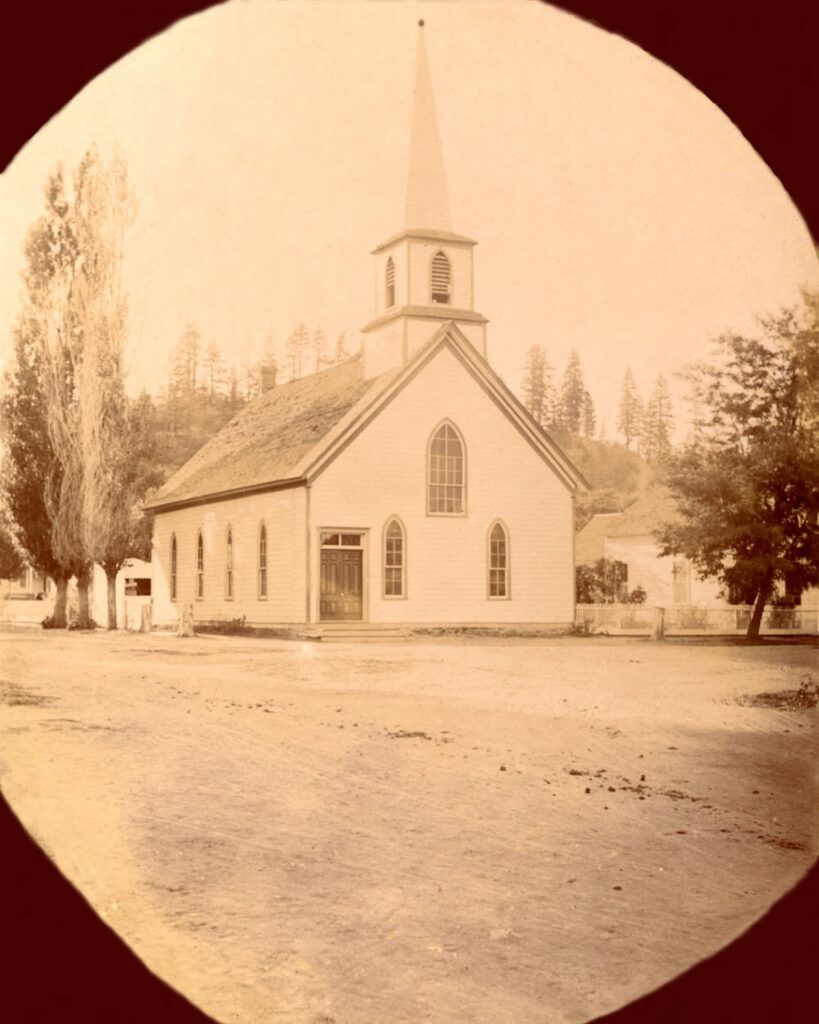
Methodist Church, Susanville, circa 1895-Courtesy of Meriam Library, California State University ,Chico

This photograph I came across in the Special Collections, Meriam Library, California State University, Chico. It was mislabeled as a Catholic Church. I informed them that it was not, that it was the Methodist Church. Lo and behold to my amazement they corrected it. Most institutions and professionals just ignore my input, especially archeologist because they can get away with a lot of atrocities since their work is hidden from public view. Oh well, so much for my editorial.

The original Methodist Church was located on the corner of Cottage and Lassen Streets, where the present church stands today. In the fall of 1875 the Reverend Warren Nims announced his intention to build a church in the following spring. Work on the structure was sporadic. On June 23, 1877, the Lassen Advocate reported: “The bell is already hung in the tower of the new M.E. Church. It is a real tony bell, its reverberations are heard for miles around. Our town is gradually taking on city airs.”  Work was rushed to completion and it was dedicated in September 1877. On June 6, 1900 three blocks of Susanville’s business district was destroyed by fire, including the Methodist Church.

Tim


Is Susanville Different?

Main Street, Susanville, October 1924—Boyd Benham/Connie Boomer

This anonymous piece appeared in the Lassen Advocate in 1924. I think it is  timeless.  What do you think?

“Is Susanville Different.” – When it comes to some needed civic improvement we often hear the expression ‘our town is different, it can’t be done.’ Then someone ventures that ‘there will be some funerals here before we can get this and that done.’

“Now the truth of the matter is, our town is no different from any other, unless, indeed, it is after all better than most towns. Human nature is same everywhere, and we are all human. What we should remember is this; our town is not different , because other towns have the same troubles as we do in bringing public opinion to the. point of civic action. Individual minds move faster than the entire body of people. Opinions differ even as to methods granting that it is mutually agreed as to the necessity for certain developments. After all, the campaign is wholesome. Time usually brings about the happy medium between conservative backwardness and on the other hand  the headlong optimism on the other. Susanville will have all she needs-better streets, tree plantings, parks, playgrounds, better traffic regulations and other other community aspirations fulfilled if we will all buckle on the armor of civic righteousness  and quit trying to excuse ourselves with word on thought that ‘our town is different, it can’t be done.’

“And as to necessity for a few funerals-we can not agree with that, neither can the so common expression be other than deplored. Instead of a few funerals, we would suggest a few births of civic interest on the part of a greater number of people who have so long stood on the side lines and watched a few of the community boosters carry all the load.”

Tim

Abraham Farris, Richmond Road Merchant

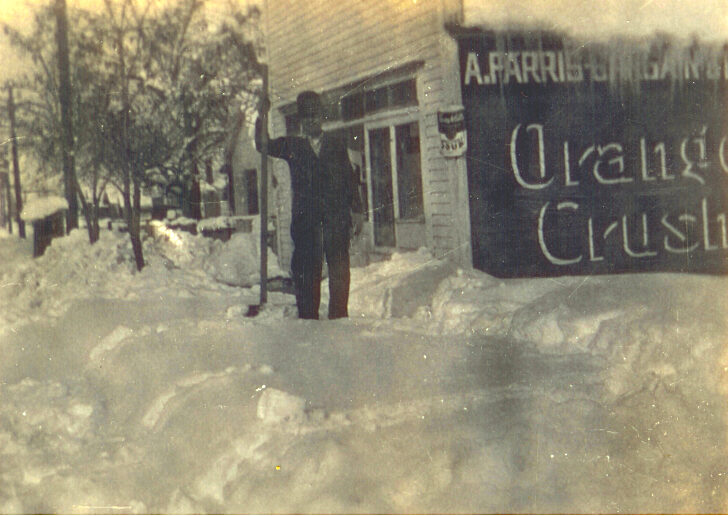
Abraham Farris in front of his store, 1937. Courtesy of Calvin Farris

The Lassen Townsite Company, incorporated in1912, was and still is Susanville’s largest subdivision. A topic for a future post. However, Lassen Townsite is a focal point on today’s topic.

In September 1912,  Abraham Farris, who was operating a store in Clio, Plumas County, paid Susanville a visit to relocate. He liked what he saw and made arrangements to move. The Lassen Advocate duly noted, “Mr. Farris impresses us as a man of enterprise and business ability, and as one who will do his share in the up building of Susanville.”

The Del Mar Building, 1937—Jere Baker

Farris, set up shop on the southeast corner of Main and Roop Streets, in the vacant Moody Drug Store building.  All went well in the beginning until the owner of the property, O.M. Doyle evicted him in February 1914.. Doyle had plans for the property and in late March ground breaking began for the erection  of a two-story brick building on the lot.  Seasoned Susanville residents will know the property as the Del Mar.

The business district was booming with the advent of the railroad, and Farris could not find a suitable location. He opted to purchase property in the Lassen Townsite on Richmond Road. Yet, this was problematic. Lassen Townsite was owned by several influential Susanville businessmen. They limited commercial development near the depot and it would be kept to a minimum, mainly for businesses affiliated with rail services. To get around this predicament, Farris hired contractor Louis Dimon to build him a house large enough for his family, but with enough space to carry a large stock of merchandise. The store operated until his death in April 1940. In 1942, the store front was remodeled. The building it should be noted burned down in 2013.

Remnants of the Farris building, June 20, 2015

Support by subscribing.