One of the city’s most interesting streets, does in fact has an interesting story of how it came to be. It originally started as a alley behind North Street. One of its first residents was Bernie Dillinger who gave it the name of Burma. Back in the 1940s as Bernie recalled “A rough, rocky, unpaved road.” Dillinger’s mailing address was 507 1/2 North Street. The 1/2 referred that he was located in the alley, and not fronting North Street.
Dillinger gave it the name Burma, for the famed road in Indochina of the same name. He was attempting to get the city’s attention, since the city did nothing to maintain and it never qualified for snow removal. This, of course, made it treacherous in the winter months, especially at that time Burma did not connect to Roop Street. Instead near the bottom of the hill it made a sharp turn and exited out onto Hill Street. With Dillinger’s due diligence the city finally started to maintain it, and even placed a street sign with the name of Burma Road.
The flooded culvert, 1938. Courtesy of Margaret Purdy
This is one of those instances, while researching something, I stumble along a gem. In 1914-15, work had begun to fill in the low land of Susanville’s Main Street between Weatherlow and Grand Avenue. One issue to be addressed was Piute Creek, which a bridge was in place. While not in the city’s jurisdiction at the time, Lassen County consulted with the city father’s as to a replacement for the crossing. It was mutually agreed in the fall of 1916, to replace the bridge with a metal culvert. This, of course, became a major problem for decades to come, as the culvert was too small to begin with and was prone to being blocked by debris that caused wide spread flooding.
Main Street, Susanville, 1885. Courtesy of Betty Barry Deal
This is what the L.M. McKinney Lassen County directory had to say about Susanville in 1885:
The county seat of Lassen county, is situated about one hundred and fifty miles northeast from Sacramento, and ninety- five miles northwest from Reno, Nevada. The location itself is a peculiarly attractive one, lying as it does just at the base of the Sierra Nevadas, where the mountains give way abruptly to a comparatively level plateau and an unobstructed view over thirty miles is obtained, including almost the entire expanse of the Susan River Valley. The river itself rises in the mountains west of the town, flows past on the south side, thence in a southeasterly direction to its mouth, some twenty-five miles distant where it empties into Honey Lake. For about half of this distance (that part adjacent to Susanville) the land is thickly settled; small farms, well built and attractive residences, and large and commodious barns and outbuildings being the rule. The remaining portion of the valley will, with irrigation, unquestionably develop as well. The United States Land Office, located at this place, shows a record of 1694 cash, 1279 final homestead and 73 final desert entries, and there still remains within the limits of this district much valuable timber lands open to claimants, as well as so rated desert land which only needs irrigation to bring it up to a standard in fertility which will compare favorably with any land of the State. Susanville has one newspaper, The Lassen Advocate, weekly, which is the official county paper. It is ably conducted by Messrs, McKinsey & Hayden, proprietors. The school facilities of the town are fully up to the times; the Methodists and Congregationalists have fine and commodious church buildings, and the organizations are well sustained. Its hotel accommodations are amply provided for in two hotels, the Johnston House, a well conducted establishment, kept by Messrs, Dowling & Myers, being worthy of special mention, and among its business interests may be specially noted the Lassen Mills, with a capacity of forty-five barrels of flour per day, which is kept constantly running. Outside communications are had by daily stage line to Reno, twenty miles of this route on the end next to Reno being by rail. Two other lines are run during seven months of the year, one to a connection with the California and Northern Railroad to Oroville, and the other to Chico, connecting at that point with rail to all parts of the State. It has a money order post office, and Wells, Fargo & Co’s Express.
The Hall residence, 1895. Today, the location is the 1600 block of Susanville’s Main Street, the current location of Grocery Outlet. Courtesy of Howard Hall.
Wright Patrick Hall is known for many things, especially that as a long serving Lassen County Clerk, and also that as the Lassen County Treasurer/Tax Collector. He first came to Susanville in 1860, and then moved to Nevada for a brief stay before returning. On May 22, 1877, he purchased 480 acres one half mile east of Susanville from Heiro K. Cornell for $700. In 1885, Hall began selling lots with Main Street frontage. In 1895, Hall hired surveyor William D. Minckler to plot 160 acres known as Halls Addition, but everyone called it Halltown. The bottom land of Piute Creek separated Halltown from Susanville. It was not until the 1920s that the two communities slowly grew together.
The springs are located on the mountain side behind the ranch house compound. Courtesy of Hank Martinez
A subscriber wanted to know more about Fruit Growers Spring, also known as Bagwell Springs. These springs are located north of present day Susanville Ranch Park.
The springs were named for James Washington Bagwell, who located on 160-acres that included the springs. In 1893, he sold out to George W. Long for $300. In 1901, William Black Long claimed rights to this spring that he designated as Bagwell. In 1919, the Fruit Growers Supply Company purchased the property for its water rights. For a number of years the spring was known as Fruit Growers Spring. It appears with that designation in the decree of Fleming v Bennett—the adjudication of the Susan River watershed. In 1935, Fruit Growers sold the spring to the Republic Electric Power Company, who purchased it as an additional water source for Susanville. Thereafter, the spring was once again referred to as Bagwell. The springs are now owned by the City of Susanville, which are used in conjunction with the city’s water system.
The staff of the St. Francis Hotel, 1915. When it first opened its door for business in 1914 and for many years, they hired Chinese to manage the restaurant, though they advertised the menu as American cuisine. Courtesy of Leona F. Byars
Back in the mid-1970s, I was part of the Chinese American Survey Project. The goal at that time was perform a record search, public and private, concerning the Chinese in every county of California. Not only did I do the search for Lassen County, but that of Modoc, Plumas and Tehama Counties.
Of course, I learned a lot about the historic Chinese population of Lassen County. Take for instance the earliest land record dated September 14, 1864 wherein Chew Henry sold a lot in Susanville to fellow countryman Hoa for $266. This particular lot, it should be noted is the current site of Susanville’s Elk Lodge. This same parcel was sold in November 1865 by Shong Lee to Isaac Roop for $150.
In the future, I will write more about the Chinese historical role in Lassen County history. Take for instance Susanville had two distinct “Chinatown’s.”
An 1886 view and the developing triangle. Courtesy of Bud Lesser
Not quite like the Bermuda Triangle, but it is an interesting piece of real estate, that really belongs to no one. Actually, the owner is the federal government, due to Roop’s carelessness. The Lassen County Assessor does not even recognize its existence.
The property in question, is located at the west end of Susanville’s Main Street, which people are familiar is the triangle piece of property in front of the Elk’s Lodge, with the diverging Pine Streets going in different directions, creating kind of like a “fork in the road.” Located there is the community Christmas Tree, and in previous years numerous Christmas displays were placed there.
By the 1890s the local newspapers wrote editorials criticizing that it was an ugly patch of unkept property at the head of Main Street. Relief came in 1902, when the Mountain Echo Band constructed a bandstand there. Four years later, the bandstand had been neglected and received community scorn for it being an eyesore.
The evolution of this plot will continue in future posts. This post is dedicated to Carole Dustin, Senior Assessment GIS Cadastral Drafter of the Lassen County Assessor’s Office who is retiring after 43 years. Carole, of her many duties was the draftsman for assessor parcel maps all these years, but never had to deal with this parcel!
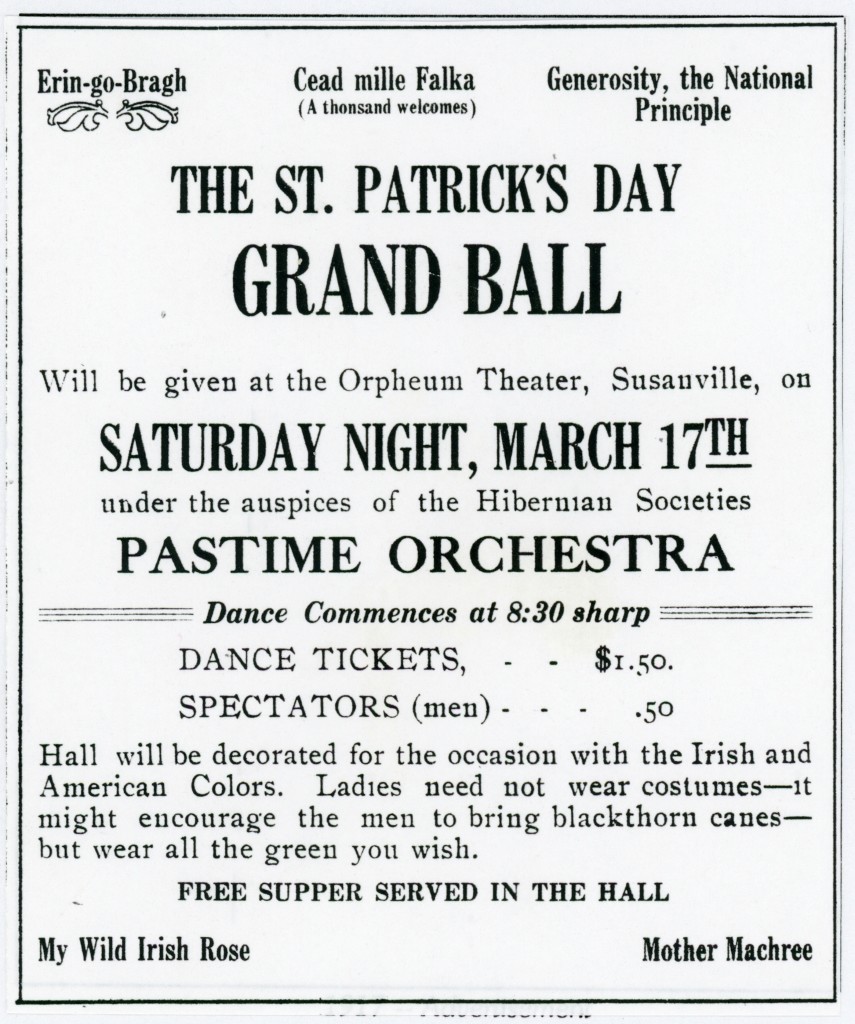
The Ladies of the Sacred Heart were an energetic bunch during the early days of the parish. One of their most popular annual events were Christmas dances. The first one was held in December 1910, and was not only well attended, but was a successful fund raiser–as usual the proceeds were used to make improvements to the church. However the next year, when Deputy Sheriff William L. Blake was killed in the line of duty in November 1911, the proceeds of the Christmas dance went to aid his widow Minnie instead. Continue reading The Christmas Ball→
The corner of Main & South Gay Streets, circa 1910.
The photographer of the above photograph had the luxury to be able to stand in Main Street, while I played it safe and took the current view from the sidewalk. Only one building still remains. In the original photograph it was the Bank of Lassen County, and now the building is the office for Verizon.
Wow, just think it was on this date in 2004 that Susanville’s Roosevelt Pool was condemned. A lot has transpired over the years, but a new pool is under construction, and more on that at a later date.
Anyhow, the following is the tale of one of the first attempts to build a swimming pool in Susanville. On February 1, 1928 Soren Hansen addressed the Susanville Rotary Club with his intentions to construct a swimming pool at the bottom of Winchester Hill near the Richmond Road Bridge. With him was Rex Dickerson of Reno to assist with finances and local architect R.D. Taylor who brought preliminary drawings. Hansen stated he already had a well drilled, striking hot water at 417 feet. In addition to the pool, he proposed tennis and handball courts. However, Hansen’s proposal did not go very far, but it would be resurrected.