During the Civil War of the 1860s, communities in support of the North, applied Union to street names, squares, etc. Susanville was a perfect textbook example.
Typical of the era, map makers were one dimensional. Susanville’s original plat, shows Union Street extending beyond Cottage and connecting Weatherlow Street at the Richmond Road bridge. There were two problems. First the proposed street would dissect the block that was home to the Susanville School District. The other was the physical restraint of the hillside for Union to connect with Weatherlow. During the messy title problems of the 1870s, caused by the town’s founder, to rectify this particular situation, that segment of Union to Weatherlow was abandoned.
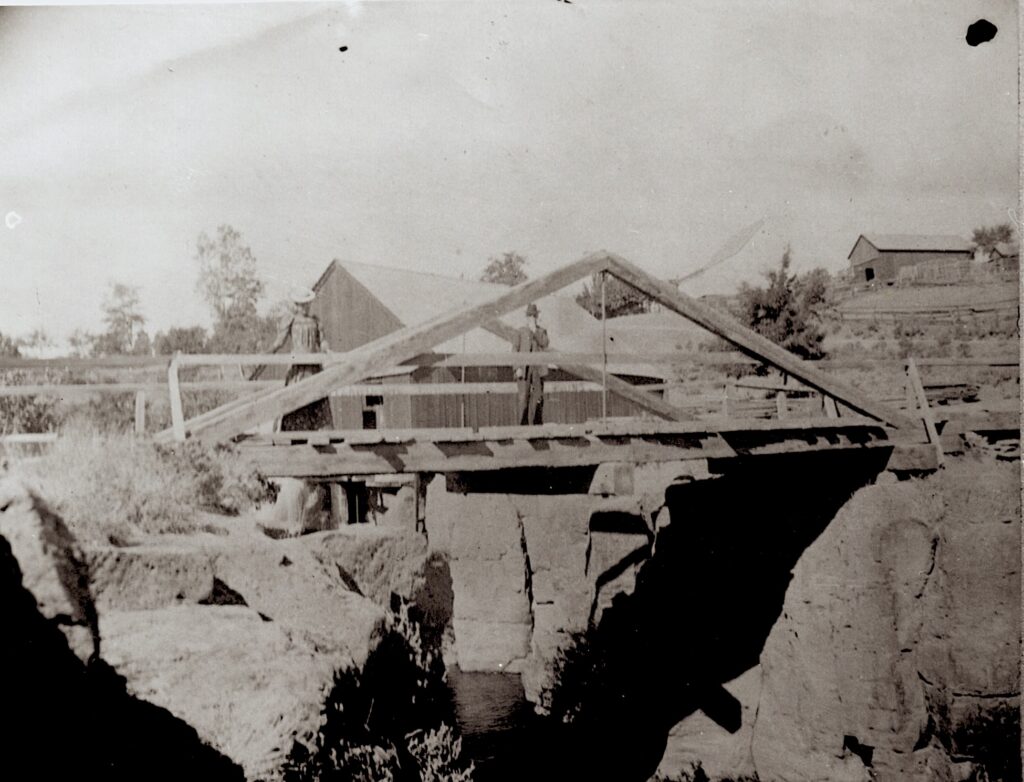
Richmond Road Bridge, 1899- This bridge was replaced in 1915.Mary Dale Folsom
It is a Tuesday and only a few more to go before we start a new year. The crossing of Susan River from Susanville was necessary for commerce. It should be noted on the north side of the bridge is where South Weatherlow Street ends. On the south side bridge is the beginning of Richmond Road.
Looking north on Gay Street, Susanville, circa 1864. Courtesy of Gil Morrill
In 1862, William J. Young opened a photography studio, the first of its kind in Susanville. It was. located on the north side of Main Street’s 600 block. In the same year, he was elected Justice of Peace, Honey Lake Township, Plumas County. Little is known about his photographic work. If the fall of 1863, he sold the business to a man by the name of Townsend, first name unknown. By 1865, Young had moved to the Idaho Territory with its mining bonanza underway.
In the fall of 1869, Young did make appearance in Susanville. This time with a stereopticon show. The local newspaper stated Young lack the skills of a good “orator” and that he should stick with photography.
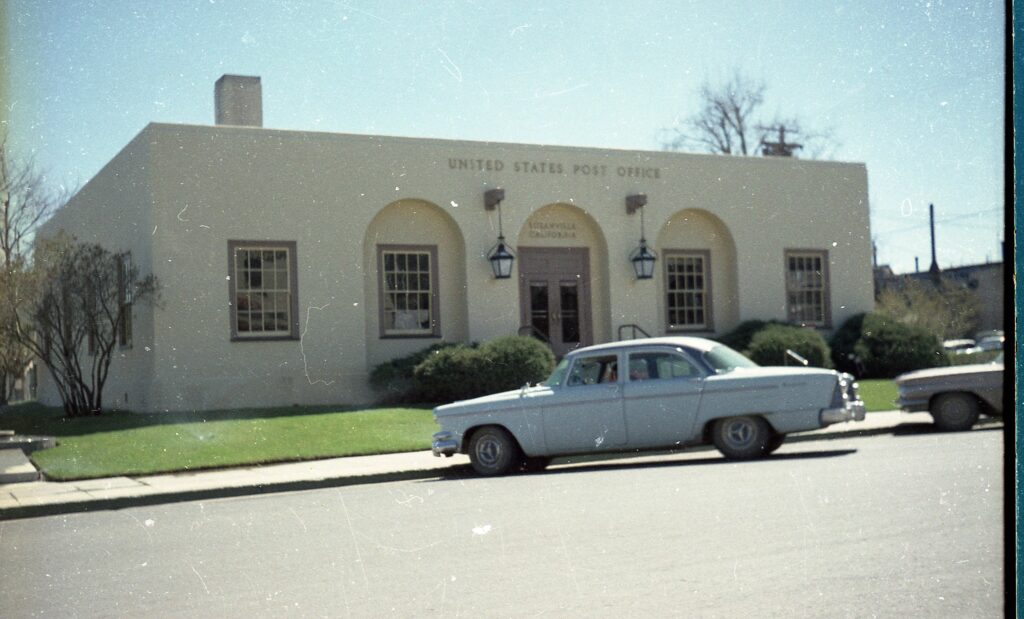
With the holidays upon us, invariably many will make a journey to the local post office. The Susanville Post Office, built in 1937, is the only Works Progress Administration building still standing. locally. There were only two. The other one was Roosevelt Pool.
In July 1925, United States Postal Inspectors paid Susanville a visit. They deemed that residential mail service should be implemented. There was work to be done. At least, in 1923, Susanville had implemented a housing number system. The postal service would provide residents free of charge mail boxes or the other option they would cut a mail slot in the front door. In November 1925, Postmaster C.D. Mathews ordered the installation of street signs.
On December 1, 1925 residential mail delivery was instituted. E.F. Unruh had the route that included the areas associated with the Fruit Growers Supply Company and Lassen Lumber & Box Company. He made his deliveries on a bicycle. R.C. Connor had the Halltown and Milwood districts and was provided an auto to make his deliveries. Herman Liidner had the incorporated city limits and he did his deliveries on foot.
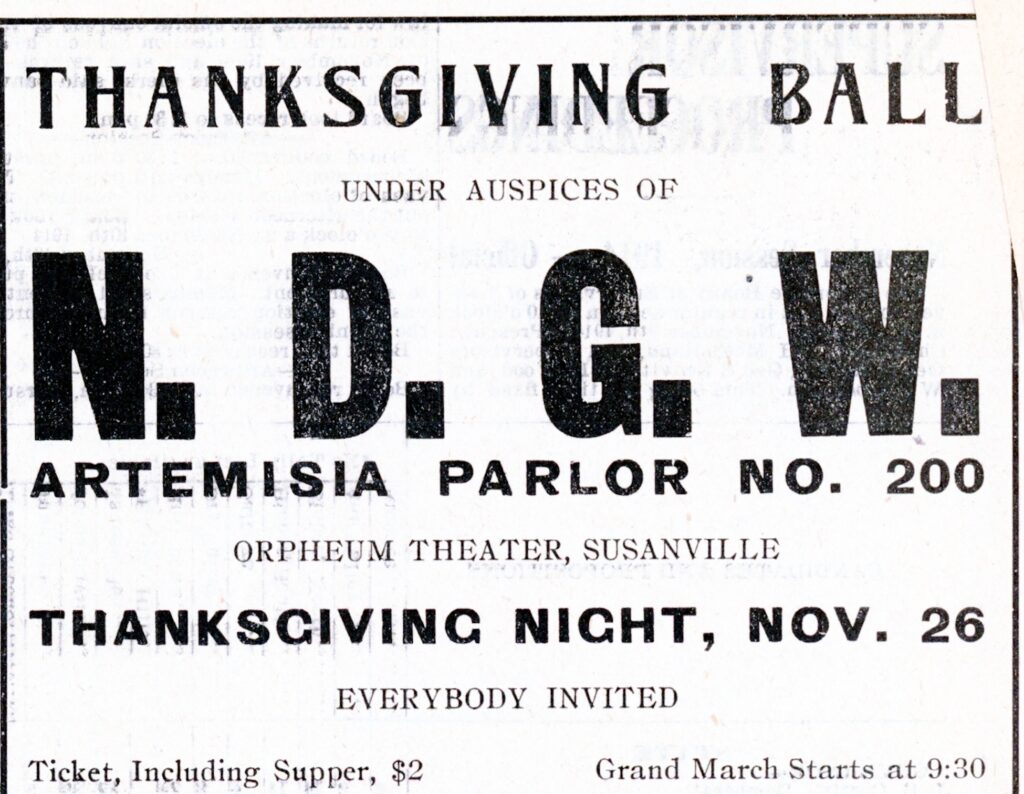
In 1914 there two Thanksgiving Balls locally, I thought I would provide back-to-back articles. After all, during holiday weekends readership is down.
Those not familiar to the Native Daughters of the Golden West, is a fraternal organization dedicated to preserve the history of California and related goals. There is still local chapter of Native Daughters, the Nataqua Parlor.,which had its origins at Standish. The Artemisia Parlor of Susanville was short-lived and absorbed by Nataqua.
There was an organizational problem with this particular event.. The fliers had the wrong date. So a word of mouth campaign ensued. One has to remember this was in 1914, when few people even had a telephone. The attendance was slightly less than anticipated, but a good time was had by all.
The event took place at the Orpheum, on the 800 block of Main Street, Susanville. At midnight, the dancers sauntered down the street to the St. Francis Hotel for midnight chicken supper. Afterwards,they returned to the Orpheum to dance the light fantastic to the wee hours of the morning.
World War II ushered in a new architectural style, that after the War it was adopted by the civilian population–the quonset hut. They were prefabricated, and a ten men crew with hardly any skills could assemble one.
The two most notables quonset huts was the old Naef Electric building in the 1800 block of Main Street. After it closed its doors circa 1977, it has been home to numerous enterprises. In the fall of 1978, it is where the Lassen County Times made its debut.
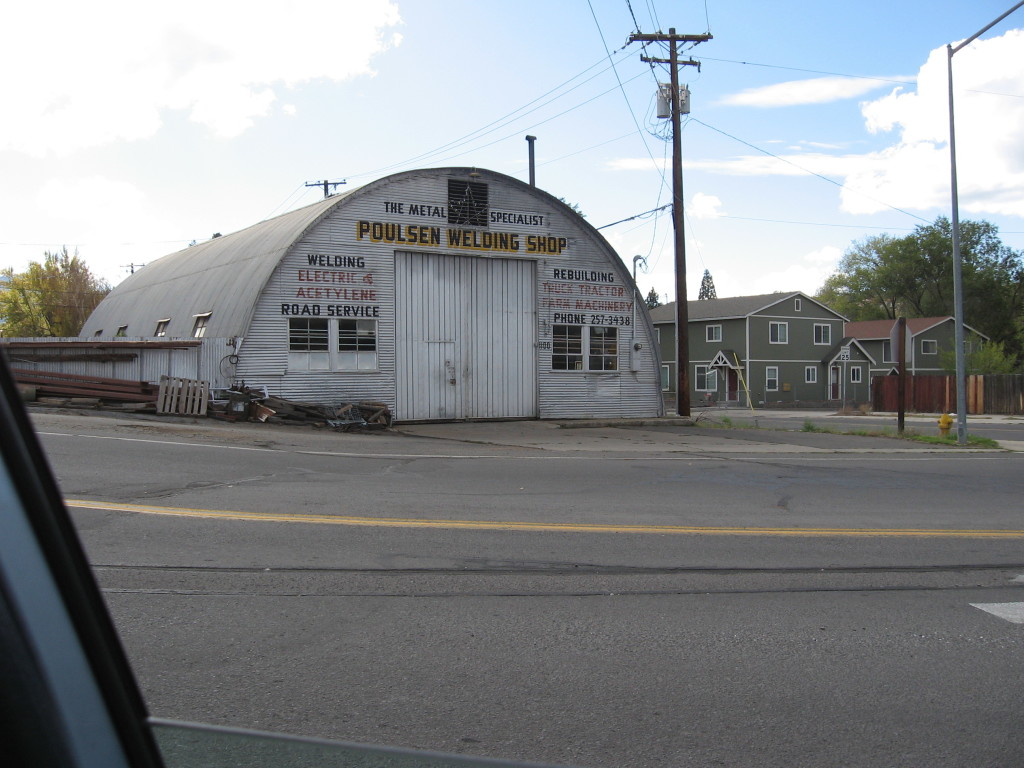
Paulsen Welding hop, October 18, 2015
The other is Poulsen Welding Shop located on Richmond Road and Riverside Drive, and carries with it, an important historic significance.
In the 1930s, Bigelow and Poulsen operated a blacksmith shop at this location, in which Poulsen would take over the business and branching out into welding. On July 11, 1946 a fire destroyed Poulsen’s shop and provided the catalyst for city annexation. The City was unable to respond to the fire as the city limits stopped on the north side of the Susan River, while Poulsen’s was on the south side, and outside the City. Efforts over the years to annex areas to the east of Weatherlow and south of Susan River had failed. The Red River Lumber Company which owned the Milwood subdivision fought efforts for fear of property tax hikes. Residents of the outlying areas wanted services such as fire protection.
Thus, the movement for “unification” was born. On April 8, 1947 a special annexation was approved by the voters. Susanville’s Main Street now extended from Weatherlow to Fairfield Avenue. The City’s land mass quadrupled in size.
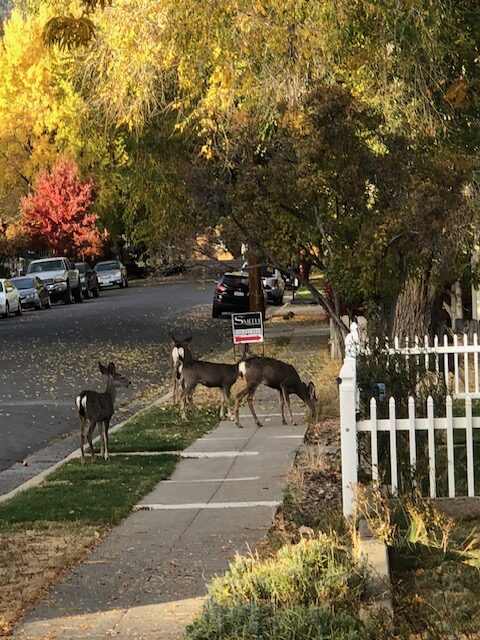
Deer grazing along Maple Street, Susanville-Courtesy of Jim Chapman
There was a time that to spot a deer in Susanville was a rarity. Those days are long gone. The deer population in the community is plentiful is an understatement. Some attribute the deer population with the passage in 1990 of the California Wildlife Protection Act. This law protects mountain lions from being hunted etc. With the increased mountain lion population, it would only make sense for deer to seek refuge inside the city from this predator. With that in mind the following is an account of a deer sighting years ago, that certain residents might find quaint.
Lassen Advocate, 16 February 1917 – It isn’t very often that deer wander into Susanville from our surrounding country, but a beautiful doe came in to see the sights last Wednesday. The animal was first seen in the Taylor fields north of town, and various persons living on North Street had a glimpse of it as made its way west to the hills.
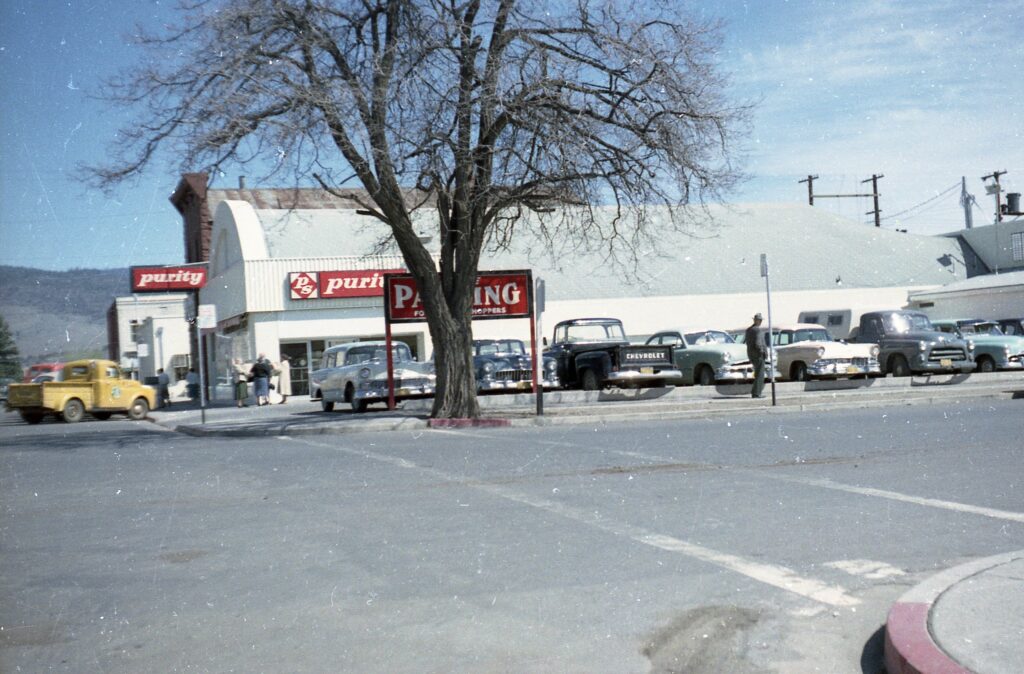
Purity Grocery Store, 65 South Lassen Street, Susanville, 1960- Another dumpster dive salvage
In the early 1920s, chain stores slowly started making inroads at Susanville, though some thought them to be a menace. One of the first grocery chains was Purity, and they opened in the Star Hotel building on the northeast corner of Main and Gay Streets. In the summer of 1938, they purchased a vacant lot on the northeast corner of Cottage and Lassen Streets and shortly thereafter constructed a store, which the building still exists. Purity closed its Susanville store in the mid-1960s, and Food Lane took over the location. Food Lane lasted nearly a decade and then it closed. Taking its place was Chicago Title Company, who operated at the location until the mid 2010s. The building is now occupied by Community Church.
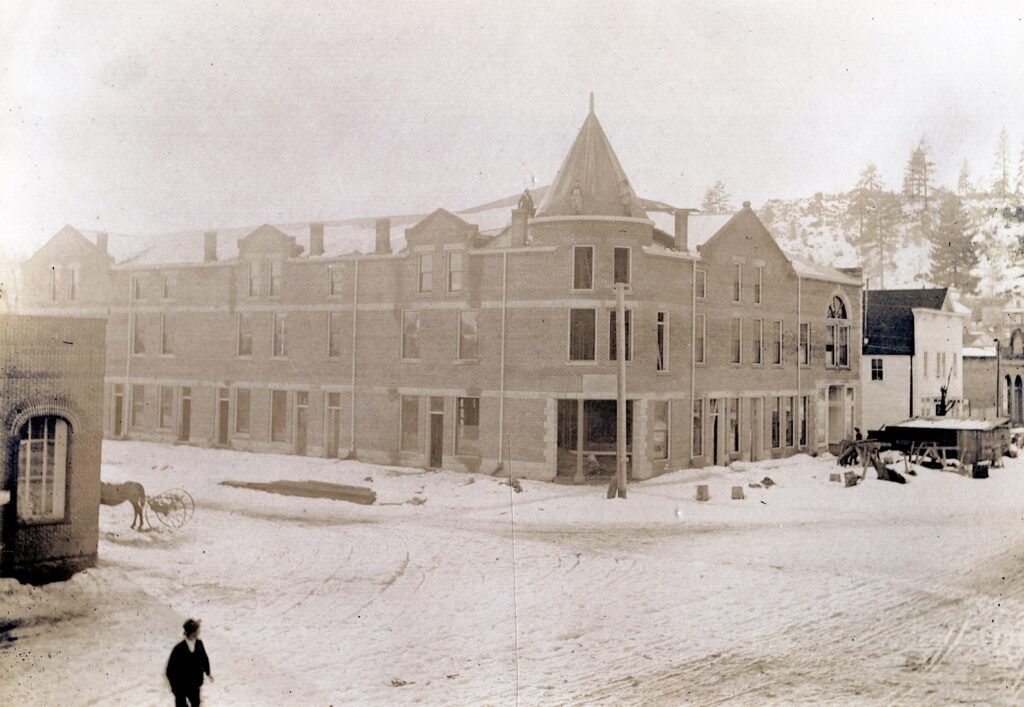
Emerson Notel under construction at Main and Lassen Street, Susanville, 1901-Mary Deal Folsom
I rescanned this photograph in hopes the new scanner features would be an improvement. I think it was a toss up. On the the other hand, newer readers might be interested about the Emerson Hotel, which would be later replaced by the Hotel Mt. Lassen.
In the late 1800s, one of Susanville’s prime property in its business district ,was the corner of Main and South Lassen Streets, that was never developed for its full potential. In June 1900, the Susanville business district consisting of south side of Main Street from Roop to Union Streets was wiped out by fire. It was a clean slate for rebuilding. Susanville entrepreneur, Charlie Emerson had a grandiose plan for the Main and Lassen Street location.
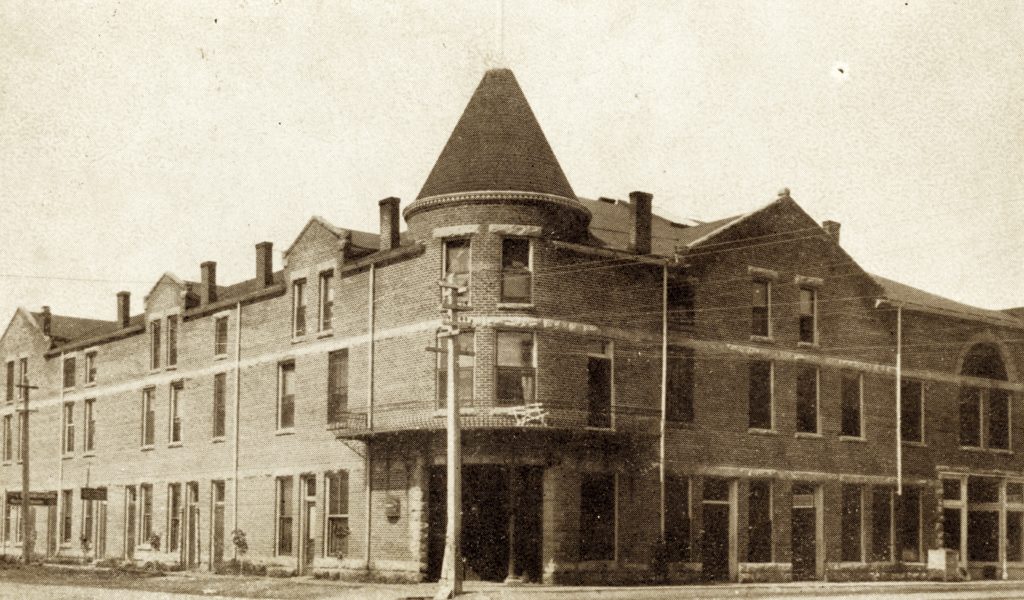
The Emerson Hotel located at Main & Lassen Streets, the current site of the Hotel Mt. Lassen.
On July 31, 1900 groundbreaking ceremonies were held for the largest most expensive building to be constructed in town to date. It was Emerson’s three-story hotel, encompassing a quarter of a block on the corner of Main and Lassen Streets. Emerson invested some $300,000 to construct and furnish the brick building that contained 27,576 square feet. The ground floor was devoted to commercial and the upper two floors contained 76 guest rooms. A grand opening was held on June 3, 1901, and The Emerson became the town’s premiere social hub.