The old George & Annie Bailey residence, January 25, 2020
Actually, “redux” is not exactly the word I had in mind. Many are familiar with the Roseberry House , 609 North Street, Susanville, which the historic home is a Bed & Breakfast. The house was built by local contractor Charles Odette in 1903 for T.A and Viola Roseberry. Many people, however, are not familiar that in that same year, Odette built a duplicate of the Roseberry House for George and Annie Bailey in the Tule District near Standish. However, the Bailey house is not visible from the County Road, since it sits back about a quarter of a mile.
The Koken residence on the corner of northwest corner of Cottage and Roop Streets—Uptegrove Familty
Of all the “mobile homes” this one was unique in a certain way. First a little background. The original Koken residence was on the corner of South Roop and Cottage Streets. It was moved to down Cottage Street, a short distance, to its present location of 607 Cottage Street. The reason for the move, was Safeway was building a store on South Roop Street, the building known today as the office Lassen Municipal Utility District (LMUD). Safeway needed the corner lot for parking for its customer, and site is still a parking lot.
Unlike the other buildings to be featured, this was the only that its exterior was dramatically altered, since it is now a two-story structure, which I am the occupant on the second floor. When the house was first moved, it was converted into a beauty shop. After the Hotel Mt. Lassen was destroyed by fire, one of its former occupants, Dr. Ray Packwood, an optometrist relocated his practice there. Packwood had previously purchased the lot behind the house, where he constructed a three-car garage, with an apartment above. However, I do not know when Packwood remodeled the Koken residence and added the second story.
607 Cottage Street as it appeared in the winter of 2005.
50 North Gay Street as it appeared in 1919. The house is now located on North Roop Street. Courtesy of Leona F. Byars
Currently, I am in the midst of a putting together an uptown Susanville mobile home tour. These historic homes have been moved from their original location, one of which is the oldest residence in Susanville belonging to the town’s founder, Isaac Roop.
Initially, it will be a self guided tour. Hopefully, either in the summer or fall, I can lead a group. The benefit of the latter, is the questions people may have, and during the walk, other items of interest can be highlighted. Below is the Dr. J.S. Wren house on South Lassen Street prior to it being moved to Cornell Street. Seasoned residents may remember Wren’s daughter, Ramona Coffin.
145 South Lassen Street, Susanville, October 1976.
Long before the Earth Day movement, spring cleaning inside and outside of one’s home was the de riegeur of the day. Personally, I got a head start during the winter sorting through and tossing stuff, since it was one of the few things I could do during my recovery.
Anyhow, long before there was even a municipality of Susanville, by the early 1870s there was always a movement on hand for the residents to clean up the outside of their homes. Most of the residents complied. However, there was no public dumping ground. It would not be until that the City of Susanville acquired a forty-acre parcel for public dumping ground. This dump remained in use until the mid-1960s. Fast forward many years later, the site was cleaned up and is now part of Skyline Park.
Main and Gay Streets, Susanville, 1924–Courtesy of Uncle Boyd Benham
Some may recall last month about the story of building the current Masonic Temple in Susanville. That article contained a rare photograph of the building under construction. At that time, I gave the photo credit to Uncle Boyd, but I knew nothing about him, or even a last name.
It was in that same month, Dr. Greg Boomer was cleaning his office in preparation of his successor. Boomer came across five professional photographs taken in 1924. They were attributed to Greg’s wife, Connie’s family. When the Boomer’s opened practice in Susanville, Connie’s Aunt Hazel Benham sent them in case they might want to use them. Hazel was married to Boyd Benham. To make a long story short, in September 1924 Boyd’s father, Ed Benham moved his family to Susanville when he assumed the role of manager of the Liberty Theater. A member of the Benham clan was a professional photographer from Marysville who took the photographs while on a visit.
The reason for this account, is that from time to time, I am asked how I locate various historical photographs. This is one of many examples.
Also, a big thank you to Connie & Greg Boomer for sharing the photographs.
Spread the word, and encourage a friend to subscribe.
During the 1930s, when Inspiration Point became Susanville’s first municipal park it was used by a lot of organizations sponsoring a variety of activities. One of the groups who used the “Point” frequently was the local American Legion post.
For several years Easter sunrise services were held there. During Holy Week the American Legion post placed a temporary wooden cross. Various church leaders participated, but keeping the service as non-denominational. It was popular too many, as hundreds attended the service that began around 5:30 a.m.—note no daylight savings time.
In the early afternoon, the American Legion post with assistance of the local Boy Scouts held an Easter Egg hunt there. In 1935, they were overwhelmed by hundreds of Susanville children who quickly found the sixty dozen eggs. As one observer put it, they could not “handle the rush” as this was twice as many as the previous year.
500 South Lassen Street was a focal point in Slippery Gulch. Courtesy of the Uptegrove Family.
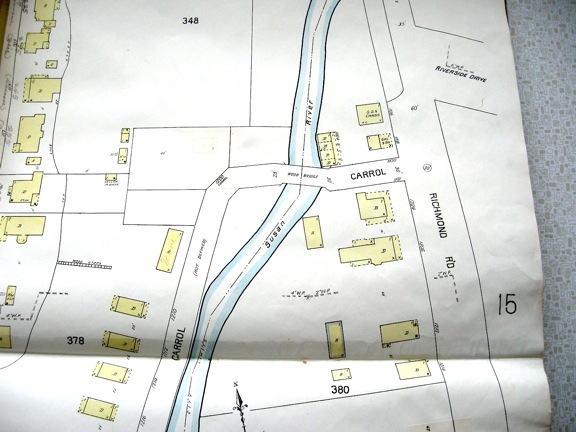
Slippery Gulch was one of those colorful Susanville neighborhoods—one that initially was scene of houses of ill repute and later bootleg joints during prohibition. Initially, it was located along the Susan River near the Richmond Road bridge when the railroad arrived in 1912. Civic leaders were not amused, since first time visitors who arrived by train, this would be their first impression of Susanville proper. The inhabitants were moved up the river along Carroll Street in the out of sight out of mind philosophy.
As a general rule the local newspapers rarely mentioned this area by name. However, in 1935, Ash Turner in his This and That column that appeared in the Lassen Mail wrote: “News that should interest residents of Slippery Gulch comes from Salt Lake City, Utah. Salt Lake district, Utah Federation of Women’s Clubs has adopted a resolution endorsing the birth control movement as ‘of utmost importance to all Americans that the population of our country be vigorous and healthy.’”
After I had completed the above, I came across another interesting editorial piece from the Lassen Mail of December 27, 1929. The paper reported a scuffle of two Indians—Lester Evans and Ruth Gerig—at the Green Lantern in Slippery Gulch. The paper concluded, “Editorially speaking in a news column it would be a good thing for the town if ‘Slippery Gulch’ were cleaned out and kept clean. If the Indians and those who frequent the ‘Gulch’ must have a scene and setting for their carousels there are plenty of wide open spaces away from Susanville and its environs where they may have full play without annoying respectable people with their drunken and noisey coming and going.”
Miller’s Construction getting ready for the demolition, of the high school, June 1968.
A question was raised concerning an article about Lassen High School’s Experimental Farm of the 1930s and its location between the school buildings and the Susan River. How the high school campus evolved is an interesting tale. In the spring of 1905, the high school board was able to use a special levy tax to construct the high school. Now, that the financial issue was resolved the next order of business was to locate a suitable site to build the new school. Three properties were offered—the Brashear property at the end of South Gay Street, an empty lot of T.W. Wilson on North Roop Street and the Blake tract on Main Street, a short distance from Weatherlow Street. It was the latter that was purchased for $2,000 and became the foundation for today’s high school campus.
A decade later the whole region was transformed with the Fernley & Lassen Railroad and the Red River Lumber Company, which two other large lumber companies would follow. Adjoining the high school to the west was the Armstrong property. In 1920, the family subdivided making the Armstrong Addition, creating the streets—Berkeley, Pacific, Pomona, Stanford and Cornell. It was Cornell Street that created a major problem. At that time the street went from Weatherlow to Alexander and dissected today’s athletic field. In the 1920s, the high school acquired property from behind the school to Cornell. As enrollments continued to increase, the school finally acquired the remaining property to the river, but the process had its moment. The high school had to go through the formal abandonment of Cornell Street through the property they acquired. Two people objected, but by the early 1930s, the issue resolved and that is how the athletic field was assembled.
Spread the word, and encourage a friend to subscribe.
In 1928, the Lassen National Forest Service leased seven acres from Lassen County on Richmond Road for a tree nursery, named the Susanville Nursery. It was done under the direction William G. Durbin, the Lassen National Forest Supervisor. In 1932, C.W. Corson, a recent graduate of the University of Minnesota has hired to be in charge of it and was so for many years. Anyhow, the initial goal was to raise 750,000 of pine seedlings over a five year period. In addition, experiments were done with cedar, fir and sequoia.
The first planting from trees from the nursery was done in 1930 to assist the reforestation of the burn on Antelope Mountain west of Eagle Lake. In addition, the nursery provided seedlings to the various national forests throughout California. It was unique that it was only large Forest Service nursery in California. In 1936, after the establishment of Lassen College’s Forestry program many of those students worked at the nursery.
In 1938, after the passing of William Durbin, the nursery was renamed to Durbin in his honor. Durbin served as the Supervisor of the Lassen National Forest from 1922-32.
Unfortunately, I do not at this time, have a date when the nursery ceased operation, but it appears sometime in the early 1950s. The property is best known today as Diamond View School.
First of all, I have to admit that I have a special affinity for this town’s particular street. After all, I grew up on this street, and decades later I returned to reside on this street.
It was so named back in 1863, when the town was surveyed, because in essence it contained numerous “cottages” and became the town’s first residential district. In the 1870s, one could call the street, the town’s religious row. The town’s first two churches were built there, and depicted in the above photograph. The first church built was the Congregational Church, followed shortly thereafter by the Methodist Church.