Tag Archives: Susanville

Susan Nobles & Susan Arnold

Susan River, February 1972

This is a tale of two Susans—Susan Parker Nobles and Susan Roop Arnold. While the two women never met, one has a river named for one Susan and the other a town, i.e. Susan River and Susanville.

First we begin with Susan River. During the years 1851-1852, William H. Nobles located a new emigrant road from Shasta, California to Lassen’s Meadows, Nevada. This road passed through the Honey Lake Valley. Nobles named the Susan River for his wife, Susan Parker Nobles.  Very little is known about Susan  Nobles. She resided in Minnesota for the majority of her married life, only moving to California when her husband, Nobles, died in 1876.

Susan Arnold and Anna Hall
Susan Roop Arnold and Anna Hall at Constantia, 1905–Philip S. Hall

Susanville was officially named on March 17, 1859 when the  Susanville Post Office was established with Isaac Roop the first postmaster. It was so named after Roop’s daughter, Susan. When her father came to California in 1850, she was left in care of her maternal grandparents. In 1862, at the age of nineteen, Susan left her grandparents home in Ohio and moved to California to be with her father. On December 27, 1864, Susan married Alexander T. Arnold and spent the rest of her life in the community that was named after her. She passed away on July 22, 1921, at the age of 79.

Support by subscribing.

Susanville’s McKinley School

McKinley School
McKinley School, 1950

The first McKinley School was built in 1920 and located on Cottage and South Gay Street, on the same lot that the former Washington School, nee Credence was located.

Yet, it was the Washington School that was built in 1900 that time had taken a toll on the structure. In 1947, the Susanville School District were concerned that it would not pass a number of safety codes. The following year the building was condemned and the district was concerned McKinley, too, would suffer the same fate. The District now had the daunting task to find funds to replace the two schools. The State of California determined that the District was “distressed” and was eligible for $341,065 in funds. It was decided to create two neighborhood schools, and McKinley was relocated to Fourth Street. The new school building opened its doors in May 1950. Of course, school campus has undergone many changes since it first opened.

Support by subscribing.

Susanville’s Special Census

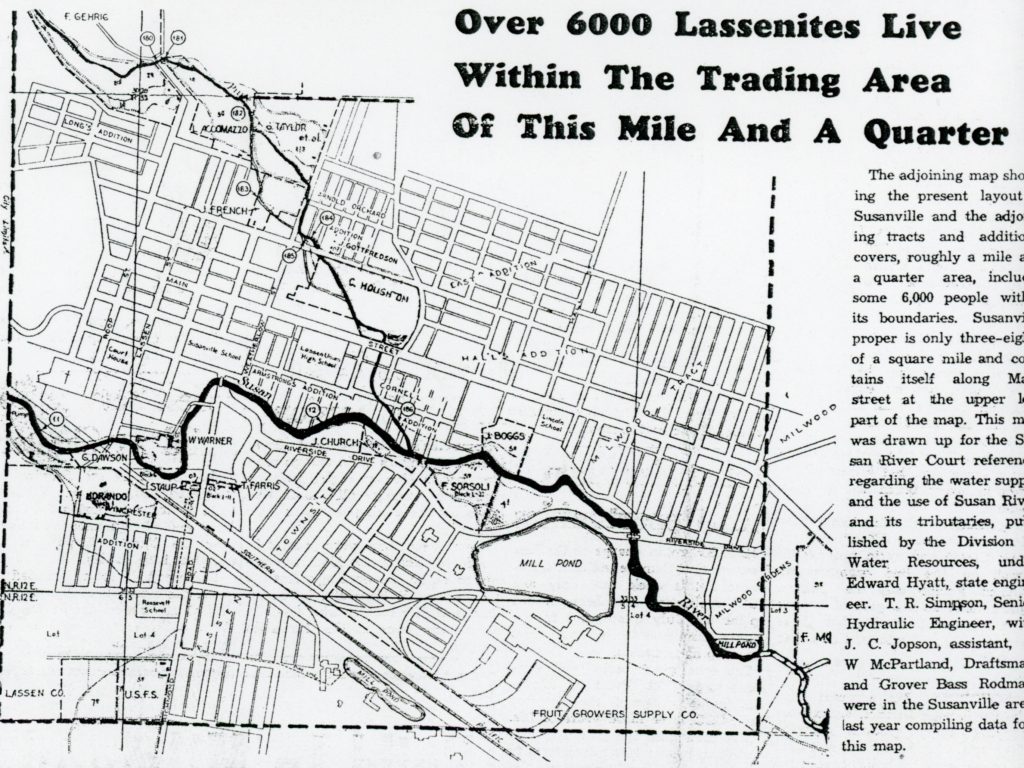
A 1937 promotional feature of the Lassen Mail newspaper.

When Susanville incorporated as a city in 1900, its eastern boundary was Weatherlow Street. In 1920, annexation of Halltown and the East Addition was discussed, but no action was taken. With continued growth east of the city limits annexation efforts failed. In 1947 that finally changed when voters approved an annexation. The City’s Main Street now extended from Weatherlow to Fairfield, and additional eleven blocks.

Everyone had guessed what the Greater Susanville population was, but no one knew exactly. After the approval of the annexation, the City requested the U.S. Census to conduct an official count. This was important, for the City needed that information to provide it to federal and state authorities for allocation of tax funds based on population. A census was conducted on April 30, 1948, and it showed there were 5,358 inhabitants.

In 2023, the population was 11,593.

Support by subscribing.

Organized Labor Comes to Susanville

Susanville, 1920

The spring of 1923 brought a new surprise when the store clerks of Susanville organized, but not as a labor union. On May 3, 1923 the Clerks Co-operative Association was organized with an initial membership of twenty-two. Harry Coleman as selected as Chairman and Fannie Winchester as Secretary.

The first item on the agenda, was a committee of five were appointed to meet with the merchants to have uniform closing hours. It was their desire to close at 6:30 p.m.. during the summer and 6:00 p.m. in the winter. Another item, was to aid each other to improve salesmanship skills. Finally, it was their desire to work in harmony with the merchants.

Tim

Election Day, 1864

Main Street, Susanville, 1864.

Lassen County was created on April 1, 1864 from the eastern portions of Plumas and Shasta Counties. On April 11, 1864, California Governor F.F. Low appointed three men—L.N. Breed, Frank Drake and H.C. Stockton—to serve as county commissioners to organize the county.*

The main task for these men was to put on a election for a slate of county officers and equally important to select a county seat. The date set for the election was May 2, 1864. Janesville and Susanville were the two sites selected for the county seat. On May 12, 1864 the final canvass of the election was held. It was a messy affair, and two precincts Fort Crook (Fall River Mills) and Surprise Valley were ultimately rejected. The minutes were vague: “The board proceeded to estimate the vote . . .Susanville having received the highest number of votes for the county seat, was declared the county seat of Lassen County.” The Quincy Union newspaper reported that Susanville won by 72 votes.

*In 1879 California adopted a new Constitution whereas the county commissioner became county supervisor and the District Court Judge became the Superior Court Judge.

Support by subscribing.

Remember Emerson Lake Golf Course?

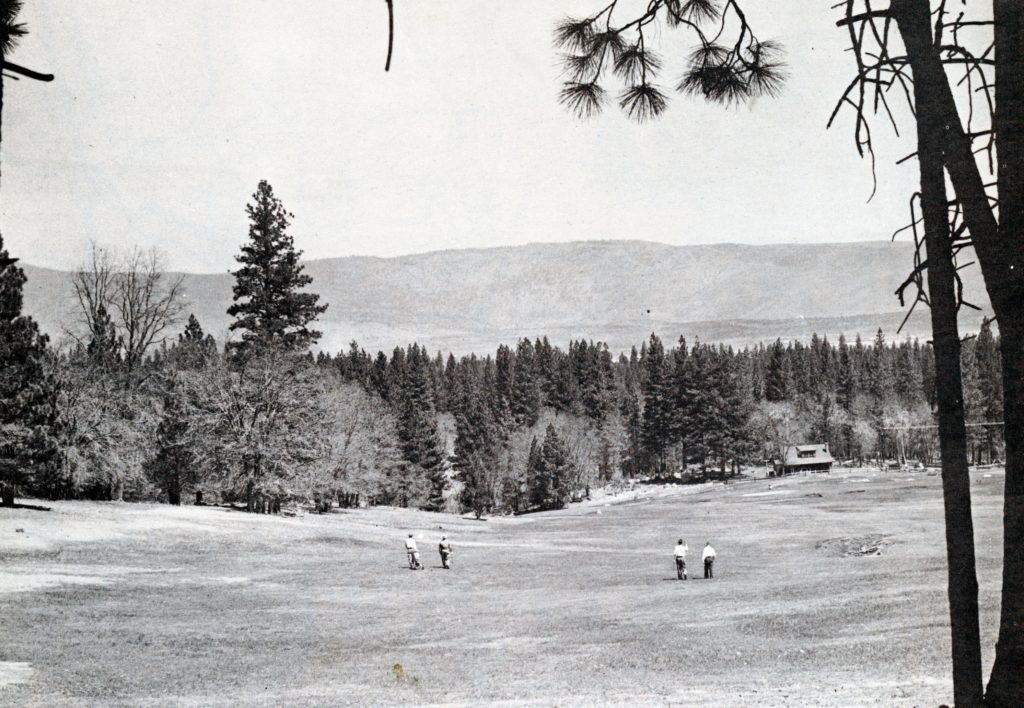
Lost Meadows Golf Course, near Peter Lassen’s Monument, was replaced by the Emerson Lake Golf Course.

In the 1960s there was a movement to have a municipal golf course. In 1967, Rollin “Rollie” Doyle Emerson (1917-1976), sold a portion of the family ranch, near Richmond School, to the City of Susanville that the latter developed into a golf course.  The Emerson family had owned  that property since 1874.

Fast forward, in the spring of 2002, Todd Sickles, manager of the Emerson Lake Golf Course, requested that the City rename the golf course to Diamond Mountain. Sickles, who had a long-term lease of the golf course, cited that with the expansion of the course to 18 holes that he wanted to create a new image for the facility and enhance its marketability.  Sickles also cited that the current name is at times misleading, as Emerson Lake is known to go dry, due to its usage for irrigation.  This issue did spark some debate.  Rollie Emerson’s son, Tro, acknowledged the problem with the dry lake, and requested that the family name remain intact and suggested Emerson Meadows.  Sickles, in the meantime, offered to construct a monument in honor of Rollie Emerson for his early day activities with the golf course and in addition, the first nine holes would be known as the “Emerson Nine.”  The City Council was divided on the issue.  Those in favor of the name change stated that marketing and financial aspects should be a priority over the region’s heritage.  On June 5, 2002, the City Council voted 3 to 2, and approved marketing over heritage and granted the name change to Diamond Mountain Golf Course.

Support by subscribing.

Fruit Growers’ Bond Measure

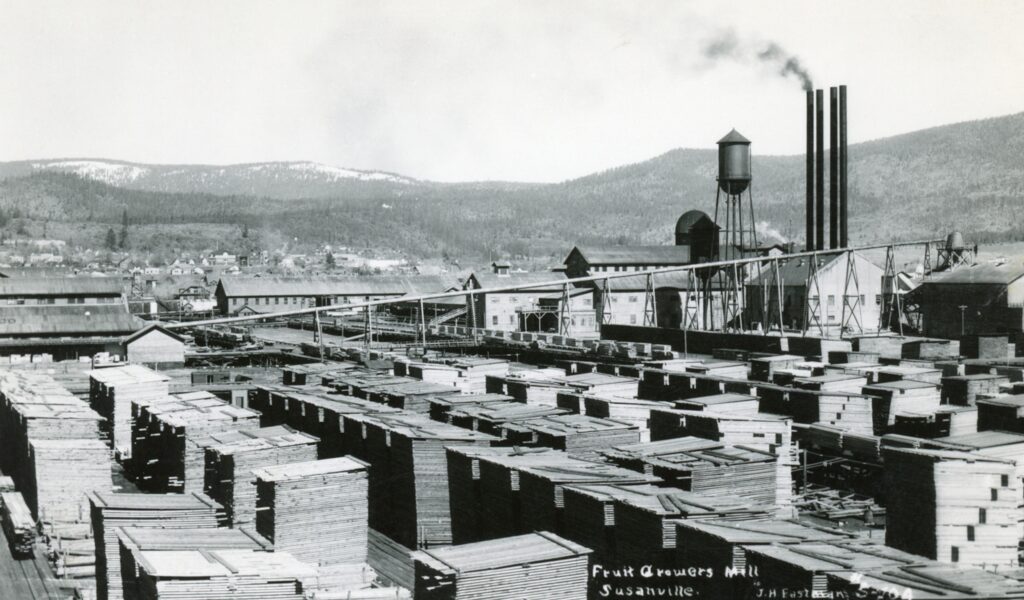
Fruit Growers Supply Company, Susanville, circa 1935

After a few years after Fruit Growers Supply Company took over a lumber mill at Hilt, it had turned into a wise investment for the citrus  growers to meet the demands for wooden boxes to ship citrus.  In 1919, after extensive research Fruit Growers decided to embark on a second mill at Susanville.

To finance the purchase of timberland as well as the cost associated to build a sawmill was not a cheap proposition. To purchase the Collins Tract of timber would cost $1,102,493 and to build a mill and related facilities was priced at $2,331.249. To raise the capitol its was deemed to sell $4 million in bonds.

One half the bonds were sold privately and the other half publicly. The private issue was immediately oversubscribed. Sold in denominations of $500 or $1,000, the bonds yielded 6 1/12 per cent interest payable semi-annually.

To pay for the bonds the growers agreed to assess themselves two cents per box. In addition to the assessment, for every 1,000 board feet of lumber sold, four dollars was budgeted to pay off the bonds generating $300,000 annually. In 1934, Fruit Growers paid off the bonds in record time and the Susanville operation was debt free.

Support by subscribing.

Susanville Library Association

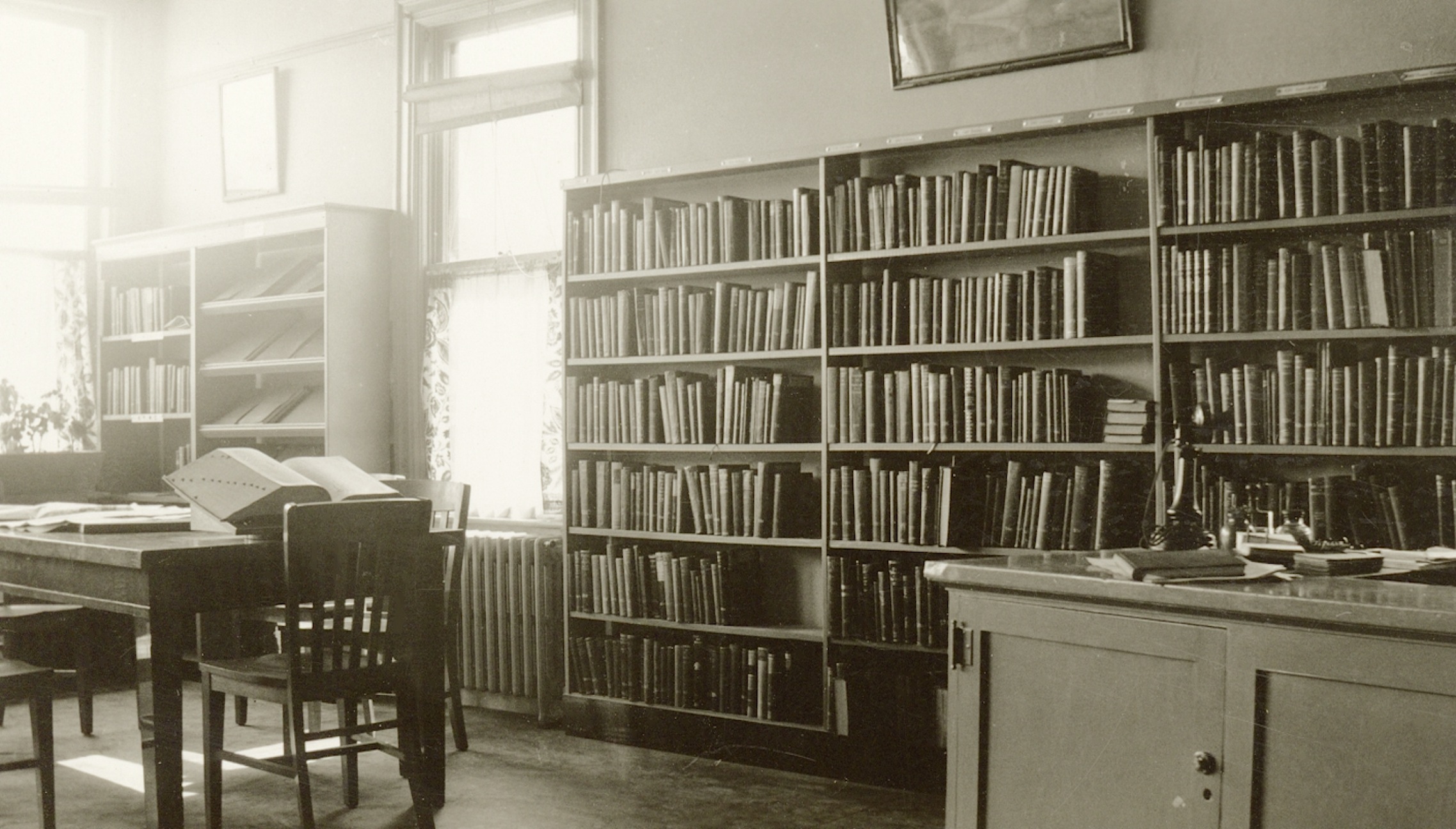
Susanville Branch, Lassen County Free Library,1920

The establishment of a library was a slow, tedious process. In 1906, one of the earliest attempts to form a library came about when some civic minded people formed the Susanville Library Association. Their initial goal was to establish a Reading Room.  Through the generosity of Charles Emerson he donated a room in his hotel for this worthy enterprise. However, the organization struggled and by 1908 it had been disbanded.

There was hope on the horizon when in 1912 a group of civic minded women formed the Monticola Club. In the fall of 1914, Lottie Cahlan of the Monticola Club reported that preparations were being made for. Reading Room in the newly constructed Del Mar building on the corner of Main & Roop Streets. They would have the expense of rent at $40 per month, in addition to lighting costs. The city agreed to assist with some of the expenditures. Members donated furniture and books. Each member donated one day a month to volunteer in the Reading Room to assist patrons, who could examine a newspaper, magazines or books. The Monticola was not finished. With their momentum by the fall of 1915 they had convinced the Lassen County Board of Supervisors to form the Lassen County Free Library.

Support by subscribing.

Margie’s Book Nook at 40!

The Big Store
Susanville’s The Big Store as it appeared in 1916. It is now the home of Margie’s Book Nook. Photograph courtesy of the Worley family

Mark your calendars for April 1 when Margie’s Book Nook celebrates forty years in business. The store had its humble beginning at 28 North Lassen Street, next to Fred’s Barbershop. Several years later, the store needed to expand and moved a block away to 35 North Gay Street. After several years passed, the store again needed more room. Another move, not quite a block away to the current location at 722 Main Street, next to The Pioneer.

I am not sure all the festivities planned for Saturday, April 1 but will be a lot of fun. More information and some of the store’s history can be found their Facebook page.

Tim

Fredonyer City It Is!

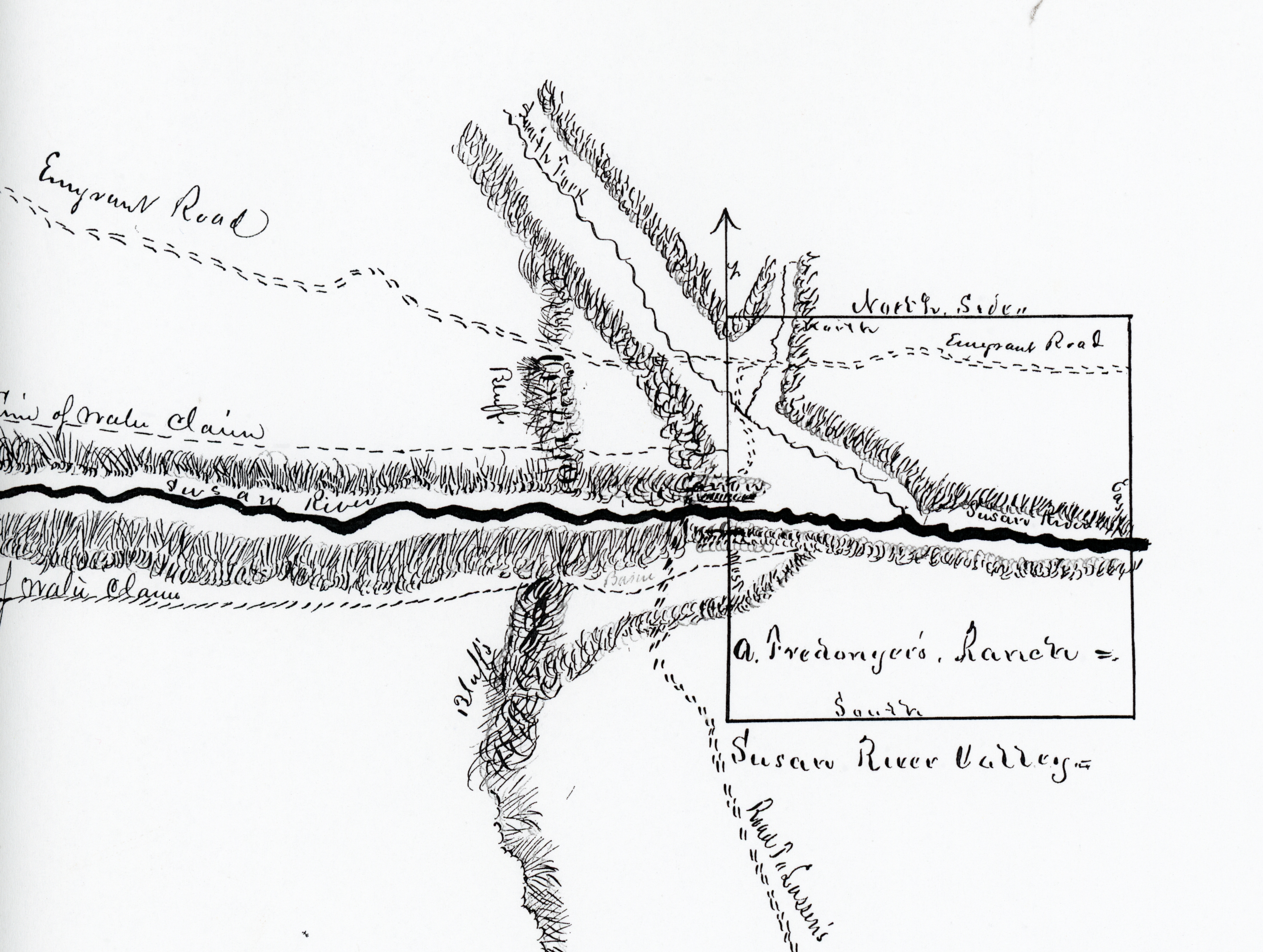
Fredonyer’s Claim to what would become Susanville.

In the spring of 1857, there were only two cabins in what would be latter known as Susanville. By summer a nucleus of a hamlet had developed and some thought it should have name.  In August 1857, two names were proposed for the settlement around Roop’s trading post—Natauga and Fredonyer City. The Red Bluff Beacon reported: “The citizens of Honey Lake Valley are divided in opinion as to which names shall be given to their new town at the west end of the valley. Natauga in the Piutah tongue signifies woman and Fredonyer is the name of the gentleman who claims to be the first white man that ever beheld the beautiful valley. A gentleman who arrived here on Sunday last had in his possession an instrument in writing signed by fifty men declaring their preference for Natauga. An equal number are said to be as enthusiastic for Fredonyer. Simple and unimportant as this question is it said is to be creating quite a jealous feeling between the two rival names. They have no politics at Honey Lake and must have something to cavil about.”

Fredonyer City was the chosen name. However, it was more or less ignored and the place simply referred to as Roops. It should be noted that Fredonyer on April 11, 1857 filed a claim to property occupied by Roop with the Plumas County Recorder.

Support by subscribing.