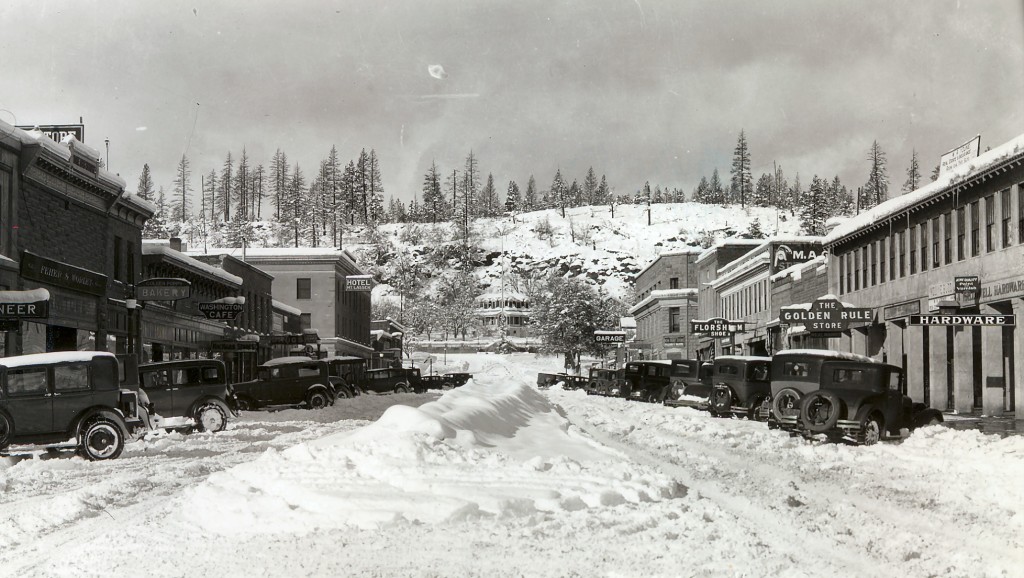
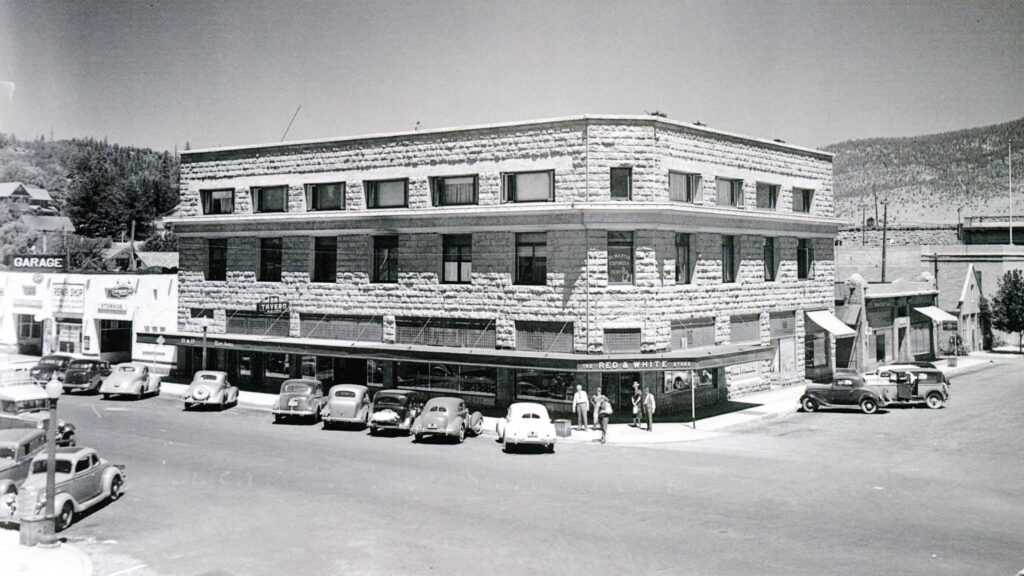
Main Street, Susanville, 1927. Note you can see where the fire burned above the Elks Lodge in 1924.
Late spring snowfalls are not unusual. Just like their counterparts of early fall snowfalls, they share a common trait—the snow melts quickly.
On March 25,1924 the Susanville area received anywhere between 18 inches to two feet of snowfall. Within twenty-four hours there was not a trace of snow. The local farmers rejoiced over their short-lived bounty, it being the driest winter on record to date. Spring rains were practically non-existent. It was a prelude of thigs to come. California would experience its worst forest fire to season to date.An interesting tidbit, the region did receive any measureable precipitation until September 15.
It was on March 20,1987, the nurses at Lassen Community Hospital, then affiliated with St. Mary’s reached an agreement ending the eight week strike. Stephanie Kruse representing St. Mary’s stated, “Everhting went very well. It is over.” While union spokeswoman, Noreen Frieling added, “The ink is on the paper. It’s done.”
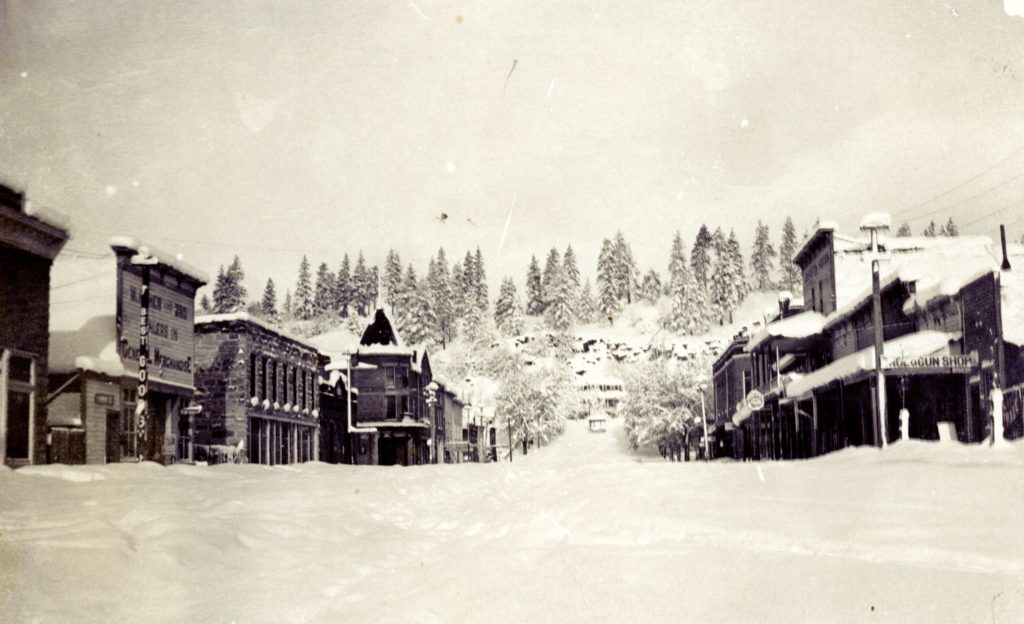
Main Street, Susanville, 1885. Courtesy of Betty Barry Deal
This is what the L.M. McKinney Lassen County directory had to say about Susanville in 1885:
The county seat of Lassen county, is situated about one hundred and fifty miles northeast from Sacramento, and ninety- five miles northwest from Reno, Nevada. The location itself is a peculiarly attractive one, lying as it does just at the base of the Sierra Nevadas, where the mountains give way abruptly to a comparatively level plateau and an unobstructed view over thirty miles is obtained, including almost the entire expanse of the Susan River Valley. The river itself rises in the mountains west of the town, flows past on the south side, thence in a southeasterly direction to its mouth, some twenty-five miles distant where it empties into Honey Lake. For about half of this distance (that part adjacent to Susanville) the land is thickly settled; small farms, well built and attractive residences, and large and commodious barns and outbuildings being the rule. The remaining portion of the valley will, with irrigation, unquestionably develop as well. The United States Land Office, located at this place, shows a record of 1694 cash, 1279 final homestead and 73 final desert entries, and there still remains within the limits of this district much valuable timber lands open to claimants, as well as so rated desert land which only needs irrigation to bring it up to a standard in fertility which will compare favorably with any land of the State. Susanville has one newspaper, The Lassen Advocate, weekly, which is the official county paper. It is ably conducted by Messrs, McKinsey & Hayden, proprietors. The school facilities of the town are fully up to the times; the Methodists and Congregationalists have fine and commodious church buildings, and the organizations are well sustained. Its hotel accommodations are amply provided for in two hotels, the Johnston House, a well conducted establishment, kept by Messrs, Dowling & Myers, being worthy of special mention, and among its business interests may be specially noted the Lassen Mills, with a capacity of forty-five barrels of flour per day, which is kept constantly running. Outside communications are had by daily stage line to Reno, twenty miles of this route on the end next to Reno being by rail. Two other lines are run during seven months of the year, one to a connection with the California and Northern Railroad to Oroville, and the other to Chico, connecting at that point with rail to all parts of the State. It has a money order post office, and Wells, Fargo & Co’s Express.
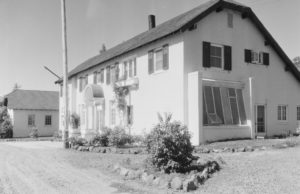
The Hall residence, 1895. Today, the location is the 1600 block of Susanville’s Main Street, the current location of Grocery Outlet.
Wright Patrick Hall is known for many things, especially that as a long serving Lassen County Clerk, and also that as the Lassen County Treasurer/Tax Collector. He first came to Susanville in 1860, and then moved to Nevada for a brief stay before returning. On May 22, 1877, he purchased 480 acres one half mile east of Susanville from Heiro K. Cornell for $700. In 1885, Hall began selling lots with Main Street frontage. In 1895, Hall hired surveyor William D. Minckler to plot 160 acres known as Halls Addition, but everyone called it Halltown. The bottom land of Piute Creek separated Halltown from Susanville. It was not until the 1920s that the two communities slowly grew together.
Personally, this latest storm was over-hyped for the region. Some forecasts called for feet of snow, but in reality it was inches. Anyhow, lets examine some big storms that occurred several years apart.
1911- On January 13 there was three foot of snow in Susanville, but the big snow still had not hit. Then it really began to snow. Six days later the storm finally ceased, five feet of snow had fallen and the depth on the ground now reached eight feet! In January 116 inches of snow had fell in Susanville, with a total precipitation of 11.59 inches.
Construction of the Fernley & Lassen Railroad, west of Susanville, January 1914. Courtesy of B.R. Zimmerman Collection
1914 – In January was another repeat of 1911. Susanville once again had eight feet of snowfall. This, of course, did not stop the railroad construction crew between Susanville and Westwood.
1916 – On New Year’s Day a snowstorm hit Susanville and dropped four feet of snow in two days. For the month Susanville received nine and a half feet of snow for the month of January. When it was not snowing it was bitter cold. On January 30 the temperature dropped to minus fourteen below zero.
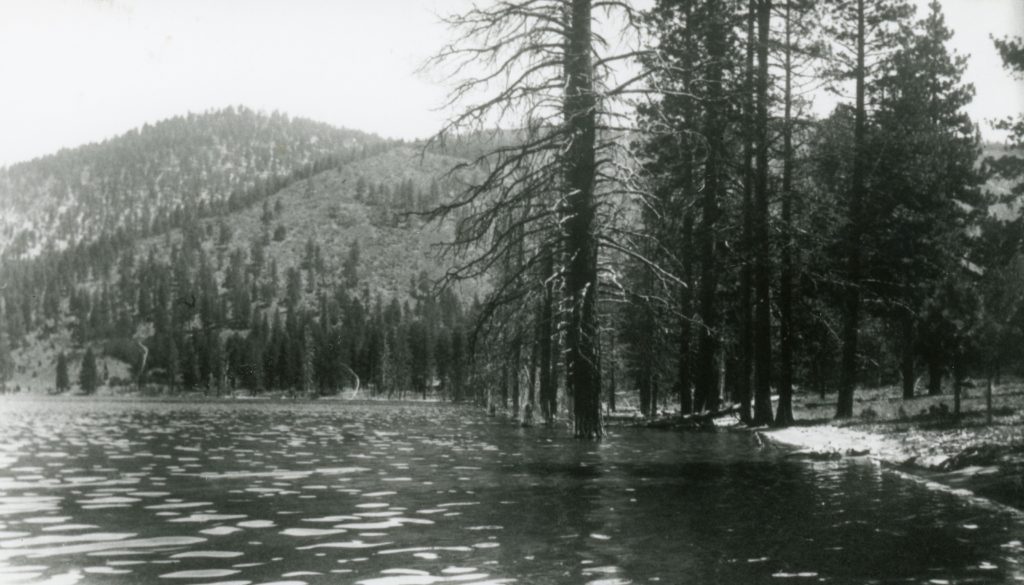
Gallatin Beach and Peak, 1916. Courtesy of Wyn Wachhorst
Eagle Lake was a beneficiary of these wet winters. In 1917, the lake reached its highest recorded water level.
North Lassen Street, Susanville, showing City Fire & Hall, circa 1930
Tuesday, is primary election day in California, so I thought it only fitting to have an election story—oh do I have many having spent many years working as a county election official. One of the most disheartening aspects is when there is low voter turnout. The general public is not aware, just how much work and preparation is involved. Okay, enough of my soap box and on to the story at hand.
The April 1930 Susanville City Council election turnout was pathetic, only eighteen votes cast! Robert M. Cook, editor and publisher of the Lassen Mail wrote:
”On Monday of this week three men were up for election as members of the city governing board. Exactly eighteen votes were cast in the election booth. That number on the face of it shows there is no local interest in how the town is run or who runs it. And the men who are on the town council board are the men who say how and where the taxpayer’s money shall be spent.
”It seems reasonable to suppose that interest, more or less, would be cenetered at election time on whom should occupy places on this governing body. The few votes cast last Monday would indicate the reverse.
”Whether or not he or she should cast a vote is up to the individual concerned. And if a person is not concerned to the extent of casting a vote then adverse criticism should cease.
”The job of councilman carries with it nothing but work and grief. There is no salary attached to the office, nor rarely any credit for work done. It is more or less of a wonder that any one would take the office as a gift, let alone having to ‘run’ for it. The different men who hold places on the board should be given a vote of thanks for accepting the responsibility they do. Instead all they get is a lot of knocks by persons who are too indifferent to express their choice of whom they want through the medium of the ballot box.
”The office of councilman is an important one and should not be treated indifferently. If there is not any interest shown in who runs the town and does the work of planning and directing, then you can’t blame the powers that be if no interest is shown on their part.”
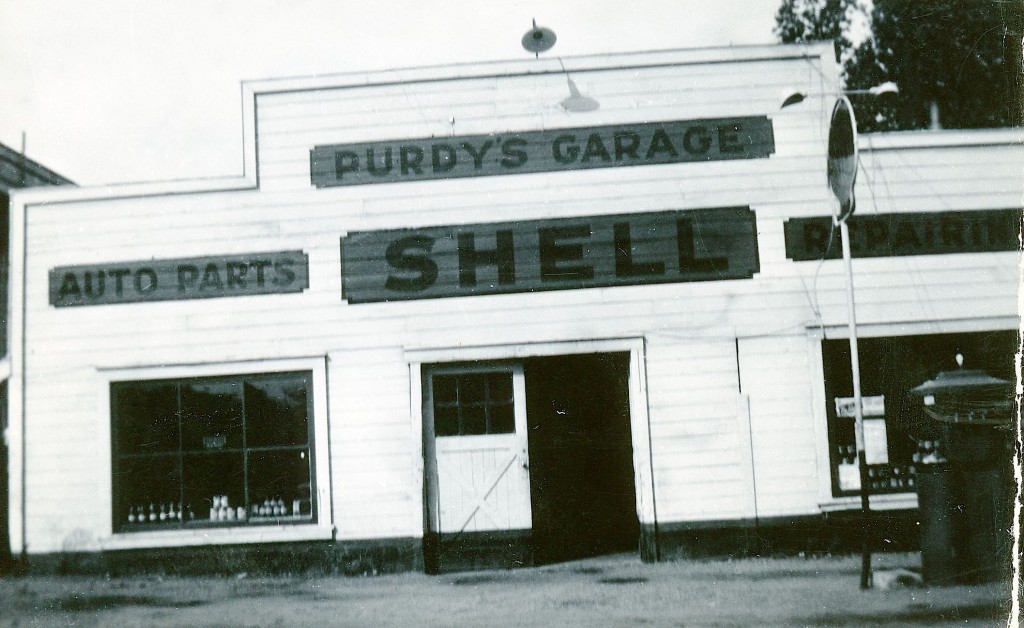
Purdy’s Garage, date unknown. Courtesy of Margaret Purdy
Some one wanted to know about the history of Susanville’s T&A Lounge located on the corner of Main and Sacramento Streets. In 1939, my grandparents, Ira and Margaret Purdy bought the Main
Street frontage between Sacramento and Spring Streets. My grandfather had a gas station and garage on the corner of Main and Spring Streets. Ira sold the vacant lot on the corner of Main and Sacramento to Tony Tonin and Al Surian—hence the name T&A. It was a short lived partnership, but Surian’s son, Gino, still owns the establishment.
My apologies for using a photograph of Purdy’s Garage instead of one of the T&A. I am still in that transitory period with issues transferring scans, hopefully the transition is just a few months away.
Susanville’s Knoch Building located at the corner of Main and North Lassen Streets has a long storied history. It was built in 1893 as a Masonic Hall, destroyed by fire in 1898 and subsequently rebuilt.
David Knoch who loaned the local Masons for the initial construction, would foreclose on that organization and took possession of the property and over time became known as the Knoch Building.
Knoch Building, circa 1900. Courtesy of Philip S. Hall
After Knoch’s passing in 1908, his son, Isaac “Ike” Knoch took possession of the building. With the arrival of the railroad to Susanville in 1913, it brought tremendous growth to the region. In 1914, when Knoch proposed to add a third story to the building. He was told it could not be done. Well, as Knoch recalled years later, “That was all I needed the word can’t.” Work on the third story was to commence shortly after Labor Day 1914, However, with the Moose Lodge proposed a harvest festival in which Main Street would be shut down for several days, the work on the third floor was postponed. When the $34,000 project was completed, Susanville also had its first elevator.
On January 16, 1911 M.O. Folsom unveiled his East Addition, Susanville subdivision containing 300 lots. Many of its north/south streets were named for trees, i.e., Ash, Cedar, Fir, Spruce. The east/west were numbered, i.e, First, Second, Third, Fourth and Fifth.
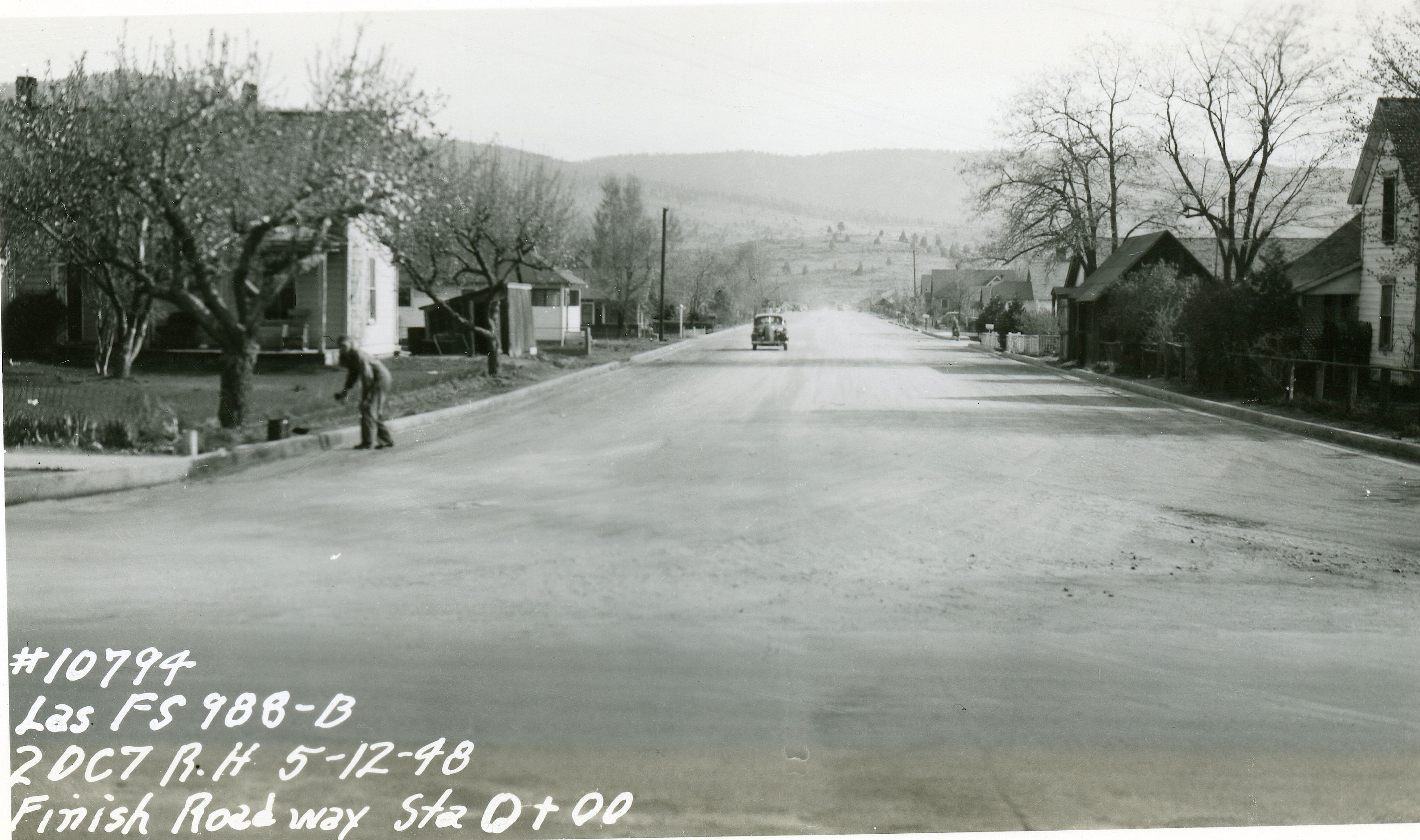
Ash Street, initially ended at Fifth Street. Travelers headed north either used Hall Street or Weatherlow Street to Chestnut. In 1947, Ash Street was incorporated into the Lassen-Modoc Joint Highway #14, the pre-cursor to State Highway 139. Ash Street was extended to connect the highway making for a straight route into Susanville.
Susanville’s first hotel, if you could call it such was Cutler Arnold’s story and half structure of hewn logs. For two years, beginning in the spring of 1857, it also housed the town’s only dining establishment, meals costing seventy-five cents.
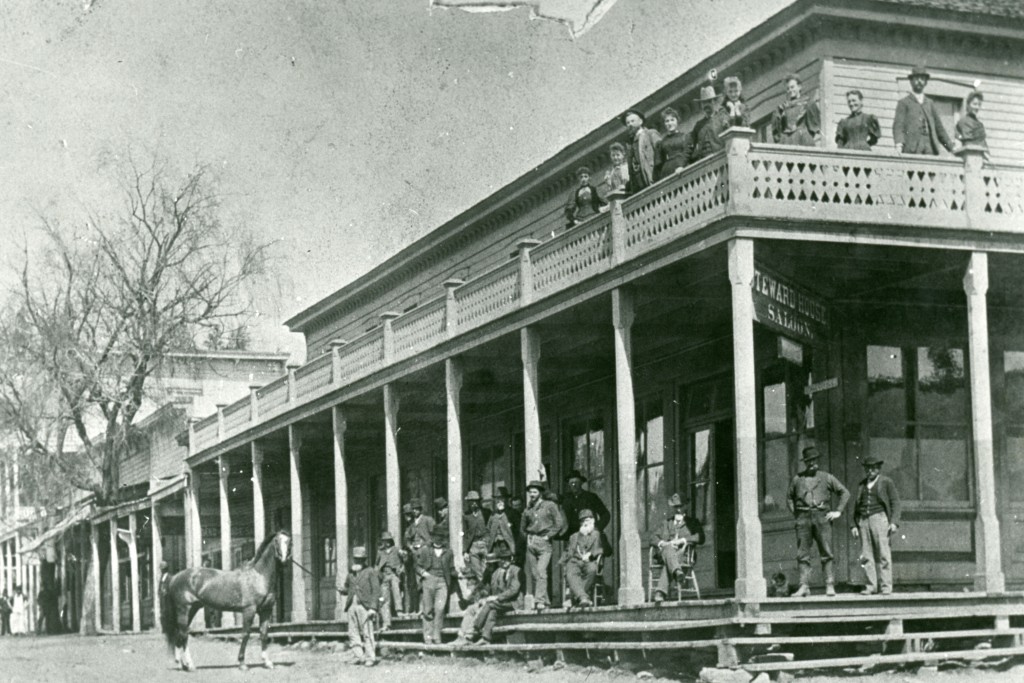
As the town progressed so did the accommodations. In 1860, Emanuel “Mike” Brannan built a two-story hotel on the northeast corner of Main and Lassen streets. It was a transitional period, as the days of log structures were being placed with wooden framed ones. Brannan operated the hotel for the next four years, and due to some financial problems lost the hotel. Just as the Brannan House had replaced Arnold’s, Brannan’s was replaced by the superior Steward House in 1864.
Susanville’s Stewart House, 1881. It sometimes was used as a hospital. Courtesy of Dallas & Joyce Snider
The Brannan House slowly faded away entirely. Its second floor was converted into lodge hall for the Oddfellows. The first floor was used for a variety purposes including that of the post office and the government land office. In 1880, it was torn down and replaced by a new Oddfellows Hall, and that building was replaced with the current structure built in 1896..