Tag Archives: Susanville

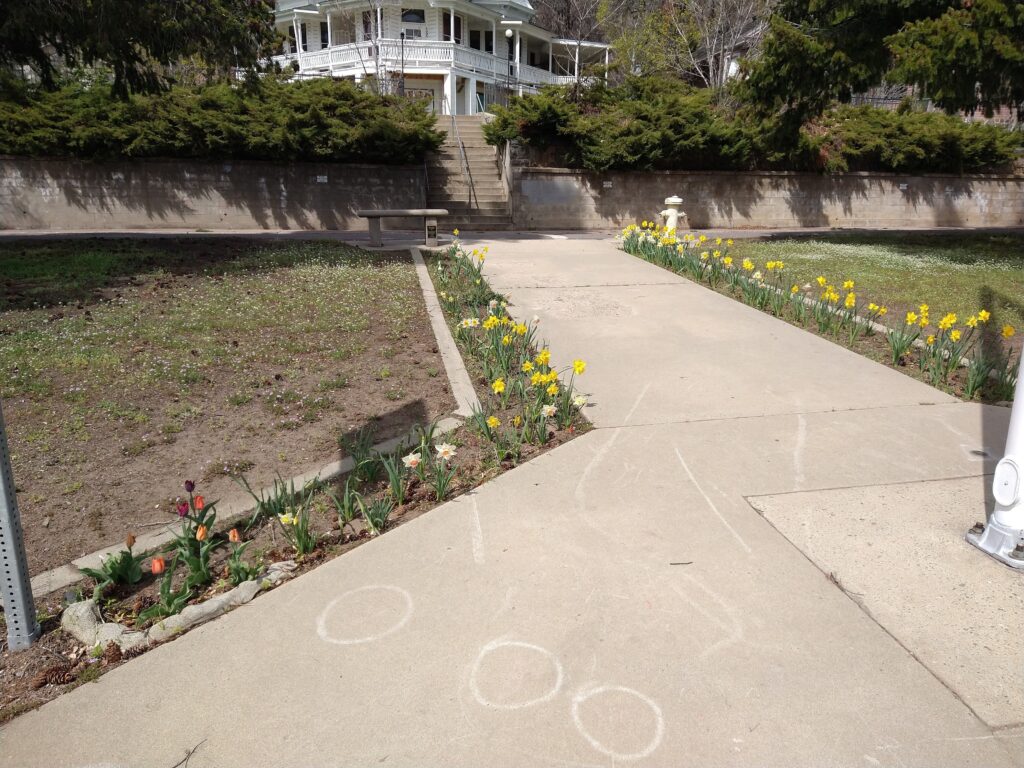
Today’s River Street, Susanville

Fruit Growers Manager’s Residence under construction on what became part of River Street, Susanville, 1920–Ed Standard

In 1922, Susanville’s  Milwood Tract subdivision was created. There was one street that was somewhat of an after thought and evolved over the years—River Street. Even before Milwood Tract and that of River Street it was the location of Riverside Hospital and Fruit Growers Supply Company’s Resident Manager’s residence. River Street, initially began from Main Street, headed one block south, then made a hard right and at the intersection of South Fairfield merged with Riverside Drive. Later it was modified at the initial one block starting point became South Gilman Street. River Street at that intersection then extended west to McDow Street. It would even later be extended again to connect with South Ash Street.

Construction of Riverside Hospital, 1920. Courtesy of Ed Standard

Tim

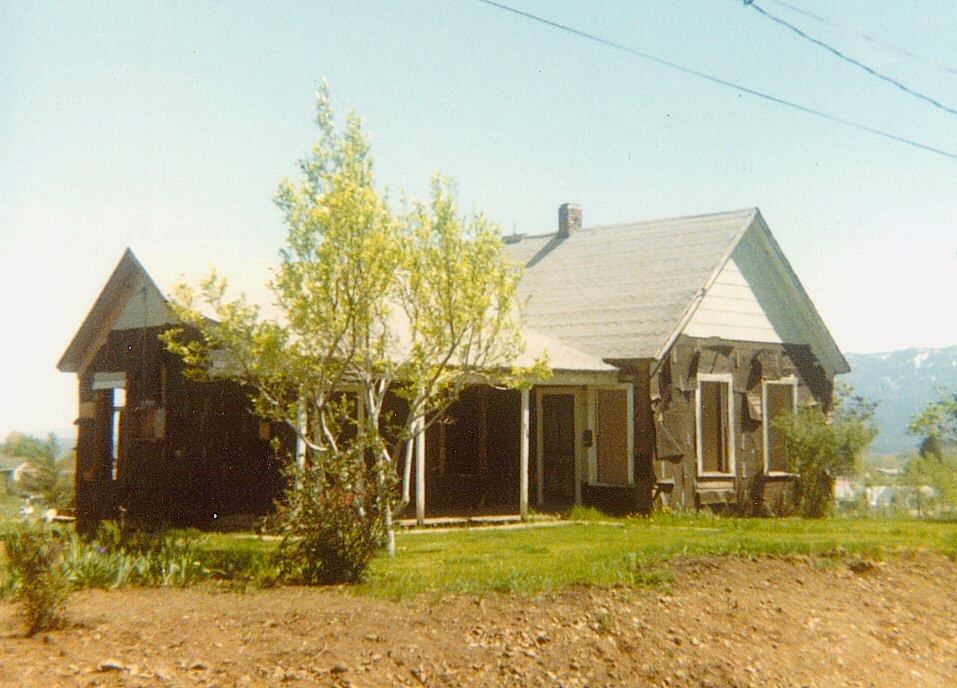
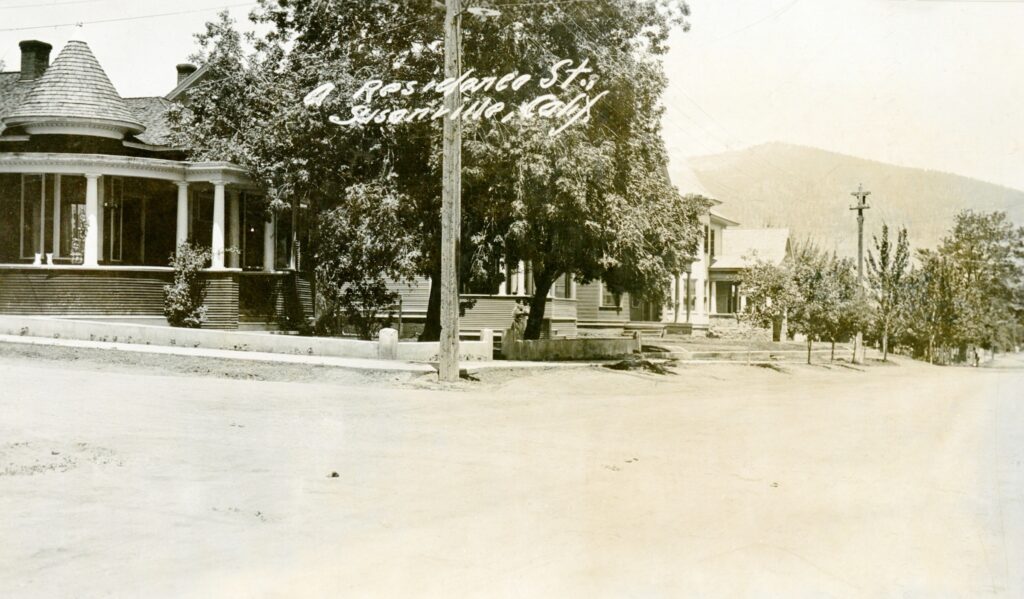
160 North Pine Street, Susanville

160 North Pine Street, Susanville, 1921–Lola Tanner

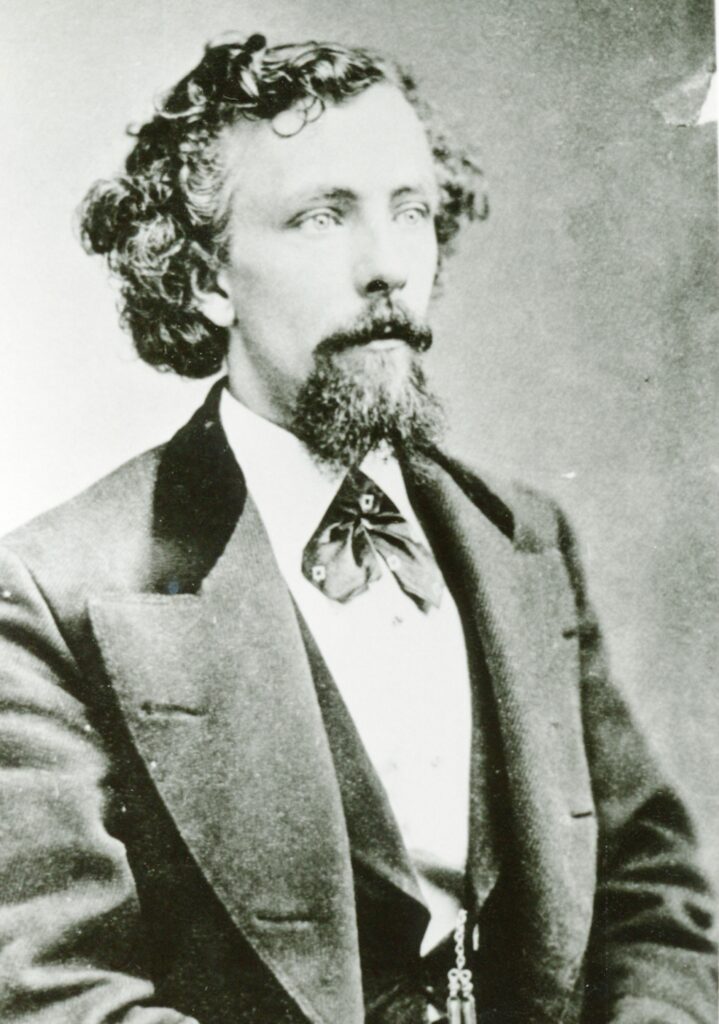
For the remainder of the month of August, I have selected a random bunch of photographs for the Tuesday Tidbit feature.. The house at 160 North Pine Street, Susanville is situated at the intersection of Pine and North Streets. It is so situated that the view from the house looks directly down North Street.  It was the original home of George B. Long and in the 1990s it was still owned by descendants.  Of course, something that is a century old does experience modification.  While that is the case with this residence, it still retains its original integrity.

Tim

Susanville as a Township

An 1886 view. Courtesy of Bud Lesser

Before the City of Susanville was incorporated, it went through its own evolution. First as a trading post, then a village. There were some citizens that were not pleased that the Lassen County Board of Supervisors dictated what the town could or could not do. Fire protection was a major concern, especially after the 1882 fire that destroyed a large portion of the town’s business district. The citizens wanted to form a fire protection district.  To do so, an actual township needed to be created with a set of boundaries and a population count. With proposed boundary set, Susanville’s first special census was enacted. On April 8, 1884 a census was held and revealed there were 586 inhabitants. Thus, the foundation was laid for what eventually would become the incorporated town of Susanville in 1900.

Tim

Susanville, August 6, 1915

The ruins of the Methodist Church and Emerson Hotel, August 6, 1915

On August 5, 1915 a devastating fire destroyed the Emerson Hotel, Hyer House Hotel and the Methodist Church. between Main and and Cottage Streets. The three-story Emerson Hotel would not be rebuilt. The Methodist Church on the other hand were able to salvage the burnt out hull of their building.

Methodist Church
The aftermath of the 1915 fire.

It would be a slow tedious process. Due to financial constraints the church did not want to take on any more debt. In 1917, the church was completed and fully functional. The one alteration was that the steeple was not replaced.

Methodist Church, 1905
Susanville’s Methodist Church, 1905

Tim

Roop’s Fort Explained

Roop’s Fort. Courtesy of Keston Ramsey

The application of “fort” to this landmark is somewhat of a misnomer. It had no military affiliation. It started out originally as a trading post on the Nobles Emigrant Trail.

In 1863, the abandoned structure became the focal point in the skirmish known as the Sagebrush  or Boundary War. The Honey Lakers fortified themselves in the log cabin during a short battle with Plumas County authorities. Hence the “fort” appellation. The building is sometimes referred to as Fort Defiance.

The so-called war was a political dispute between Plumas County officials and the residents of the Honey Lake Valley. At issue was who had jurisdiction  over the region—Nevada Territory or the State of California. While it was known that California’s eastern boundary from the Oregon border to Lake Tahoe was the 120th meridian. The problem was no one knew where it was. For a complete version see Sagebrush War.

Subscribe


Clampers Invade Susanville 40 Years Ago

Neversweat ECV528

On August 4, 1984 some 500 members of the fraternal organization known as E Clampus Vitus descended upon Susanville. The occasion was the chartering of the Neversweat Chapter #1863 of the E Clampus Vitus and the dedication of the Pioneer, the oldest establishment in Northeastern California. The organization has been around since days of the California gold rush, and was a spoof on the more refined fraternal organizations of the day. In the 1930s it went through a revival and focused on marking historical sites and having a good time while doing so. The Neversweat Chapter was not the first for Susanville, as a lodge existed in 1868. In the early 1880s there were several lodges in Modoc County.

Neversweats chartering festivities at the Pioneer, August 4, 1984.

Back to that day at hand, the Lassen Advocate summed it by reporting, “By 7:30 a.m. most area residents were awakening for breakfast and routine Saturday tasks, the revelry at the Pioneer was already in full swing. Clampers were 3 to 4 deep at the bar, the beer was flowing and festive mood in the air. The celebrants began arriving at 6:00 a.m. and spilled from the sidewalk into the eastbound lanes of Main Street. Traffic was undoubtedly light during the early morning celebration.”

Never miss a story, click here to support and subscribe.

The Pioneer On The Move Update

For several years prior to 1912, the Pioneer had a biergarten next door. Courtesy of Philip S. Hall

Earlier this year I wrote about how the Pioneer Saloon was moved from 722 Main Street to 924 Main Street. You can read about it here 

924 Main Street, Susanville, July 2024–Jim Chapman

I wrote how the building has been modified over the years. A reader wanted to know what it looks like today.

In 1902, Susanville passed Ordinance No. 17 that prohibited the construction of wooden buildings in the heart of the town’s business district–Main Street frontage buildings from Roop to Gay Streets. In 1912, the ordinance was amended to include all buildings to Weatherlow Street.

Tim


Susanville’s Distinct Southern Pacific Depot

Susanville Depot, 1914

Susanville’s Southern Pacific Railroad Depot on Richmond is unique in many ways. By the time the railroad reached Susanville in 1913, the company had already adopted a set of standard depot building plans.

In 1913, the residents wondered what kind of depot they would have. As far as the Southern Pacific  were concerned it would be a modest structure, since in their opinion, Susanville was a small community that had no industry.  A wooden 26 foot by 62 foot depot was built, being part passenger depot and part frieght shed. It opened to the public on September 14, 1913 with C.B. Morton’s the first depot agent.

Susanville Depot, 1970.

Times quickly changed and by 1921 Susanville boasted two large lumber mills—Fruit Growers Supply Company and Lassen Lumber & Box Company. The original depot was no longer able to meet the needs. In 1927, the Southern Pacific constructed a 75-foot addition and unlike other depots its exterior was stuccoed.

Depot 78
Susanville Depot, September 1978.

Times were rapidly changing, especially with the State of California’s ambitious highway construction plan. As automobile travel became the preferred mode of transportation, travel by train declined. In 1933, rail passenger service at Susanville was eliminated. In 1979, Southern Pacific closed the depot.

To Support Donate or Subscribe

Susanville City Council’s Pay Day

Flora Neuhaus, served as Mayor of Susanville, 1926-27–Phyllis Beard

For over three decades since the founding of the City of Susanville, the council members were true volunteers. Serving in such a position can be a thankless job at times. In 1936 it was the topic at hand. On April 14, 1936,  voters not only were asked to vote for two new council members, but whether the city the council members should receive some form of minimal compensation for their time and effort.  Of the 141 votes cast, it was approved to pay the council members with 82 yes; 53 against and 16 who declined to vote on the issue. The mayor would receive a sum of $30 a month and members of the council $20 a month.

To Support, Please Subscribe 

It Was Hot In 1931

Susanville, circa 1936

It has been toasty warm around these parts in July. It should be noted the summer of 1931 was of Susanville’s hottest and driest on record. A heat wave lasted nearly two months, with little respite. In July and August, only eight times did the high temperature dip below 90. In July there were nine consecutive days when the high was over 100. On July 19 and 20 was it ever hot, both days registered 106. It was also dry. On June 16th .03 inches of precipitation fell. Not another raindrop fell on the town for the next four months, until October 17th when .30 inches was recorded.

In cae you were wondering the first week of July 1876, incidentally witnessed Susanville’s hottest ever recorded temperature–108 degrees–and it was reached on three different days.

Tim