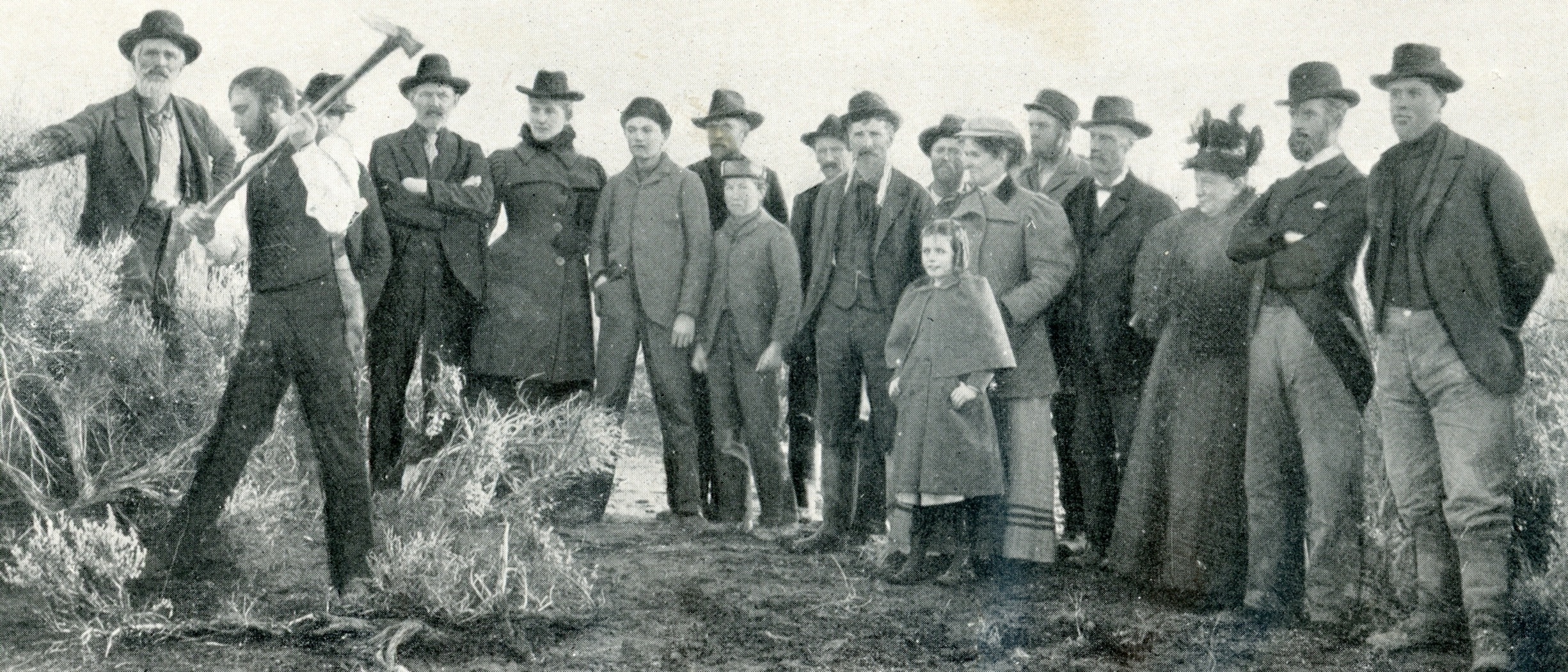
It being the second to the last day of the year, I little “housekeeping” is in order. While earlier in the year I wrote about the Standish townsite dedication held on February 5, 1898. It was my intent to use the above photograph. Nancy Johnston Chappuis was able to identify nearly everyone of the ceremonial cutting of sagebrush at Standish. So for historical posterity here is that information.
Cutting the sagebrush is William E. Smythe. Standing behind left to right Ben Leavitt, Hi McClellan, Gertrude McClellan, unknown, Jim Elledge, Homer McClellan, A.E. Torrey, Harriet Torrey, unknown, unknown, Mrs. Dunn, H.R.T. Coffin, and Robert Barham.
If Standish were to have a sister city, it would be New Plymouth, Idaho located in the Payette Valley of southwestern Idaho. Both communities had the same founder, William E. Smythe of the Associated Colonies of New York.
Established in 1895, Smythe noted the Plymouth Colony of Idaho will be the model of communities to be established hereafter. Its plan was made by the President of the Associated Colonies, with the co-operation of men of the largest practical experience in western life. Two years after its founding, the official head of Plymouth Colony writes, “We have not a single colonist who is discontented, or one who regrets that he located here.”
New Plymouth’s was a fairly successful venture. While its counterpart Standish was not. The Associated Colonies expended large sums at Standish and was forced into bankruptcy in 1901, thus ending the colony system.
The Cover of th 1897 brochure The Standish Colony in the. Highlands of California.
Since it is Thanksgiving, how appropriate to note one of the best known pilgrims of yore-Myles Standish—for whom Standish, California is named for. The founders of Standish did not quite follow all the Puritan beliefs. They took a little here, a little there. The main goal was for everyone in the Standish community to be self sufficient. They noted in the above publication, what a standard diet consisted of from examining a bill of fare published in San Francisco. Every item on the menu for breakfast, supper (i.e. lunch) and dinner could be raised in the Honey Lake Valley, with the exception of coffee and tea.
Since this is holiday where food is an integral here is the menu for a typical supper (.i.e dinner) meal. Mushrooms and Sweatbreads in Chafing Dish; Cucumber sandwiches; Compote of Pears; Layer Cake; Cheese and Tea.
The nation’s colony movement of the 1890s gained great momentum with experimental communities—Greeley, Colorado is a prime example. The target audience to attract settlers were people who lived in the urban centers east of the Mississippi and the enticement of living in a healthier environment.
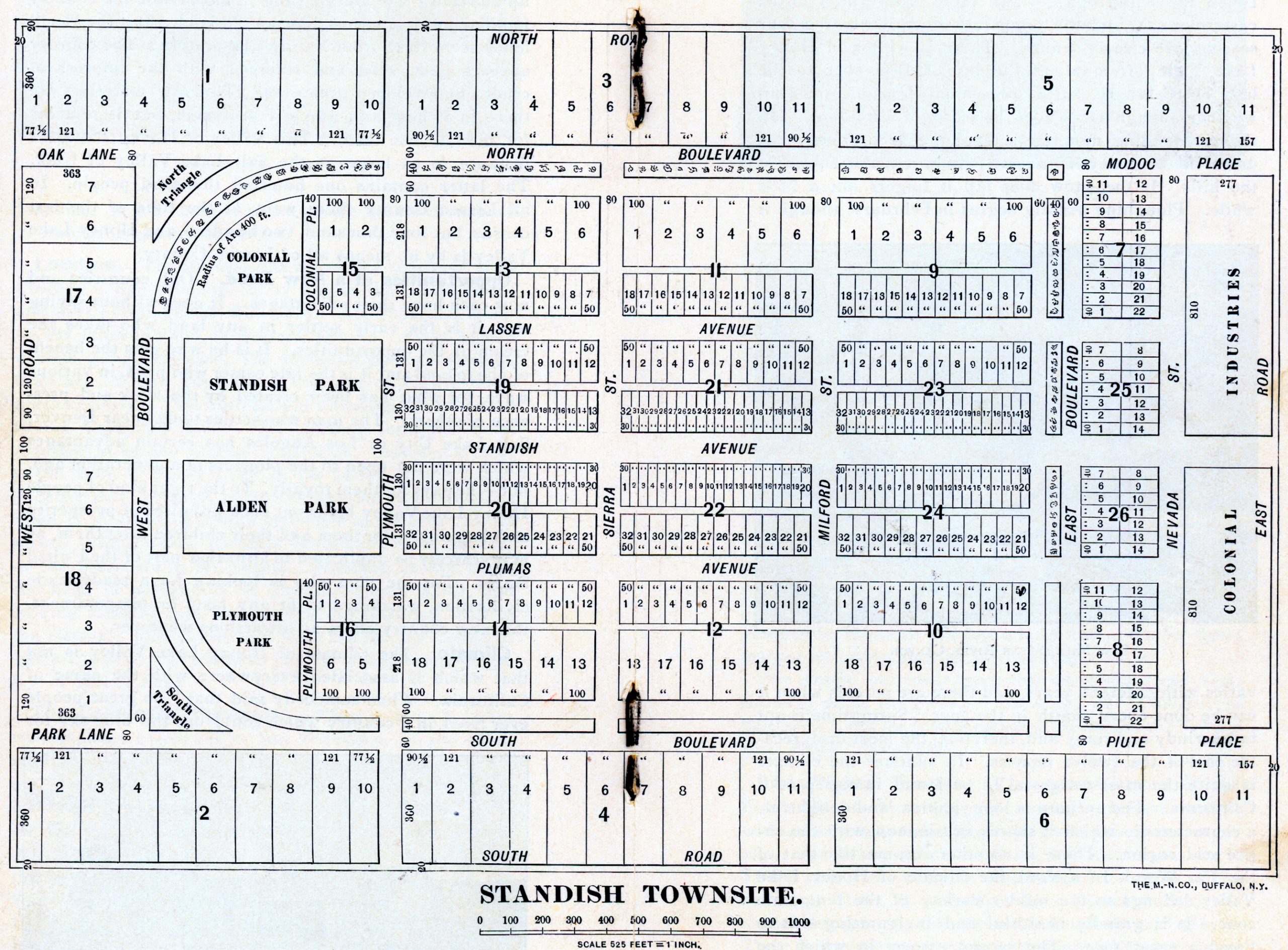
Associated Colonies of New York planned for Standish to be centered around what they referred to as the Farm Village. It was the concept of agricultural European communities, where everyone resided in a village and during the day ventured out to work their farm property. This is what the Associated Colonies referred to as the Blessing of Neighbors. Instead of living on an isolated homestead, far from a another soul, they believed in the immense benefit of the social interaction that a farm village would provide. In turn, with the village, this would create a school, library, social activities and so forth. Unfortunately, there were difficulties at Standish from its earliest years, which forced Associated Colonies to abandon this endeavor.
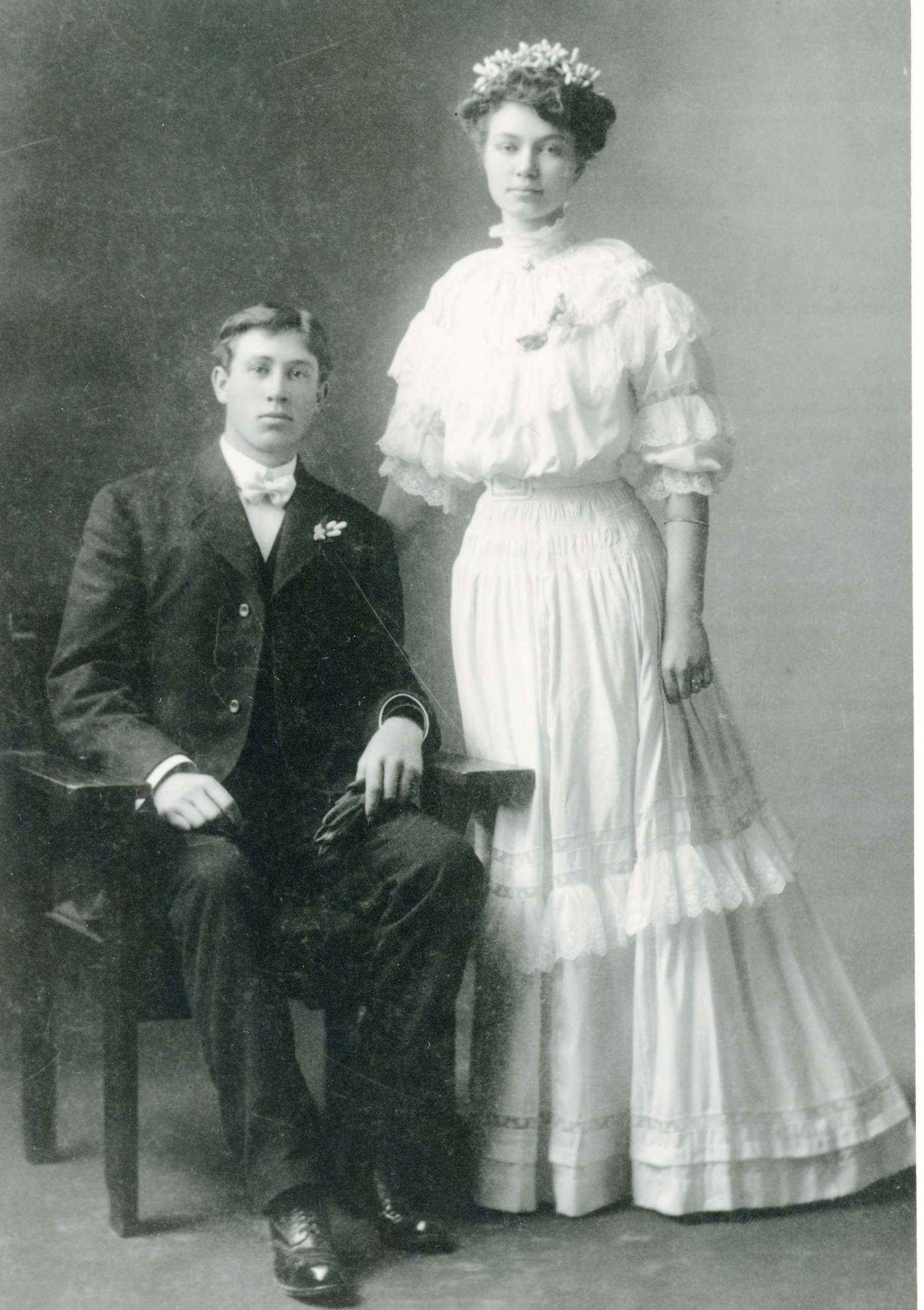
Ed & Nancy (Johnston) Chappuis, 1906–Betty B. Deal
Someone recently wanted to know who Chappuis Lane was so named. The Chappuis family operated a ranch along the Susan River, where the lane passes through.
In 1890, Frank Johnston filed a 160-acre homestead at that location and in 1893, moved his family there. In 1906, his daughter Nancy married Ed Chappuis. For many years it was known as the Johnston & Chappuis Ranch. After the passing of Frank Johnston in 1909, his Fred Johnston, along with Ed & Nancy Chappuis carried on. In 1951 the ranch was divided, with Nancy Chappuis retaining her father’s original ranch. Nancy and her sons—Evan, Ray and Leo—carried on for many more decades. (It should be noted that Ed Chappuis passed away in 1943).
Over a century ago, it did not take much to form a corporation. Many of the Articles of Incorporation consisted of two pages. In the Lassen region numerous small companies incorporated and by today’s standards many would be deemed a non-profit. This was the preferred method then to raise money by the sale of stock. Some ventures succeeded, while others did not.
Take for instance in 1899 a group of local leaders formed the Susanville Hall Association. This they thought was needed since there were no public halls. It was their goal to sell $5,000 in stock. They did not succeed and their initial offering only netted $450.
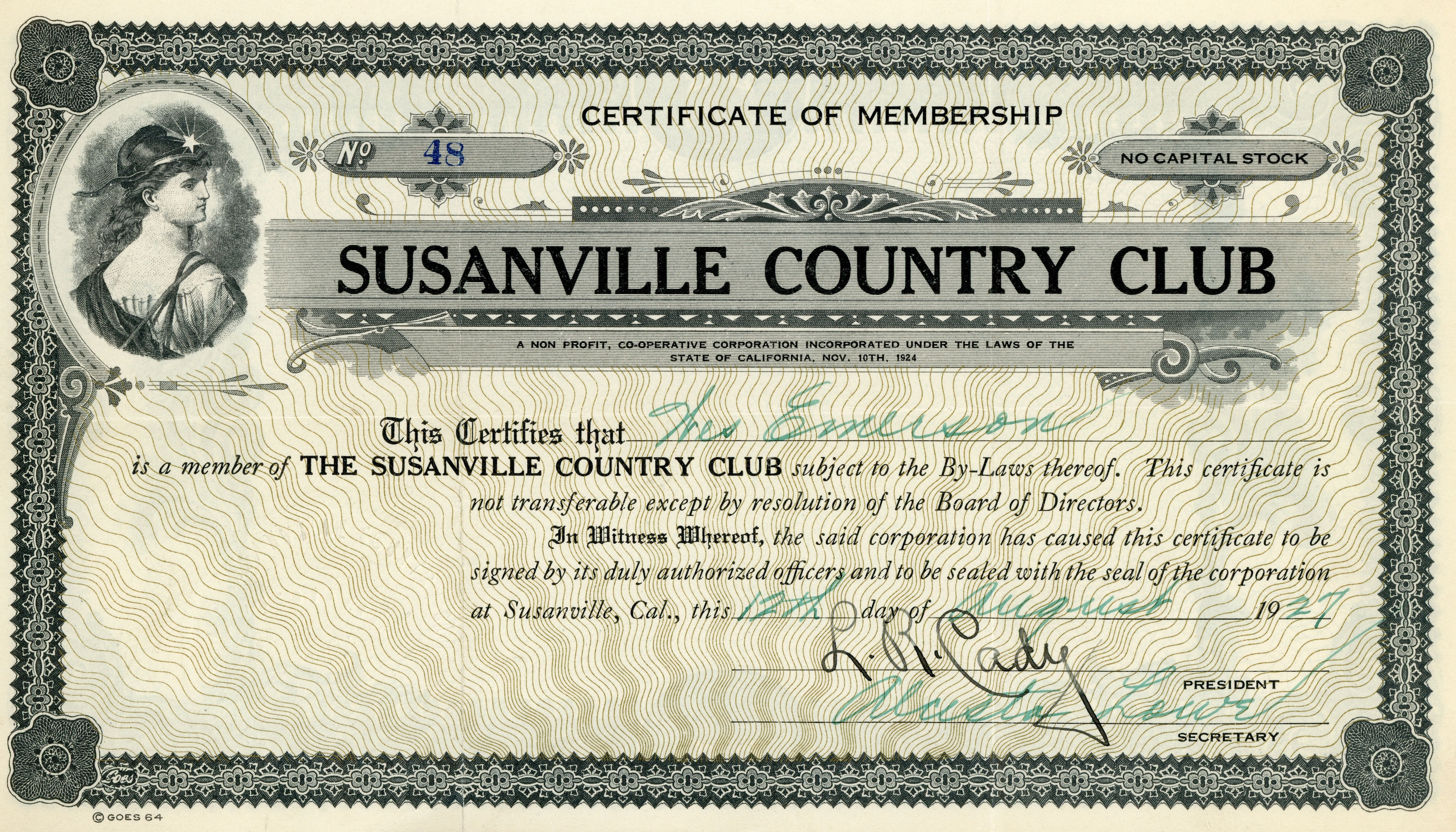
Stock certificate courtesy of Dick and Helen Harrison
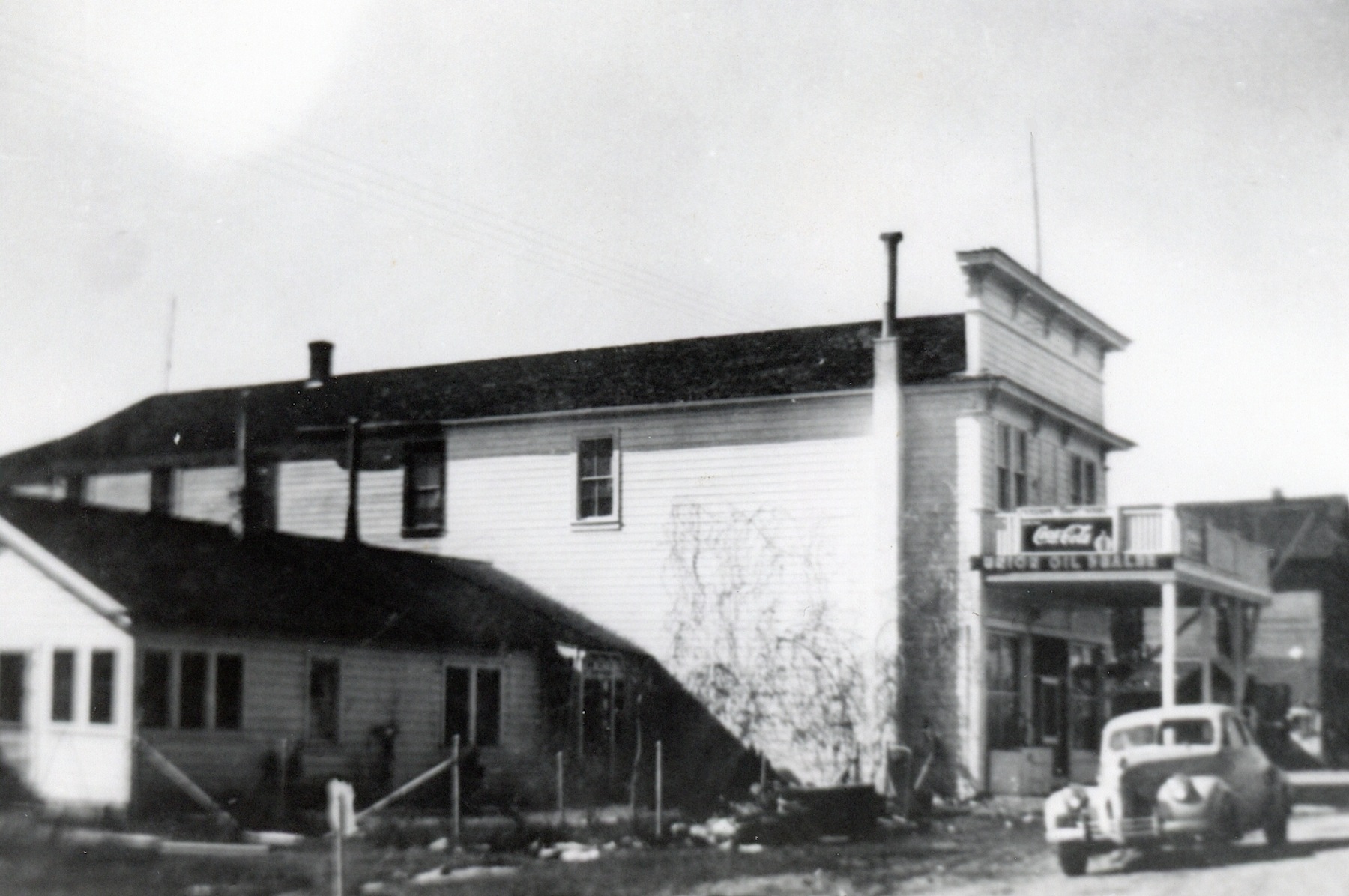
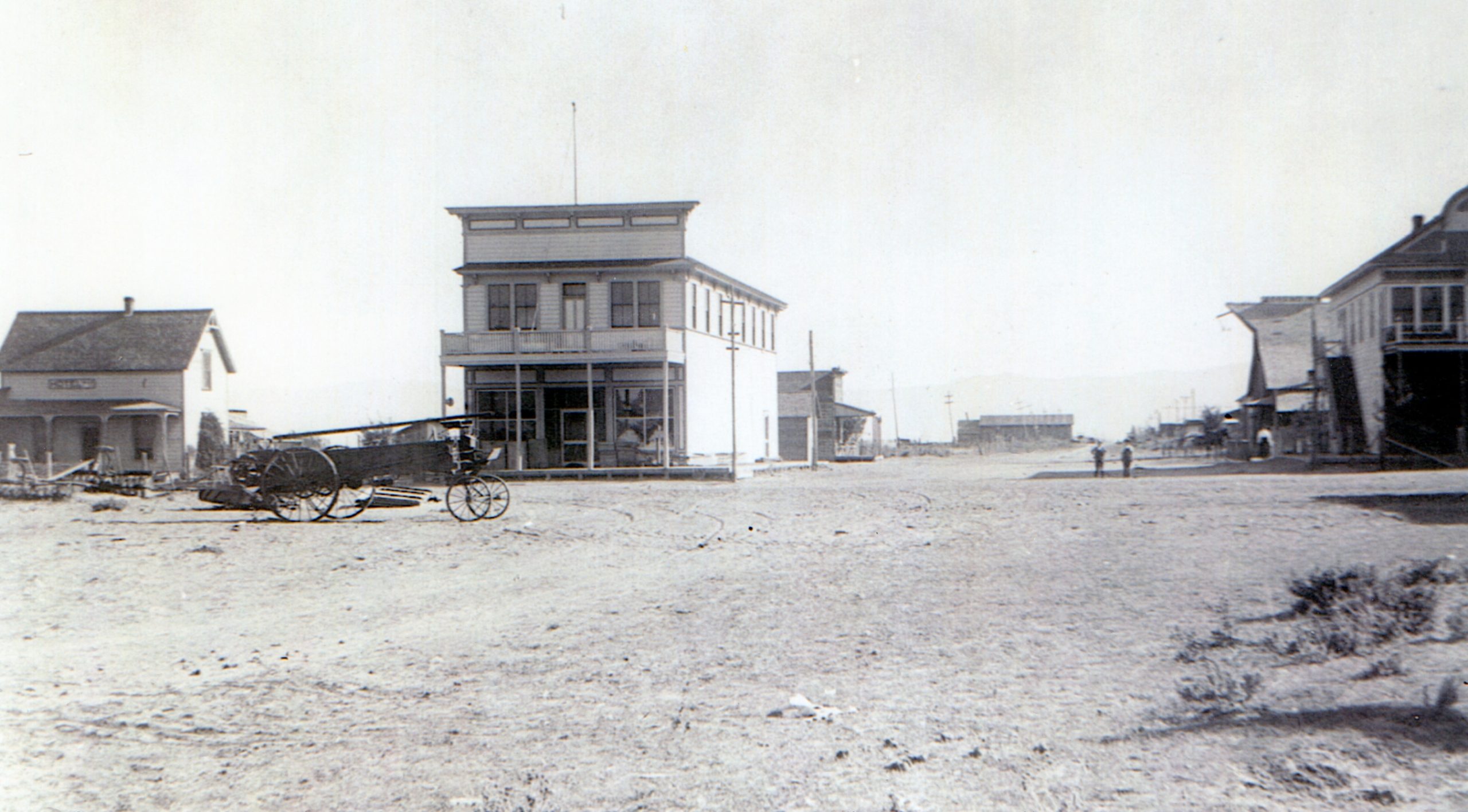
In 1908, the Standish Hall Association was successful. Seasoned residents will know the building as the former Neil’s Mercantile. It is the vacant two-story building on Highway 395 and to the west is the Wayside.
The Standish store, no date. Courtesy of Camilla Moody.
By the 1920s, the practice of forming small corporations was declining. The Susanville Country Club that purchased the Wingfield Estate was successful and then there was the Susanville Hotel Company, i.e., Hotel Mt. Lassen that turned into a messy affair.
By 1900, Standish Colony was not developing the way the founders envisioned. However, Buntingville merchant, Mike Phillips, from across the valley saw potential at Standish. He closed up shop there and moved to Standish.
Phillips first order of business was to open a store at Standish. Then he became the principal figure to organize the Standish Creamery. That was followed by building the town’s first hotel. When Phillips was at Buntingville he established a newspaper Buntingville Breezes. In 1903, he made an unsuccessful attempt to establish a newspaper at Standish.
In 1904, for reasons unknown, he sold his Standish properties. A.E. & Harriet Torrey bought the hotel. It should be noted that Harriet was Standish first postmaster. The creamery and store was sold to Susanville businessman Charles Emerson. Phillips relocated to Reno Nevada and never heard from again.
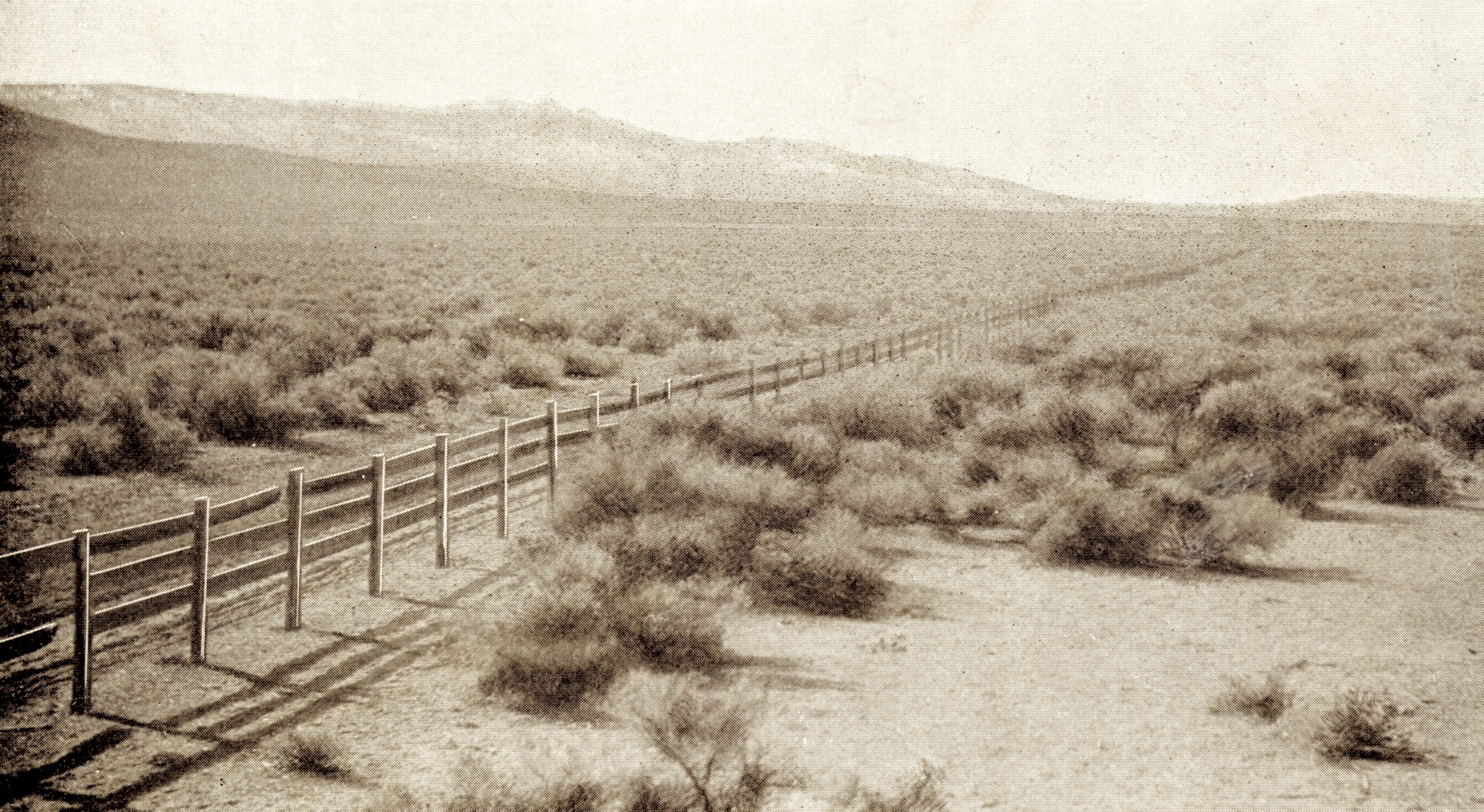
The Standish townsite prior to clearing the sagerbrush, January 1898
A lot of planning went into Standish Colony, and the selection of the townsite was no exception. Some of the initial work in late 1897, early 1898 was conducted by H.R.T. Coffin and Tom Barham. They had a vague idea where it might be located. Their task was to poll the area residents about a prohibition clause that would be included in the deeds. It was simple that no intoxicating liquors be manufactured or sold, and if a person violated the clause the property would revert back to the Associated Colonies.
It was Albert Halen, the civil engineer for the colony to make the final decision for the location. He selected a 240-acre site, where the Susanville-Datura stage line dissected through the middle of the townsite—known today as U.S. Highway 395 North. On February 5,1898 various members of the Standish Colony gathered at the future townsite. William E. Smythe, one of the founders of the Associated Colonies did the ceremonial cutting the sagebrush there.
In June 1898, the Associated Colonies published a small booklet “The Standish Colony in the Highlands of California. It contained this description: “The village site of Standish is located on high ground and enjoys fine, natural drainage. The sagebrush has been cleared and the streets and parks laid out in accordance with the beautiful Plymouth plan. The Colony homes will command views of splendid mountain pictures in all directions—to the east, beyond the blue sheen of Honey Lake, the towering Hot Springs Mountains,; to the north, brown heights of Shafer’s Peak and the picturesque defile which Willow Creek flows down to the valley and lake; to the south, Diamond Mountain and its sisters clothed in dark forests crowned with snow; to the west, the higher Sierras with that great Sentinel of the north—Lassen Butte—holding eternal vigil over the Sacramento Valley, on one side, and Honey Lake Valley, on the other.”
In 1891, William E. Smythe was involved with the National Irrigation Congress, which opened doors to him. Smythe’s interest was irrigation/reclamation issues of the American West. He then formed the Associated Colonies as a venue to promote his vision. This colony movement was based a lot on the Puritanical beliefs of New England. In 1895, they founded a colony at New Plymouth, Idaho.
Smythe was intrigued with the Honey Lake Valley and its many failed irrigation projects. In 1897, he planned for a colony there to be known as Standish. He was even able to secure Edward Purser’s Susan River Irrigation System, which included the reservoirs of McCoy, Hog and Leavitt. It would be an interesting experiment that we will explore in future installments.
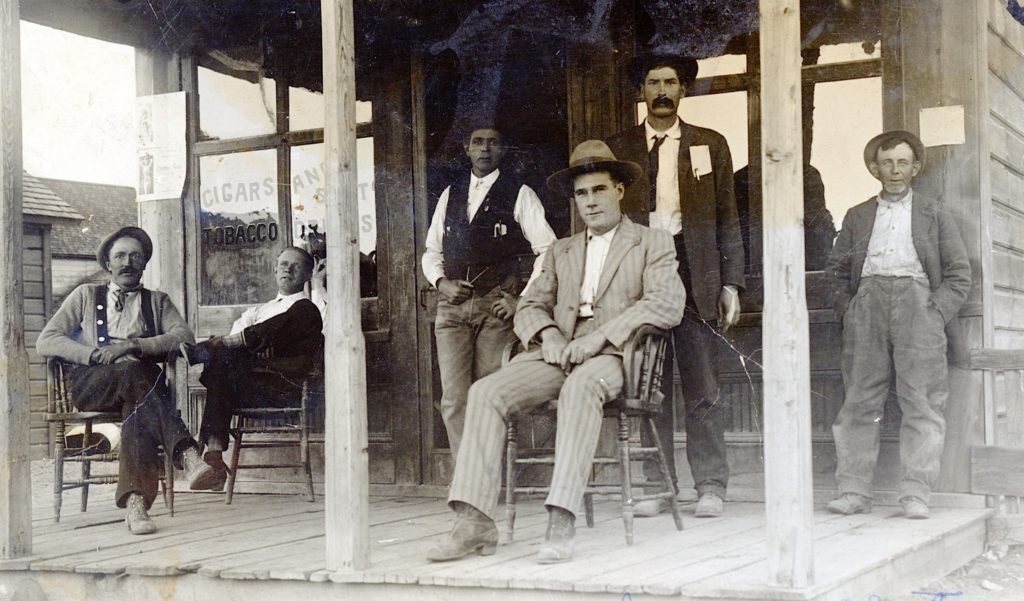
Dobyns Saloon—L-R Seated, Leslie Cottingham, Garfield Vogt, Roy Hopkins—Standing L-R Unknown, Unknown, Shorty Roe, 1907–Betty Barry Deal
During the planning stages of the Standish Colony in 1897, numerous issues were addressed. One, it would be a “dry” town and deeds would include a covenant restricting the use, sale or manufacture of intoxicating liquor. However, things changed quickly, after the initial construction of the town of Standish. The organizers of the Standish Colony were beset with numerous problems, and financially struggled. In 1901, the Standish Colony went bankrupt, a major milestone for the fledging town. No longer under tight control from the town’s founders, Standish went into a boomtown stage.
There were other changes on the horizon. A part of the old Wild West era was coming to end, in which one could randomly open a saloon. Lassen County adopted an ordinance, that to operate a saloon one had to apply for a county liquor license.
In December 1906, Susanville resident, Henry C. Dobyns submitted the necessary paper work to Lassen County for a liquor permit to operate a saloon in Standish. Among the documents included was. petition signed by 15 registered voters of Standish. At the January 2, 1907 Lassen County Board of Supervisors meeting they approved Dobyns license. By the end of the month Dobyn’s “Tipton Saloon” was opened for business in Standish.
There was a lot of resentment in the Standish community having a saloon. It was just a matter of time before things got ugly. On September 5, 1907 James Wood and N.B. Elledge filed a complaint with the county board of supervisors that Dobyns was not in compliance. They cited that not only underaged children of 18 had been served alcohol, but also allowed to loiter there. Then there was the issue of selling alcohol to Indians, who then became inebriated and causing havoc in the community. On September 21, 1907 a hearing was held with testimony from ten Standish residents about how the business was conducted in a disorderly and indecent manner. After all was said and done, the board revoke Dobyn’s license and gave him to the end of the month to close the saloon.
 It being the second to the last day of the year, I little “housekeeping” is in order. While earlier in the year I wrote about the Standish townsite dedication held on February 5, 1898. It was my intent to use the above photograph. Nancy Johnston Chappuis was able to identify nearly everyone of the ceremonial cutting of sagebrush at Standish. So for historical posterity here is that information.