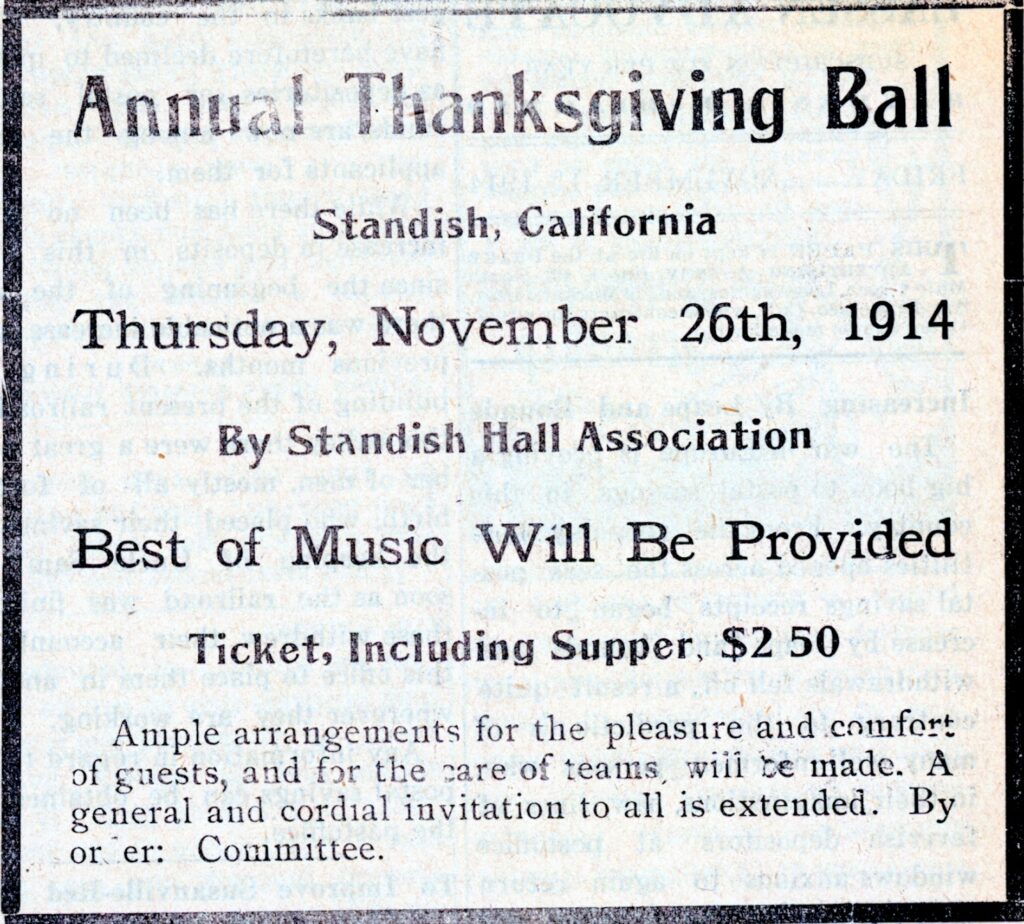
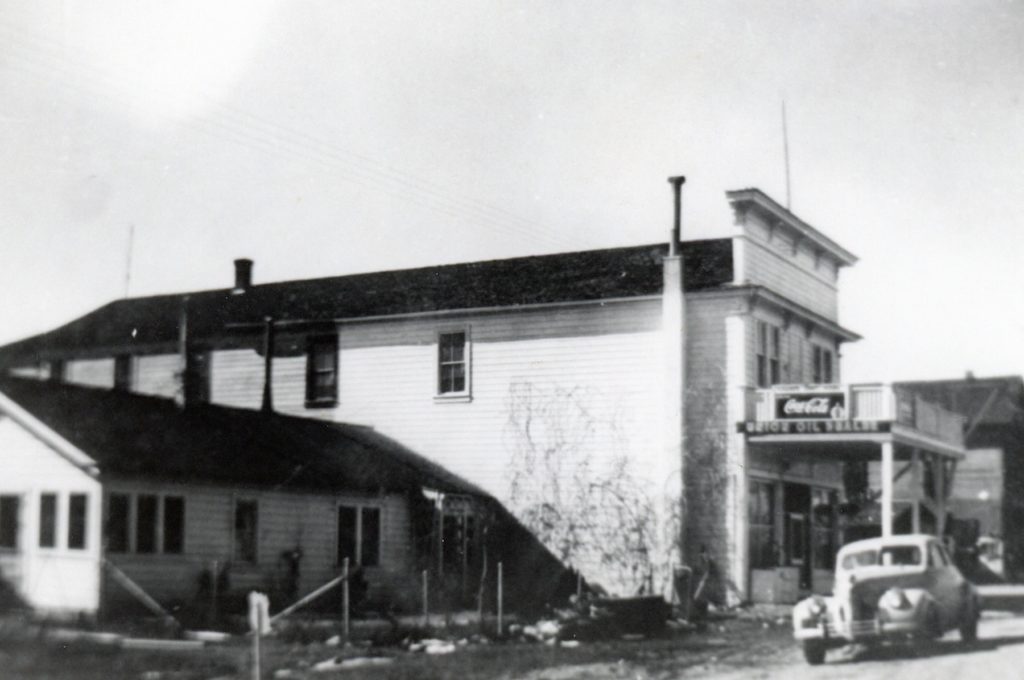
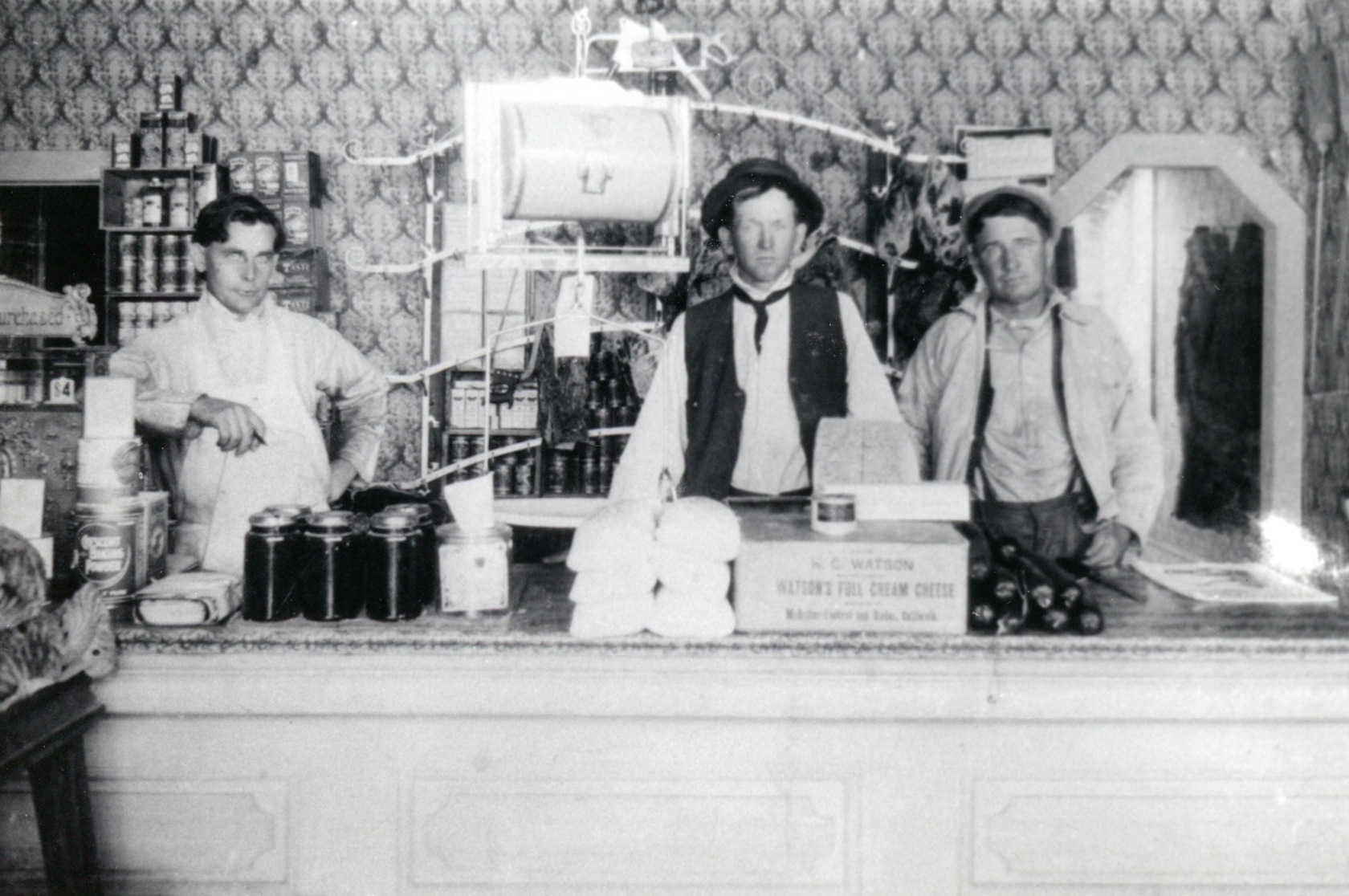
A major fundraiser for the Standish Hall Association was its annual Thanksgiving Ball. The Association owned a two-story building in that community, and a prominent one at that. Seasoned residents will remember as Niel’s Mercantile. Built in 1907, the second story was a hall that many organizations utilized. The first floor was rented to a commercial enterprise to assist with payment and upkeep of the building.
Niel’s Mercantile Standish,, no date. Courtesy of Camilla Moody.
The Association reported that the ball was a successful event, both in terms financially and socially. Standish was gaining notoriety for its social scene, as the Odd Fellows Lodge would be holding a Christmas Ball next month.
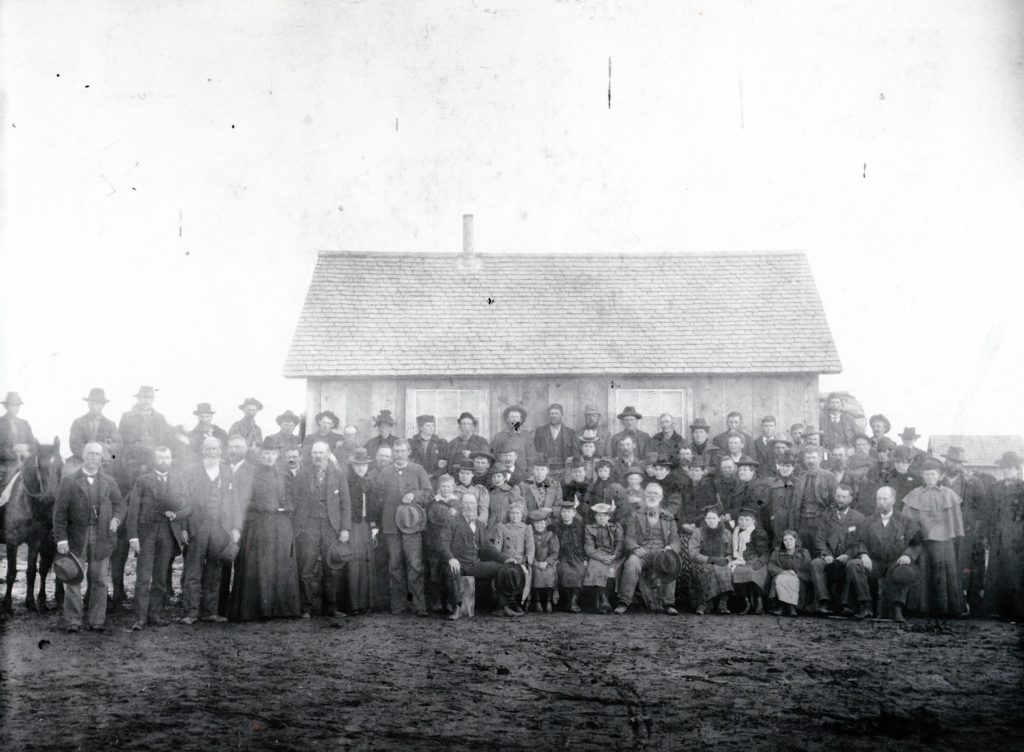
Members of the Honey Lake Valley Colonial Club assembled in front of the Honey Lake School, at Datura, 1897. Courtesy of Betty Barry Deal.
In 1898, was the groundbreaking moment for planned utopian community of Standish. Its founder, William Smythe envisioned it based on the religious beliefs of Myles Standish and economic structure promoted LDS leader Brigham Young. Smythe believed that people desired to escape the industrial cities of the East, for a more simple life in the West. Water was to needed to irrigate the land. so the Standish Colony purchased the Susan River irrigation system, which would be its downfall. The colony did entice a few New England transplants to Standish who introduced a new plant to the region, which is enjoyed by many each spring for its fragrant blossoms–lilacs.
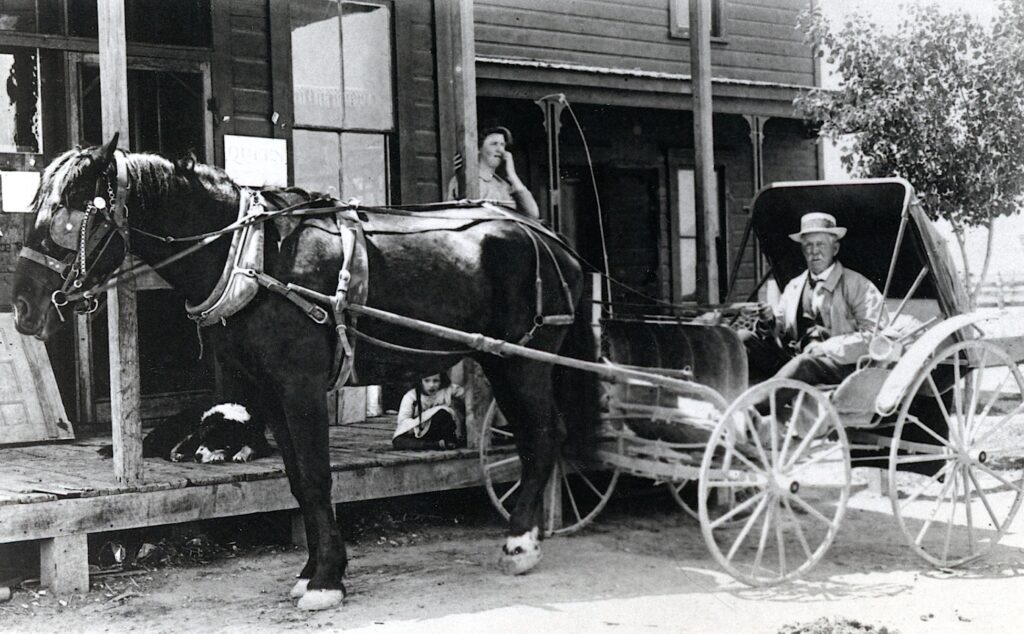
Ben Leavitt in his buggy in front Vic Perry’s store Standish, circa 1908. Leavitt was one of the first settlers Buggytown–Betty Barry Deal
Note: This post originally appeared 22 February 2023. At that I time I used the 1889 photograph of the Buggytown Ditch, because I misfiled the above buggy photograph.
No doubt you never heard of it. It was not named for pesky insects or pushy people either. An irrigation ditch was named as such, too. Buggytown, in its unique way was not even a town, but more like a sprawling affluent neighborhood in the late 1800s, located to the west of Leavitt Lake.It was so named as one of the first settlers possessed a buggy when such luxuries were rare on the frontier. It would later become known as Clinton, which consisted of a store, post office and the Riverside School. In 1973, it was transformed when the first phase of the Leavitt Lake Subdivision began.
Survey crew to enlarge the Buggytown ditch near Johnstonville, 1889. Courtesy of Betty Barry Deal
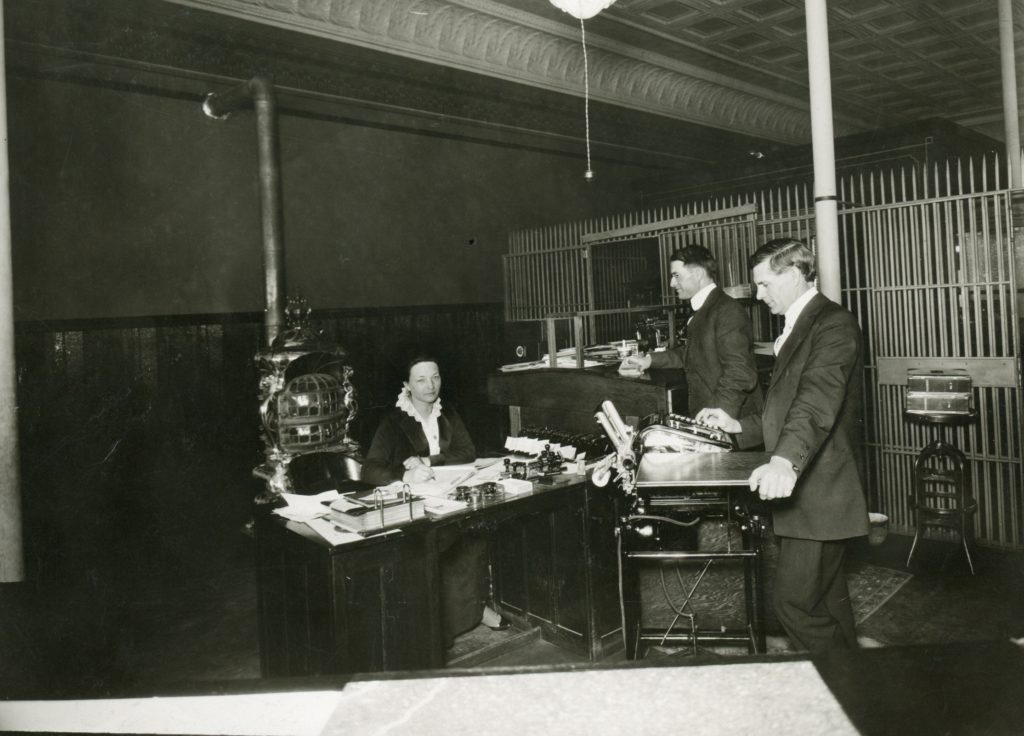
Standish Branch of the Bank of Lassen County inside the Wrede Hotel
For a time, Standish was a very prosperous community in the Honey Lake Valley. Not only did it have numerous businesses, but a hotel, and a creamery, too. Everything was so good, in fact, that it even had its own financial institution.
In 1892, the Bank of Lassen County was established in Susanville, the first of its kind in Lassen County. In the spring of 1915, the bank announced it was going to open its first branch in Standish. However, it encountered some delays, especially with the installation of big safe, inside the Wrede Hotel, where the branch office would be located. On August 30, 1915, the branch opened with W.H. “Wally” Fulton, as the manager. Fulton had a long association with the financial institution, and equally important was well-known in the Standish region, having been married to Kathryn Mapes. The Standish Branch operated for ten years, closing its doors on December 31, 1925.
Wally Fulton later moved to Susanville and in 1933 became the City’s Treasurer. He remained in that position until his untimely death in 1941 by suicide. He used a gun in the city vault, and waited until the noon whistle from the Fruit Growers mill to mute the sound of the gun shot.
Never miss a story, click here to support and subscribe.
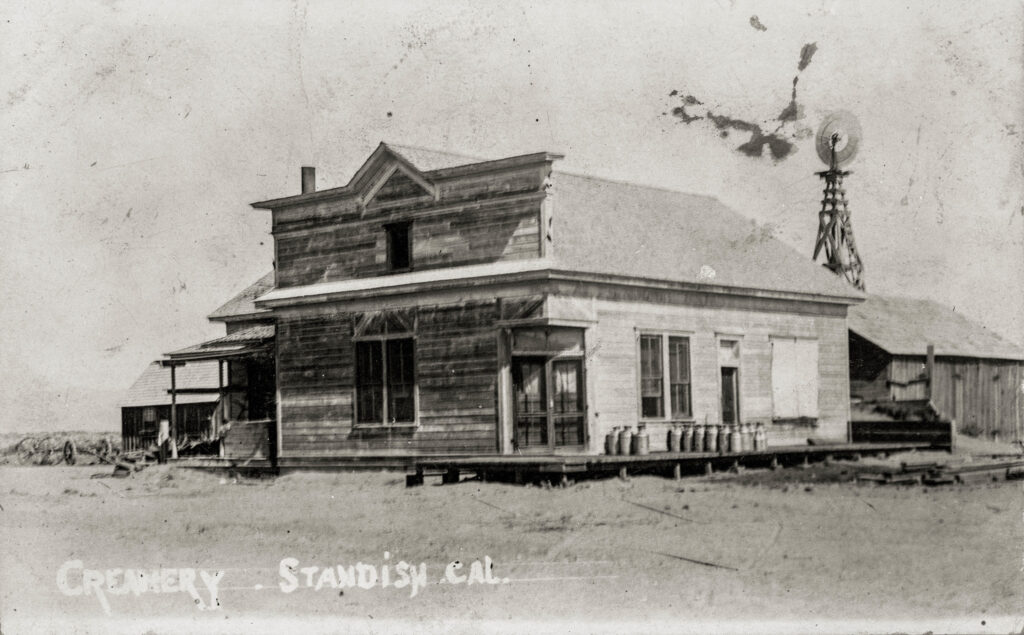
In the past, I have written snippets about the Standish Creamery, so now a complete version. In 1898, Standish was founded as a utopian community based on the belief of Myles Standish. In beginning all worked well. By 1901, the Associated Colonies of New York, backers of Standish filed for bankruptcy. With that entity removed it allowed the community to grow without the former’s restrictions.
In 1901, Buntingville merchant Mike Phillips relocated from the west side of the Honey Lake Valley to Standish. One of his many enterprises at Standish was the establishment of a creamery. In 1904, Phillips for unknown reasons sold his various businesses there and moved to Reno. Susanville businessman, Charlie Emerson bought the creamery
In 1916, Emerson boasted that his creamery had the only pasteurized milk in Lassen County. It should be duly noted that California State Law required all milk to be pasteurized.
In 1929, the creamery was destroyed by fire and not rebuilt.
Before there was the Great Depression of the 1930s, there was the 1893 Depression. The recovery from the latter was a slow process. Take for instance, the NCO Railroad remained stalled at Amedee for most of the 1890s. It was not until 1899 that the railroad finally began to extend its line northward to the Madeline Plains.
Standish, 1910–Prentice Holmes
The utopian community of Standish floundered since its beginning in 1897. While company officials stated their goal was to take a slow course, that proved disastrous. In 1901, Associated Colonies the organizers/promoters of Standish went bankrupt.
On the surface in 1900-1901it looked like was Susanville booming. Four major brick buildings were constructed, but that was partially in response to recovery of a major fire in June 1900 that took a huge chunk of the town’s business district.
One area that looked promising were the proposed railroads. There was the Marysville- Susanville Railway, the Oregon Short Line to name two. While the so-called paper railroads never materialized, they did have surveyors in region, thus adding to speculations.
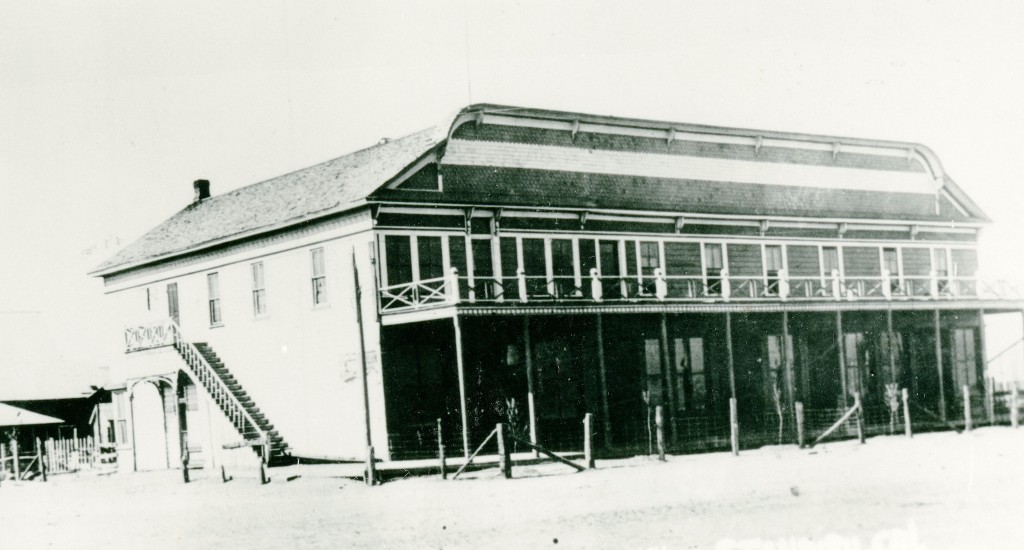
One of the first buildings constructed at Standish was known as Pringle Hall when it was built in 1898 by James Pringle. Upon the completion of the hall Pringle joked that it was his Opera House.
In 1905 Pringle began a complete renovation of the hall. He converted it into a hotel and enlarged the structure by quite a bit. The renovated building had a frontage of 86 feet and a depth of 60 feet versus the original dimensions of a 60 foot frontage and a depth of 30 feet. The first floor contained a store, restaurant and a branch office of the Bank of Lassen County. In 1908, Pringle sold the hotel to Frank Wrede for $2,772.05, the amount he owed on the mortgage. Wrede continued with the hotel for the remainder of his life, though by the 1930s, the hotel rooms received little use.
Standish Branch of the Bank of Lassen County inside the Wrede Hotel
In the summer of 1937, Virgil McClure (Wrede’s son-in-law) announced his intentions to tear down the Wrede Hotel and replace it with a restaurant and bar. For whatever reason, he procrastinated and did not do the demolition until the fall of 1942. McClure, however, never carried out his original intention and it remained a vacant lot for many years.
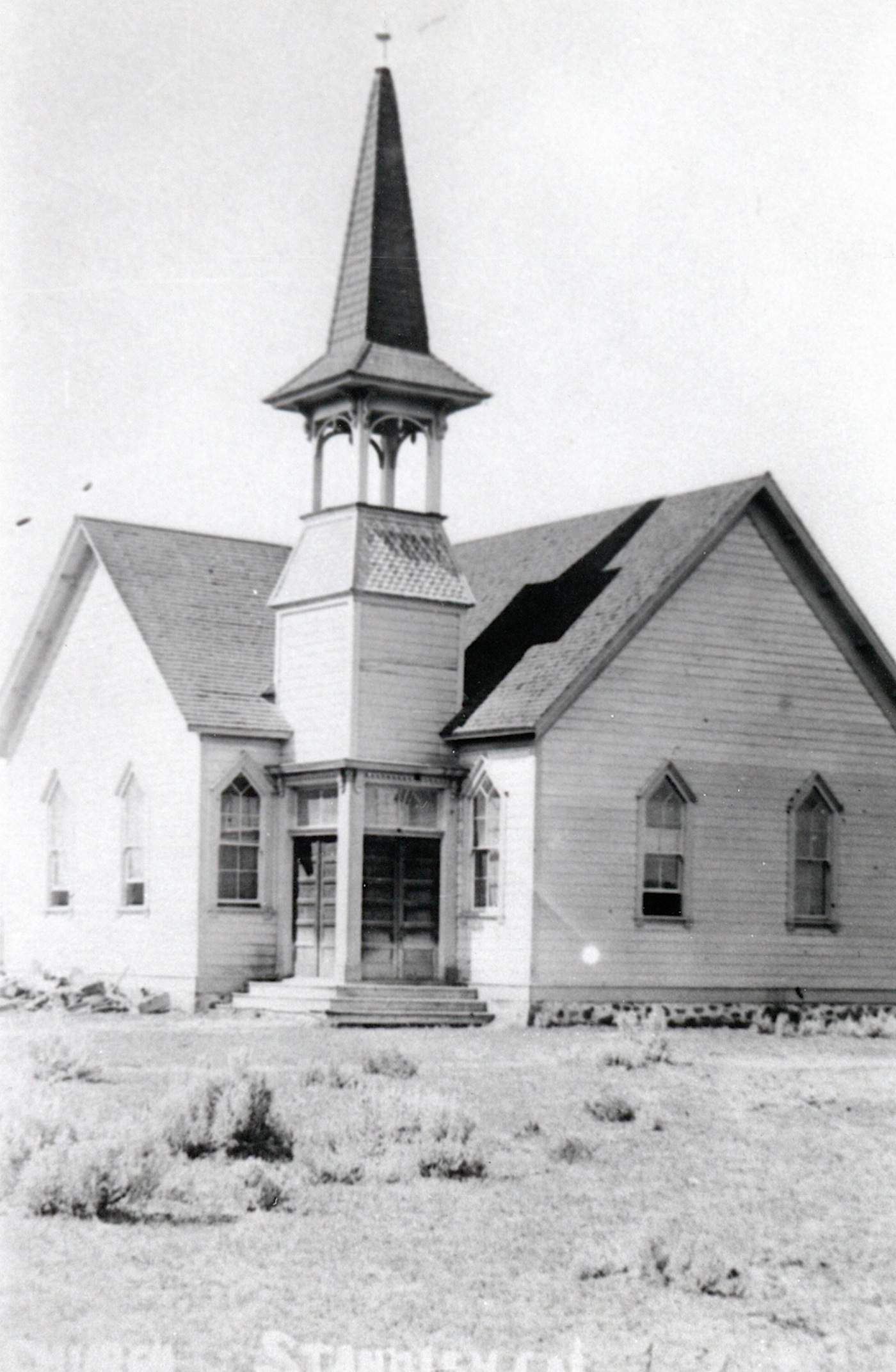
During the early years of Standish religious services were held in Pringle Hall, By 1903, the Methodist wanted a church for Standish. Frankie Coffin remembers her mother, Mrs. Eva (Hartson) Cain and Mrs.H.R.T. Coffin went to house to house in that part of the valley to raise money for the church.By September 1903 enough subscriptions had been raised to build the church. It was constructed by James Pringle and John Hamilton and completed in the spring of 1904.
On June 12, 1904, dedication ceremonies were held for the new Methodist Church at Standish. A sermon was given by Rev. E.W. VanDeventer, Superintendent of the Nevada Mission. A fund raiser was held afterwards and raised enough to money pay all debts associated with the construction and extra $30 paid for chairs for the church. The Rev. C.G. Lucas was the first pastor, who was stationed at Janesville. He would do a circuit holding services at Standish, Milford and Doyle.
By the late 1920s, church membership declined and for a number of years no services were held. In 1938, saw revival and the Methodist Church at Standish was back in operation. How much longer it remained I do not know. Today, it is known as the Standish Bible Church.
Emerson’s Store, Left to Right, Bill Lewis, Jim Mapes, Todd Hemler, 1916. Courtesy of Prentice Holmes
This is a bit different, I came across an interesting display advertisement in the Lassen Advocate for Charles Emerson’s store. The store’s motto by the way “We Are Here to Stay.” By 1907, Emerson’s enterprise included his hotel and store in Susanville, as well as a store and creamery in Standish. Below is the ad copy, I found it amusing, may be its a personal taste.
”The mummy aint had no fun fer more’n than five thousand years.” Moral: Don’t be a mummy.
Probably what you need right now is a pleasurable vehicle. We have lots of them and want to get vid of ‘m all. (Old Man Studebaker told us confidentiality we could have a few more when we paid for these.)
Your best girl or your mother-in-law may be pining for fresh air. Our mission in life is to separate you from your wherewithwall so if you want anything with wheels we can make a quick trade—Emerson.
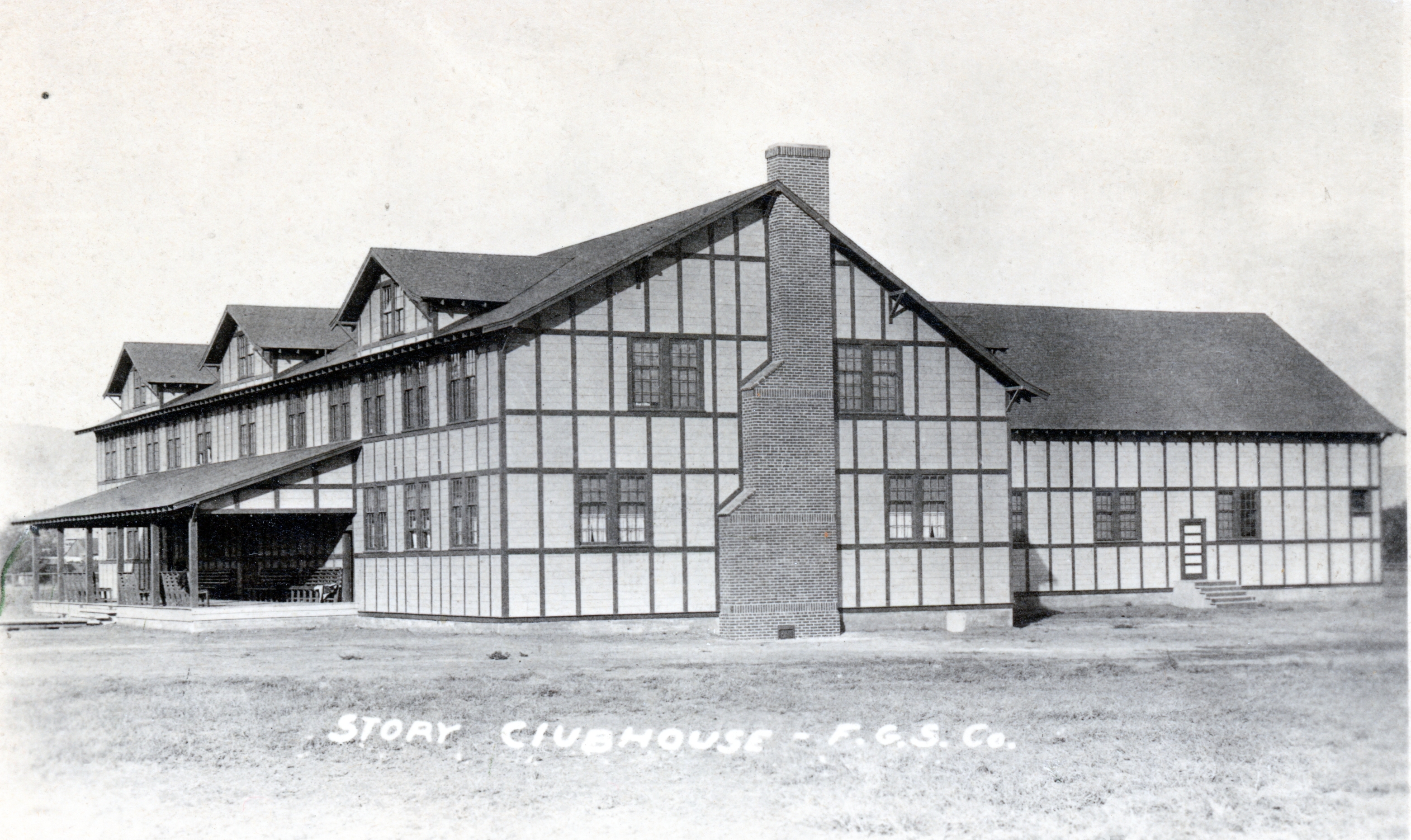
The following is an account from the Lassen Mail about the local festivities. It included a dance held at Standish, at the Cindercone, which is still standing. The reference to the Story Club, is now the site of Susanville’s Riverside Park.
”Local residents ‘painted the town red’ here Monday evening to usher in the New Year with all the fitting and time honored customs and ceremonies.
”Three dances held, at Standish, the Commercial Hotel and the Story Club furnished ample entertainment to many while many private parties and ‘functions’ were organized to aid in the general whoopee. The public dances at Standish and the Commercial were well attended as was the more formal event of the Elks Ball at the Story Club.
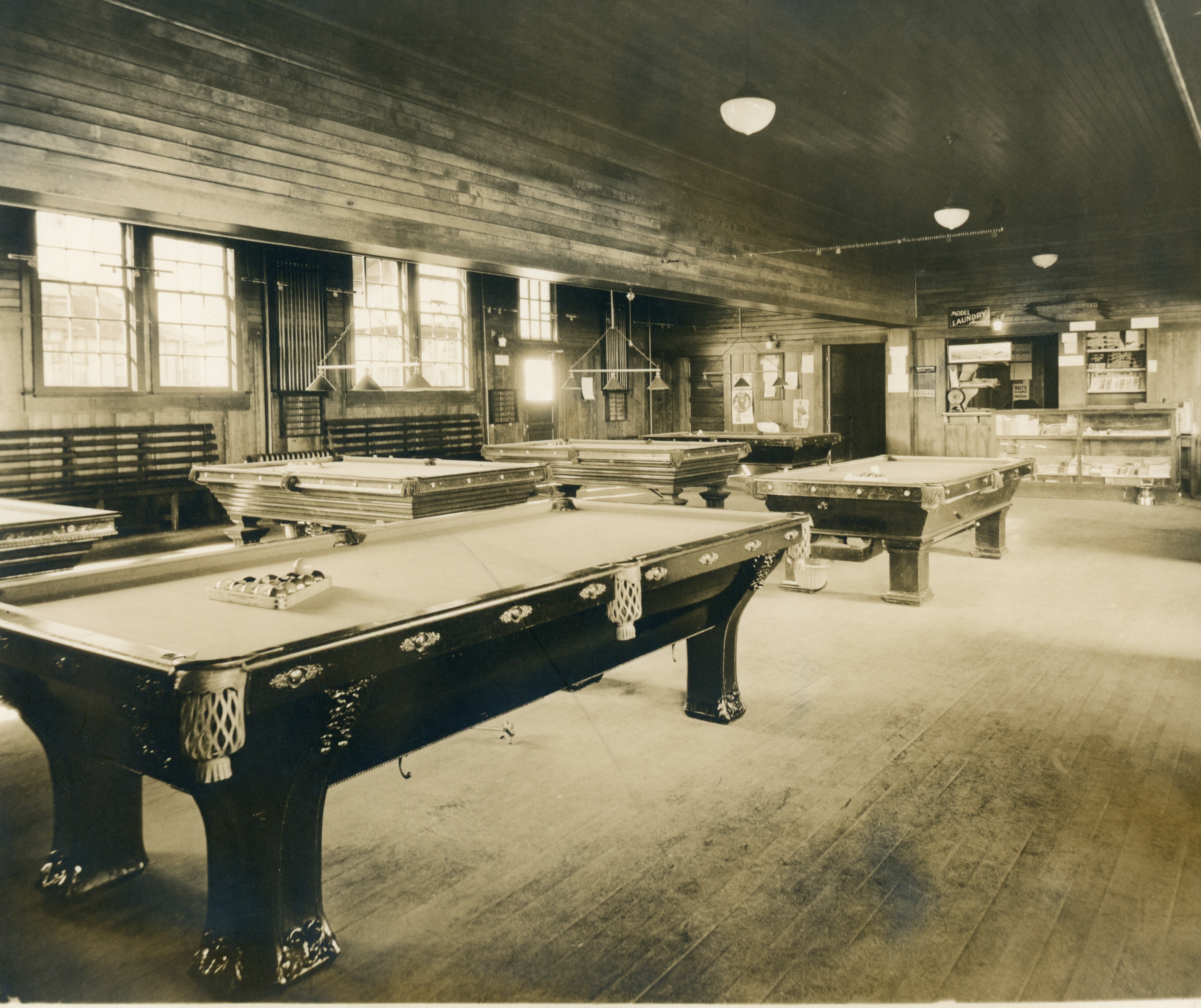
The billiard room, Story Club, Susanville, 1923. Courtesy of the Fruit Growers Supply Company
Revelers were still wandering the streets at six or seven o’clock New Year’s Day but belied the general impression by hanging up a perfect record for sobriety and safety as traffic records can testify.
“A number of ‘prominent citizens’ were overheard in expressions of relief now that the annual celebration is over with, now its time to go back to work.”