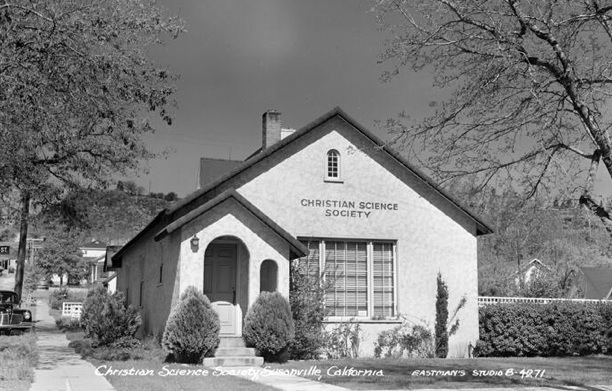
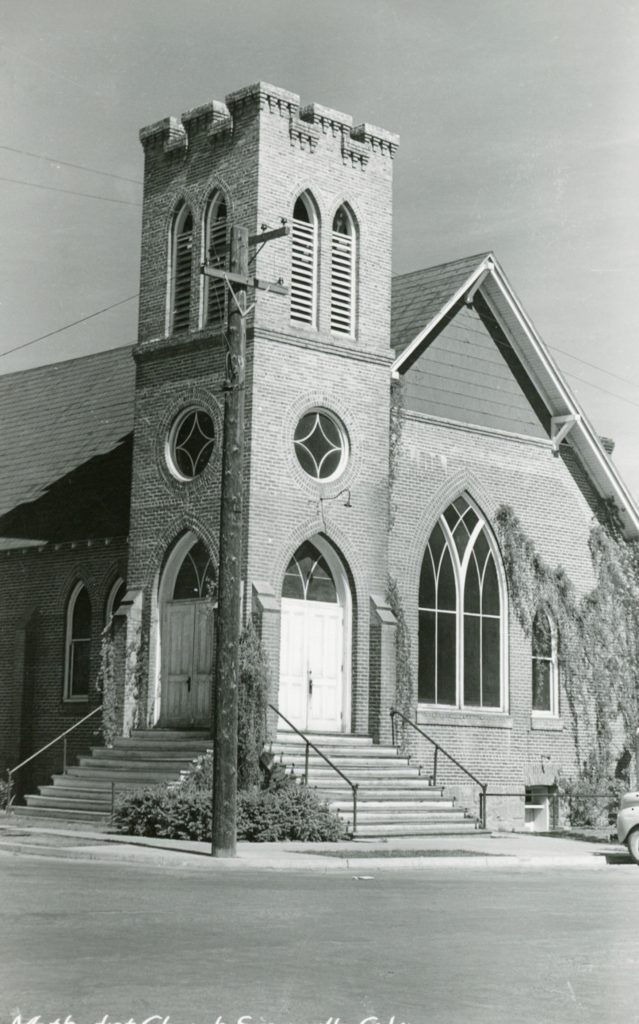
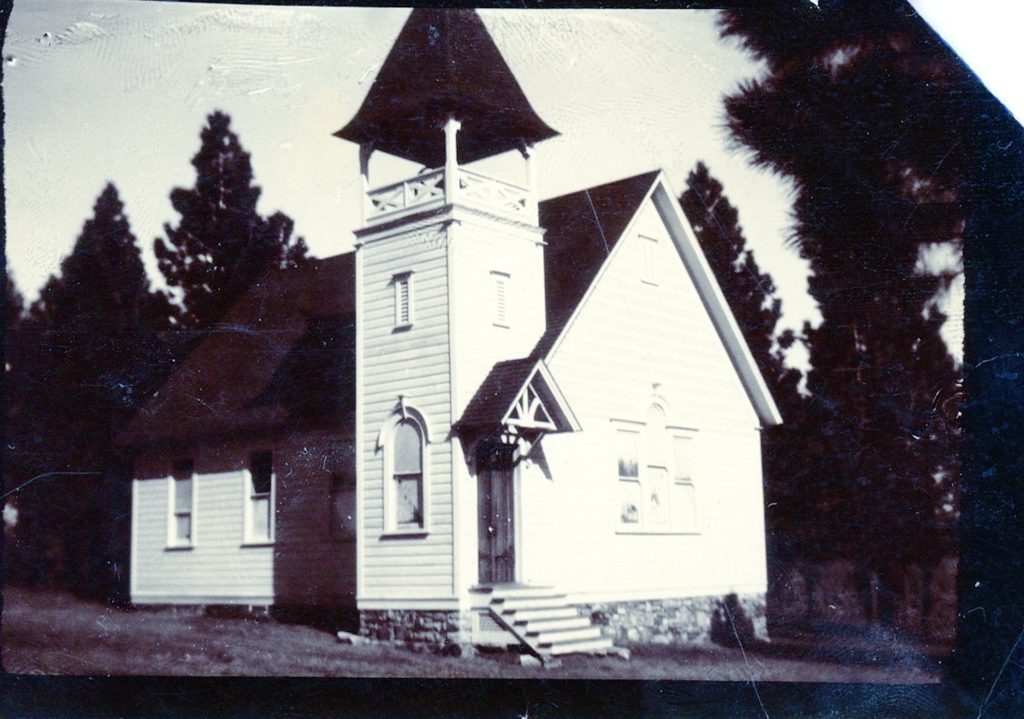
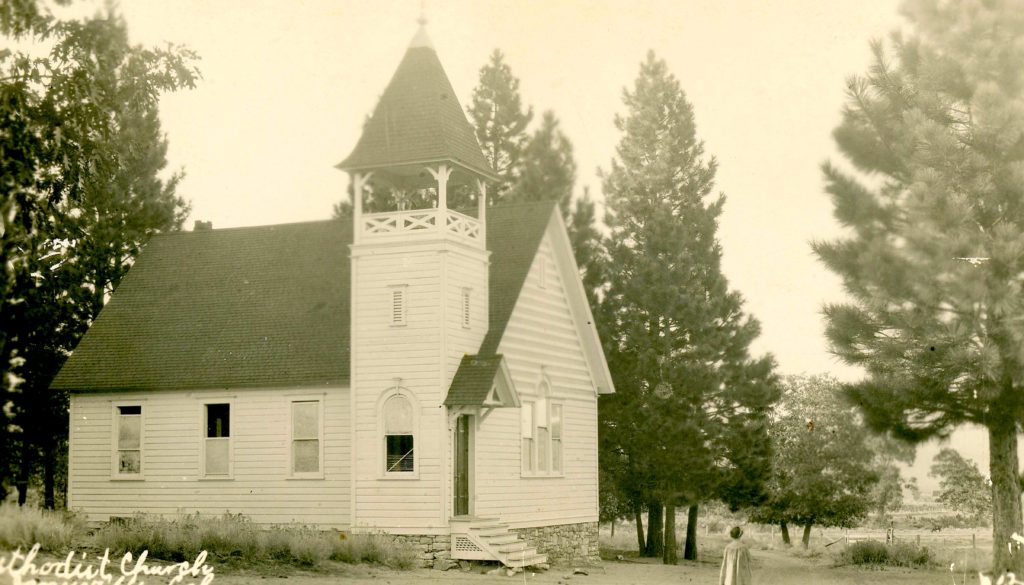
In 1920 the Christian Scientists organized locally and held their meetings in the hall of the Knoch building. On August 26, 1931, they purchased property on the corner of Mill and Lassen Streets from Gladys Burroughs and Iva Raker. In the fall of 1937 they announced plans to build a church. The following spring, Enoch Strom began construction of the church. The first services were held in the new church on June 12, 1938. During the Thanksgiving Services of 1938 the building was dedicated. At the same the congregation was pleased to announce that is was debt free. Over the years saw a slow decline in attendance and in 1999, the local church disbanded.
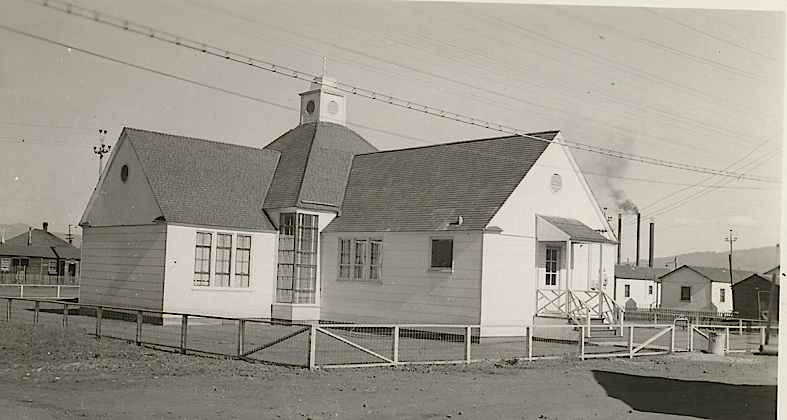
Church of the Latter Day Saints, Westwood, June 14, 1943
On March 9, 1940 the Church of the Latter Day Saints held groundbreaking ceremonies on corner of Ash and Fifth Streets, in Westwood. This was the last house of worship to be constructed under Red River Lumber Company’s tenure at Westwood.
The church was designed Caldwell and Richards, Los Angeles architects. After World War I, the LDS Church began to implement standardized plans. This particular church was the first to use this particular layout. The $9,000 church was built by volunteer labor and completed in four months.
In 1986, its congregation had grown, wherein they bought property in nearby Clear Creek and built a new church. In 1991, their old our church was acquired by Our Lady of Snows Catholic Church which they converted into a parish hall. However, with their new Lake Almanor church, it will be just a matter of time when this is placed on the market, and only time will dictate its fate.
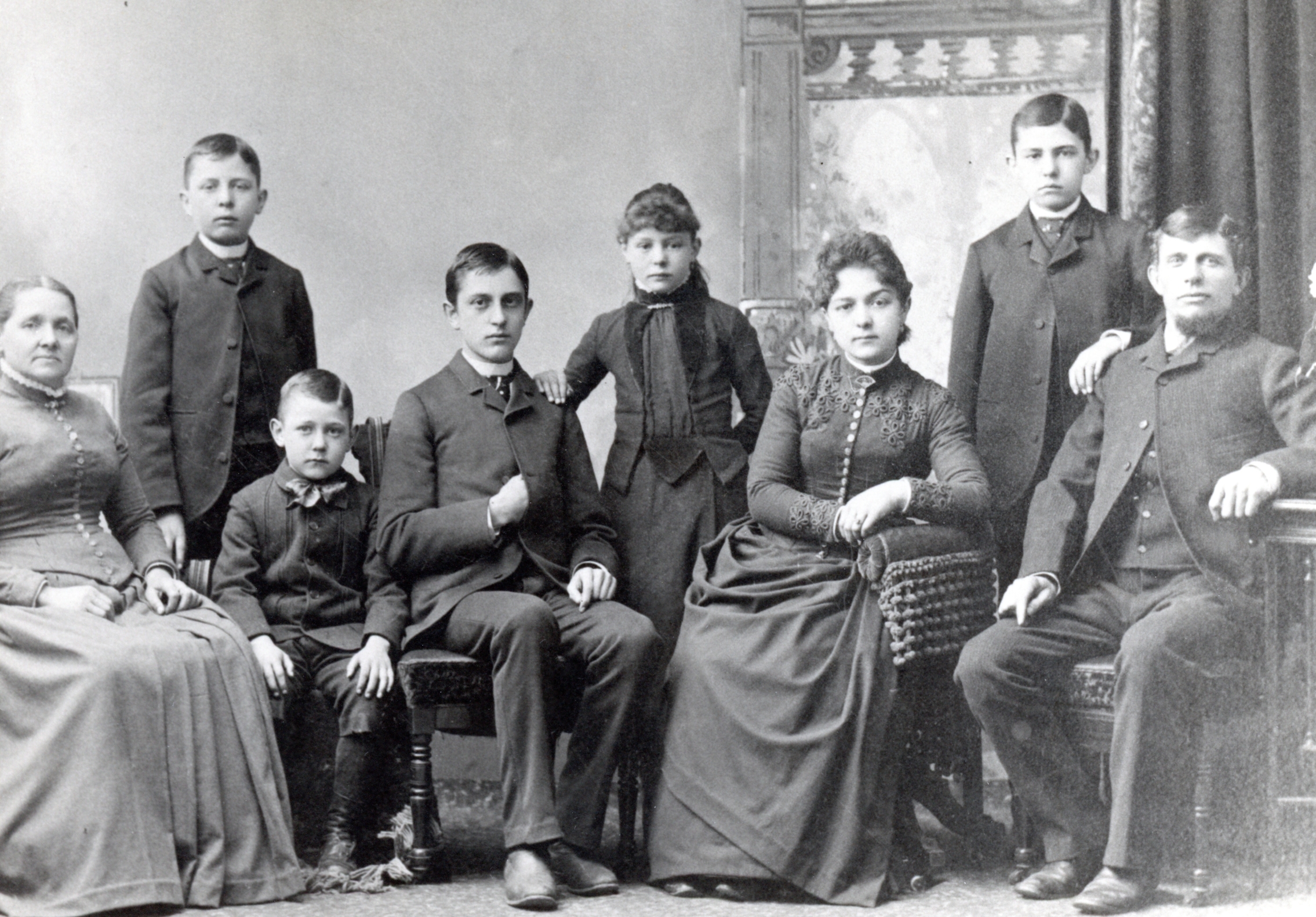
Daniel Dieter Family circa 1890. Left to Right, Barbara Dieter, George William Dieter, Ernest Dieter, Fred William Dieter, Ella Dieter (who married Floyd Hoffman), Luise Dieter (who married Charles Hollfelder), Daniel Martin Dier, Jr. and Daniel Martin Dieter, Sr.—-Carrie Golden
The Lutherans were slow to organize in the Honey Lake Valley. On August 29, 1896, Pastor J.H. Theiss held the first Lutheran service in. Janesville. Like many other religious denominations the minister would ride a circuit so services initially were sporadic. In 1904, the St. Paul’s Evangelical Lutheran Church was established at Janesville. Its initial charter members were Dan Dieter, Sr., William Hoffman, Fred Dieter, George Dieter and Dan Dieter Jr. On July 28, 1907, the Reverand F.G. Gundlach arrived to dedicate to their church located on the Standish-Buntingville Road (A-3) near Sears Road.
During the early years many of the sermons and hymns were in German. By the early 1920s services were also held in Susanville at Fruit Growers Story Club. By 1930, the Janesville church was abandoned, though in 1941 a church was built on the corner of Ash and First Streets in Susanville.
Red River Lumber Company’s town of Westwood was fairly well planned, but all the facilities built between 1912-14, a house of worship was not included. This was extremely odd when factoring in that T.B. Walker, founder of Red River was a devout member of the Methodist Church.
The spiritual needs, however, was not completely ignored. In October 1913, the Rev. Robert G. Green, a Methodist minister at Akeley, Minnesota, where Red River operated mill, was recruited to come to Westwood to oversee the social welfare of the community. Green found it to be challenge as to where to hold non-denominational services. Westwood’s first multi-purpose facility
was the Opera House, and it was there where Green delivered his Sunday sermons. One of the problems holding services in the Opera House was that Green had to compete with other parties who wanted to use the building, since it was the only facility dedicated to public gatherings. Green had been informed a church would be built after the Opera House was completed, but that did not happen.
By early 1917, the pressure was on for a church to be built. A committee had organized to solicit donations. They had plans for a building, not only for its seating capacity but that it should have a full basement to provide for a library, kitchen/dining rooms, and other rooms for sociable functions such as Y.M.C.A. meetings. After considerable debate it was determined that ideally the church should seat 600 churchgoers. Once the committee agreed to the building’s size, they were able to calculate the cost. They estimated a price tag of $8,700—with lumber the most expensive item at $4,000. The committee had secured $3,000 in pledges and pressure was placed on Red River on its “stingy” spending for its employees. Red River was also learning the hard way in a critical labor market, that to retain workers and their families concessions had to be made. Red River finally obliged.
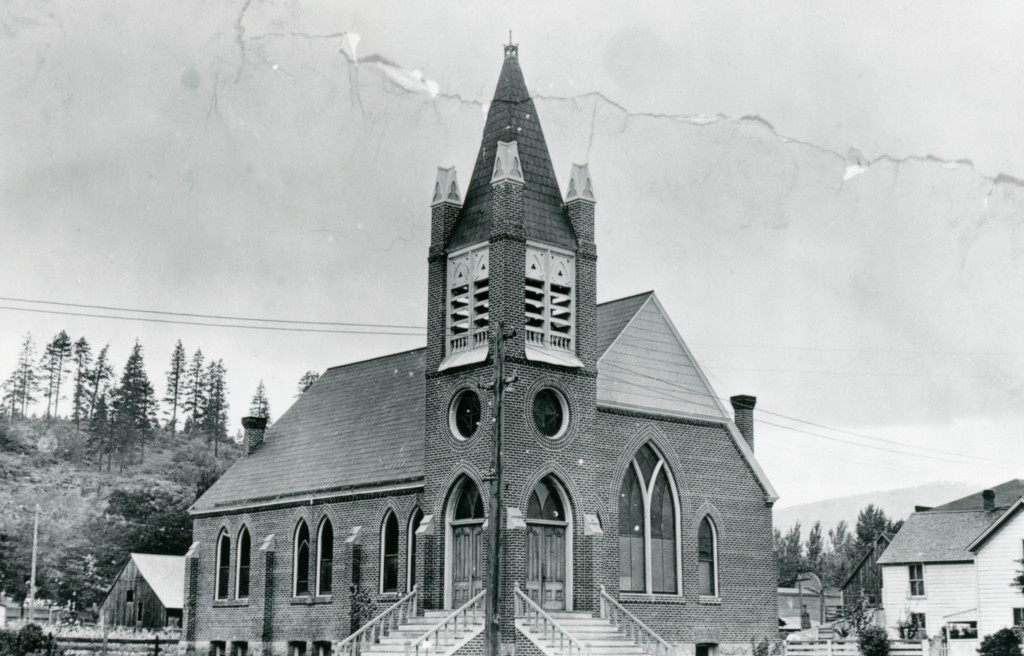
In the summer of 1917 the church project moved forward with Red River donating the lumber and labor. The site selected was at 500 Cedar Street, which Rev. Green described as a rock pile strewn with empty beer and whiskey bottles. By November 1917 the new church was completed. Initially, it was a church with no name. Since it would serve the needs of variety denominations it was named The People’s Church. On Sunday May 19, 1918 dedication ceremonies were held with Dr. John Wilson, District Superintendent of the California-Nevada Methodist Conference officiating.
Someone deserves bonus points for creativity thinking out of the box for this social event—a Waist Social. That is correct, waist as in the human figure and not waste as in rubbish. To attend the function at Susanville’s United Methodist Church, the admission fee was probably the most unique I have ever come across in all my years of research and this was clever. To gain admission, a person’s waist was measured, for every inch cost one cent.
The entertainment was noteworthy, too. One feature was a “colored” wedding, wherein James Crawford was the bride, James Compton, the groom and Maynard Buckles as the minister. All this hi-jinx was done in part to welcome the Rev. D.D. Edwards, the new minister of the Methodist Church in October 1926.
When Honey Lake is full, it has found many uses such as boating, fishing and ice-skating to name a few. One of the more unusual usages of the lake was baptisms. On Sunday, March 8, 1914 the Janesville Baptist Church held services at the Lakeview School. After the services, the congregation went to the shores of Honey Lake, where the Rev. L.D. Howard baptized several new candidates into the flock. Unfortunately, I have not been able to find a record as to who they were.
In 1919, Honey Lake went dry and would remain so until the winter of 1937-38. So baptisms as the lake was no longer an option. On April 2, 1932, the Rev. Bond of the Seventh Day Adventist Church o Susanville found an alternative—the Wendel Hot Springs—which thirteen members were baptized there.
On December 2, 1938, Father Patrick J. Moran became the fourth priest at Susanville’s Sacred Heart Church. A dynamic figure, he would leave an indelible mark over the next twenty-eight years.
Father Moran’s first crusade would be a vigorous campaign to raise funds to build a new church to replace the existing church that had been built in 1892. The existing church could no longer accommodate a flourishing parish.
Another problem with the old church it was cold and drafty in the winter months—with its only source of heat and ornate pot-belly wood stove.
The original altar at Sacred Heart, circa 1910. Courtesy of Milton Mallery
After Moran’s first winter, enough was enough. Father Moran had the following notice published in the Lassen Advocate on November 26, 1940: “That weekday Masses will be celebrated each morning at the parish house during the cold months as it is impractical and unnecessary to heat the church each morning for the services. However, Sunday services would be held in the church.”
It would not be until 1949, when the new church was completed.
First of all, I hope no one finds this story offensive, there is literally a lot of “tongue and cheek” humor in the following newspaper article. After all, this was type of writing was common a century ago. With that mind, the following is from the Lassen Mail of October 20, 1926:
”The sale of indigestion tablets should take a big jump this week and antidotes for ptomaine poisoning and kindred stomach ill should be much in demand for the men of the Methodist Church are cooking a “big feed” for the women of the congregation this evening at the first get together meeting of the season. The women are rather dubious, but if for nothing more than curiosity, there were will be no doubt a large crowd present. The massacre begins at 6:30 p.m.”
The Janesville Methodist Church had a very short time span, of just thirty years. By 1928, it had been abandoned. In January 1946, the Trustees of the Susanville Methodist Church, who had inherited the old church put it up for sale. The demand for buildings in the region was extremely high due to the conclusion of World War II. The trustees asked for bids to be submitted by February 4, 1946. Unfortunately, I have not been able to ascertain what transpired since then.
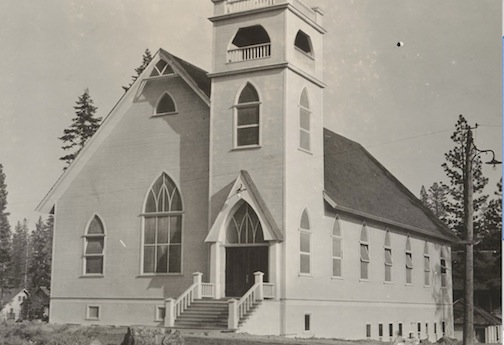
Janesvlle Methodist Church, 1911. Courtesy of Marge Foster
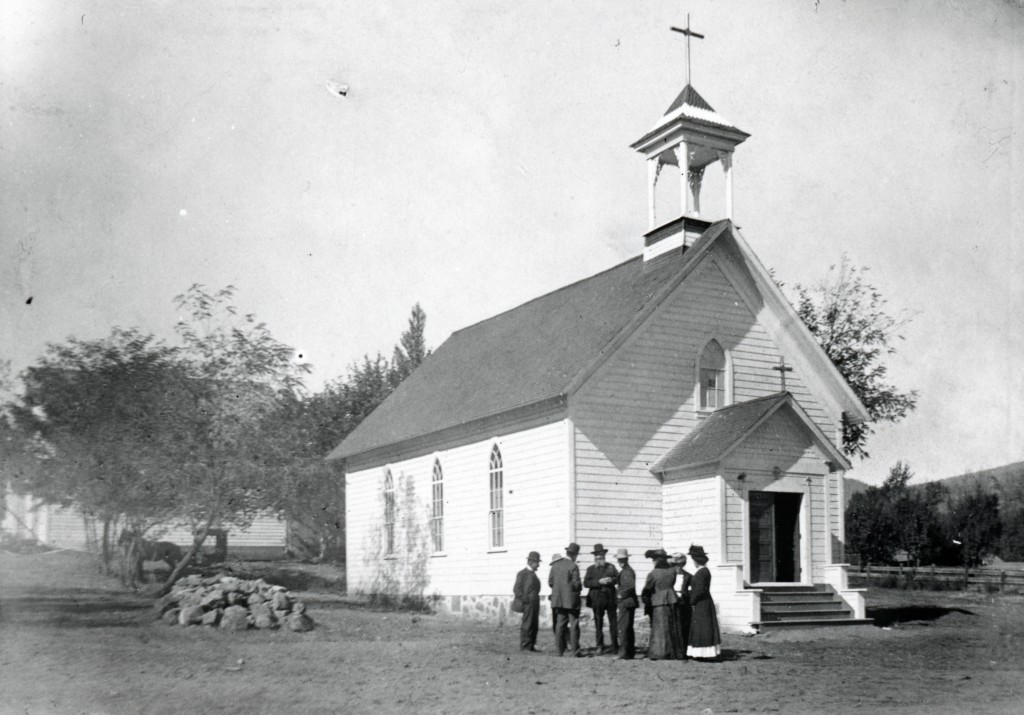
On Sunday, August 29, 1897 was a joyous day with the dedication of the new Janesville Methodist Church. Dr. E.W. VanDeventer presided over the services, with a standing room crowd in attendance. The church measured 28’x40’ feet was built by Susanville contractors, Enhorning and Harrison for $1,500. Frank Rowland donated the land for the church. Trustees for the church were: G.W. Meylert, Wm. Dow, E. Winchester, George Riddle, W.T. Masten, J.T. Masten and Charles Cramer.