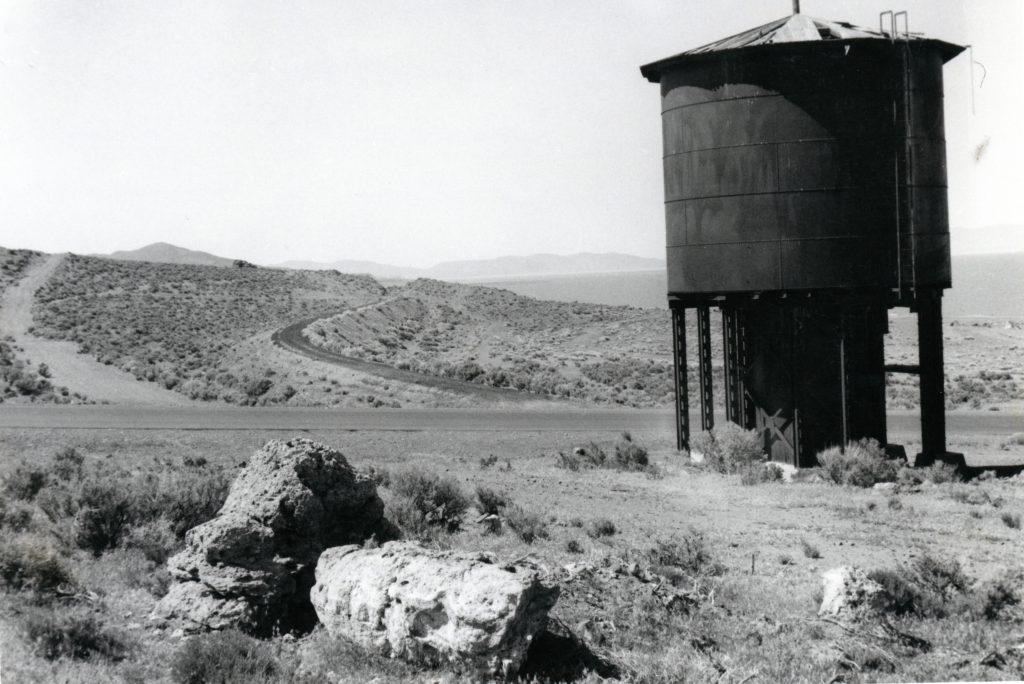
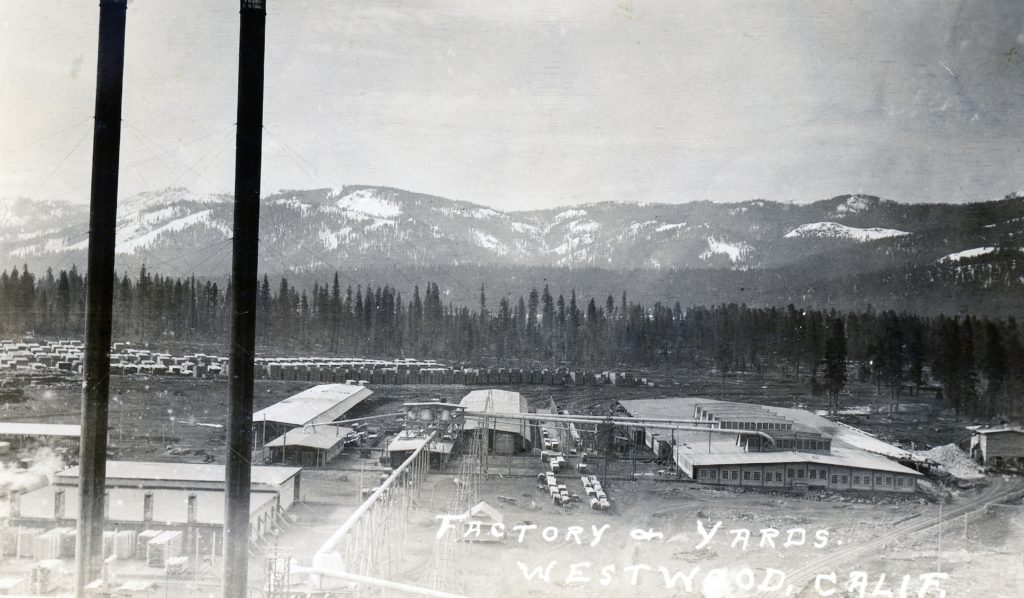
In 1912, when an agreement between the Southern Pacific Railroad and the Red River Lumber Company was reached to build the Fernley & Lassen Railroad from Fernley, Nevada to Westwood time was important consideration. The Southern Pacific had two years to construct the line.
The demise of the railroad was a slow, lingering process. In 1963, a 60 mile segment from Fernley to Flanigan was abandoned. In 1978, the segment between Mason Station and Susanville experienced the same fate, though it would be rehabilitated into the Bizz Johnson Trail. It should be noted this segment had not been in use since 1955 due to extensive flood damage and the Westwood mill closure, Southern Pacific deemed it was not in its best interest to make costly repairs. In 2006, the tracks between Susanville and Wendel were removed.
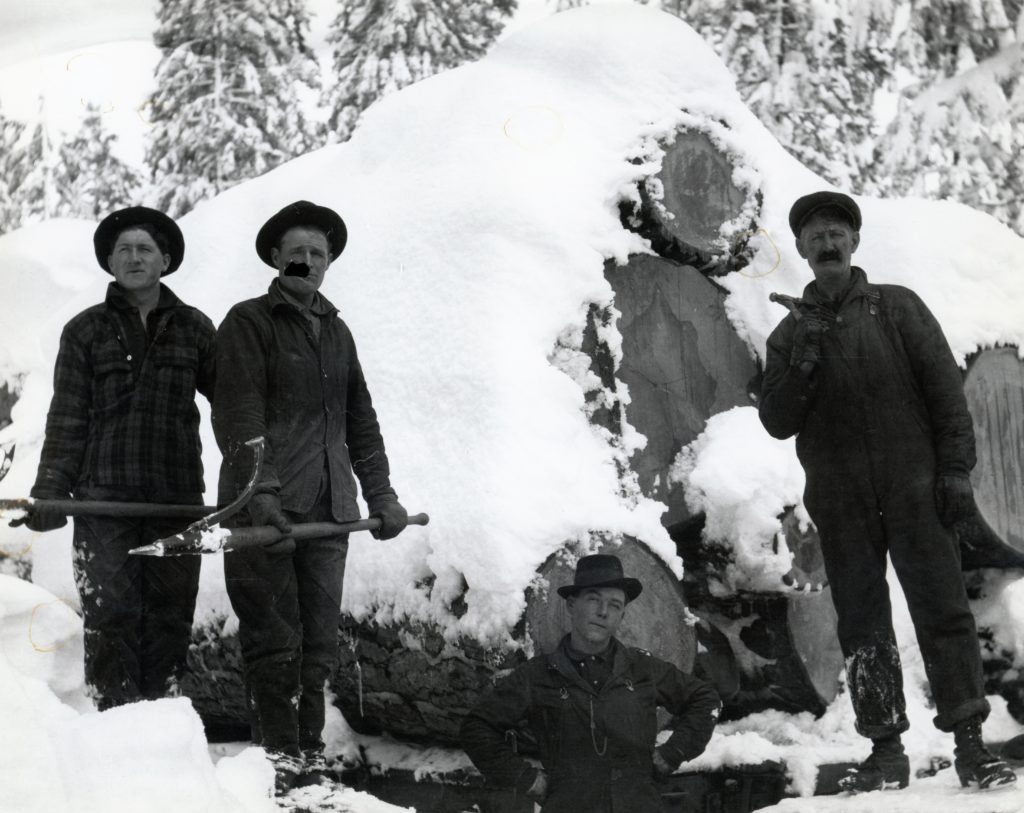
A winter logging crew, 1916. Courtesy of Hank MartinezWhen the Red River Lumber Company moved its operation from Minnesota to Westwood, California it would become quite the learning experience for the company. In addition, the company’s founder, T.B. Walker, desired that the California operation be under the full responsibility of his five sons, which was easier said than done.
One of the sons, Fletcher Walker, was the resident manager of Westwood and had more or less full control of the operations. However, it was necessary for Fletcher to keep his father and brothers informed of the company’s activities, especially since it cost $3,5 million to construct the company town of Westwood during the 1912-1914 era. In addition, another $3.7 million was spent on the purchase of 800,000 acres of timberland in Northern California.
One of the many early family disputes was where to locate the company’s first mill, (there were plans for several small mills throughout Northern California) which would eventually be the location of Westwood. One of the biggest concerns of the Westwood site was that it was located in a snow-belt region. This would have a ripple effect on operations because more kilns would be needed to dry the lumber to hindering logging operations.
Whatever the case may be, it was Fletcher’s goal to operate Red River year round, much to the chagrin of his father. On February 25, 1915, T.B. wrote to Fletcher criticizing him for running the mill during winter storms, and that he should just shut it down. T.B. commented: “I have never expected that we could run all year in the mountains of California. I had in mind when I was securing the millsite where you built, that this would likely be about a nine or ten month’s milling job.” T.B. then chastised Fletcher’s decision to cut white fir and second-class pine trees. Again, T.B. commented, “If we get a mixed lot of lumber cut, considerable of which will pay us no more than the milling and marketing will cost, it will leave us behind in meeting our obligations. I have never figured on cutting timber in California, clean.” T.B. continued to stress in only cutting the best timber to turn it into money to meet its many obligations, especially taxes and bond payments. In addition, Fletcher stated he needed at least a half million dollars to finish the plant. In conclusion, T.B. was sympathetic when he wrote, “I realize the disadvantages and drawbacks that you work under in trying to build a milling plant out in the open woods, with everything to contend with, and where logging, sawing, handling, cutting up and shipping are all at a serious disadvantage, and where you have more or less bad weather, in the winter at least, that naturally makes it an up-hill battle.”
Finally, Fletcher questioned his father’s judgment on the ease of operating a winter mill in Minnesota, and remarked, “I never discovered that it was an easy operation to get through four months of cold and snow.”
The following year T.B. again requested Fletcher to shut down the logging operations in the winter as it was just plain too costly. Fletcher agreed the winter operations operated at a loss. However, his justification was that outfits such as McCloud River Lumber Company that called it “quits” in the sawmill operation on November 1 placed Red River at an advantage by having a ready supply of lumber. In summation, Fletcher wrote, “In place of our figuring from this end on closing down, we have been figuring carefully the pros and cons of taking advantage of the bulging market to produce a bunch of timber of lumber this summer and make a real killing.”
Whatever the case may be, it was a lesson learned and not repeated, so in 1918 Red River discontinued its attempt at year-round logging. One practice that Red River implemented like other large lumber concerns of Northern California of the era was to harvest addition logs during the fair weather season, to have a stockpile to keep the sawmill in operation during the winter months.
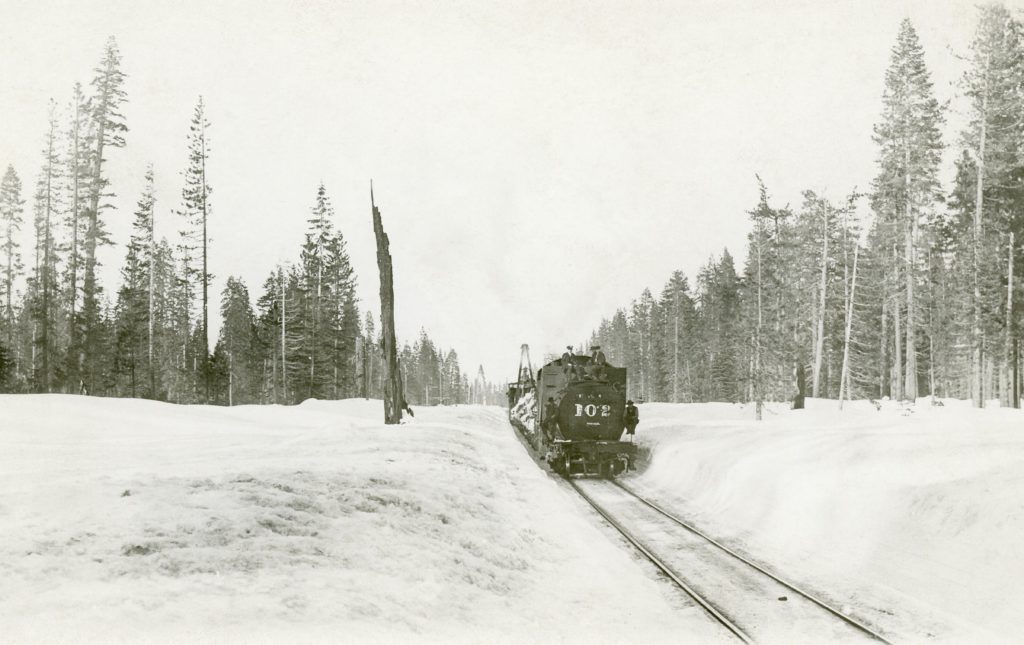
Red River’s 102, with a jammer in tow.As today marks the anniversary of the bombing of Pearl Harbor, I recall a comment a colleague made many years ago and how it was linked to Lassen County. At issue was when the Red River Lumber Company sold its scrap iron to Japan, who would in turn use to the scrap iron for war purposes and ultimately the bombing of Pearl Harbor. In September 1933, Red River Lumber Company sold $15,000 of scrap iron and obsolete machinery to the Japanese government. According to the press release “Many see the order from Tokyo for junk the possibility that preparations are being made for war on an extreme scale. Scrap iron is utilized in munitions making.”
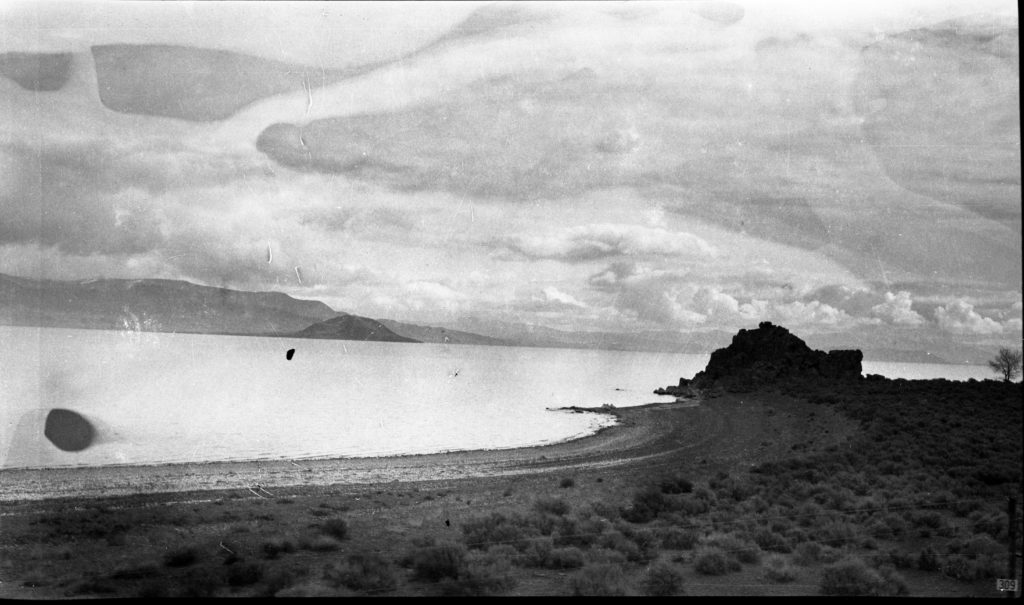
Pyramid Lake, 1915. Courtesy of the Otto Kratzer Collection.Since it is a long holiday weekend, and many might have short attention spans I will keep the post brief. While sifting through the Otto Kratzer photograph collection who worked for a brief time for the Red River Lumber Company from February to May 1915 was this picture of Pyramid Lake. It was taken from the train while Kratzer was enroute to Westwood. While it may not look like much, those familiar with the lake will see the obvious as to how much the lake has dropped in the last 102 years.
Red River Lumber Company’s Westwood Box Factory, 1915.One hundred years ago, the major component of the lumber mills was the box factory. It is rather a misnomer, since what was actually manufactured was box shook. Box shook were the various sized wooden slats that are used to make wooden crates, which was how the nation’s fruits and vegetables were then shipped. The shook was shipped to packing houses were they were assembled. To understand the enormity the amount of lumber used to make these boxes, was that during the early 1930s of the great depression over half of lumber produced in the United States was used for box shook. It was not until after World War II that the cardboard box would slowly become the preferred shipping container. In the future we will explore this topic further.
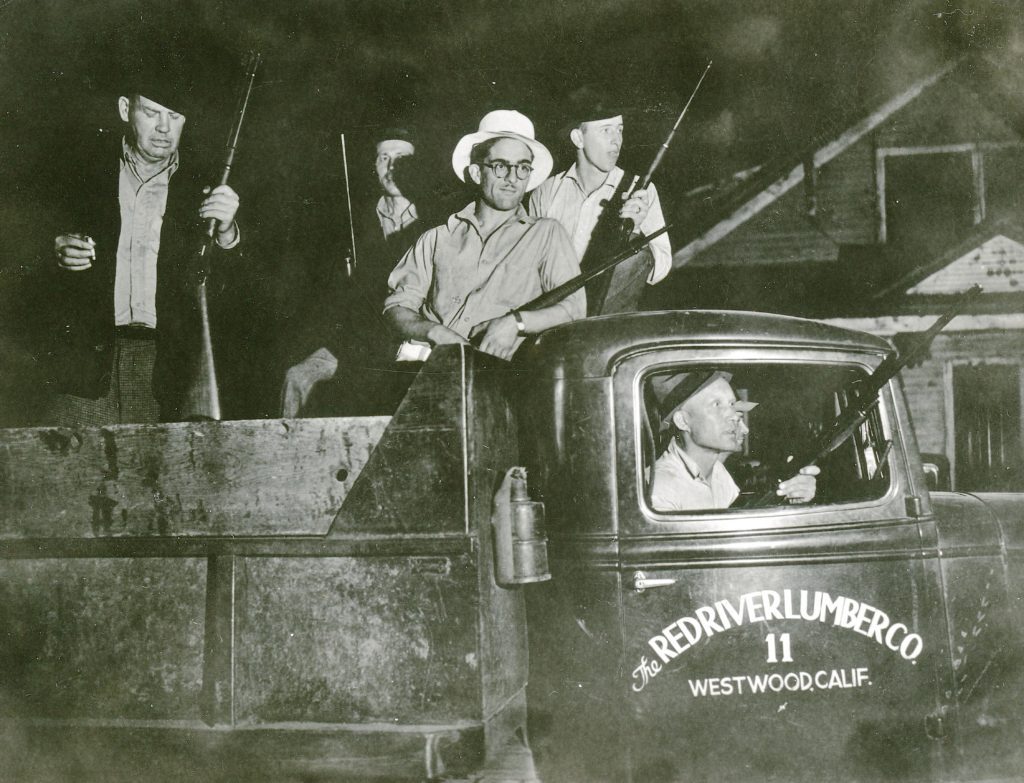
Purge Nite. Courtesy of Frank W. DavisIt is only fitting that on Labor Day that we remember the great purge of in which nearly 400 men, women and children were forced out of their homes in Westwood on July 13, 1938 over a labor dispute, one that lingers to this day. Yet, by the end of that historic day the California Highway Patrol, with the National Guard on standby placed a blockade on the community, sealing it from the world until things could stabilize. According to historian Gerald Rose about the historical significance of the purge he wrote, “Not until the 1941 deportation of Japanese-Americans was there a large forced migration of United States citizens.” To learn more about Westwood’s labor history, read Red River: The Turbulent Thirties.
Lassen County Courthouse, 1922.When the Red River Lumber Company established its operations at Westwood it had a very congenial relationship with Lassen County officials. That all change in the fall of 1916 when United California Industries wanted to rent a hall in Westwood to discuss prohibition. Red River refused. A firestorm erupted by the Susanville press the Red River’s general manager, R.F. Pray. Pray was livid with the newspapers’ coverage and their commentary of the sordid affair. First, he noted, the newspapers had no right to publish the correspondence between United and Red River, as it was a private business affair not subject to public scrutiny. Pray in his rebuttal wrote, “When commencing operations on a large way in Lassen County three years ago, we informed the public and our employees that we were in engaged in the manufacturing of lumber and not in politics, that we refused participate in them, or be drawn in any political issue.” In conclusion, Pray inferred Red River did not deserve this kind of treatment recently played out in the press. After all, he reasoned, not only was Red River the county’s largest industry and it was the largest purchaser of local produce. Finally, if Red River had its way, last year they would have defeated the bond measure for a new county courthouse, reducing the company’s tax burden. Yet, Red River stayed out of the political arena and now Lassen County citizens are enjoying their modern facility that otherwise would not have materialized.
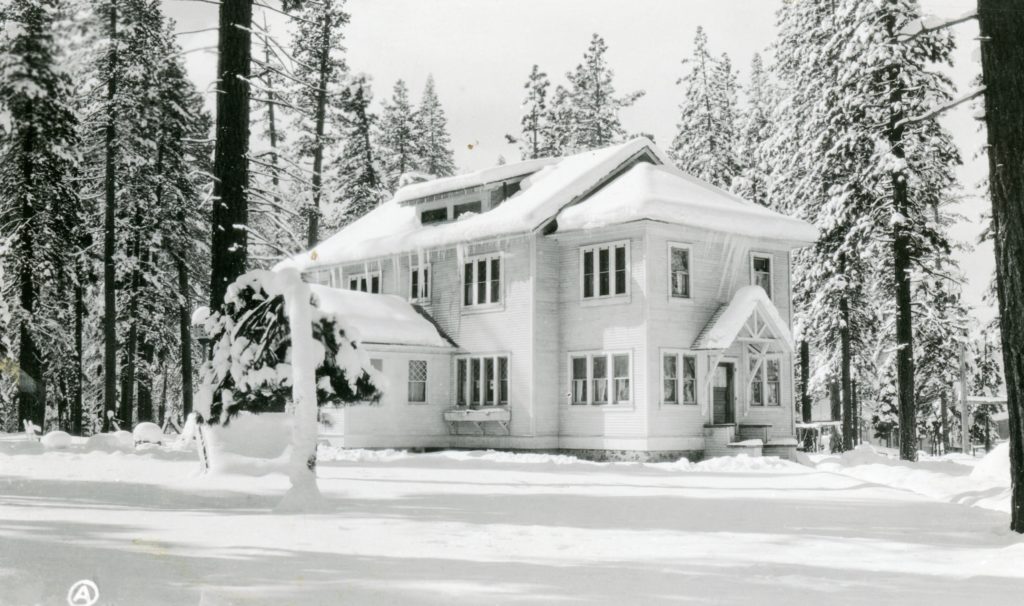
The El Solano, circa 1916. Courtesy of Leona Jackson.One of the peculiar oddities back in Westwood’s early history there were no accommodations for the traveling public. The Red River Lumber Company who controlled the town wanted it that way. This would hinder any “undesirables” to try infiltrate the town, i.e., such as union organizers. However, Red River needed to provide some sort of accommodations for people visiting on official business with the company. Red River constructed the El Solano at 501 Birch Street to meet those needs.
In the 1930s, during Red River’s financial crisis, the company converted its American Legion Hall into a hotel known as the Blue Ox Inn, and thus the El Solano diminished in status. It would later be converted into apartments. In the fall of 1965 the Assembly of God Church renovated the building, and the second story removed. Today, it is a private residence.
Camp Harvey was a railroad logging camp during the 1940s of the Red River Lumber Company and later Fruit Growers Supply Company and located approximately 20 miles east of Poison Lake.
The cookhouses in logging camps always operated at a loss. However, a cookhouse could make or a break a camp—poor food resulted in an exodus of loggers. In 1948, Fruit Growers raised the price of a meal to one dollar at Camps Harvey and Stanford, and the complaints were loud and clear. Fruit Growers instead of losing 36 cents per meal, they only lost 8 cents.
In 1949, Fruit Growers leased the cookhouses and commissaries at those two camps to H.S. Anderson Company for one dollar. Fruit Growers thought maybe an outside company could handle the operations for more efficiently. They would never find an answer.
By the end of May the cookhouse crews represented by Local 769 of the Bartenders and Culinary Workers Union walked off the job in a wage and hour dispute. Logging came to standstill. The two camps with a population of nearly 500 became ghost towns, with Robert Simons and Harry Beal remaining as caretakers. After the weeks went on and no end to the strike Fruit Growers closed down the camps permanently. In addition, they abandoned that railroad logging line.
When Red River Lumber Company moved to California, its founder T.B. Walker, intention that this was to be his five sons operation: Gilbert, Willis, Clinton, Fletcher and Archie. Clinton, was at odds with his brother’s handling the affairs, and left the company in 1913, but was brought back into the fold during the company’s financial crisis of the 1930s. The Minnesota Historical Society has a large collection of the company records and from time to time I will share some excerpts from the letters between the family members that provides some interesting insight in how the company operated. Continue reading Clinton Walker’s Correspondence→