Tag Archives: Red River Lumber Company

Westwood’s Deportation Continued

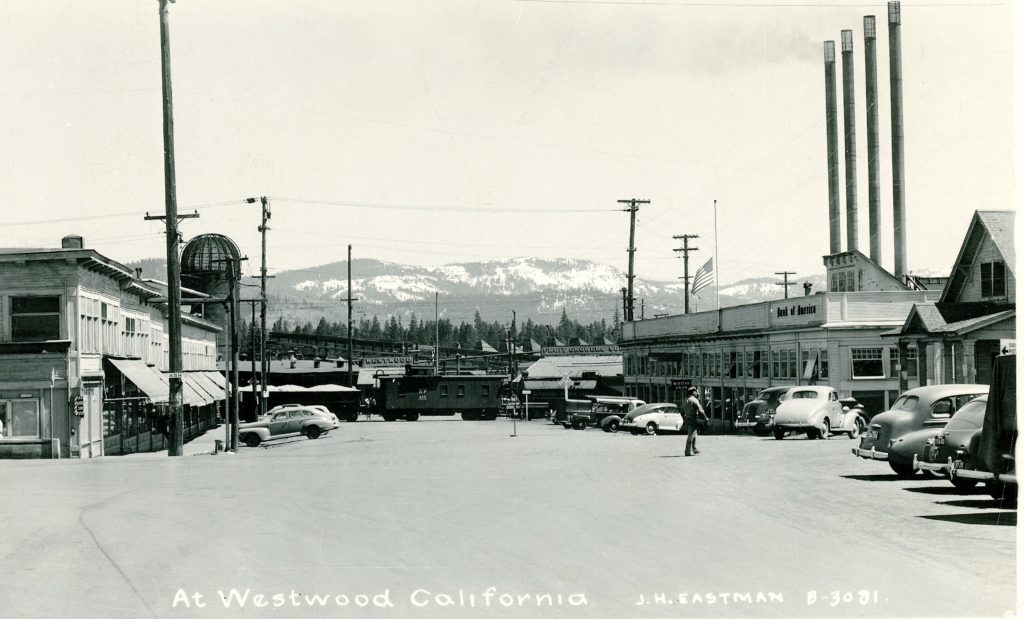
Westwood,, 1931. Courtesy of C. Derek Anderson

The county wanted to oblige, but it had no funds. They deferred to take any action and turned the matter over to the federal immigration officials. J.C. Borden of the Immigration Bureau was brought in to investigate the situation. What he found on his arrival was that of the forty-five applicants only a handful were eligible to receive aid to pay for their return to Mexico. Yet, the issue was also moot, as Borden noted, because all the Mexicans had gone back to work. He informed the Board, should the issue arise again, that under a federal ruling any alien who had been in the United States for three years and becomes indigent can be returned to his native land with the cost borne by the federal government.
Yet, Red River’s actions caused a lot of anxiety and speculation among its Mexican workforce. In January 1931 rumors circulated that it was going to eliminate all Mexican labor. Red River issued a statement to ease fears among its Mexican employees: “The policy is to employ this [Mexican] labor on certain classes of work as they are very satisfactory in certain moderately well paid positions, do not move around looking for other positions which cuts down the cost of labor turnover. They are considered essential and desirable as part of the plant personnel. It is not the policy to employ outside Mexicans while work is scarce, but it is the policy to take care of those who have been here for some time and have proven to be good workmen and citizens.”

The deportation issue did arise again, as unemployment was persistent with the stagnant economy. In the fall of 1931, Lassen County transported more than one hundred Mexicans to San Francisco, who were then handled over to federal authorities to deport them to Mexico. The county deemed it was cheaper to pay the transportation costs than to provide aid. Many of the Mexicans were willing to leave, and those who had the means left on their accord. The issue was not isolated to Lassen County for 50,000 Mexicans throughout California had been deported that year.

Support

Westwood’s Deportation of Immigrants

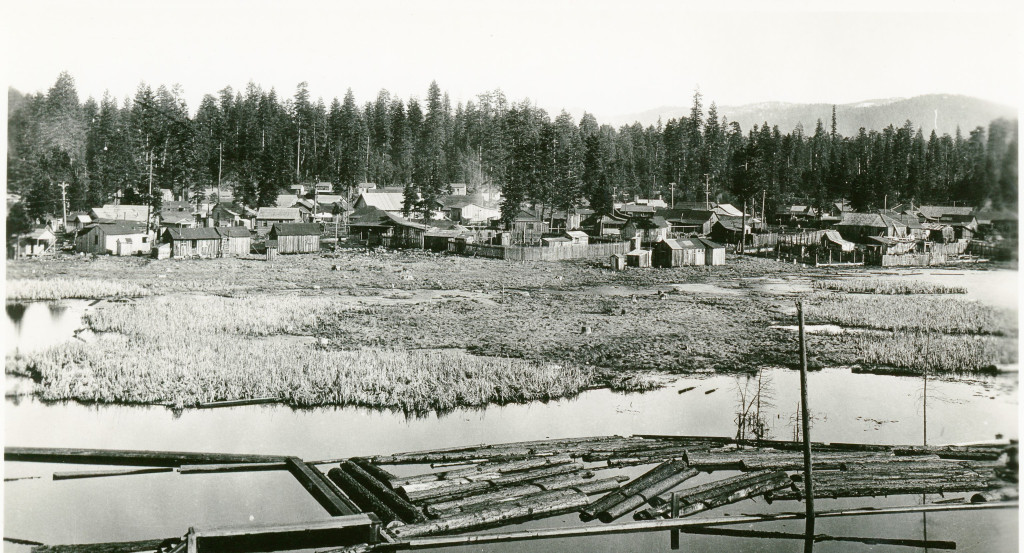
Westwood’s Old Town, home of many of its immigrant workforce. Courtesy of Hank Martinez

Note: This was one of my early posts, that a few people expressed an interest. It should be duly noted that mills of Fruit Growers and Lassen Lumber & Box also hired large contigencies of immigrants.

One of the more unusual annals in Red River’s history was deportation. Red River hired a large percentage of foreigners whether it be Scandinavians, Italians or Mexicans. With the downturn in the lumber market, the company was forced to layoff some of its workers. If they thought that the layoff was temporary, they allowed the affected worker to remain. By 1930, however, Red River sought alternatives, as they could no longer bear the financial burden.

In December 1930 Red River notified the Lassen County Board of Supervisors of the lay offs and sought aid to provide for the unemployed Mexicans in Westwood, with the emphasis to pay the costs for their deportation. This had not been the first case where aid for the indigent and/or deportation had been raised by Red River. In the fall of 1929, the first deportation occurred at Westwood. Six members of the Phil Trudeau family, who were in the country on a visitor’s permit, were returned to Canada and eight Mexicans were deported to their native land.

On January 5-6, 1931, the Board of Supervisors held a two-day hearing concerning the deportation of Mexicans at Westwood. There were forty-five indigent Mexicans at Westwood who had been laid off and Red River took care of their needs. Again, Red River felt that it was either the county or the federal government’s obligation to provide them with food and other basic necessities and not the company. The Mexicans did meet the requirements to receive government aid. Even though they were not citizens, they were legally here and had been previously employed.

Never miss a story, click here.

Poison Lake Logging Operations

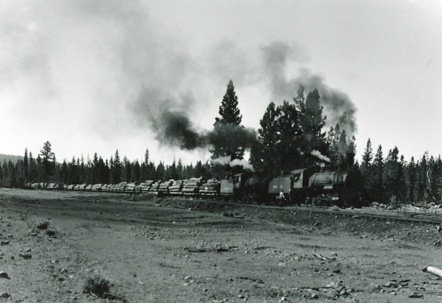
A Fruit Growers Supply Company logging train near Halls Flat, 1947

Poison Lake in western Lassen County was in essence the last frontier for railroad logging in the region. By 1940, the Red River Lumber Company had nearly exhausted its tributary timber around Westwood. It was also a critical time for Red River, not only dealing with a dwindling timber supply, but a younger generation of the Walkers having more influence in the operations.
With the nation already gearing up for the effort, demand for lumber increase, which in turn commanded higher prices.

While Red River was in crossroads about the future of Westwood, they were able to agree on item. With demand for lumber at an all time, and profits, too, it was best to carry on, with the hopes of finding a likely buyer during the good times.

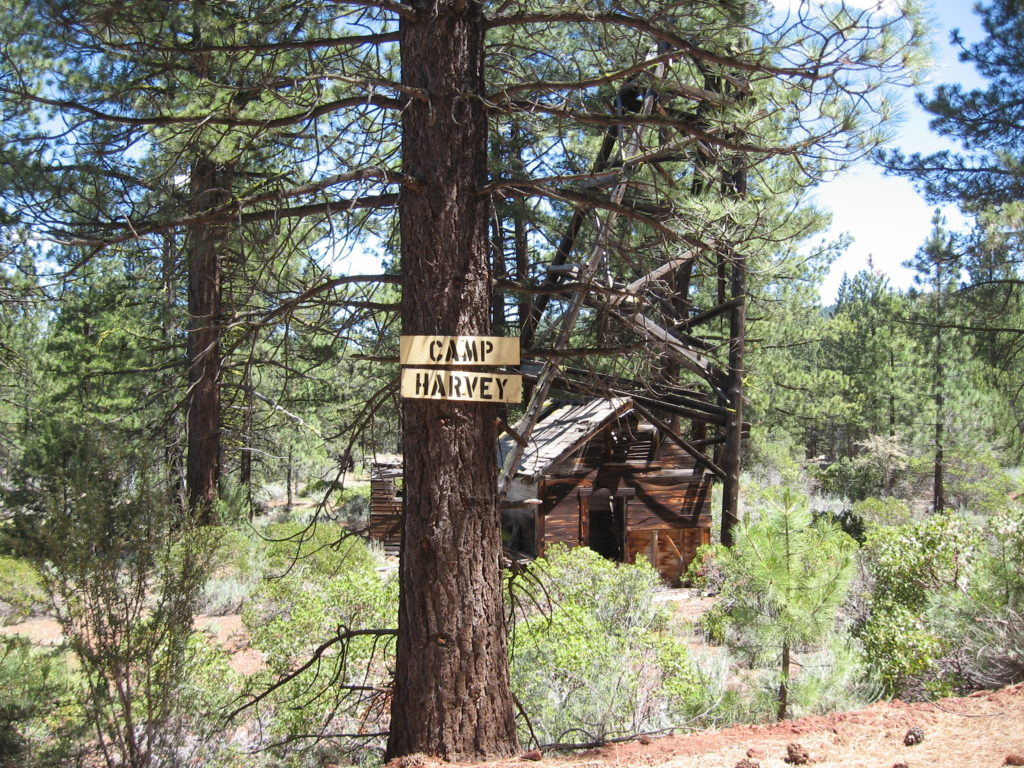
The next destination to log was Red River’s Black/Harvey Mountains tracts some thirty miles north of Westwood. As an extra enticement, Lassen National Forest nine million board feet at Poison Lake. In 1941, Red River established Camp Bunyan at Halls Flat and started logging east towards Blacks Mountain. In 1944, they built railroad logging spurs around Poison Lake. While traveling along Highway 44 west of Poison Lake and looking on the south side of the highway these old railroad grades are still visible.

Subscribe

Reforestation

Diamond Mountain, circa 1940. Courtesy of Margaret A. Purdy

It is interesting to note that before the Red River Lumber Company and the Fruit Growers Supply Company harvested a single tree, the two companies stated with their sustained harvesting practices they would operated into perpetuity. While both companies no longer operate sawmills, they own large swaths of timberland, which is routinely harvested. However, large swaths of territory the companies would log contained a great deal of volcanic rock, not the best soils for second growth trees. In addition, when they did a tremendous amount of logging in these areas, it coincided during a twenty year drought cycle from 1917-37, that until this time the region had never experienced since the Anglo settlement of the 1850s.
On the other hand, they had a positive outlook. Take for instance during the dedication ceremony of Fruit Growers sawmill in Susanville in 1921. Charles Emerson, a well known merchant and rancher was one of many dignitaries to speak. Emerson told the crowd of his own reforestation locally. Emerson recalled that as a child [he was born in Susanville in 1868], forty years ago, he helped plant a tract of pine trees on the family ranch just south of Susanville on Diamond Mountain. Those seedlings, he said, had become a fine stand of pine timber, many of which were 22 to 24 inches in diameter.

Subscribe

Clarence Falegar, A Tragic Tale

Chico Newspaper headline

The Red River Lumber Company archives in Minnesota provides a wealth information on so many topics. Of note, the kept interesting records and observations about logging/sawmill operations throughout Northern California and Oregon.

One area where company officials “Whitewash” is that of industrial accidents. After all, it should be duly noted especially in that era, logging and sawmill operations were very dangerous occupations. Of course, in company records, invaribly the employee was at fault.

A perfect example is that case of Clarence Falegar. On September 7, 1916, Fletcher wrote: “Day before yesterday while one of our electricians was at work on a high voltage line, 2300 volts, he got a hold of a live wire in each hand causing a dead short through his body, killing him instantly. He was a young fellow by the name of Clarence Falegar who was raised on the Falegar Ranch in Falegar Gulch of Mountain Meadows, had had been at work for us a couple of years. He was 23 years old, single, has a brother working here and his Father lives in the Sacramento Valley, I believe. This make, as I recall, the 13thman to be killed on the construction and operation of this plant in three years, which is a pretty heavy price for the lumber and development of the plant, but I do not know how any one of the accidents could have been avoided as long as we have the element of heedlessness, carelessness and disregard for ordinary precaution along with the element of accident.”

Red River’s Saw Dust Pile

In the mid-1920s, Red River Lumber Company had two hydro-plants in operation to generate power for Westwood. This abundant power supply created an unusual man-made landmark. Red River was able to conserve its sawdust/wood waste pile, which took on a life of its own as it started looking like a small mountain. This created a nice reserve of free fuel that was readily available at any time should there by interruptions from the hydro-plants. To comprehend just how large it was, a Ripley’s “Believe it or Not” column once designated it as the world’s largest waste pile. In 1941 it lost its status to Portland General Electric Company who reported having a 130-foot high pile of sawdust. Continue reading Red River’s Saw Dust Pile

Westwood’s CIO Building

CIO headquarters. Courtesy of Frank Davis

After the rioting broke out from the court hearing a small group of CIO sought shelter in their building, (it being a small structure measuring 16 by 24 feet). It was only a matter of time that angry mob would descend. Aid arrived in the nick of time before matters got completely out of control with Lassen County Sheriff Olin Johnson and his deputies. Johnson had Jack Granger, a respected AFL member, be his spokesman. Granger’s is plea to the angry mob stated: “Fellows I ask you on behalf of Sheriff Johnson and those women and children in the building to open way and let them be taken out of here. We are aware of the hysteria that got us all and there is no thought of fear. Let’s play ball with the Sheriff.” The mob obliged and all those inside—29 to be exact—were escorted unmolested from the structure by the sheriff deputies. It was still a harrowing experience as the crowd had slashed the car tires of the sheriff deputies and they had to drive away on the rims!

The AFL resented the CIO headquarters; many considered it a symbol of the labor problems of Westwood. Exactly what the AFL’s intention were was anyone’s guess. Once the evacuees were escorted out of the building, the mood of the crowd changed and then someone yelled, “Let’s do something.” Within in moments, the American flag on top of the building was lowered. Then in a wild frenzy the mob began dismantling the building. Within thirty minutes it had been reduced to rubble.

Tensions between the two labor groups would continue for years. Even after the AFL in a 1941 special election to become the sole union to represent Red River Lumber Company employees, resentment lingered with many CIO’s for decades.

The Westwood Riot

Fourth Street, Westwood, March 2, 1939. Courtesy of Bill Ashenhurst

The Red River Lumber Company faced many issues during the 1930s at its Westwood operation. Two major factors were finances and labor. Two labor unions were involved, first the Congress of Industrial Organizations (CIO) followed by the American Federation of Labor (AFL). Initially, the two groups appeared to be on the same page in demanding wage increases. By 1939, that was no longer the case, as there were friction between the two groups.

The anxiety between the two, especially the AFL, worsened while the men grew impatient from being idle during the weeks passing in February during a strike and blamed the whole situation on the CIO. It was just a matter of time when the situation would once again become volatile. What ignited the spark is not clear, though one account stated it started with an encounter between Marjorie Scott, wife of a CIO and Earlton Shannon, the business agent for the local AFL. Scott, according to one account, made some insult to Shannon in front of the post office and Shannon retaliated with some extreme vile and abusive language. He also advised her to get into the car with her companions for her well-being. So incendiary were his remarks that it warranted his arrest.

On March 2, 1939, a preliminary hearing concerning Shannon’s behavior was held in the Westwood Justice Court to determine whether there was sufficient evidence bind him over to the Superior Court for additional charges. After Judge J. M. Lamson adjourned the hearing is when the chaos began. The courtroom was crowded with spectators. After the adjournment, a fight broke out between Ben Nissen (CIO) and Riley McComas (AFL). From this other fights erupted; some fifty or more were reported and the crowd slowly worked their way down Ash Street, to the CIO headquarters next to the Westwood laundry.

To be continued tomorrow.

Butt Lake Donkey

Not sure what kind of water craft this was on Butt Lake in the 1920s, when Roy Rea, a Red River employee, who took the picture.

Cheers to those creative types who who think outside of the proverbial box. In 1925-26, the Great Western Power Company, forerunner to PG&E constructed a reservoir at Butt Valley to the west of Lake Almanor, expanding its hydroelectric system. When Great Western constructed Lake Almanor in 1914, it had entered into a contract with the Red River Lumber Company to log and remove trees from the reservoir site. A similar arrangement was done for Butt Valley.

Red River abandoned its traditional logging methods for this project. By January 1926 Red River had felled 16 million board feet of timber in Butt Valley, and now waited for the spring run off to fill the newly created reservoir. To retrieve the logs, Red River built a huge raft to float a steam donkey engine to do the job. As an observer remarked of the “ocean liner,”  that contained 61,000 board feet of logs bound together by cables, that after it served its usefulness, it was dismantled and the logs milled.

Subscribe

Exploring All Angles

Known today as the Susanville Ranch Park, for many years it was the John T. Long Ranch.

In the spring of 1913 when the Red River Lumber Company was busy constructing the company town of Westwood, there was a lot of resistance to its location. As a matter of fact, Fletcher Walker was the only person that liked that site.

This, of course, greatly disturbed T.B. Walker, the family patriarch. After all, the California operation, was designed with the intent that it would be completely operated by his sons. In attempt to keep harmony in the family, T.B even scouted out several different locations while construction of Westwood was in full swing. One site in particular that caught his attention was the John T. Long Ranch just northwest of Susanville—known today as Susanville Ranch Park. One of the key componets for the site, was that it have an ample water supply.  T.B was not sure if Piute Creek and nearby Bagwell Springs would be sufficient. With that in mind, in a memo dated March 17, 1913 T.B wrote: “Water could be pumped from Gold Run, a distance of probably not more than three or four milles to reach our mill site. This was can be piped underground in wooden pipes banded with steel bands, that costs much less than iron pipes and stand a still greater pressure.”

Subscribe