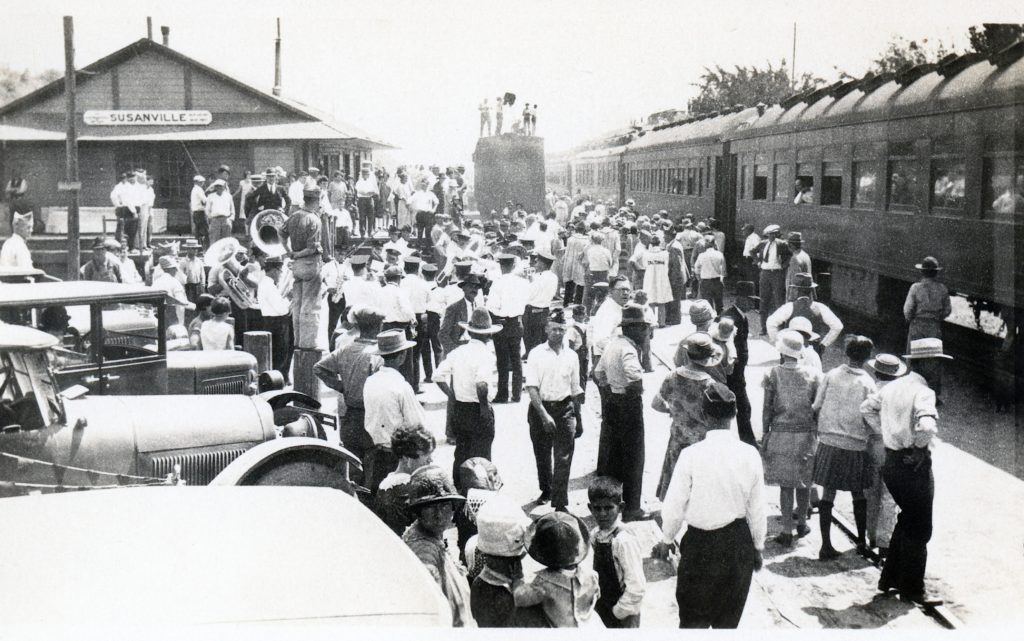
1926 American Legion Convention delegates arriving at the Susanville Depot. Courtesy of Nellygrace Stoll.
Susanville’s Lassen Mail newspaper dubbed the Southern Pacific’s passenger train the “Toonerville Trolley.” The Mail was quick to report that the train “crawls in and out of Susanville.” One of the problem’s that plagued the railroad, especially on the Nevada segment was the train encountered stray livestock, thus causing a delay in its regular schedule. In 1933, that would not be a problem when the Southern Pacific abandoned passenger train service on its Fernley & Lassen Railroad, a move that upset a lot of people, and, of course, the Lassen Mail.
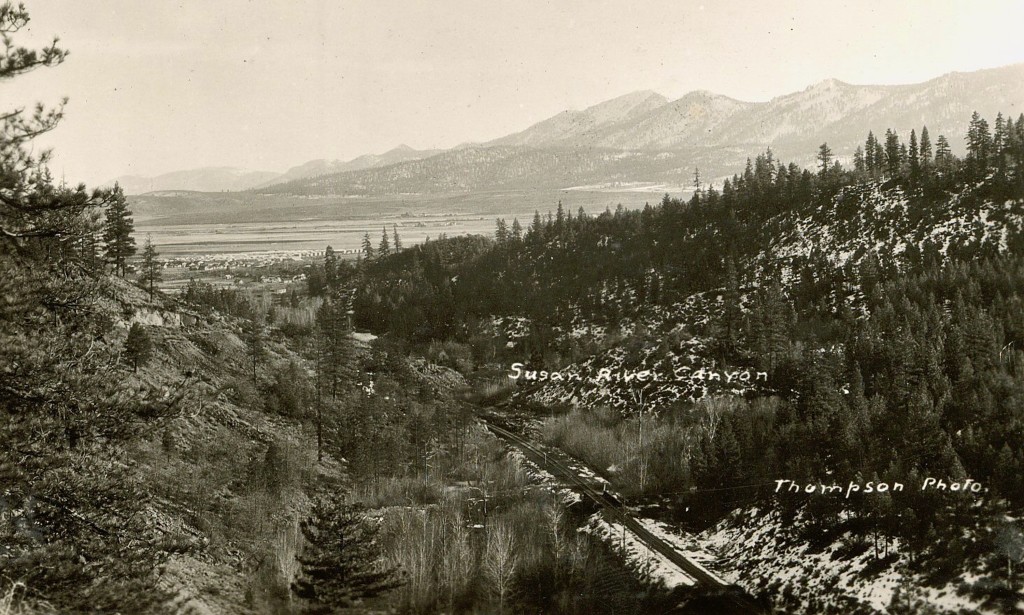
Susan River Canyon, 1920. Courtesy of Lola L. Tanner
Often just referred to as the “Bizz,” is a thirty-mile recreational trail that was converted from the abandoned Fernley & Lassen Railroad between Susanville and Westwood. There were a number of hurdles along the way, one which was to secure federal funding. Name it after a well known congressman, would do the trick. In1983, Congress designated it as the Bizz Johnson Trail in recognition of Northern California Congressman Harold T. “Bizz” Johnson who served in the House of Representatives from 1958 to 1980. This an excellent time to enjoy the trail and the fall colors.
The east slope of Fort Sage Mountain is now covered with cheat grass. June 7, 2018
If there was one positive aspect due to the lack of railroads in the region, was it delayed the appearance of invasive non-native plant species. The Russian Thistle, best known too many as the iconic “tumbling tumbleweed” did not make its appearance in Lassen County until 1914. The first plants were spotted along the Fernley & Lassen Railroad right-of-way. For the next two years, major efforts were undertaken to eradicate it, but it was a lost cause. The tumbleweed was followed next by an even more hazardous plant cheat grass. After the 2017 fire that spread from Doyle to almost Pyramid Lake, in many of the burned areas is covered with a thick growth of cheat grass, thereby choking out native plants.
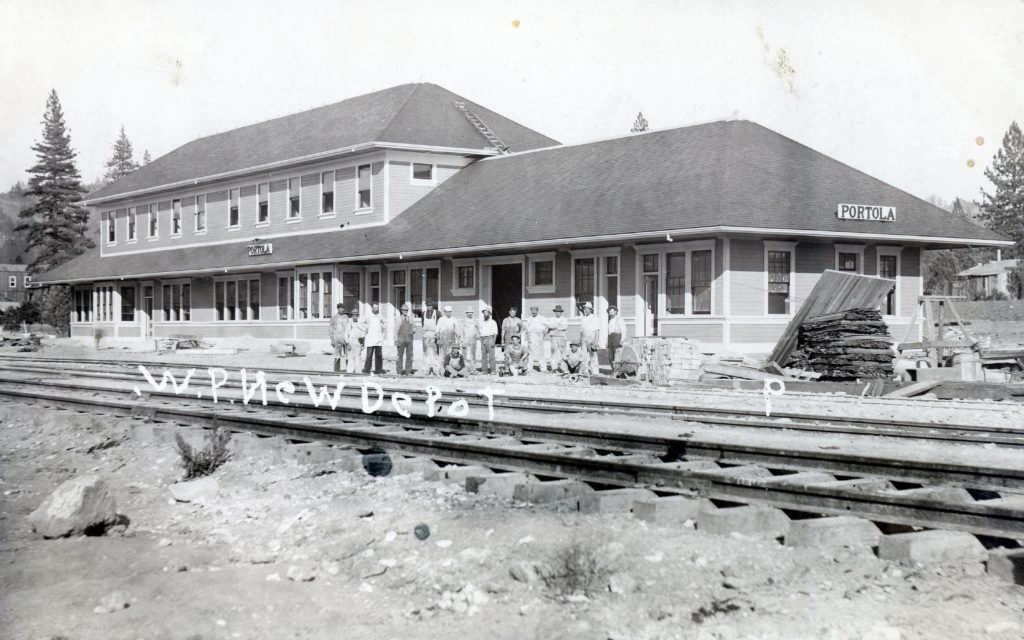
The Portola Depot. Notice the rails had been recently laid, no ballast.
During the construction of the Western Pacific Railroad, and with the rails reaching California, the big question was where the division point would be. There were two small stations, that sought that destination—Rayl, now the site of Herlong and Omira, just a short distance south of Doyle. While those two places were never serious contenders the battle was between Doyle and Portola. Each had their unique assets, but it was Portola that would claim victor.
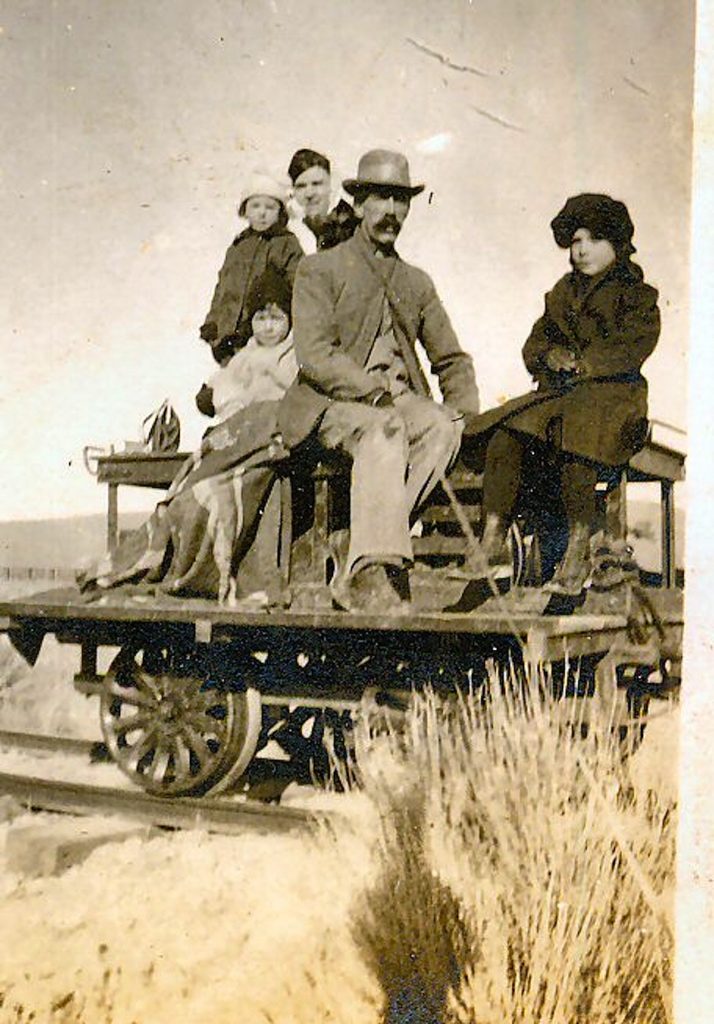
The A.C. Herring family on a NCO speeder at Amedee, circa 1909.
This was something I had always wanted to do, was ride on an old fashioned railroad speeder. They were so named, as I understand, that they were faster than a handcar. Speeders were used to examine maintenance of the railroad track. You might have seen the modern version were pickup trucks that have flanged wheels that can be lowered onto the rail, and I think that would be fun too.
The view from the approach of Lakview Terrace Estates, February 13, 2018
This was a dubious land subdivision that was laid out northeast of Amedee in February 1893. It was promoted to investors outside the area and for a good reason. The prospective buyer was presented with maps and photographs of the prosperous new town of Amedee. They were informed the new addition was on ground slightly higher that of the town, thus with its views made it desirable residential property. When buyers actually inspected lots they purchased, they were in for a real surprise. As the Amedee Geyser reported: “Truly the view from the terrace is a magnificent one, but the suburban resident to reach his home with the assistance of a fifty foot ladder will lose enthusiasm over the scenery.”
In the fall of 1893, a warrant for H.B. Griffith’s arrest was issued , who was the promoter of the subdivision, on the grounds for selling property under fraudulent pretenses. Griffith caught wind and fled the state, thus avoiding criminal charges.
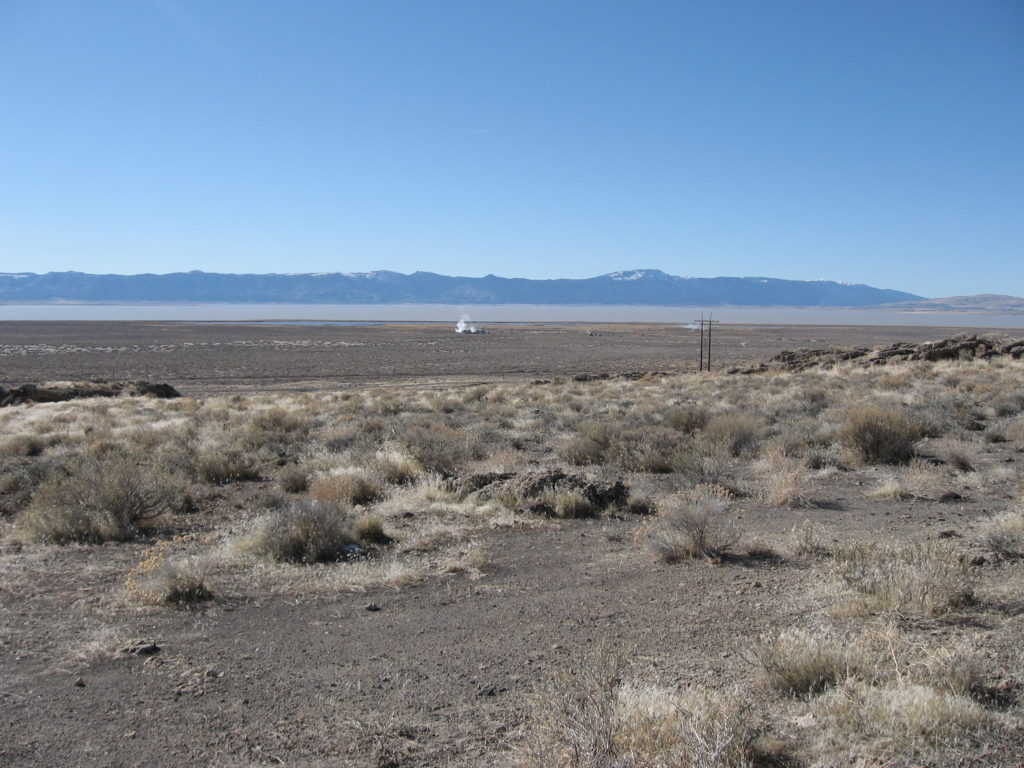
Located at the southern end of the Smoke Creek Desert, it was a tiny outpost on the Western Pacific Railroad that for a brief time even had its own post office that operated from 1911-1916.. Some of the old buildings remain in a dilapidated state, the railroad had abandoned it years ago. The most striking feature is the huge gravel pit the railroad used for its ballast.
It makes for an interesting stop, just to view the shear expanse of the Smoke Creek Desert and ponder where you might head to. If you continue along the main road, the next stop is the abandoned Bonham Ranch. Continue further, you can take a left turn on Smoke Creek Road and make an entire loop of the country, as it will take to near Viewland on Highway 395.
In the fall of 1912, Benjamin H. Leavitt proposed the town on his original ranch. Leavitt wrote to his granddaughter, Edith Elledge, of his intentions: “I am going to cut the old ranch up into small tracts and sell it off in ten and twenty acre tracts . . . I am also building a road down from Rice’s Canyon, you know that is directly north of the town of Leavitt, to connect with all the northern trade clear out to Big Valley. The R.R. Co. have agreed to put their stock yards there. I have given them the land for the stock yards. I am also going to extend the road through the ranch to intercept the Janesville Road near Billey Indian. All the merchants of Janesville have agreed to order their good shipped to Leavitt which will make it one of the largest shipping points on the Fernley & Lassen.”
In addition, Leavitt offered railroad officials land if they would construct their roundhouse there. That proposition did not occur as Susanville’s business community convinced the railroad to locate that operation in their town. “The City” consisted of only the store, a few dwellings, and several large corrals that held livestock for shipment on the railroad.
Yet, years later, one could say a city of sorts of was built just north of Leavitt, the home of the California Conservation Center and High Desert State prisons.
The NCO train near Amedee, January 1916. Courtesy of Marie H. Gould
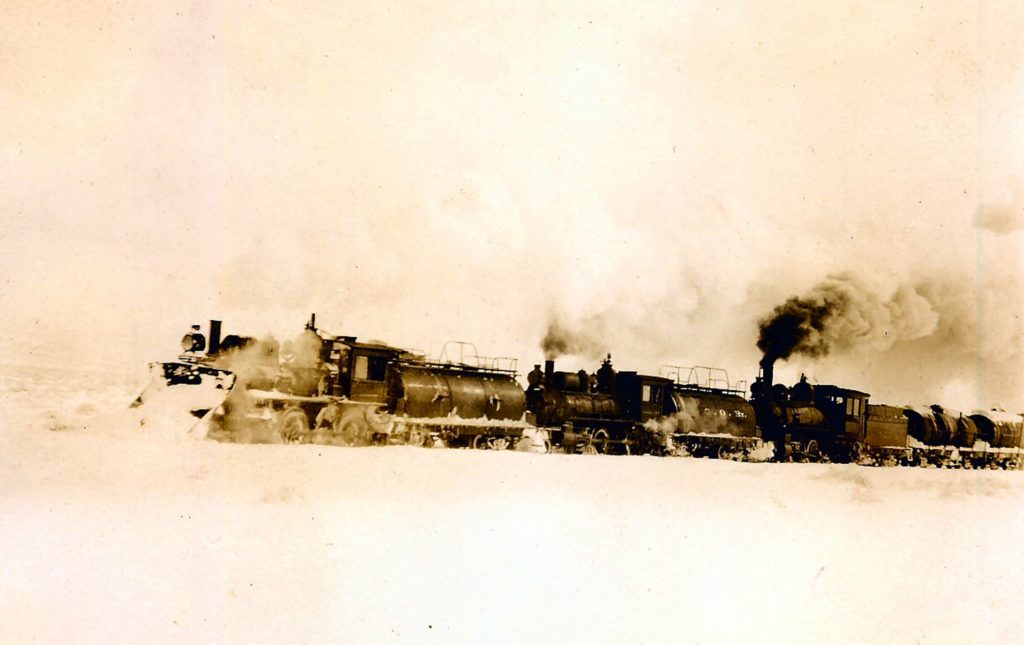
The poor little Nevada-California-Oregon Railroad had a troubled beginning that would stay with it. The N-C-O for those not familiar was narrow gauge line that ran from Reno, Nevada to Lakeview, Oregon. It was initially known as the Nevada & Oregon and later the Nevada & California, before it finally incorporated all three states in its name in 1888.
These initials, N-C-O became a target for criticism for the railroad’s poor service. The railroad received such dreadful titles as the Narrow-Crooked & Ornery, Northern California Outrage, Never Comes Over and the Nevada-California-Occassional. J.M. Tremain, editor of Susanville’s Lassen Weekly Mail, called the N-C-O a Tri-weekly: “It goes to Reno one week and tries to return the next.”
Rail cars on the old Southern Pacific line at Flanigan, February 13, 2018
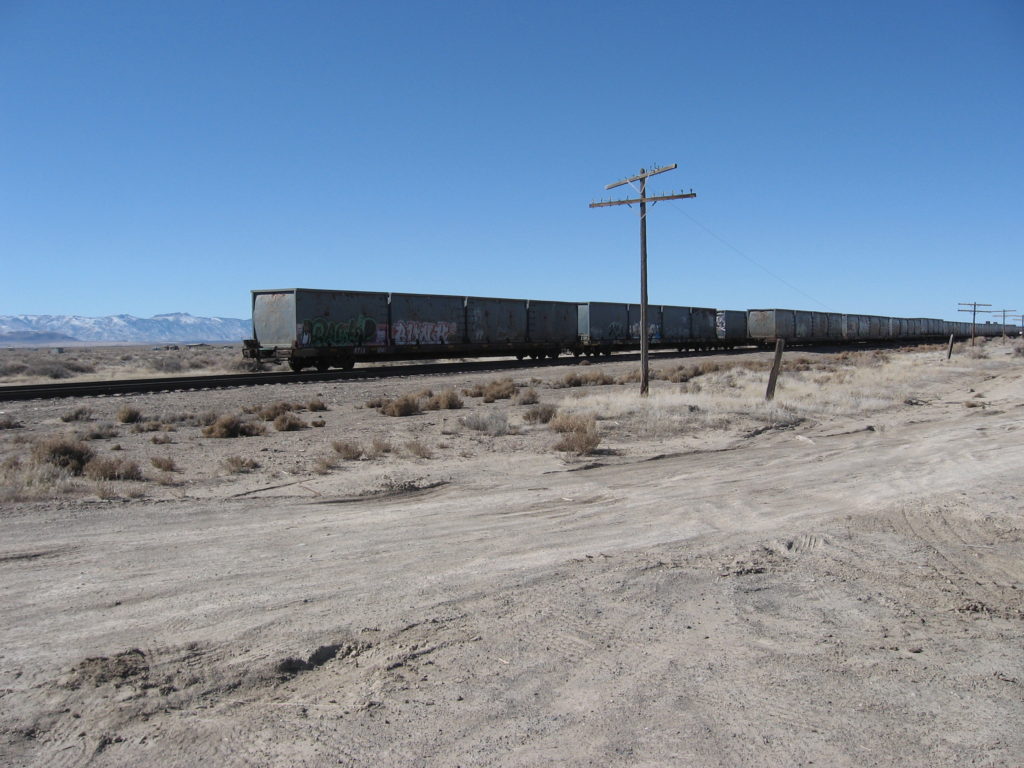
There is really not much left of the former railroad community of Flanigan. It is, however, not void of activity. As you can see from the photograph there are lots of railroad cars parked there. They happen to be full of railroad ties. Near the former intersection of the two railroad lines, is now chipper to grind the old ties.