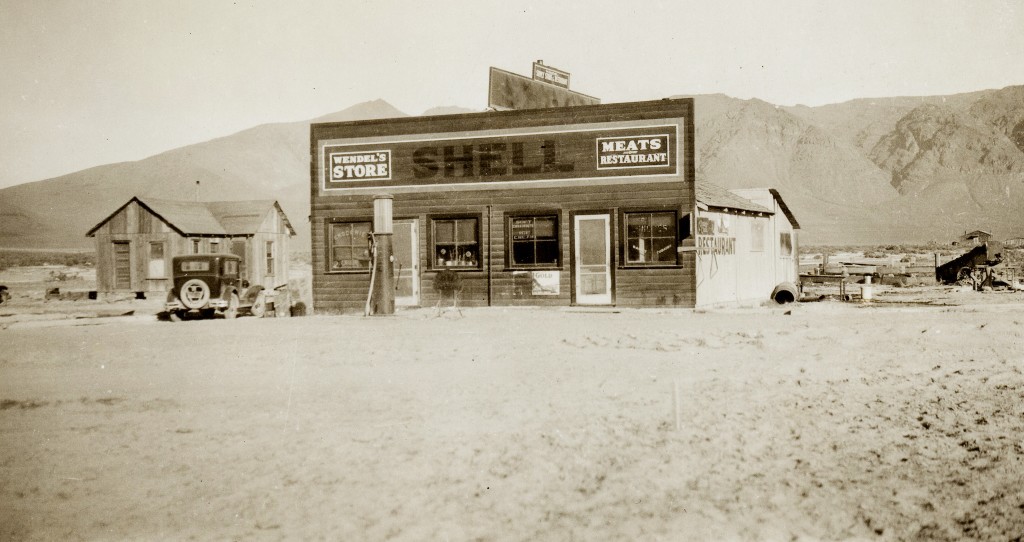
Wendel Store, circa 1925. Courtesy of Alda Riesenman
This was not your best criminal mind at work. At one o’clock in the morning of February 22, 1931, fifteen-year-old Paul Bryan entered Bill Lewis’ restaurant in Wendel. (It no doubt operated twenty-four hours day to accommodate the railroad workers.) He asked the night clerk for some onions. The clerk went into the store room to fetch the onions. When the clerk returned Bryan and the store’s slot machine were missing. In a short time Bryan returned for the onions. The clerk obliged with the onions and when Bryan left, the authorities immediately notified.
At daybreak, Sheriff Jim Leavitt spotted the young man in the railyards trying to board a freight train. He was arrested on the spot. About a mile from the restaurant the slot machine and bag onions were found. The slot machine had been chopped opened with an axe, the money all gone.
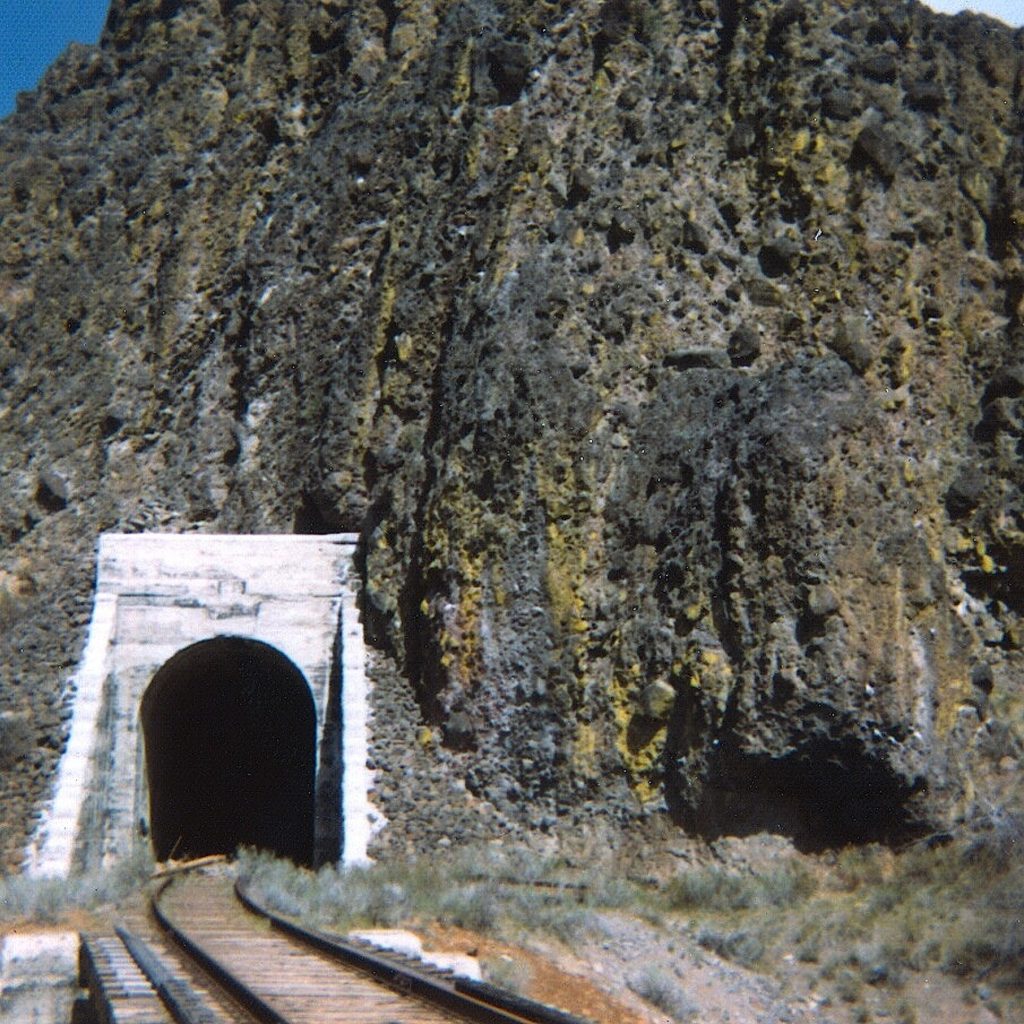
Chilcoot Tunnel, December 2, 1906. Courtesy of Marge Foster
In the fall of 1903, Western Pacific Railroad surveyors invaded the Honey Lake Valley and the region west of Susanville. This led to speculations regarding a new route to bypass Beckwourth Pass. If that was the case, the railroad would not have to build the 6,002 foot-long Chilcoot Tunnel under Beckwourth Pass, but even an additional longer tunnel at Spring Garden towards Quincy. It was decided on the Beckwourth Pass route, though the Susanville route would later gain traction.
On May 28, 1912, a fire broke out on the west end of the Chilcoot Tunnel. The heat was so intense WP crews were unable to suppress it. Newspapers, both local and regional, were quick to attack the WP over the costly Chilcoot and Spring Garden tunnels. It would take nearly a year before the Chilcoot tunnel could be repaired. To keep the trains moving, an expensive shoo-fly (temporary track) was constructed over Beckwourth Pass.
The Susanville route, now referred to as “cut-off” was debated. On September 13, 1912, Susanville’s Lassen Advocate wrote: “The Chilcoot Tunnel is still too hot that men cannot work in it. That tunnel will yet make it so hot for the pocketbooks of the Western Pacific.” It took nearly a year and a half before the tunnel reopened.
One of popular local attractions is the Bizz Johnson Trail. It is a Rails to Trails Project to convert the abandoned railroad line between Susanville and Westwood. Like many projects it did not happen overnight. When it was first proposed in 1978, there was some local opposition.
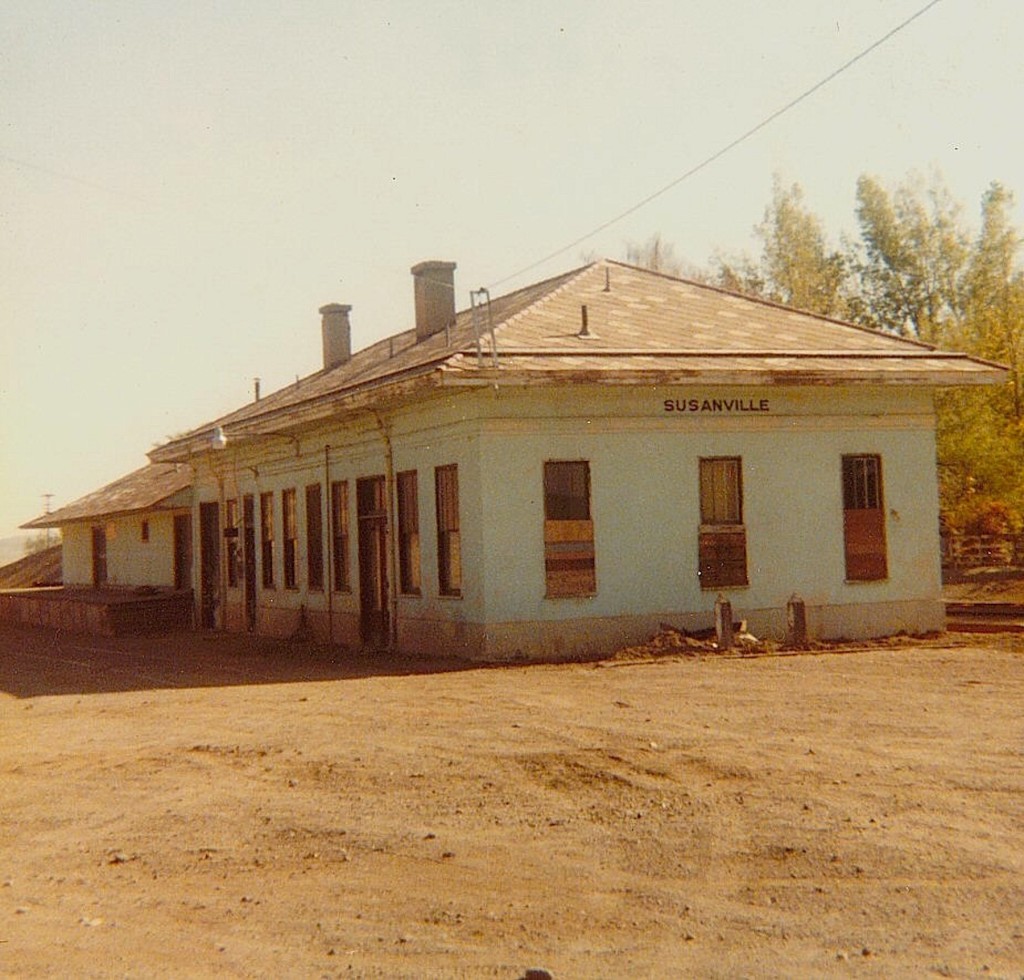
Anyhow, the project moved forward. There was a lot of work to be done to make the conversion a reality—like the removal of the rails and ties. In the summer/fall of 1981, Jim Dobbas of Truckee, a salvage operator had the job to remove the said rails and ties. For a time there was an impressive site of stacked rails and ties at the Susanville Depot. A portion of the re-usable rails were donated to the Virginia and Truckee Railroad.
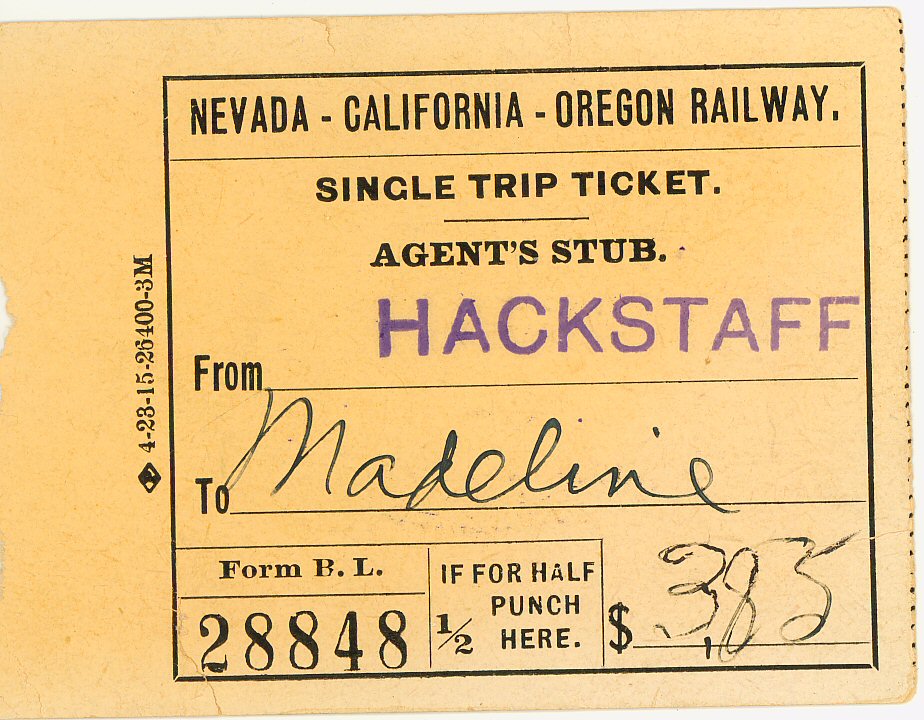
A November 22, 1915 NCO ticket stub. Courtesy of Dorothy Capezzoli
The Nevada-California-Oregon Railroad (NCO) was a stingy operation and because they had no competition for many years, took advantage of the situation with its freight and passenger rates.
However, in January 1892 the NCO offered a generous one thousand mile ticket good for the whole year for an entire family at $30. At that time, Amedee was the end of the line and was 80 miles north of Reno. A one way fare between the two places was $1.35. So if one was doing frequent travel it was a bargain. With Amedee a thriving boomtown, the NCO knew there were would be a lot of passenger traffic, hence the special offer.
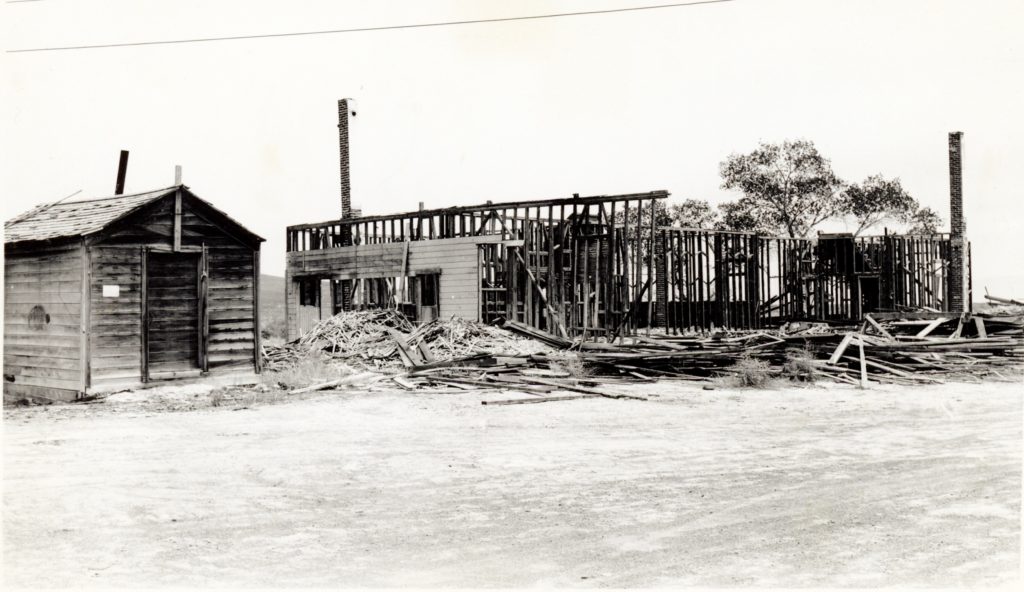
The remnants May 1950. Photograph taken by Harry Ryan
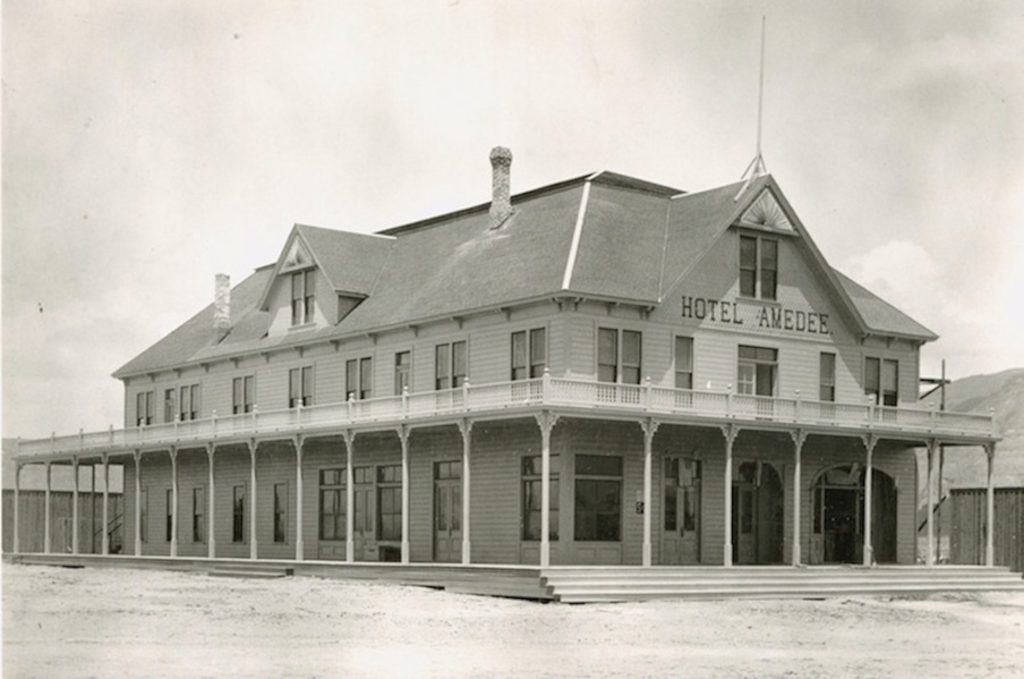
Amedee was the premier railroad boom town on the east side of Honey Lake. It was created in essence when the Nevada-California-Oregon Railroad (NCO) extended its line there in 1891. The following year witnessed lively times rivaling in population of Susanville. The town’s centerpiece was the majestic Amedee Hotel. In 1899, the NCO began work to extend its line north, and Amedee slipped a notch or two in importance. A revival of sorts began in 1910 with the Standish Water Company’s development of an elaborate irrigation system. In 1912. A second railroad, the Fernley & Lassen, added more excitement to region.
By 1917, Amedee’s decline had begun. In 1918, the NCO abandoned the segment of the railroad that serviced Amedee. At the same time the Standish Water Company’s project failed. Then with the advent of World War I a major segment of the east side of Honey Lake was de-populated. By the 1930s, the only occupants of the hotel was the town’s caretaker. By the 1940s the hotel was in a slow decay. In the spring of May 1950, Jack Humphrey who owned it had the hotel dismantled, since it was constructed with premium lumber. The lumber was then hauled to Jack’s residence near Milford, in which he intended to use it to construct a new home the following year. That September a forest fire destroyed the barn that the lumber was stored in.
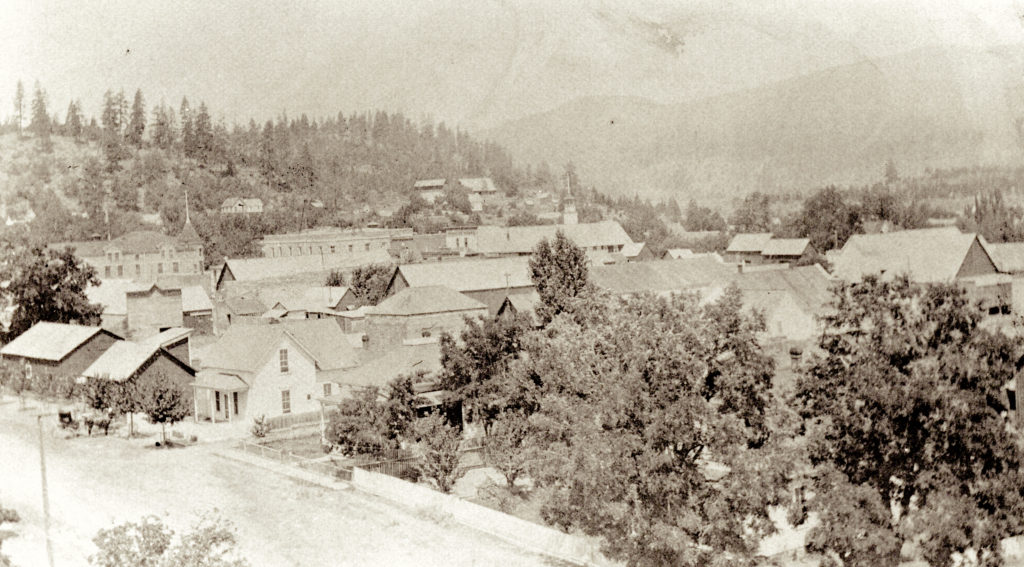
A unique view of Susanville, 1905. Courtesy of Mary Dale Folsom
This was a very short-lived organization that existed during the month of January 1899. The lead instigator, was well known Susanville attorney, E.V. Spencer. At this time, The Nevada-California-Oregon Railroad (NCO) began work to extend its line north from Amedee to the Madeline Plains, again bypassing Susanville. Spencer and L.C. Stiles were appointed representatives of the Club to meet with NCO officials, in this case E. Gest, the manager. The duo reported the meeting was cordial, the NCO had no intent to construct a feeder line. Gest, is the people wanted to construct it, he estimated the cost at $100,000. The initiative floundered. It is interesting to note that Gest testified that summer to California Board of Equalization that the people of Susanville did not deserve a railroad.
There were some local critics that thought the Susanville Improvement Club could do a lot of other work than trying to be a railroad builder. Whatever the case may be, the improvement club morphed into the Susanville Town Hall Association a month later.
In 1910, with no concrete substantial proof that a railroad would traverse the Honey Lake Valley, the Lassen County Chamber of Commerce remained positive that one day it would happen. In an attempt to be proactive, they approached the Susanville City Council to rename the town. It was their contention that the suffix “ville” carried on the conotation of a small village. They wanted something with a metropolitan flair. It was a sensitive issue, since the town’s namesake Susan Roop Arnold still resided in the community. The chamber wanted the matter placed on the ballet. The council said no, case closed.
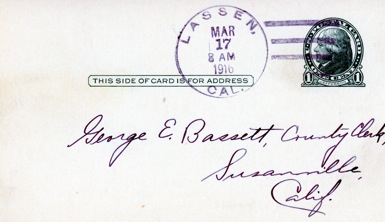
In 1912, with the Fernley & Lassen Railroad a reality, the real estate community was in full force to rid the Honey Lake Valley of town’s ending in “ville.” The first victim was Spoonville, which became Edgemont. The next one, Janesville, was controversial. well. On July 2, 1914, the Janesville Post Office was renamed Lassen. This did not set well with many of the town’s residents. A petition was sent to the Postmaster General to restore the name, but it was denied. It led to confusion since the town was known as Janesville, but its mail designation was Lassen. In 1923, the residents once again petition the postal authorities to restore the name. It was granted and on September 22, 1923, the Lassen postal designation was dropped.
Stacy was a small agricultural community in eastern Honey Lake Valley and serviced by the Fernley & Lassen Railroad. The post office was established on July 11, 1912 and named for Stacy Yoakum Spoon, a wife of one of the town’s promoters. Of note, the Yoakum name may not be familiar to many. Stacy’s father in the early 1900s was the manager of the San Francisco Ranch in Willow Creek Valley, known today as Five Dot. Her sister, Eulalee, married Robert Trussell, a well known Johnstonville family back in the day.
Once upon a time, many years ago, when I was with my Dad, we met an elderly gentleman, who my father introduced me to him as the “Mayor of Stacy.” At that time, to be quite honest, I am not even sure if I knew where Stacy was. Anyhow, that man’s name was Allson Newman, a native of nearby Sierra Valley. In 1916, Newman’s parents, Ferdinand and Jennie located to Stacy, where is father operated a store and the post office. After his father’s death in 1942, Allson took over the family business and postal duties, too. As the region continued to de-populate, the Stacy Post Office closed on June 30, 1951. In the course of time, the Mayor of Stacy, would finally retire to make his home on South Spring Street, Susanville.
Stacy Depot. The town was named for Stacy Yoakum Spoon, wife of Grover Franklin Spoon, one of the town’s developers and its first postmaster.
Great Northern’s Tracklayer entering Big Valley. Courtesy of Orville Watkins
In 1893, The Great Northern Railroad reached Seattle, Washington, from its origins in Minnesota. Its founder, James J. Hill, known as the “Empire Builder” wanted more. He wanted to extend his line south to tap into the lucrative California market. During the early 1900s over a half dozen railroad surveys were made in the Lassen-Modoc region. Speculation was rampant. In 1909, it was rumored that the Great Northern would purchase the region’s NCO Railroad which would provide Hill a link into California. It never materialized, and Hill retired from the railroad in 1912, and passed away in 1917.
In the late 1920s, Hill’s dream would become a reality with the construction of the Inside Gateway, where a 200 mile railroad construction project would connect the Great Northern and Western Pacific Railroads. The Interstate Commerce Commission approved the project in 1929.The Great Northern would build an 88 mile rail line from Klamath Falls, Oregon to Bieber where it would connect with the Western Pacific, as they would extend a branch line from Keddie to Bieber.
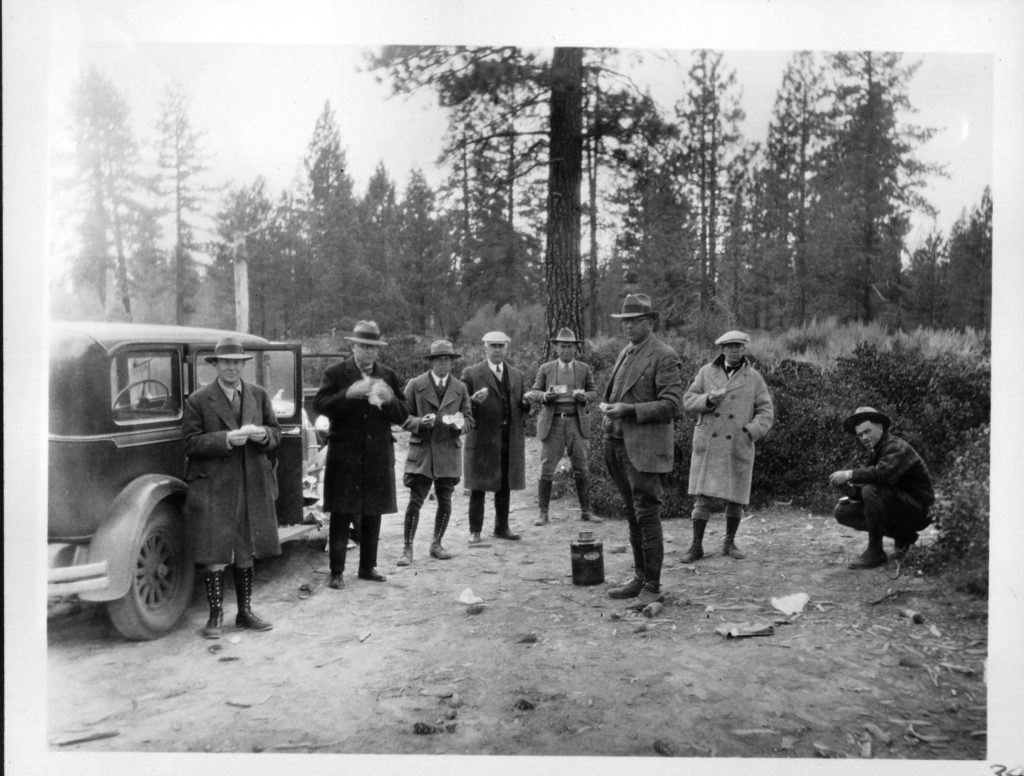
Lunch break of park and Western Pacific Railroad officials, 1930. Courtesy of the National Park Service
For the casual observer who decides to make a detour off Highway 44, near Poison Lake in western Lassen County, to travel the dirt road north to Pittville, one will see a variety of sights along the way. One of the first encounters is that of Halls Flat, a small non-descript sagebrush covered flat surrounded by pine trees. Nothing to get excited about, but like watching one of those late night infomercials, there is a lot more in store!
In the late 1910s, Tehama County rancher, Walter Davis Hall (1886-1960) used this area for summer grazing and on April 29, 1926, he was granted a 160-acre land patent—hence the name Halls Flat. Little did he know, that not to far in the distant future, this spot would be an amazing hub of activity.
It first began, in 1930, when the Interstate Commerce Commission approved what many refer to as the Highline or Inside Gateway that connected the Western Pacific Railroad from Keddie, California with the Great Northern Railroad at Klamath Falls, Oregon. This just happen to coincide with the development of Lassen Volcanic National Park and this future railroad line would come close to the park’s eastern boundary. Customary at the time, Lassen Park and Western Pacific had a courtship—the park seeking a concessionaire, while the railroad hopefully would see increased passenger service among other amenities.
This is where, Halls Flat could have played a pivotal role. Western Pacific would develop a resort at Manzanita Lake in the park. At Halls Flat, or maybe Poison Lake, where a railroad station would be built, there would a stop. At this point, passengers would disembark and be shuttled by bus through the northern section through the park to their destination at Manzanita Lake to spend days recreating. To build the lodge at Manzanita along with other amenities was estimated at $275,000. Due to outside legal issues, the Western Pacific had to suddenly withdraw from the proposal.
The stage was set, for different reasons, and Halls Flat became a major hub of activity during the 1930s and 1940s that we will explore in future installments.