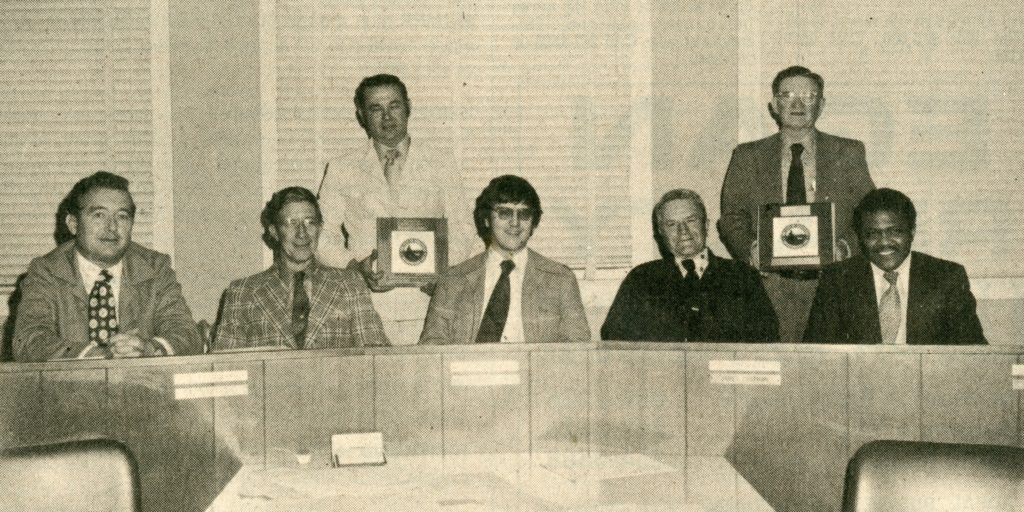
Seated left to right: Fred Metz, Mayor Pro Tem Charles Richardson, Mayor Jim Chapman, Dan Sanchez and Herman Walker. Standing outgoing city council members Ken Loflin and Ivor Lanigar.
At the Susanville City Council’s organizational meeting on March 9, 1976, Jim Chapman, at the tender age of 21, was made the Mayor of Susanville, the youngest person ever to hold that title. Chapman had aspirations that year and ran for Lassen County District Two Supervisor and won that seat in November.
It should be duly noted the city’s organizational meeting then was ceremonial, but not this time. The council rolled up their sleeves and went to work on the pressing issue of the day concerning the grandstand at Memorial Park.
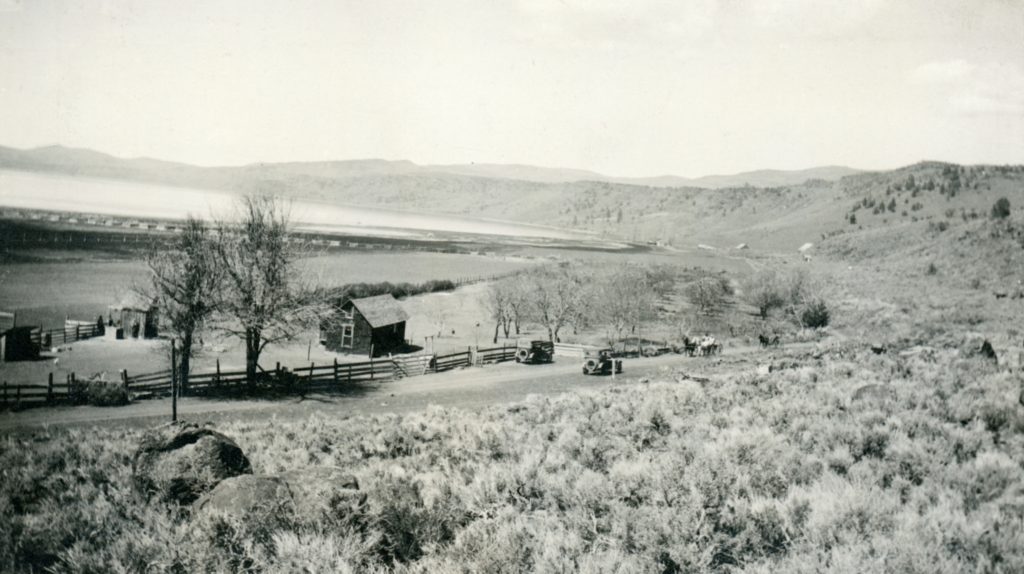
Fritter Ranch, Eagle Lake, 1921. Courtesy of Lola L. TannerIn 1884, James Fritter, along with his wife Frances and three small children left Butte County and located on the northeast shore of Eagle Lake, claiming 160 acres. Nothing unusual about that. In 1903, he planted an apple and peach orchard, which he had many successful harvests, which is rather remarkable given the elevation at the lake, that even regular gardening can be a challenge.
For a brief time, Fritter had political ambitions. In 1900, he ran for State Assembly and lost. Two years later, he ran for a seat on Lassen County Board of Supervisors and was successful. However, things did not go smoothly. Willow Creek Valley resident, H.A. Morrill contested the election, citing that Fritter was not residing in the district. The matter drug on for some time in the court, but in the end he prevailed. In 1910, Fritter ran for public office for the last time, again for a seat on the Lassen County Board of Supervisors. He lost in a landslide to W.C. Brockman.
As the years went by his grown children moved onto other things. In January 1932, with his years advancing and running the ranch by himself, he opted for retirement at Pacific Grove. He died there two years later. It should be noted the family still owns the original 160-acre homestead.
Roops FortThis a Cliff note version of this event that occurred on February 15, 1863, that would result in the creation of Lassen County. In the simplest terms the conflict also known as the Boundary War was the result of John C. Fremont’s selection in 1850 of the 120th Meridian for California’s eastern boundary. The problem was no one knew where that was, and assumed it followed the crest of the Sierra Nevada Mountains. In the late 1850s, with the settlement of the Honey Lake Valley, officials of both California and Nevada saw the uncollected tax dollars waiting to be had. Tensions escalated wherein an armed conflict from the two states took place at Roop’s Fort, also known as Fort Defiance. In the end a truce was called when both sides agreed to conduct a boundary line survey to locate the 120th Meridian, in which it was determined the majority of the Honey Lake Valley was located in California.
Lassen County, 1907While there is plenty of chatter of late regarding a Calexit or State of Jefferson one of the more interesting and plausible movements was to consolidate California’s 58 counties into 27. In 1933, California Assemblyman B.F. Feigenbaum made the proposal, citing with highways and transportation facilities there was no longer a need to have a courthouse at everyone’s back door. He said the cost savings would be tremendous and noted rising costs that in 1911 county government cost was $39 million and in 1930 had ballooned to $299 million. In our neck of the woods, Lassen Plumas and Sierra would be combined as one. Our neighbors, Shasta and Tehama would merge, and the same with Modoc and Siskiyou.
Lassen County Courthouse, 1922.When the Red River Lumber Company established its operations at Westwood it had a very congenial relationship with Lassen County officials. That all change in the fall of 1916 when United California Industries wanted to rent a hall in Westwood to discuss prohibition. Red River refused. A firestorm erupted by the Susanville press the Red River’s general manager, R.F. Pray. Pray was livid with the newspapers’ coverage and their commentary of the sordid affair. First, he noted, the newspapers had no right to publish the correspondence between United and Red River, as it was a private business affair not subject to public scrutiny. Pray in his rebuttal wrote, “When commencing operations on a large way in Lassen County three years ago, we informed the public and our employees that we were in engaged in the manufacturing of lumber and not in politics, that we refused participate in them, or be drawn in any political issue.” In conclusion, Pray inferred Red River did not deserve this kind of treatment recently played out in the press. After all, he reasoned, not only was Red River the county’s largest industry and it was the largest purchaser of local produce. Finally, if Red River had its way, last year they would have defeated the bond measure for a new county courthouse, reducing the company’s tax burden. Yet, Red River stayed out of the political arena and now Lassen County citizens are enjoying their modern facility that otherwise would not have materialized.
In 1925, Great Western Power Company announced its plans to enlarge Lake Almanor. The raising of the dam would flood a large portion of Chester Flats, thus flooding a number of roads, and also Red River Lumber Company logging railroad network. Controversy arose when Great Western informed the Plumas County Board of Supervisors that the road across Chester Flats would be re-routed to follow the high water contour. The residents of Chester and Westwood were furious, for such a proposal would add an additional seven miles between the two communities. They wanted a causeway in which the current route would remain the same. Great Western balked at the idea. After all, a causeway would cost Great Western $220,00, while to re-route the road would only cost $50,000. To make a long story short the opponents bypassed the Plumas County Board of Supervisors and had the State Highway Department intervene. In 1926, an agreement was made between the State and Great Western that a causeway would be constructed.
Roop Siding on the Fernely & Lassen Railroad just north of Pyramid Lake, April 1966. Courtesy of Gil Morrill
After nearly 100 years after Lassen County was created in 1864, some historians thought it really should have been named Roop County. However, that would have been problematic, since across the stateline in Nevada was Roop County. Nevada officials were critical of the Roop name, J. Wells Kelly, who compiled the First Directory of Nevada Territory questioned the choice of the name and stated that it should have been named Lassen County. Kelly wrote: “Every dictate of gratitude and propriety, suggested the name of Peter Lassen—the noble old pioneer who, the first to enter, finally lost his life in exploring these wild regions—as that which should have been bestowed upon the county.” The after effects of the Sagebrush War reduced Roop County to a long narrow strip of land from Pyramid Lake to the Oregon border. Since it was a sparsely settled territory, with no town, the Nevada Legislature, on February 18, 1864, attached it to Washoe County for judicial and revenue purposes. On January 16, 1883, it was officially abolished and made a part of Washoe County
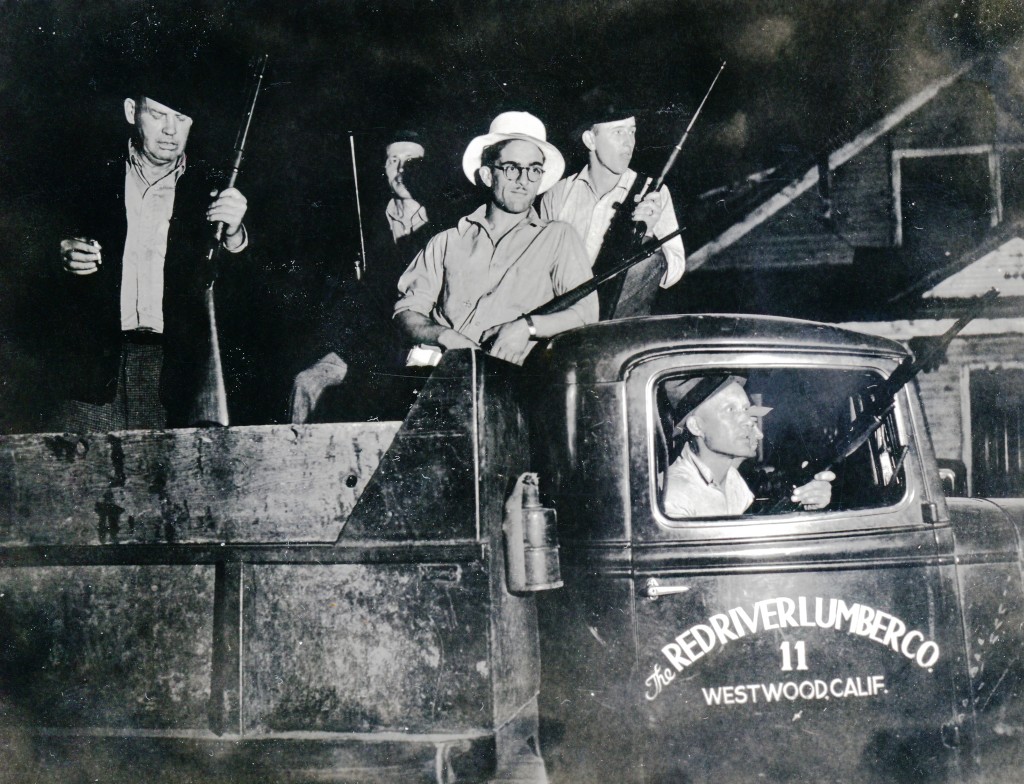
Purge Night, July 13, 1938. Courtesy of Frank Davis
Estate Sale: I need to make room for items from my mother’s estate. This a great bargain 50% off, your cost $12.50 plus shipping. What a deal!
The carefree spending days of the Red River Lumber Company came to an abrupt end. Bonds were used to finance the construction of Westwood came due. On the other hand, Fletcher Walker continued expanding operations, each at an additional cost. The bondholders on the other end were not pleased with the delinquent payment and return. A free for all battle occurred as to whether the banks or the Walkers would control Westwood. The Walkers, made concessions to keep the banks at bay.
Then there were labors problems. It began with the purge of the CIO members and their families who were driven out of Westwood in 1938. That was the tip of the ice-berg. The following year the AFL went on strike over the same issue of wage restoration that the CIO wanted. It was a mess, to say the least, and it would be one of many factors that would seal Red River’s fate. Click here to order.
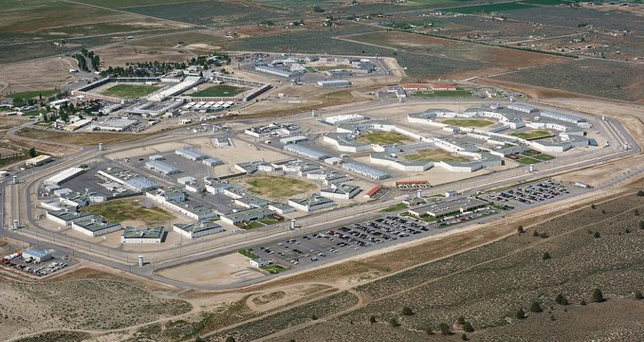
So it is a different from the French version. On this day in 1993 groundbreaking ceremonies were held for High Desert State Prison. Long before construction of its neighboring prison the California Conservation Center as it was originally called, was highly debated. So much in fact, the issue whether to build a second prison was put before the voters of Lassen County in June 1992, that won by a 58 percent voter approval. High Desert State Prison was designed to house 4,500 inmates and opened in September 1995.
A native of North Carolina and born on 29 April 1813, is in many ways considered the original dean of Lassen County’s legal community. Like so many, he slowly worked his way west. His first stop Montgomery County, Indiana where his four children were born. Then it was to Iowa for a brief spell. In 1849, Harrison set out for the gold fields of California and like so many others, had never mined before.
Fortunately, when he arrived in Shasta County he was able to fall back on his original profession as an attorney. He served two different terms as county judge in Shasta, and then moved to Red Bluff. There he served a term as Tehama County District Attorney. In 1862 he was lured to the mines of Unionville, Nevada. Again, he fell back on his previous profession and passed the Nevada bar exam.
In 1863 he returned to Red Bluff to spend the winter and the following spring moved his family to Susanville. On October 18, 1865 he was elected county judge of Lassen County. After his two year term expired, he continued with his mining interest. In June 1868, he was appointed to the position of Lassen County District Attorney, as Isaac Roop failed to qualify for that job. He remained in that position until his death on April 24, 1870. It should be duly noted that some of his descendants still reside in Lassen County.