Tag Archives: Nevada

Hardin City, Nevada

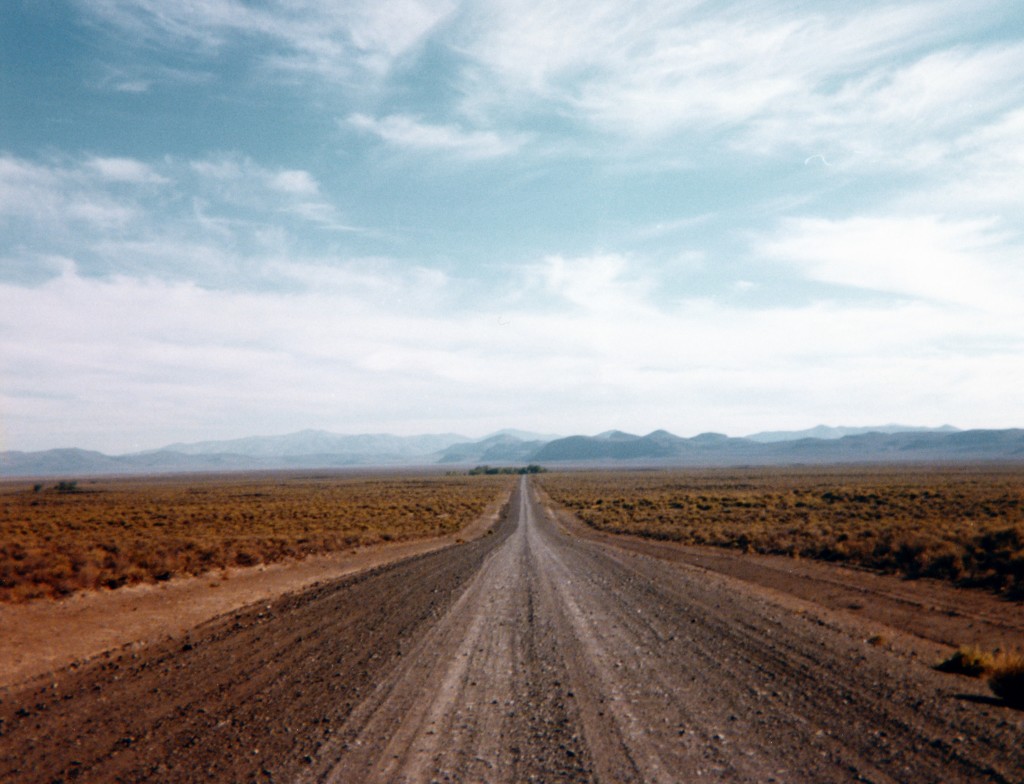
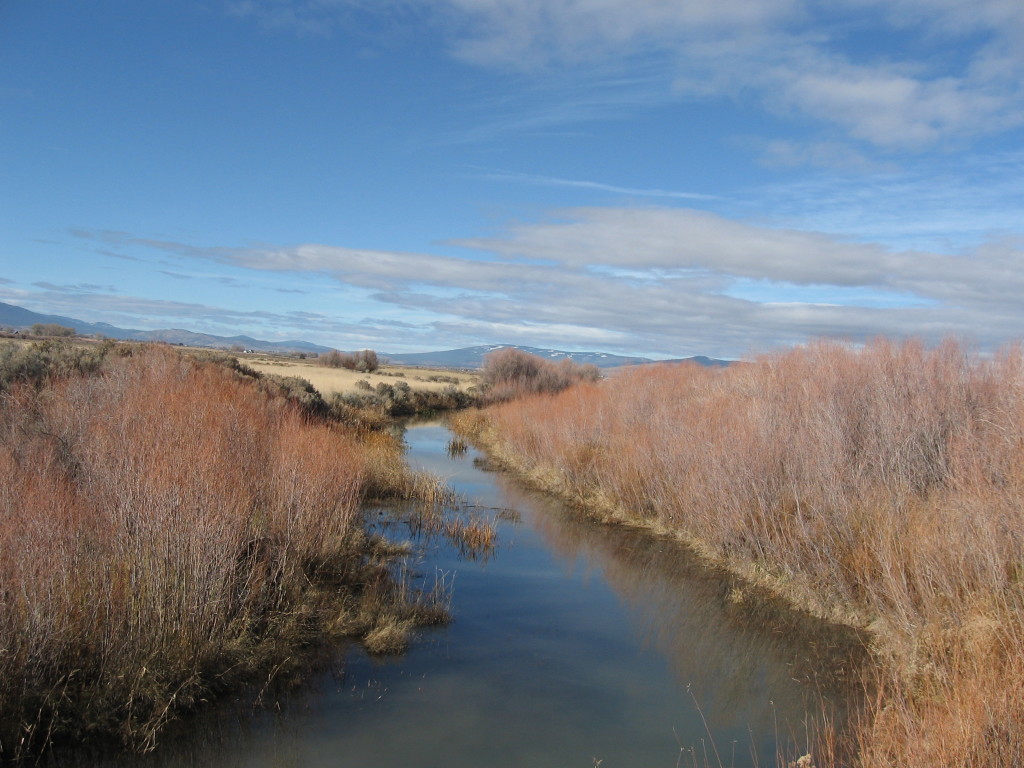
Clapper Canyon/Creek, Black Rock Desert. Courtesy of D. Dickerson

Hardin City was a short lived mining town in the Black Rock Desert during the 1860s. It was named after James Allen Hardin, a member of emigrant party in 1849 who a made an accidental silver discovery in that vicinity by picking up a rock there, but did not realize until later when he resided in Petaluma. Thus, another lost mine story began. In 1859, Peter Lassen and others made an expedition in search of the mineral deposit and it was a fatal mistake for him and his companion, Edward Clapper. Lassen was only several miles from where Hardin City would spring up.

Anyhow, while sorting through my file on Camp McGarry, I came across this article of Modoc Independent of Alturas dated 11 September 1884. Its an account from Alturas resident, H.L. Spargur,  who was one of many prospectors in the Black Rock Desert back in the 1860s. I thought some might enjoy it.

”Black Rock — H.L. Spargur who has been on a prospecting trip through a portion of Nevada, relates some stories which cannot fail to be interesting to them who some eighteen years ago believed that the Black Rock mines were the richest in the world, and braved all sorts of dangers and hardships in efforts to develop that section, but at last were forced to abandon the mines and see all their golden dreams fade away. Mr. Spargur was one of the those who, in 1866, went to the Black Rock mines and, with his family, stayed there as long as there was a ghost of a show, and was among the last to pull up camp and seek new fields.

“Many of our readers will remember that a quartz mill was built, and that no less than three towns were laid out, and for a time the Black Rock country was a lively one. Mr. Spargur says that although it has been sixteen years since he left Harden City, (one of the three towns referred to) he found it looking natural as the day he left it. The houses, which the miners built for themselves and families were of adobe, and although for 16 years they have been deserted by human beings, they are now in as perfect a state of preservation as they were when they were abandoned in 1868. Mr. Spargur speaks of the wonderful preservative qualities of the water of that place and the peculiar state of the atmosphere, and gives it as his opinion that “a man would never die at Black Rock.” He says that in the year 1867, when the quartz mill was built a wooden pipe was laid to convey the water from one of the springs to the mill, and that when a year afterwards the mill was torn down and hauled away, this pipe was left undisturbed and that at the time of his visit to Black Rock, some three weeks ago, the water was still running
through the pipe and the material of which it was made was as sound as it was the day the water was turned in. Mr. S. says that while strolling through the streets of Harden City he noticed pieces of boards and even the smallest splinters of wood which has been there exposed to the elements all these years, are still as firm as when they left there by the miners years ago. “[Note: The quartz mill was moved to Hayden Hill]
Donate

Postal Cancel – National Air Mail Week

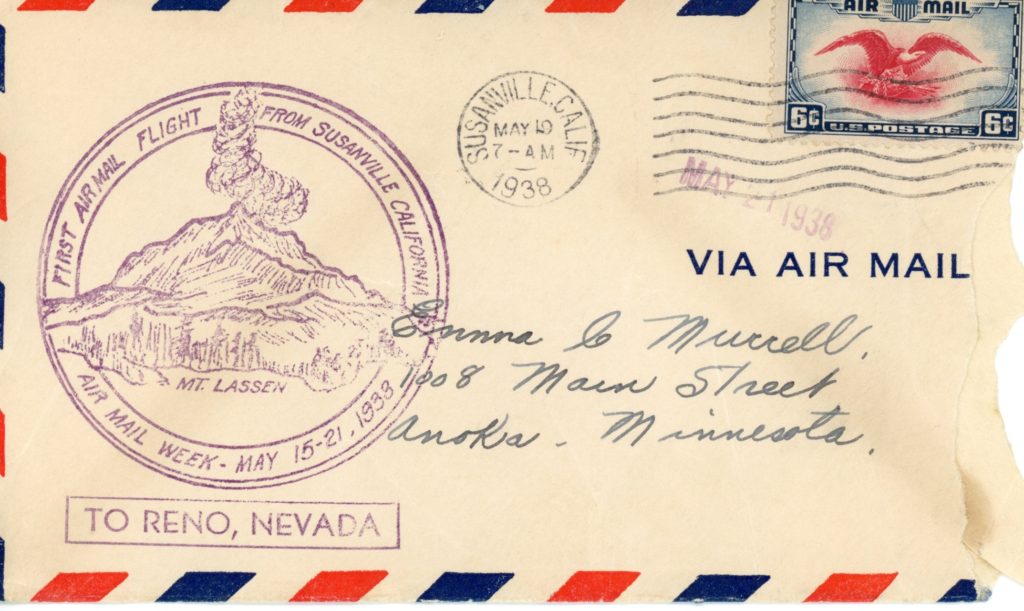
Susanville resident Florence Uptegrove sent this special air mail to Emma Murrell.

One just never knows what can be found on Ebay. Some time ago, I found this Susanville Postal cancel for National Air Mail Week which was held during the week of May 15-21, 1938. It commemorated the twentieth anniversary of the implementation of air mail. Citizens and communities were encouraged to participate.

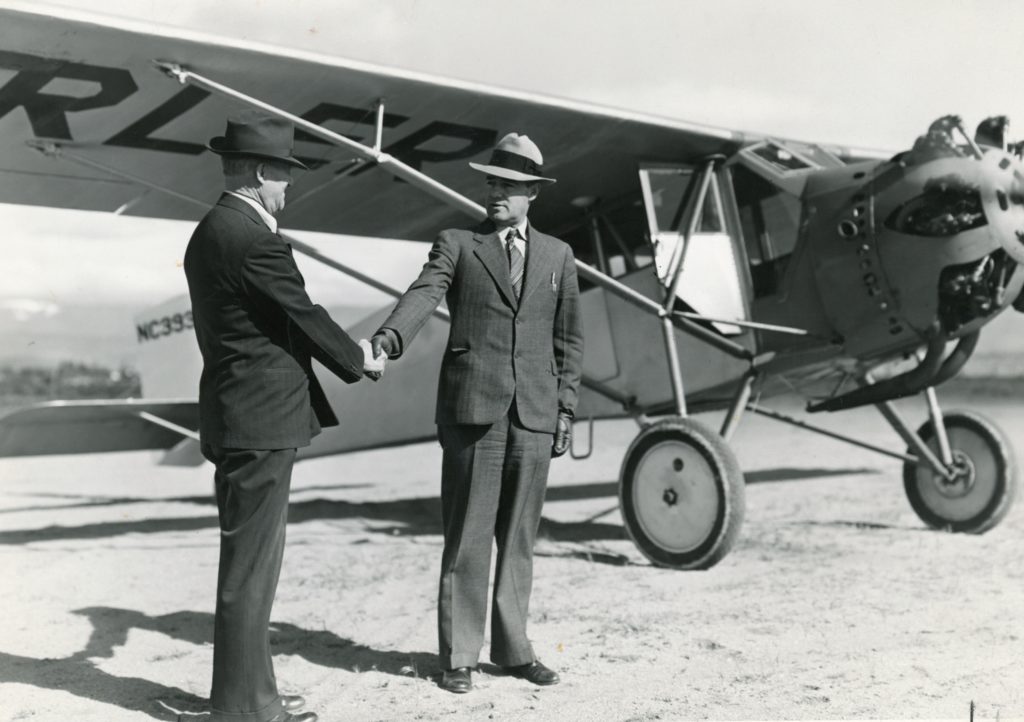
Postmaster Elmer Winchell with Ben Curler at the inagural airmail flight at the Susanville airport on May 19, 1938.

Of course, Lassen County Superior Court Judge Ben F. Curler an avid flier was more than happy to participate in carrying air mail. For a brief time, when Curler served as magistrate for Lassen Volcanic National Park he would fly to Mineral to hold court. Curler’s May 1938 airmail flight went from Susanville to Reno. At Reno, he picked up his father, Washoe County District Court Judge, Ben V. Curler. The elder Curler, was a pilot, too, having obtained his license in 1935 at the age of 70. The two flying judges departed Reno and flew to various Nevada communities as part of the National Air Mail Week campaign.

Never miss a story, click here to subscribe.

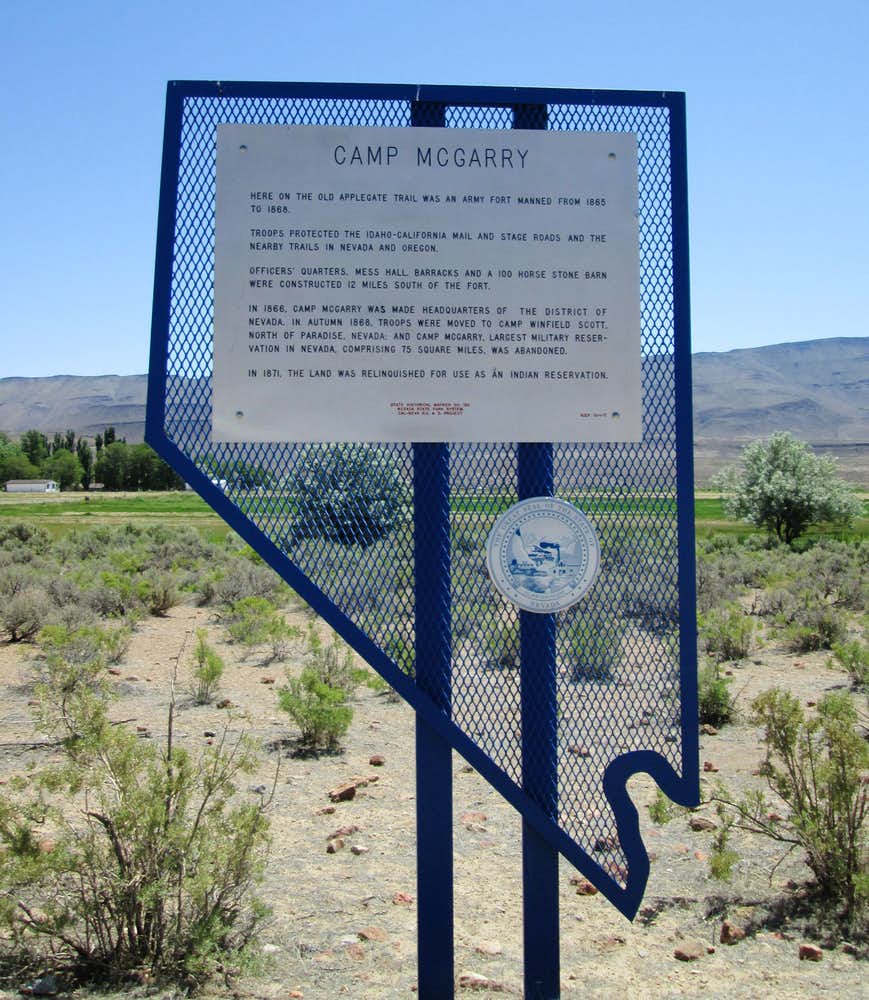
Camp McGarry, Nevada

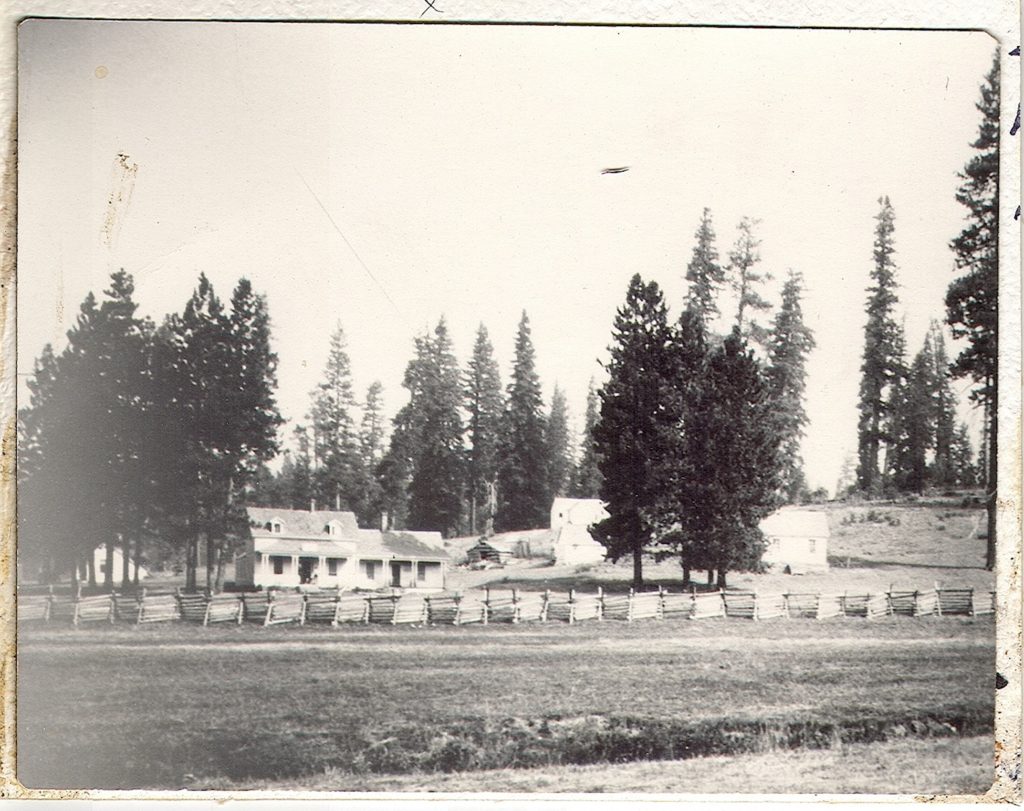
Nevada State Landmark, Camp McGarry at Soldier Meadows

Camp McGarry was a military outpost in remote far northwestern Nevada at Summit Lake. It was established on November 23, 1865 by the California Calvary. It has some unique attributes. It was named for Civil War hero, Brevet Brigadier General Edward
McGarry.

Contrary to popular belief that it was established for the protection emigrants of Lassen-Appelgate Trail, that was not the case at all. Its location was far removed from the Trail. It was for the protection of the mail route. The fastest way from San Francisco to the Idaho mines, was via Susanville, to Smoke Creek and Black Rock Deserts, then headed north via Summit Lake. On October 14, 1865, the Idaho-California Stage and Fast Freight was incorporated with its headquarters in Susanville. The incorporation papers states that the sole purpose was “to operate stage and fast freight from Chico, California via Puebla Valley to Ruby City and Boise, Idaho.” The Company was able to obtain the government’s lucrative tri-weekly mail route contract from Chico to Ruby City at $45,000 a year. The initial 427-mile trip from Chico to Idaho took three and a half days. It would be a short-lived operation. In 1868 the Central Pacific Railroad tracks were laid into Nevada reaching Winnemucca, and that reduced travel by half.  On December 18, 1868 Camp McGarry was abandoned, the troops transferred to Camp Winfield Scott, at Paradise Valley, Nevada. On March 25, 1871 the military relinquished the Summit Lake territory and it was transferred to the U.S. Department of Interior. Today, a portion of it, is part of the Summit Lake Indian Reservation.

Camp McGarry was the largest Nevada military reserve with land comprising seventy-five square miles. An unusual feature there was the use of underground passages connecting the barn, mess hall, and barracks .

Another unusual trait, it had a summer and winter location. The harsh winter conditions at Summit Lake forced the camp to move to what become known as Soldier Meadows, just north of the Black Rock Desert. Remnants exist at both locations. However, Summit Lake site  is not accessible to the public it being a part of the Summit Lake Indian Reservation. The southern encampment is now the headquarters of the Soldier Meadows Guest Ranch.

Support

Quincy Union Newspaper

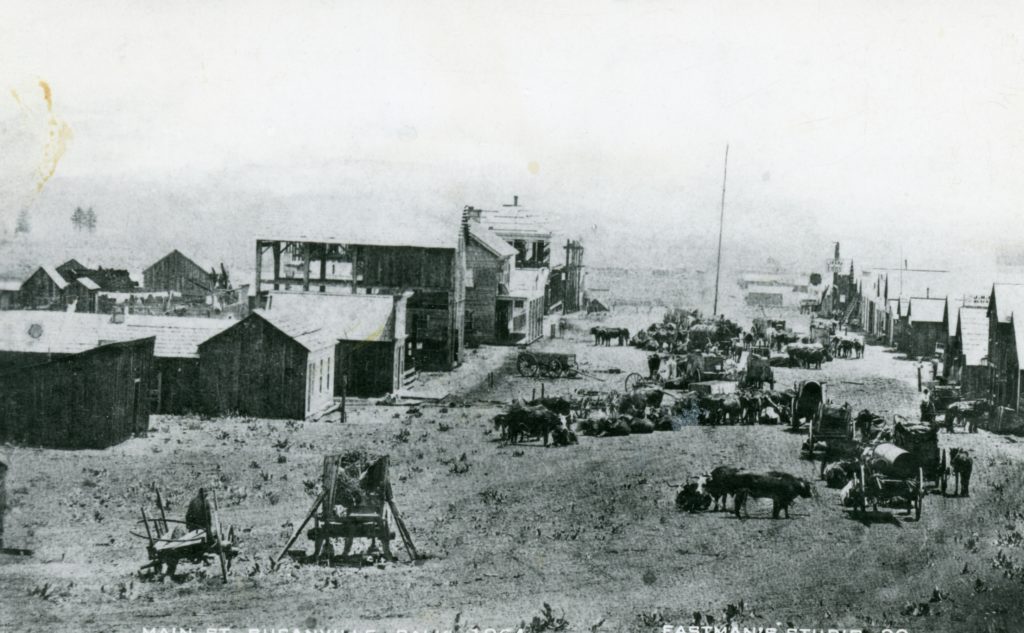
Main Street, Susanville, 1864.

While sifting through some notes, I came across these items from the Quincy Union newspaper of the 1860s. Regional newspapers such as The Territorial Enterprise (Virginia City) to the Marysville Daily Appeal provided coverage of the Honey Lake environs. So here are some tidbits.

January 3, 1864 – They have a rabbit mine at Honey Lake. On one day 400 of those animals were sent to the Virginia City market.

January 30, 1864 – Hay is selling for $80-$100 per ton in Honey Lake. There is no hay in Sierra Valley.

March 5, 1864 – The farmers in Honey Lake are busily at work ploughing, sowing, repairing and improving their ranches.

September 17, 1864 – The new jail in Susanville is in course of erection and when completed will be an ornament to the town and very convenient. It is built of Roop granite found in the quarry near the town.

September 15, 1866 – Post Offices at Black Rock. Post offices have been established at Spring City and Hardin City. W.H. Vanalstine is appointed postmaster at Spring City and Charles Nixon at Hardin City. This will be of a great accommodation for the Black Rockers.

29 September 1866 – On the Way. Alvaro Evans of Long Valley has a quartz mill on the road for Black Rock. They expect to have it put up and running by the first of November. (Note: This mill was moved to Hayden Hill in 1871)

Tim

The Perils of Research

Longville, Humbug Valley—Plumas County Museum

January has been an interesting month, especially research wise. While working on a story about noted archaeologist Francis Riddell, I came across something he compiled that escaped my attention. It was account of the Papoose Massacre of 1866 that was relayed to him by Kitty Joaquin. There are three versions, which will be explored in the future.

While doing some research on Marion May Hapgood, born 1902 at Likely (her parents owned the South Fork Hotel), I came across an article about how Stover Mountain was in eruption at the same time as Lassen Peak. Then I was re-reading Marion’s grandfather Eber Bangham’s 1906 biography. This has the earliest history of Granite Creek Station. Then, in turn, I remembered that Thomas Bare who owned the nearby Deep Hole Station, also owned the meadow at Granite Creek. More about that in the future.

In the course of all of this, the Milford Cemetery pops up. According to Asa Fairfield, Mrs. Mary Harris was the first person buried there in 1867. However, in that cemetery is a marker for Philip Wales who died on June 6, 1864. Both Wales and Jacob Boody were found dead in proximity of each other, and case was never solved., Again more on that in the future.

One topic, has a way of mushrooming into several, and its an interesting journey.

Tim

The Military Outposts of the 1860s

Smoke Creek Desert
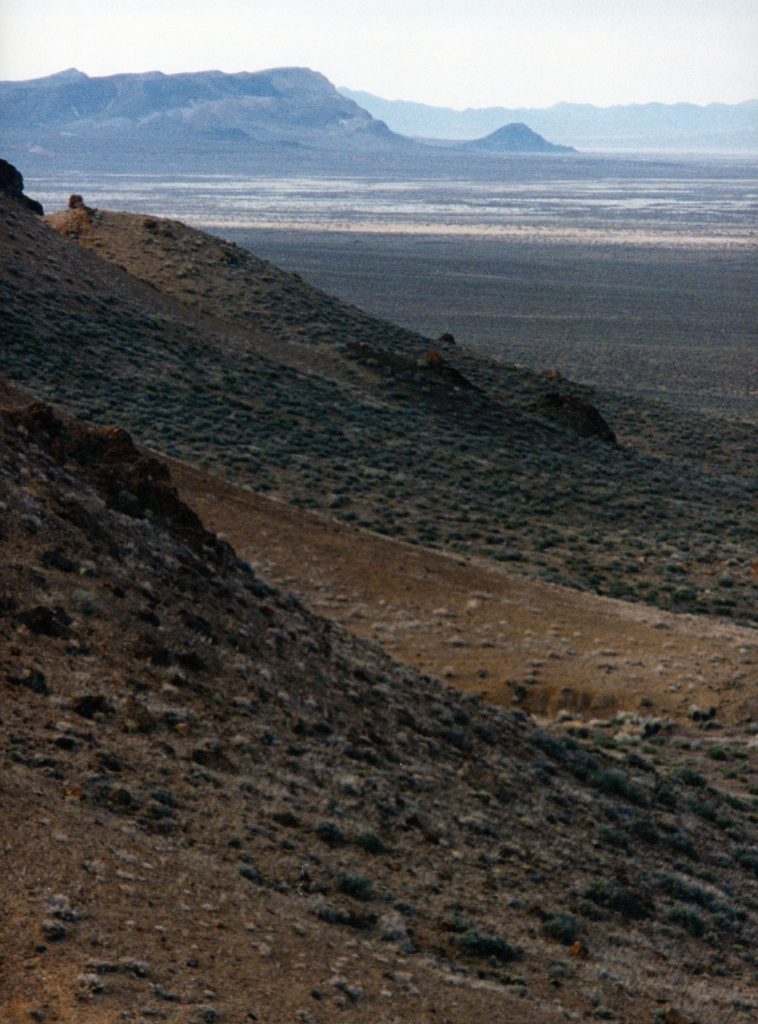
Smoke Creek Desert looking towards Sheepshead, fall, 1977

First of all, I want to acknowledge the late J.S. Thompson, who was not only a good friend, but one of his main interests was early Nevada military history that he graciously shared with me.

United States military presence in the Honey Lake Valley was sporadic during the Indian conflicts of the 1860s.  Initially, Fort Crook, now Fall River Mills, during the 1850s was the nearest military outpost. In 1858, Fort Crook soldiers had an encounter with Pit River Indians at the northwest corner of Eagle Lake, but never ventured to the Honey Lake Valley.

Relations between the Native Americans and the Anglo settlers had deteriorated by1859. The murder of Edward Clapper and Peter Lassen in the spring of that year in the Black Rock Desert, did not help matters—the Indians rightfully/wrongfully were accused. Between that episode and increased traffic on the Nobles Emigrant Trail, the military made an appearance. During the summer of 1859,  a military outpost known as Dragoon Bridge or Willow Creek Station was established along the Nobles Trail where it crosses Willow Creek in the Honey Lake Valley. These troops came from the San Francisco Presidio.

Tensions between the Anglos and the Indians did not improve. On January 13,1860 Dexter Demming was murdered by the Indians in Willow Creek Valley, north of Susanville. It was like a slow burning fuse that would ignite into the Pyramid Lake War of 1860. After Demming’s death the Honey Lakers petitioned California Governor Milton Lathom for military assistance. By the time their letter was received in Sacramento, Lathrom was out of office, he only served five days as governor!

Not all was a loss. In the summer of 1860 the San Francisco Presidio sent troops to the Honey Lake Valley and established Soldiers Bridge along the Susan River near present day Litchfield.

Susan River, near the Soldier Bridge military site. November 19, 2015

In 1861, the area had no military presence. Things changed quickly with the mining discoveries of the Humboldt in Nevada and the quickest route was via the Nobles Emigrant Trail. This prompted military officials to establish a permanent military outpost at Smoke Creek near the California/Nevada border. The troops, it should be noted came from Fort Churchill, Nevada.

For whatever reasons a mobile military unit named Camp Johns established a base camp near Susanville in June 1864. They did a reconnaissance of the  area to Modoc and Northwestern Nevada. The troops came from Fort Churchill and returned there in August. They were replaced with a new set of soldiers with the same mission, and the camp was renamed Susan. It lasted briefly, and the soldiers returned to Fort Churchill in October.

That was the end of actual physical military presence of the region until the establishment of the Sierra Army Depot in 1942. However, there were Camp McGarry and Fort aka Camp Sage that I will write about in future posts.

Donate


Honey Lake, 1868

Honey Lake, 1984
Honey Lake, February 1984. To the right is the Hartson Sand Ridge. Photograph courtesy of Bob Sorvaag

Yesterday, we explored what was originally thought of as a strange phenomenon when Honey Lake went dry in 1859. A decade later the residents were puzzled by the high water of Honey Lake. In 1868 Honey Lake had reached its highest level ever witnessed. There, of course, a lot of speculation causing the lake to be so high, just as there was when it went dry. Many believed that the lake now contained springs, thus, why the lake was ten feet higher than known, flooding a lot of adjacent farmlands. There was even speculation that if the lake level continued to rise, that a channel be constructed to drain the lake into nearby Pyramid Lake. In the course of time, the lake level subsided and in 1887 it went dry.

Donate

Your Questions

Cross
This cross marks the graves of the soldier’s buried at Camp Smoke Creek

Two interesting questions were posed, which I will address in separate posts. The first is Fruit Growers Supply Company’s “Sunkist Lodge” on the south shore of Eagle Lake. It just happens to be for sale.

As to the military of the 1860s, is an interesting topic. I already have two posts scheduled. The military encampment at Smoke Creek served two purposes. An interesting facet of that operation was to prevent gold bullion from leaving the State of California, on the suspicion that it might be used aid the Confederacy. Of course, there is some interesting political drama with these military encampments. Stay tuned.

Tim

P.S.  I just realized I had done a lot of research on Camp McGarry, located at Summit Lake and Soldier Meadows in far northwestern Nevada.

A Honey Lake Story

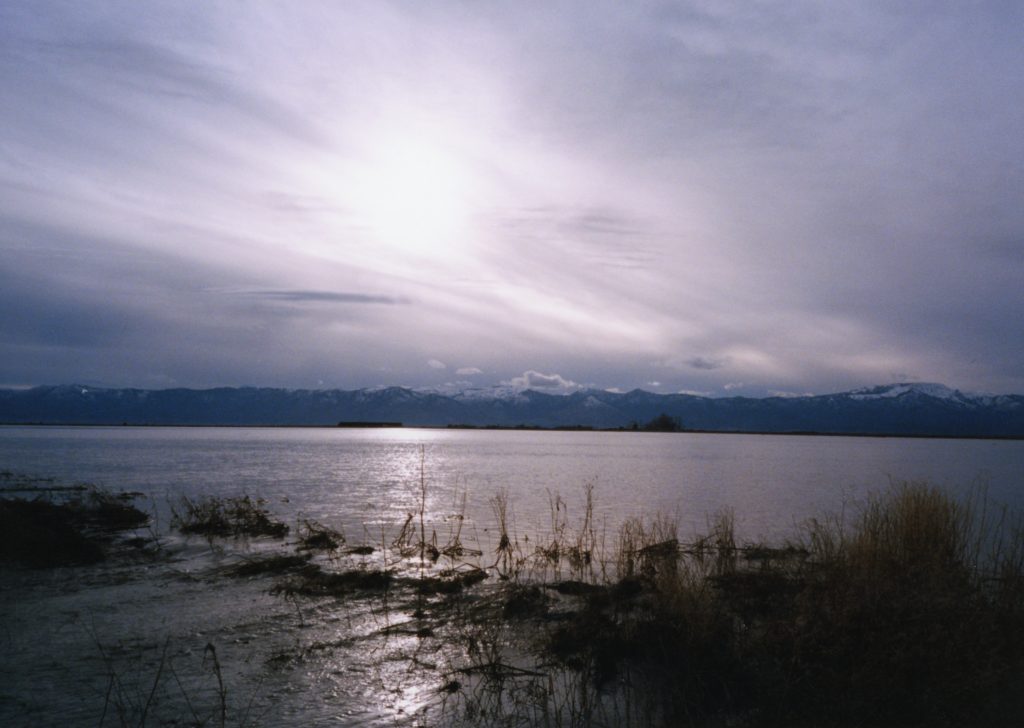
Honey Lake, 1997.

While researching Granite Creek Station, I came across some correspondence with Jesse Horn. He was a grandnephew of Andrew Litch, one of the proprietors of the Station. Horn was born at Milford on May 25, 1912. On February 25, 1980 Jesse Horn, wrote:  “An old Piute Indian from Nevada told me a story you might be interested in. At the time I was quite a small boy and as our custom was with the Indians, a sort of variation of a peace pipe. We cut a watermelon and ate it with him. This served two purposes for us; they didn’t steal our watermelons and they gave us their business.

This is what he said as he pointed across the lake to the Skedaddle Mountains. “See high water marks on mountain? Old Chiefs say many, many moons ago, no one can count. Great spirit get mad. Honey Lake that time, she big like many waters cover all valley, make Tahoe look like a pond. There was great big earthquake, thunder, lightning. Whole world shake mountains fall apart. Honey Lake break loose and make Pyramid Lake. All big fish go there.’”

Support

Twenty Miles From A Match

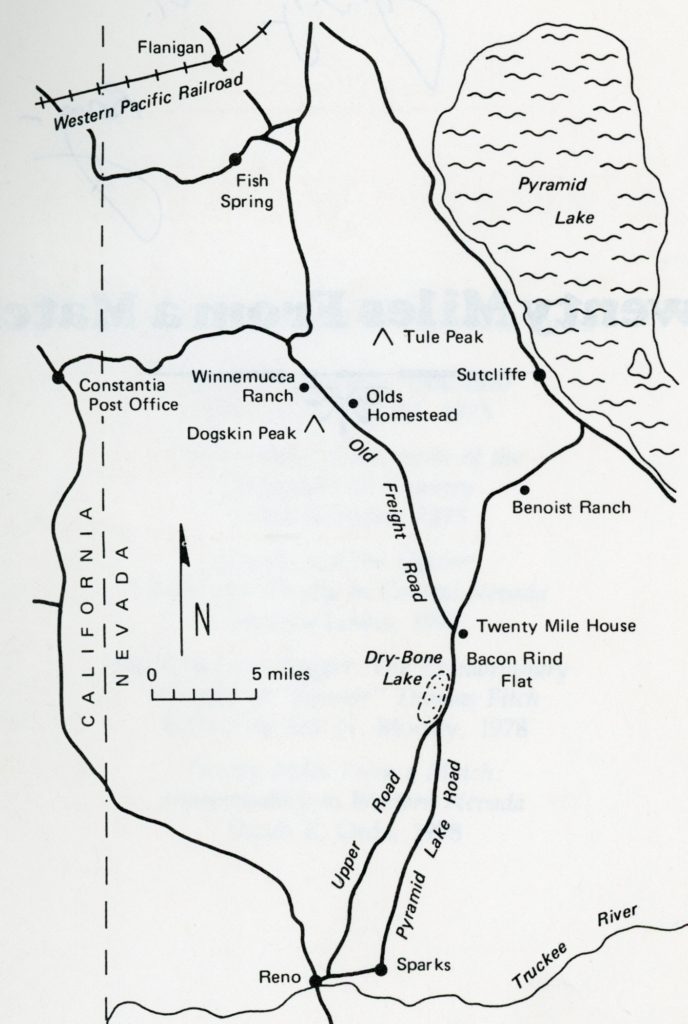
The map from the book indicating the region.

Twenty Miles From a Match by Sarah Olds was first published in 1978 by the Bristlecone Press of the University of Nevada. It is still in print today, which speaks volumes as to this entertaining book.

In 1908, Sarah Olds packed up her family of five children, along with her ailing husband and settled on a desert homestead north of Reno. It is a remarkable tale Sarah wrote about her shear determination to make a go it. It was her husband’s nephew, Hiram “Hi” West who planted the seeds of homesteading and more particularly that of Tule Mountain, some thirty-five miles north of Reno. Of course, Hi, would benefit if the Olds family settled there, as he would have nieghbors.

Sarah wrote, “After my homesteading talk with Hi, I didn’t let the idea get out of my mind. He told me Tule Mountain was the greatest game country ever laid out of doors. There were droves of deer, literally thousands of sage hen, coveys of mountain and valley quail, doves galore, some cottontail and of course, the much despised jack rabbit. All this added fuel to the homesteading scheme which was fast developing in my mind. My biggest problem was in getting A.J. [her husband] interested enough to file papers on a homestead. I could just hear him saying, ‘Why old lady, you’re crazy. It simply can’t be done.’”

Thus, the stage was set for a twenty year experience of homesteading.

Support