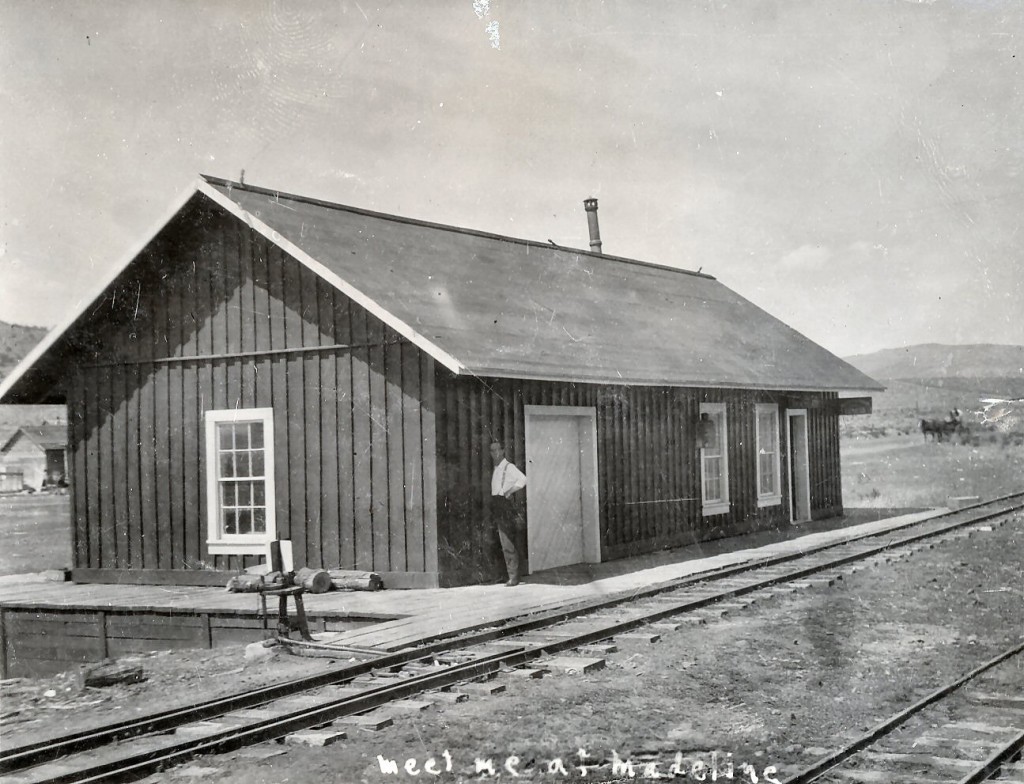
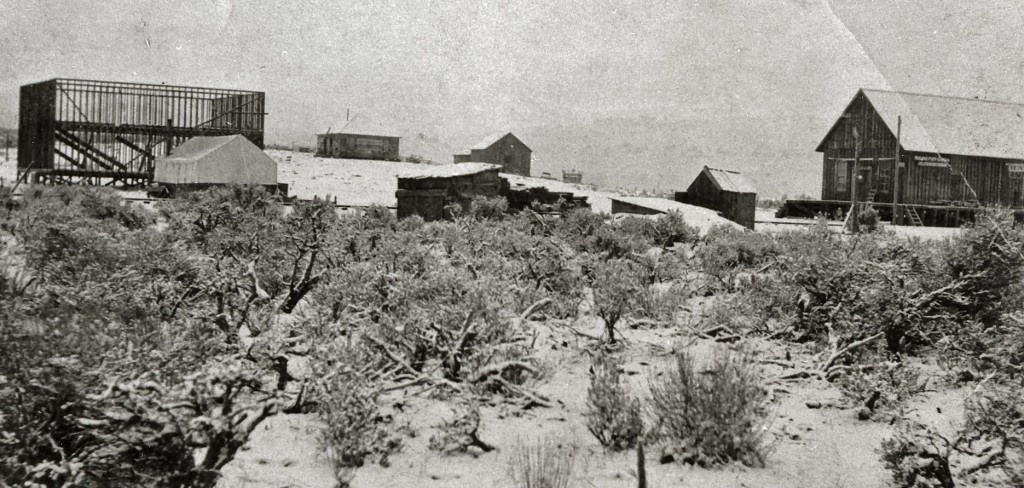
For those stuck in the winter doldrums I have a nagging question on my mind. When was the laat NCO train to depart from Wendel? In 1925, the Southern Pacific acquired the NCO. In July 1927 that company began the standard gauging the NCO at Wendel.
It should be noted that in the summer of 1917 the NCO sold its southern portion of its line, a 64 mile segment, from Rayl (Herlong) to Reno. On January 30, 1918, the last NCO train to depart from Reno occurred. In 1922, the NCO was granted to abandon sixteen miles between Rayl now known as Hackstaff to Wendel. The last train on that segment happened on October 31, 1922. Why were these two events well documented, but not Wendel?
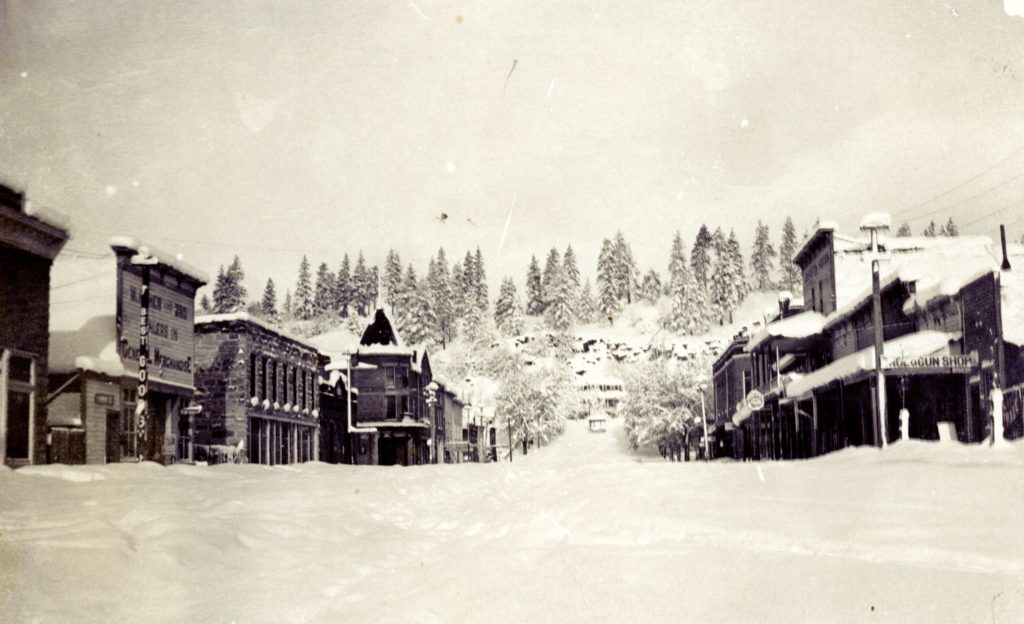
Typically, the largest snowstorms in this region occur in the month of January. It was January 1914 that proved to be a record breaker with 93 inches of snowfall that month. It also happen to be a rainy month with 9 inches of rain. In all, the total precipitation for the month was 18.17 inches.
The weather conditions was problematic for the completion of the Fernley & Lassen Railroad to Westwood. Due to the weather whiplash of rain and snow, the soil became saturated and prone mud slides in the Susan River Canyon. Railroad officials, of course, had a lot to worry about, as the construction with the Red River Lumber Company had a completion date to Westwood by. March 1.
In a related railroad matter was the NCO train delays due to frequent wash outs of the track. The US Postal Service had a contact with the NCO to deliver mail originating from the East. Since the NCO had a poor delivery record of the mail, the Postal Service by mid-February ordered all mail would be re-routed via the Fernley & Lassen. Many residents of the Honey Lake Valley rejoiced after this announcement, as regular mail delivery would be six days week.
Tim
P.S. – It should noted the other spectrum, there would be dry Januarys in which no snowfall occurred that month. I do know from records searched those rare years occurred in 1893 and 1912. The latter was so mild that baseball games were routinely held.
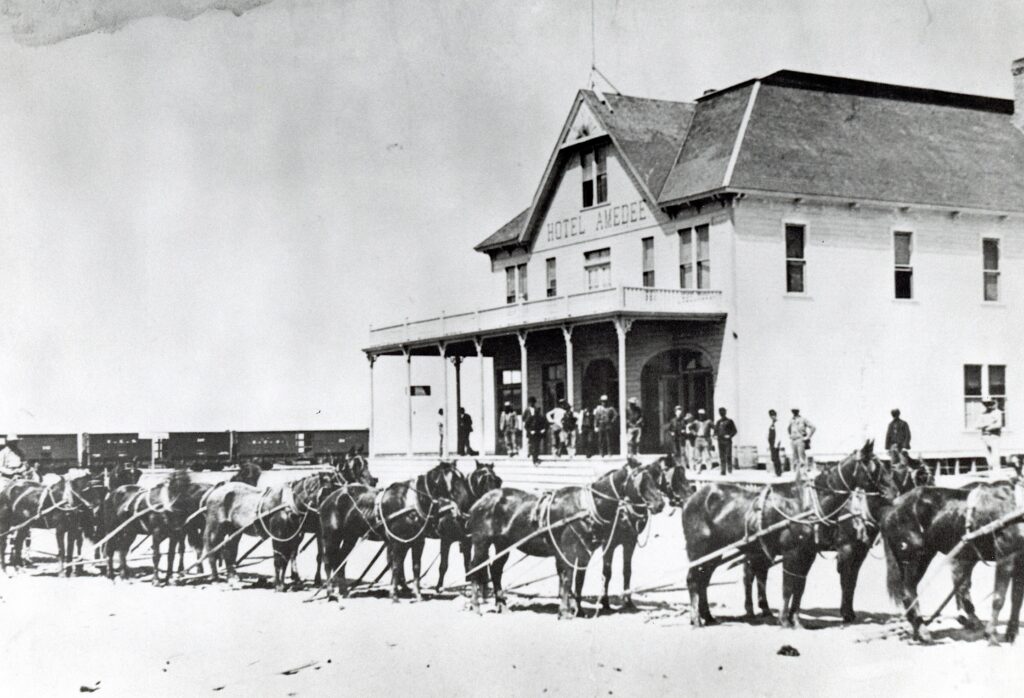
In June 1891, E.W. Hayden, editor and publisher of Susanville’s Lassen Advocate made a trip to Amedee, the Nevada-California-Oregon Railway’s (NCO) new terminus. In his mind, he was prepared to see another wide spot in the road like its predecessor, Liegan, located some ten miles to the south. Liegan was the terminus of the NCO from September 1888 to November1890. It was a remote, desolate location. There is scant documentation about this station. Hayden, before writing about the bustling activity at Amedee, provided this rare glimpse about Liegan.
“Then one is surprised, for most of us expected to see Liegan repeated, that is, a small freight house, a bale of hay, a sack of grain, a post, perhaps several posts to hitch horses to, three of four barrels of water hauled out from Doyle for drinking and domestic uses and a place in which to take meals, and which in the matter construction and value was not up to the average Honey Lake henhouse.
”This about what was comprised in Liegan, the first. Later it was much improved, but Amedee at first sight would cause ‘Old Josh Whitcomb’ to say ‘Well I be goll durned.’”
Then there a published story in which four men from Surprise Valley took the stage to Liegan bound for Reno. After nearly a week being stranded there , the men started out on foot to follow the railroad tracks to Reno. As the story goes “A week at Liegan is enough to drive almost anyone wild.”
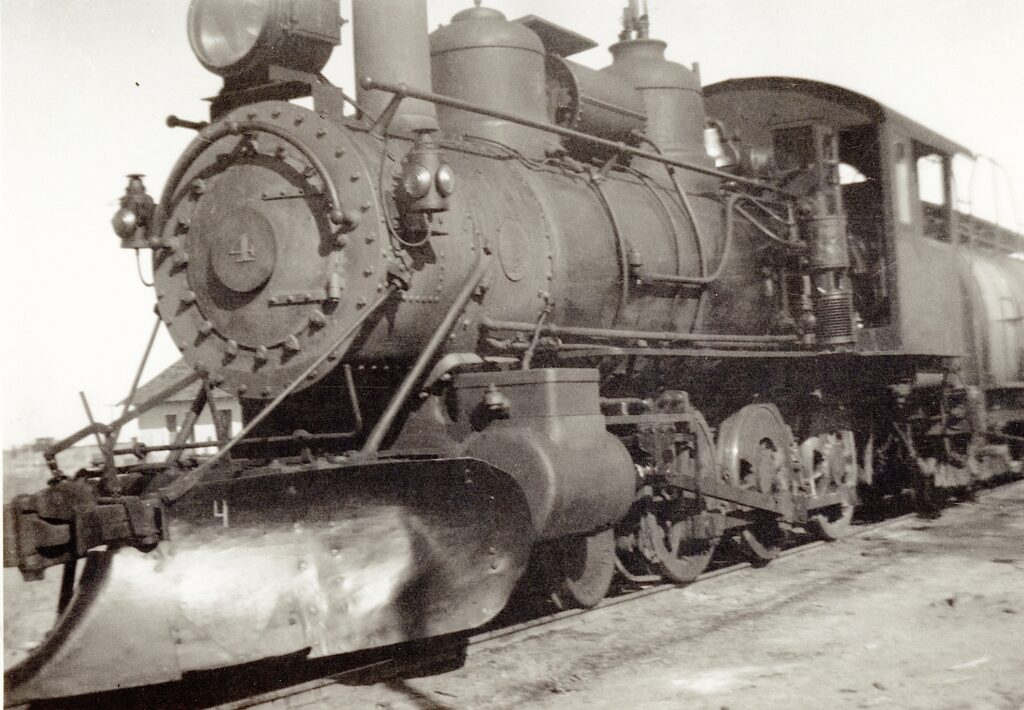
The NCO actually had two locomotives designated the No. 4. The first one was sold to the Tonopah Railroad in 1904. It was replaced by by the NCO’s No. 6, which was then designated the No. 4, after the original one was sold. It was, of course, became part of the Southern Pacific when that railroad bought the troubled NCO Railway. According to railroad historian, David Myrick, it was “broken up” on September 12, 1934 at Sacramento. I am not sure what the difference is between being broken up and scrapped.
When I received this photograph from Tom Armstrong many years ago, I do not recall him providing any information. However, I could be wrong and it is buried deep in my NCO files I have a self imposed ban of examining. Another story, for another time.
After consulting with two individuals who are a lot more knowledgeable on NCO rolling stock and I hopefully relay their findings without error. Of course, if someone has more information or that I need to make a correction, please let me know.
The NCO purchased two Meister cars. They were converted into touring cars. Alas, while I have seen photographs, I do not possess any. The images are rather impressive. It is my understanding, and I could be wrong, the NCO acquired them around 1920. Information about them is sparse. If anyone can enlighten more on this topic, we would be glad to hear from you.
Earlier this year, I wrote out Lassen County’s so-called Mobile Home Culture. It was about instead of demolishing a structure, it was moved to a new location. You can read the story here.
Our neighbor to north in Alturas, took moving a building to the extreme. First a little background. In December 1908, the NCO Railroad finally made its way to Alturas. One would think the residents would be thrilled. That was not necessarily the case, since the NCO had increased its freight rates, it had a chilling effect.
The NCO built a stone passenger depot on 12th Street, far from everything else in town. The residents complained. To appease the situation, the railroad carefully disassembled the stone depot, numbering each stone, and once dismantled the stones were reassembled at the new location on Fourth Street. The depot closed in 1938, and in 1962, the Alturas Garden Club took over the property and still maintains it.
While reading the Lassen Advocate for 1924 I came across this article about a NCO train wreck. I promised a friend whenever I came across of such, I would transcribe and send it along. Since there are some rail fans who subscribe, who may enjoy, too.
Lassen Advocate, May 16, 1924 – “NCO Train Nearly Wrecked. The train from Alturas yesterday came nearly wrecked a few miles from Karlo when on rounding a curve a section of the track as encountered that had been buckled from the intense heat.
”Approaching the curve at a speed estimated by W.R. Payne, a passenger, at 25 miles per hour. The engineer noticed the track was four or five feet out of line. He immediately applied the emergency brake and climbed down the gangway of the engine. He called the fireman to jump. The fireman jumped and suffered a badly sprained ankle. He was taken to Reno for treatment.
”The engineer who was standing in the gangway with one hand on the air brake and the other on the bad as thrown from the engine, but was not injured. The train went on perhaps the length of the block before coming to a stop.
”There were three or four freight cars containing lumber, a baggage car, passenger car and private car of S.H. McCartney, general manager of the railroad.
”Some of the cars left the track and the train was able to proceed after a delay of an hour. The brakeman acted as fireman to the terminus at Wendel.
”Passengers in the train experienced some queer sensations and one passenger declared that they hit an automobile as he had seen the man thrown from the car. That was the fireman who jumped from the engine.
”The cars careened over to one side and left the rails, but when they came back to the rails they staid on. Had the train been going at a lesser rate of speed when it hit there might have been a serious wreck but the speed at which hit, 18 to 20 miles an hour, was just the right speed to prevent any derailment.”
Early day Ravendale. Courtesy of Dorothy Capezzoli
There were three communities on the Madeline Plains, Madeline, Ravendale and Termo. All three owed their existence to the Nevada California Oregon Railroad, which the arrived on the plains in 1899 and created Termo and a few years later Madeline.
It was reported that the end of February 1910, that a new NCO station was rapidly being built five miles south of Termo. Dame rumor had it that it was to become a division point for the NCO railroad. It was also stated that J.H. Williams and G. Horton were surveying a town plat.
So much for speculation. William B. Edwards, locally known as Uncle Billy had formed the Western Land & Power Company to entice homesteaders to eastern Madeline Plains. The best stopping off point was the homestead of Jim and Laura Coe. They agreed to subdivide their land, and the NCO also agreed to establish a station there. On November 15, 1913, the official town plat of Ravendale, was recorded with the Lassen County Recorder. According to Madeline Plains historian, Don Garate, the name Coeville had been suggested for the new town, but Laura Coe already chosen a name—Ravendale. Why she chose that name is not clear.
Unfortunately, when it comes to the history of the Nevada-California-Oregon Railway (NCO) the majority of published accounts cover the basics. Yet, there is a tremendous wealth of material that remains untouched in a variety of records, which researchers have neglected and this is just one example.
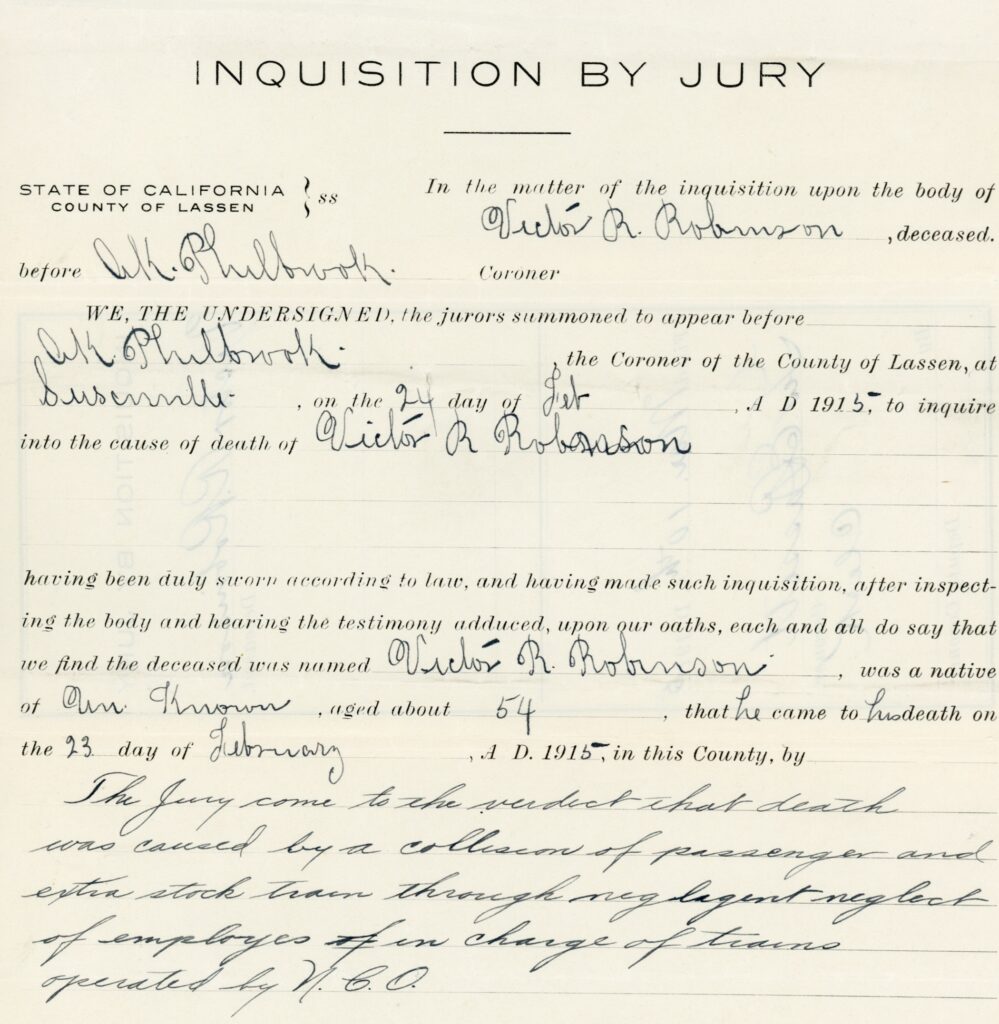
Today’s post is a perfect example of such research. The material comes from the Lassen County Coroner’s Inquest that involved a NCO train collision at Horse Lake. On February 23, 1915, Victor Robinson boarded a NCO passenger train at Lakeview, Oregon bound for Reno, on his way to Sacramento. According to E.G. Ryder, the Traveling Freight and Passenger Agent for the NCO that the passenger train had stopped at Horse Lake Station and was just starting again when a NCO livestock train, consisting of fourteen cars loaded with cattle, also heading south, struck the passenger train. Ryder was in the caboose of the stock train, so he was not sure of all the details. Ryder stated, “That Robinson was caught between the two cars on the passenger train. There were two coaches and Robinson was between the two coaches on the platform.” When the collision occurred Robinson was ejected from the platform died immediately from injuries. The account is rather confusing, but I shared it with a person familiar with the NCO cars and he was under the impression that Robinson was thrown under the wheels between the two coaches upon impact.
Horse Lake Station, 1915. Courtesy of Nevada Historical Society
Ryder was the only person to testify at the inquest. The twelve men summoned for the coroner’s jury and this was their conclusion, “The Jury came to the verdict that death was caused by a collision of passenger and extra stock train through the negligent neglect of employees in charge of trains operated by the NCO.”
The Amedee Post Office had the unique distinction of its opening and closing dates. The post office was established on New Year’s Eve, 1890 with Lewis Brubeck as the first postmaster. It should be noted that many of the railroad agents, also served as postmaster over the years. So, it was 100 years today on Leap Year Day 1924, witnessed the closure of the Amedee Post Office. The post office and town was named for Amedee Depau Moran, one of the owners of the NCO Railroad.
The east side Honey Lake Valley residents were not completely without mail service like they are today. Located between Amedee were Stacy and Wendel, both railroad communities. Stacy resident Allison Newman, who my Dad introduced me to him as the “mayor of Stacy.” Newman was that town’s postmaster for decades until it closed in 1951. The Wendel Post Office closed in 1993.
Spread the word, and encourage a friend to subscribe.