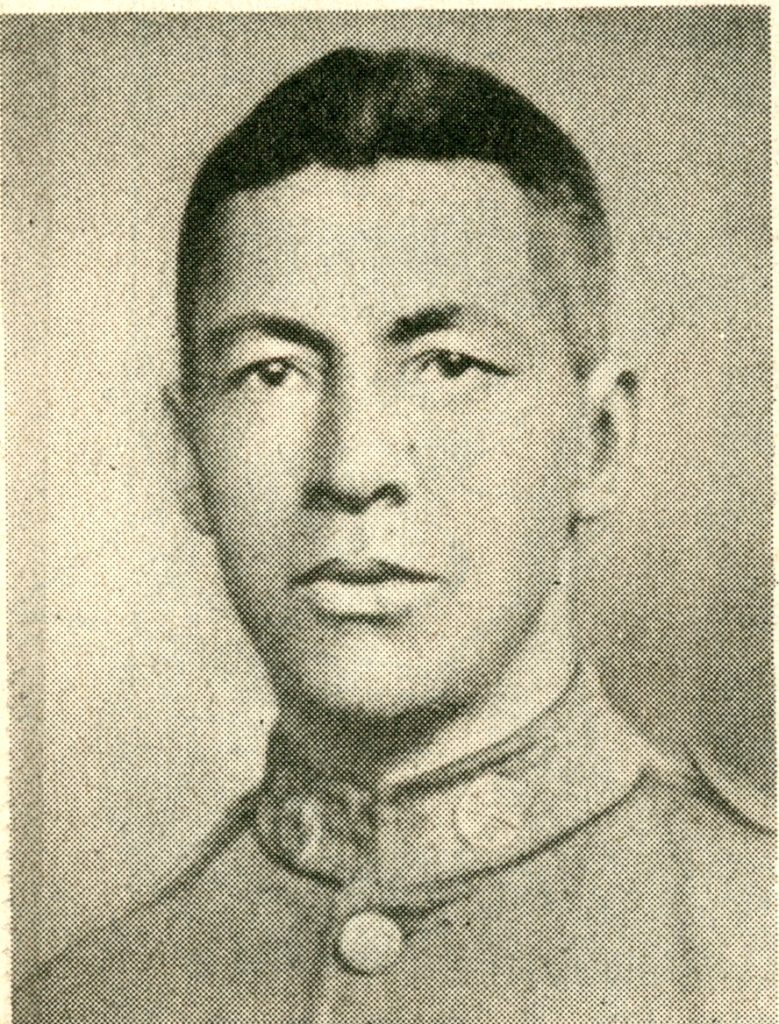
Thomas Tucker. Source: Lassen Advocate of March 10, 1976
In 1970, the Lassen County American Indian Organization held its first annual All Indian Basketball Tournament. In 1976 during the nation’s bicentennial a special championship trophy would be in the memory of Thomas Tucker, a Maidu. Tucker fought in World War I with Company L, 363 Infantry, 91 Division of the U.S. Army. He was killed in action on September 28, 1918 in France. Susanville’s American Legion Post 204 was named in his honor. Oh, and by they way, the Bridgeport Renegades won the tournament by crushing the North State Hawks of Redding, 100 to 53.
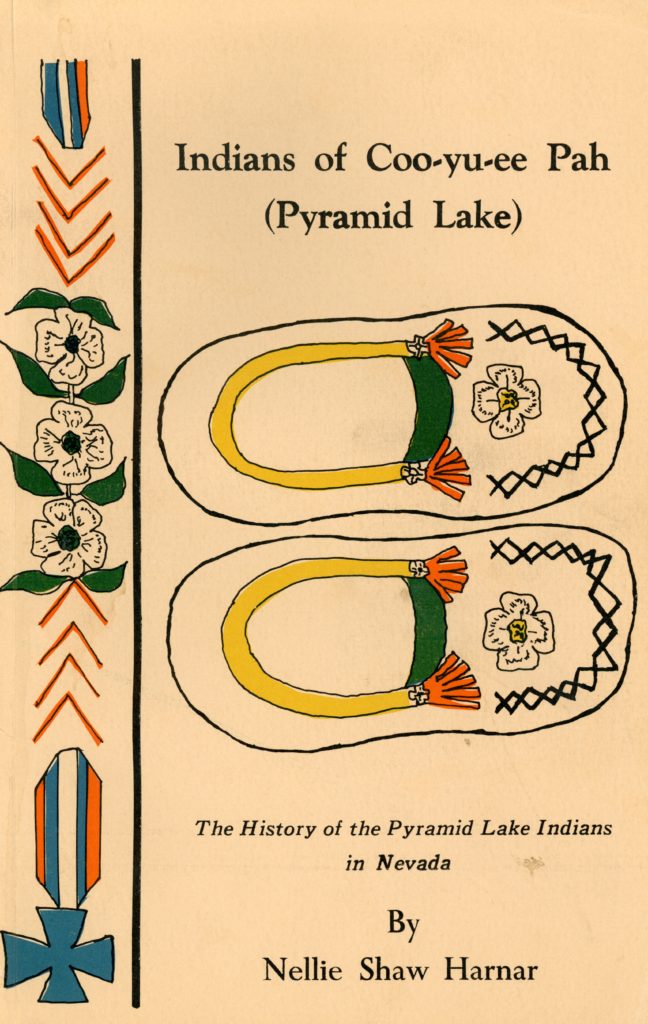
A good read.This is the title of Nellie Shaw Harnar’s 1974 book concerning the history of the Pyramid Lake Indians spanning the years 1843-1959. Nellie was born in 1905, a Ne-muh or Northern Nevada Paiute at Wadsworth, Nevada. This is a very well researched work, for those that might be interested in the topic. While it is no longer in print, it is available through such sites as Bookfinder.com or available at many libraries.
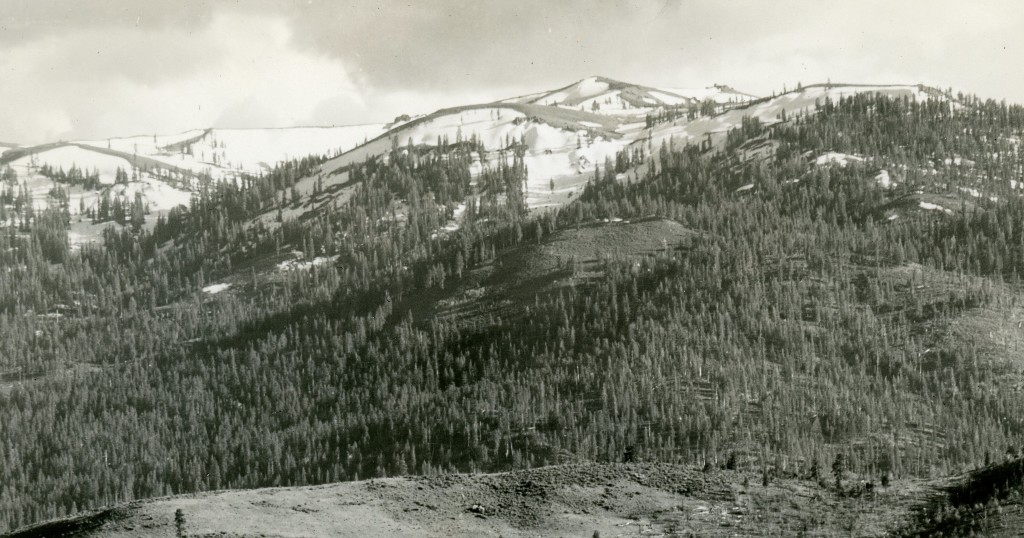
Diamond Mountain, circa 1940. Courtesy of Margaret A. PurdyAn inquisitive mind wanted to how Diamond Mountain obtained its name. It was so named in the 1850s, when prospectors found numerous crystal quartz along the range. The crystal clear quartz had a “diamond” like character. Some of these can be quite large. In the 1950s, a large crystal quartz weighing over 100 pounds as discovered on Thompson Peak and eventually found a home at the Smithsonian Institute. In 1910, Lassen County historian Asa Fairfield wanted to change Diamond Mountain to Mount Roop, but that did no go over well with anyone. Finally, the Honey Lake Pauite referred to the mountain range as wago yamos or ‘timber bend.”
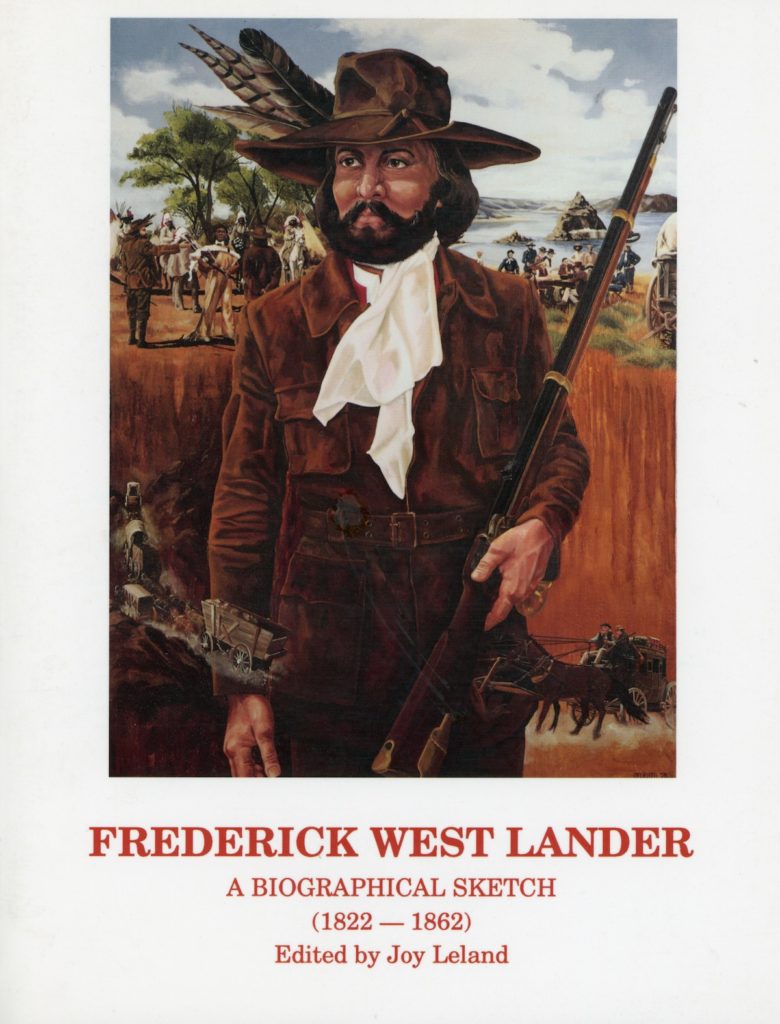
Worth the segment alone dealing with the Nobles Trail.Frederick Lander was part of several expeditions of the 1850s to locate a route for a Pacific Railroad. There would be many turn of events during this time period, among them the nation’s civil war. When Lander arrived in the Smoke Creek/Honey Lake area, it just happened with the outbreak of the Pyramid Lake War of 1860, and there were several contributing events in the Honey Lake Valley that had a bearing. Lander was caught in the middle. He did keep an excellent account of those activities, which were published by the Desert Research Institute in 1993 with Joy Cleland as editor.
On a side note, even though he died in 1862, one hundred and thirty three years his estate funded a re-photographic survey of Eagle Lake; where in using photographs of the early 1900s, Desert Research Institute went back to those sites to photograph and examine the changes.
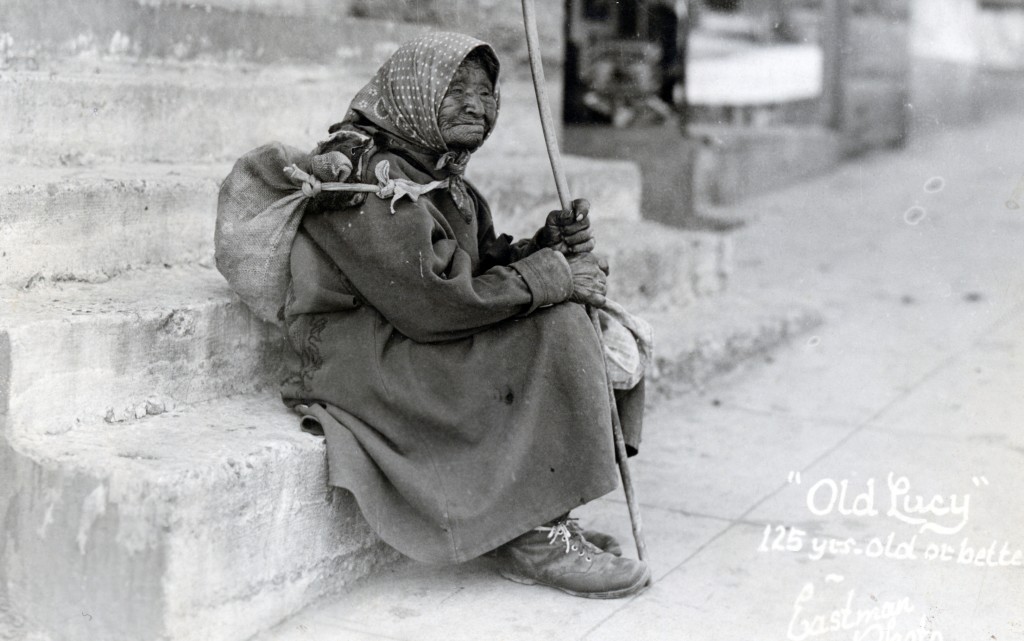
On September 29, 1929 Old Lucy a colorful character on the streets of Susanville passed away, purportedly at the age of 125. While she best known as Old Lucy, she also had another Anglo name, Sally Norman. Dubbed a “picturesque” Native American of the era, she was a familiar sight as she ambled about Susanville, bundled up in numerous clothes, walking with the aid of a stick. People who knew her back in the 1870s considered her old back then. While her age was exaggerated when she died, documents placed her age at around 100. Whether she was born in the Honey Lake Valley is not known, though there accounts that she recalled when Peter Lassen came to valley. In addition, it is stated she was part of the Maidu tribe.
As a rule, I I avoid Native American sites due to their sensitivity. However, some sites are well known and are routinely visited by many, and that is the case of Tommy Tucker Cave, It was a significant archaeological site excavated by archaeologists from the University of California from 1949 to 1951. The cave is located 200 feet above the Honey Lake Valley floor. It was named for Thomas “Tommy” Tucker (1895-1918), a Madiu from Big Meadows (Lake Almanor), and the second person from Lassen County to die in World War I. One can read Francis Riddell’s complete report here.
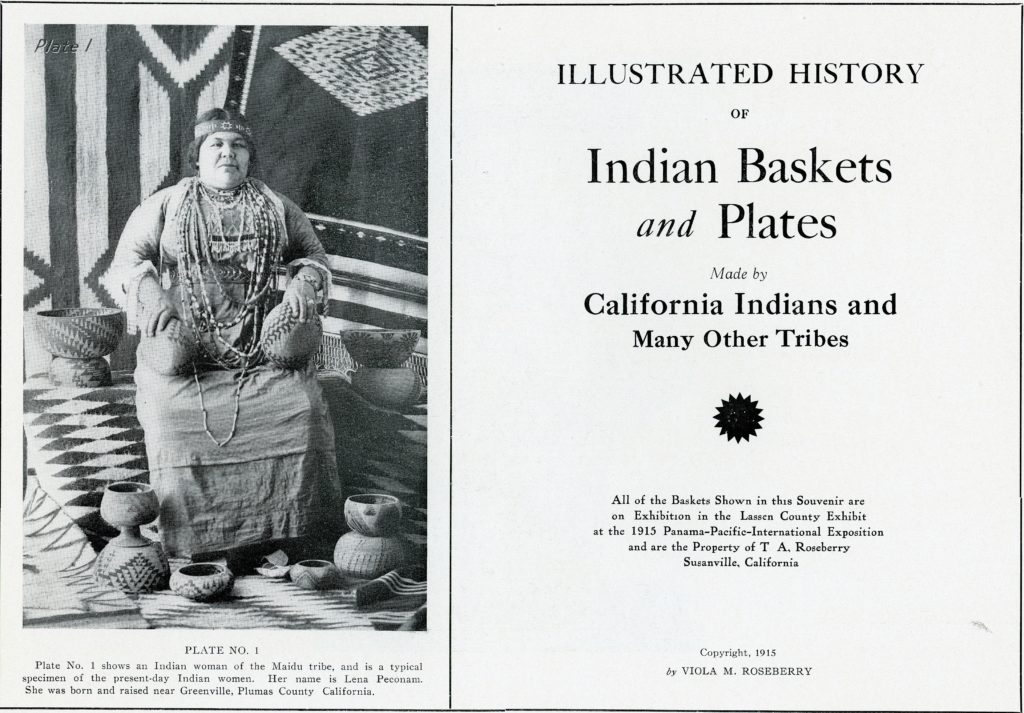
Cover page of Viola Roseberry’s book. Remember to click to enlarge the photograph.
Susanville resident Viola Roseberry (1860-1936) had a special fondness of Native American heritage and that of their basketry. She possessed a large basket collection. In 1915, the collection was displayed at the Panama-Pacific International Exposition held in San Francisco. To coincide with the exhibit she published a book, Illustrated History of Indian Baskets and Plates made by California Indians and Many Other Tribes. Book had a price of 50 cents.
The cover picture is of Lena Peconum who has numerous descendants in this area. Viola wrote stories behind the baskets, such as one Maidu woman Comanche, who at the time was believed to be the oldest Maidu weaver, approaching 100 years of age, and residing in Genesee Valley, Plumas County.
The Peconom family is one of the better known Maidu families. If you noticed that I highlighted the name in bold, there is a reason. The family name has been misspelled for years with a um instead of the proper om. Of course, the name spelling was brought to light, during the proposed name change of the first branch of Willard Creek to Roxie Peconum Creek to commemorate Roxie Yoanna Peconum (1851-1958), well-known member of the Maidu tribe, who gathered roots and berries in the region. However, some thought the name should be for the Peconom family, and not an individual family member. If it was to be the latter, the name should be Yoanna Creek for Roxie. Whatever the case may be, on February 11, 1993 U.S. Board of Geographic Names approved the name change to Roxie Peconum Creek.
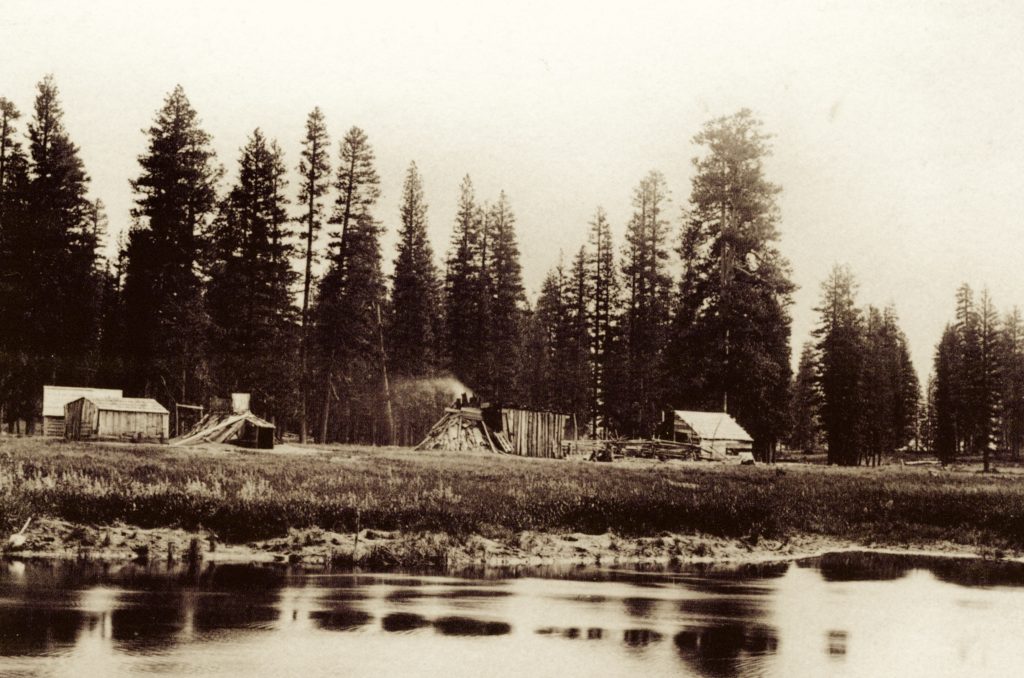
Big Meadows [now Lake Almanor] Maidu Camp, 1887. Courtesy of the National Park ServiceIf there was a text book history of Lassen County, N.D. Rideout name would probably not show up, and if it did it would be an obscure footnote. Yet, this Marysville merchant did exercise some influence on the region, especially when he became an investor in a short line railroad known as the Northern California. When T.B. Walker’s Red River Lumber Company began acquisition of timberland in Northern California, the two men became acquainted. After all, Walker was in need of a railroad to access his holdings, and Rideout owned one. In 1906, Rideout and Walker reached an agreement wherein the Northern California Railroad would build a line from Red Bluff to Fall River Mills, where Walker intended to build his first sawmill in California. However, in 1907, Rideout abruptly died, and everything came to a halt.
However, Rideout, also left a bit of legacy behind as he had an interest in photography. He was amateur photographer, long before cameras were common place. In 1887, he took several photographs including the one above, and also one of Drakesbad.
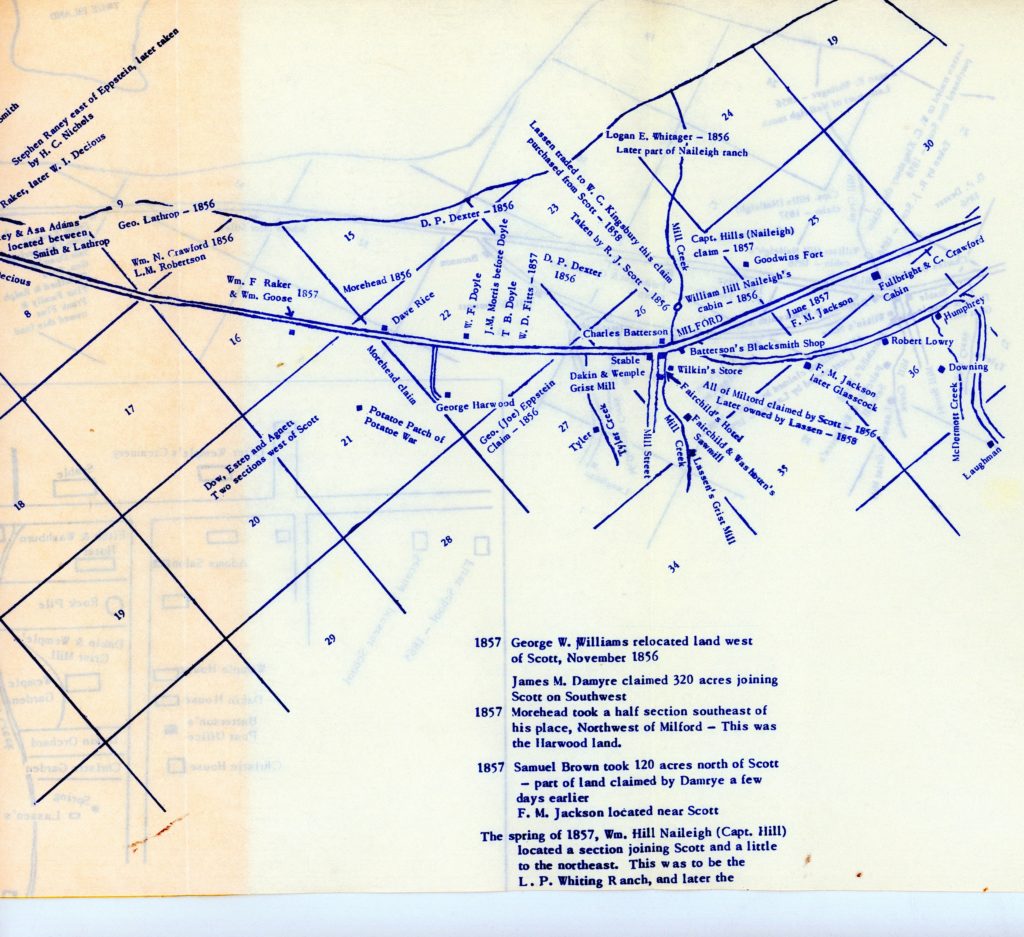
Claude Wemple’s historical map of the Milford region, shows not only the location of the Potato War, but numerous other sites.
Who knew that the almighty spud would be the cause of conflict? It all began in October 1857 when a band of Washo Indians visited William Morehead’s potato patch, some two miles northwest of Milford. When confronted by Morehead and others the Washo became belligerent and this did not go over well with the residents of the Milford district. The locals received re-enforcements from the California state arsenal, volunteer fighters from Sierra Valley, and a band of Piutes. During the skirmish several Washo were killed and many wounded. In the aftermath, the Washo withdrew from the lower end of Honey Lake Valley and never ventured north of Long Valley. Again, the residents petitioned for a permanent military fort after the Potato War, only to be ignored, again and again.
Spread the word, and encourage a friend to subscribe.