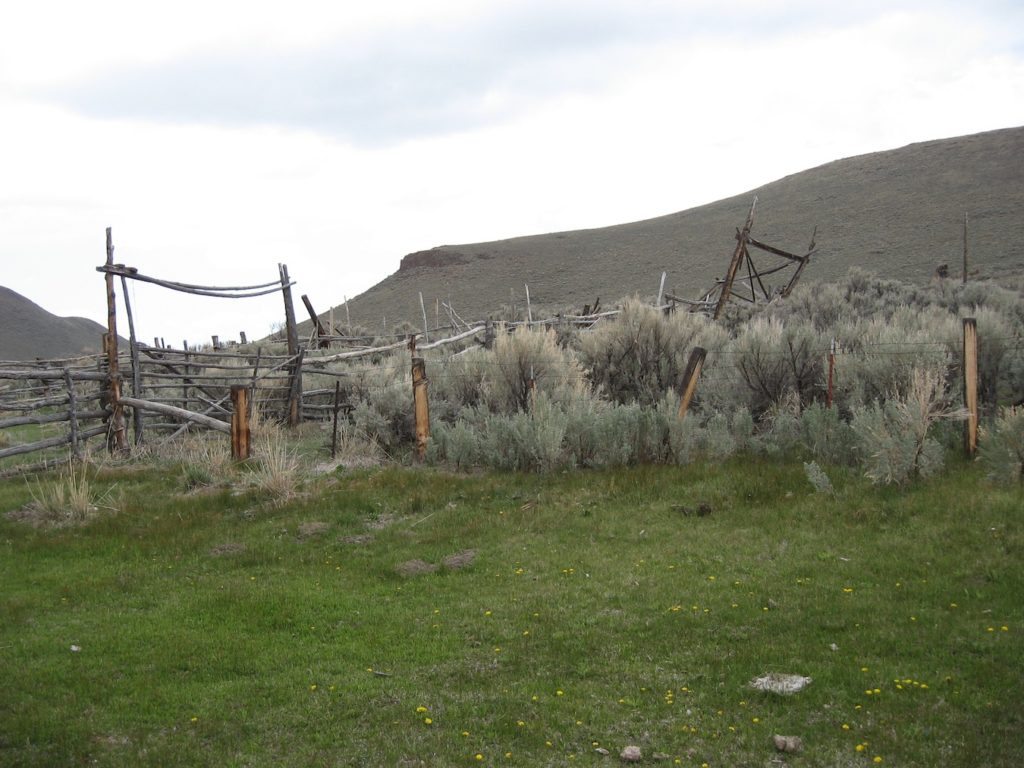
Summit Camp is an old livestock camp, located near the headwaters of Mahogany Creek, that is the stream that feeds Summit Lake—May 10, 2008
In May 2008, my dear friends, Derek and Pat Anderson invited me to partake in an expedition through Smoke Creek/Black Rock Deserts with a goal of High Rock Canyon. One day we spent exploring the Summit Lake area. It should be noted we made a base camp at Soldier Meadows Guest Ranch. Our departure was to be through High Rock Canyon, but due to certain difficulties, that was abandoned. To make a long story, even longer, I did research on Camp McGarry to give the owners at Soldier Meadows additional information to share with future guests.
Camp McGarry was so remote that it relied on the Susanville business community for all of its supplies. The following are excerpts from the Sage Brush newspaper, forerunner to the Lassen Advocate about the coming and goings out in that district. Its lengthy, so if you have no interest, feel free to skip. Continue reading More Camp McGarry→
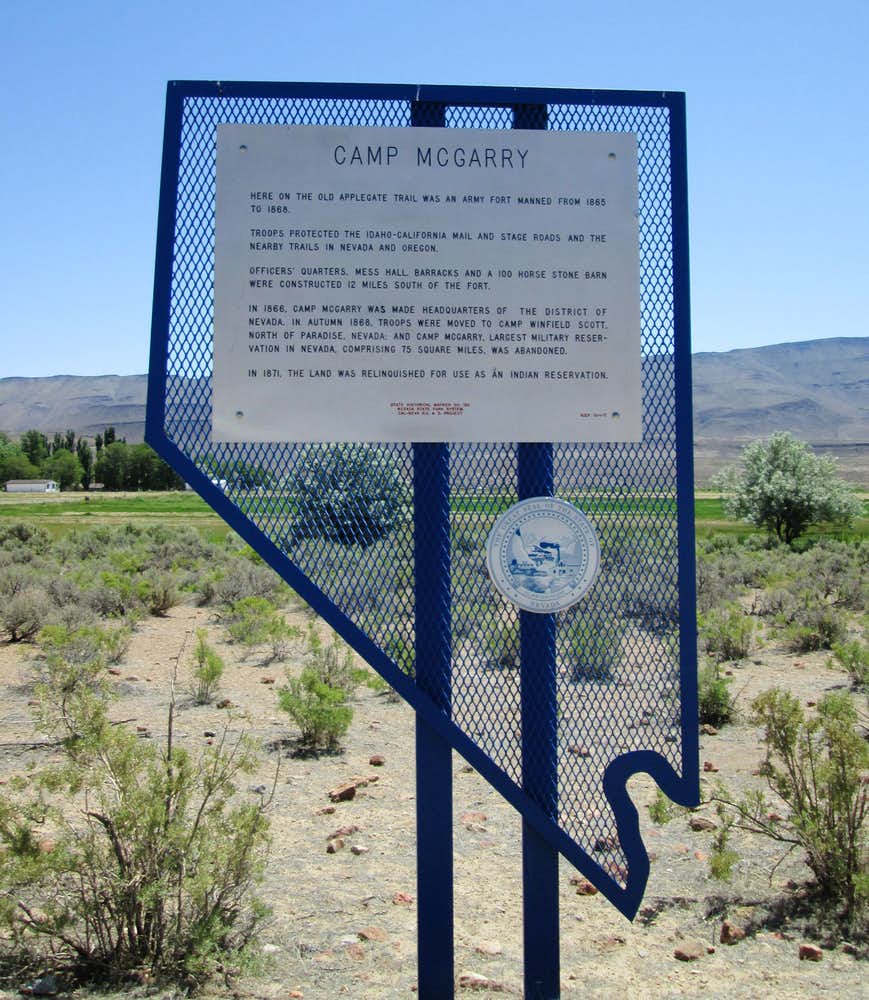
Nevada State Landmark, Camp McGarry at Soldier Meadows
Camp McGarry was a military outpost in remote far northwestern Nevada at Summit Lake. It was established on November 23, 1865 by the California Calvary. It has some unique attributes. It was named for Civil War hero, Brevet Brigadier General Edward
McGarry.
Contrary to popular belief that it was established for the protection emigrants of Lassen-Appelgate Trail, that was not the case at all. Its location was far removed from the Trail. It was for the protection of the mail route. The fastest way from San Francisco to the Idaho mines, was via Susanville, to Smoke Creek and Black Rock Deserts, then headed north via Summit Lake. On October 14, 1865, the Idaho-California Stage and Fast Freight was incorporated with its headquarters in Susanville. The incorporation papers states that the sole purpose was “to operate stage and fast freight from Chico, California via Puebla Valley to Ruby City and Boise, Idaho.” The Company was able to obtain the government’s lucrative tri-weekly mail route contract from Chico to Ruby City at $45,000 a year. The initial 427-mile trip from Chico to Idaho took three and a half days. It would be a short-lived operation. In 1868 the Central Pacific Railroad tracks were laid into Nevada reaching Winnemucca, and that reduced travel by half. On December 18, 1868 Camp McGarry was abandoned, the troops transferred to Camp Winfield Scott, at Paradise Valley, Nevada. On March 25, 1871 the military relinquished the Summit Lake territory and it was transferred to the U.S. Department of Interior. Today, a portion of it, is part of the Summit Lake Indian Reservation.
Camp McGarry was the largest Nevada military reserve with land comprising seventy-five square miles. An unusual feature there was the use of underground passages connecting the barn, mess hall, and barracks .
Another unusual trait, it had a summer and winter location. The harsh winter conditions at Summit Lake forced the camp to move to what become known as Soldier Meadows, just north of the Black Rock Desert. Remnants exist at both locations. However, Summit Lake site is not accessible to the public it being a part of the Summit Lake Indian Reservation. The southern encampment is now the headquarters of the Soldier Meadows Guest Ranch.
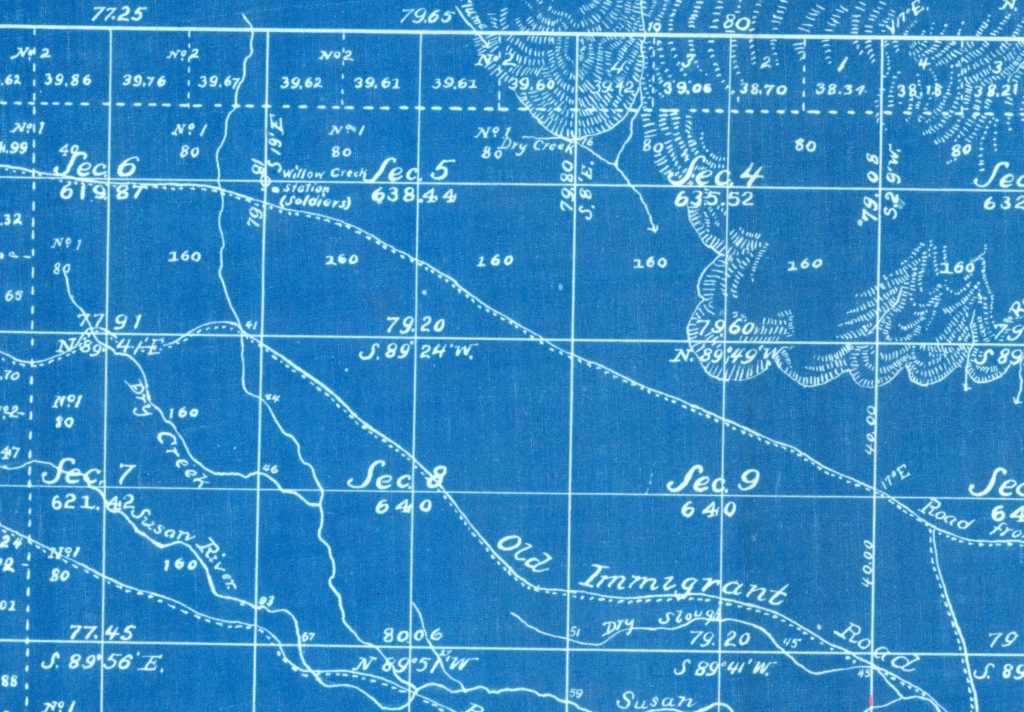
Note: This post originally appeared in April 2016. While examining a Government Land Office survey map of 1882, it notes the location of the Soldier’s Station.
In the fall of 1856, Levi Breed set up a trading post on the Nobles Emigrant Trail where it crosses Willow Creek, just north where the current Lassen County road A-27 crosses Willow Creek. It was second such post for the Honey Lake Valley. The following year Breed located to Janesville and became that community’s largest merchant for a number of years.
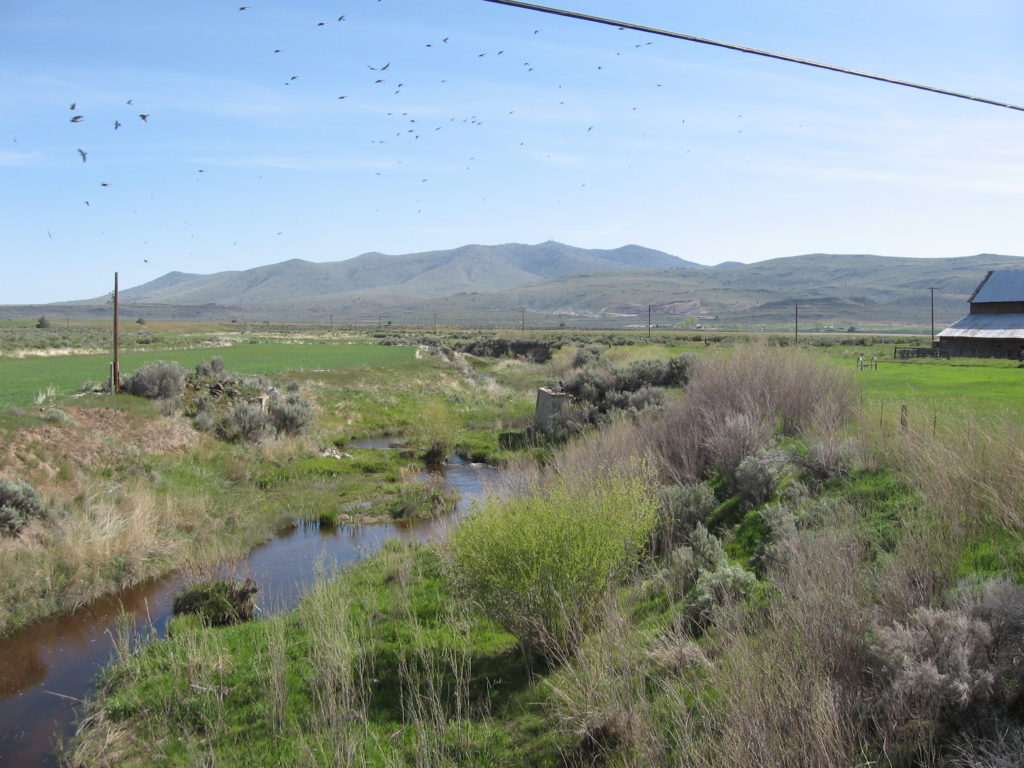
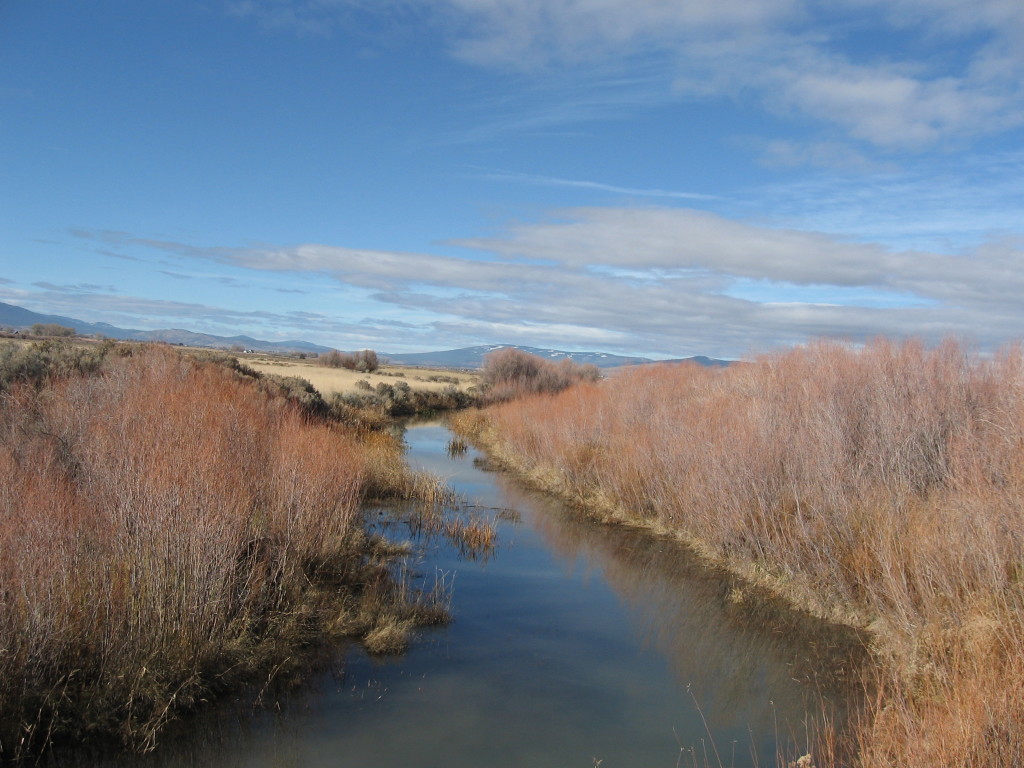
Looking north along Willow Creek towards the site of Dragoon Bridge, April 19, 2016.
It was the military that came along next to locate on Breed’s abandoned post. In 1859, a military station, under the leadership of First Lt Milton T. Carr, A 1 Dragoons, was established at the Willow Creek crossing. Its main purpose was to protect the travelers on the Nobles Emigrant Road. This group consisted of twenty-four men from Fort Crook, Fall River Valley. “Dragoon” is the name for a mounted soldier or cavalryman.The following year, it was replaced by Soldier’s Bridge which was located further to the east and along the Susan River.
Never miss a story, click here to subscribe and support.
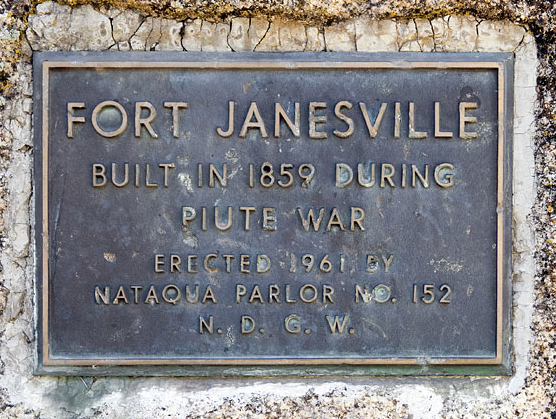
Native Daughter’s plaque for Fort Janesville site.It was actually built in 1860.
Yesterday, I wrote about the military presence in the region during the 1860s. There is a little follow up about how the locals took matters into their own hands so to speak. Those early day Honey Lakers were an independent lot. They had to. Their numbers so small, and far removed from the gold fields, they had no choice but to be resourceful and make do the best they could with their own resources.
Since military assistance was not reliable, Honey Lakers took matters into their own hands. Captain William Weatherlow usually was the one to form a posse when needed during the conflicts of the Indians and settlers. During the Pyramid Lake Indian War of 1860 the residents of Janesville built their own stockade for protection known as Fort Janesville. In 1864, a local militia was formed known as the Honey Lake Rangers which functioned similar to a National Guard Unit.
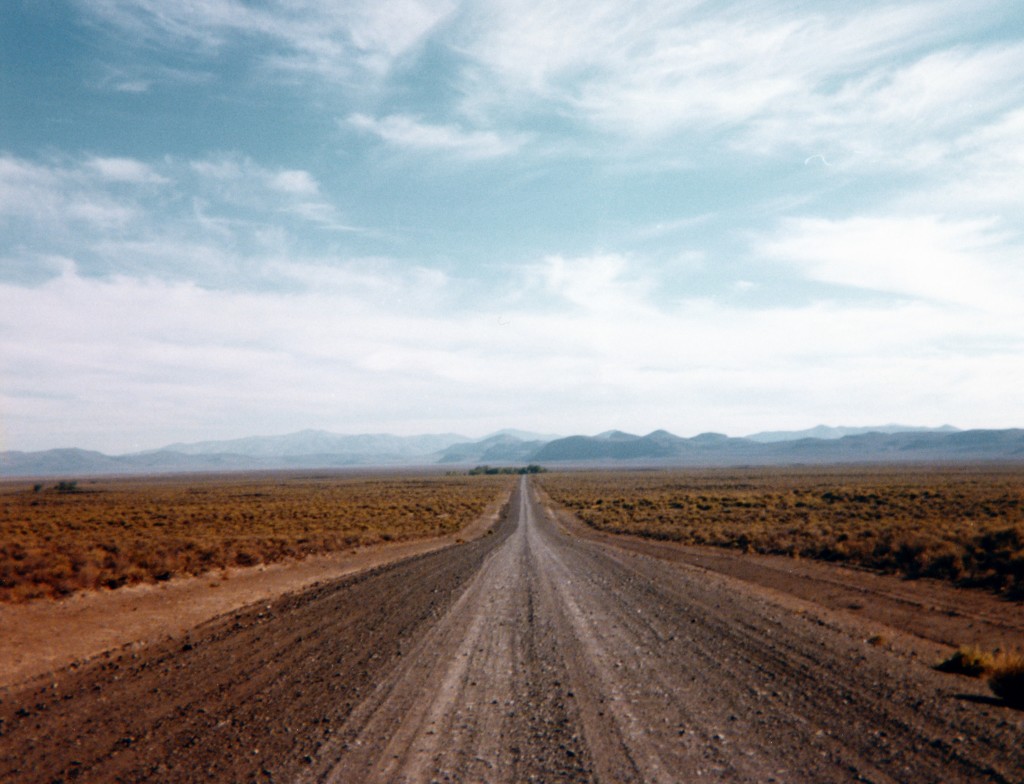
Smoke Creek Desert looking towards Sheepshead, fall, 1977
First of all, I want to acknowledge the late J.S. Thompson, who was not only a good friend, but one of his main interests was early Nevada military history that he graciously shared with me.
United States military presence in the Honey Lake Valley was sporadic during the Indian conflicts of the 1860s. Initially, Fort Crook, now Fall River Mills, during the 1850s was the nearest military outpost. In 1858, Fort Crook soldiers had an encounter with Pit River Indians at the northwest corner of Eagle Lake, but never ventured to the Honey Lake Valley.
Relations between the Native Americans and the Anglo settlers had deteriorated by1859. The murder of Edward Clapper and Peter Lassen in the spring of that year in the Black Rock Desert, did not help matters—the Indians rightfully/wrongfully were accused. Between that episode and increased traffic on the Nobles Emigrant Trail, the military made an appearance. During the summer of 1859, a military outpost known as Dragoon Bridge or Willow Creek Station was established along the Nobles Trail where it crosses Willow Creek in the Honey Lake Valley. These troops came from the San Francisco Presidio.
Tensions between the Anglos and the Indians did not improve. On January 13,1860 Dexter Demming was murdered by the Indians in Willow Creek Valley, north of Susanville. It was like a slow burning fuse that would ignite into the Pyramid Lake War of 1860. After Demming’s death the Honey Lakers petitioned California Governor Milton Lathom for military assistance. By the time their letter was received in Sacramento, Lathrom was out of office, he only served five days as governor!
Not all was a loss. In the summer of 1860 the San Francisco Presidio sent troops to the Honey Lake Valley and established Soldiers Bridge along the Susan River near present day Litchfield.
Susan River, near the Soldier Bridge military site. November 19, 2015
In 1861, the area had no military presence. Things changed quickly with the mining discoveries of the Humboldt in Nevada and the quickest route was via the Nobles Emigrant Trail. This prompted military officials to establish a permanent military outpost at Smoke Creek near the California/Nevada border. The troops, it should be noted came from Fort Churchill, Nevada.
For whatever reasons a mobile military unit named Camp Johns established a base camp near Susanville in June 1864. They did a reconnaissance of the area to Modoc and Northwestern Nevada. The troops came from Fort Churchill and returned there in August. They were replaced with a new set of soldiers with the same mission, and the camp was renamed Susan. It lasted briefly, and the soldiers returned to Fort Churchill in October.
That was the end of actual physical military presence of the region until the establishment of the Sierra Army Depot in 1942. However, there were Camp McGarry and Fort aka Camp Sage that I will write about in future posts.
This cross marks the graves of the soldier’s buried at Camp Smoke Creek
Two interesting questions were posed, which I will address in separate posts. The first is Fruit Growers Supply Company’s “Sunkist Lodge” on the south shore of Eagle Lake. It just happens to be for sale.
As to the military of the 1860s, is an interesting topic. I already have two posts scheduled. The military encampment at Smoke Creek served two purposes. An interesting facet of that operation was to prevent gold bullion from leaving the State of California, on the suspicion that it might be used aid the Confederacy. Of course, there is some interesting political drama with these military encampments. Stay tuned.
Tim
P.S. I just realized I had done a lot of research on Camp McGarry, located at Summit Lake and Soldier Meadows in far northwestern Nevada.
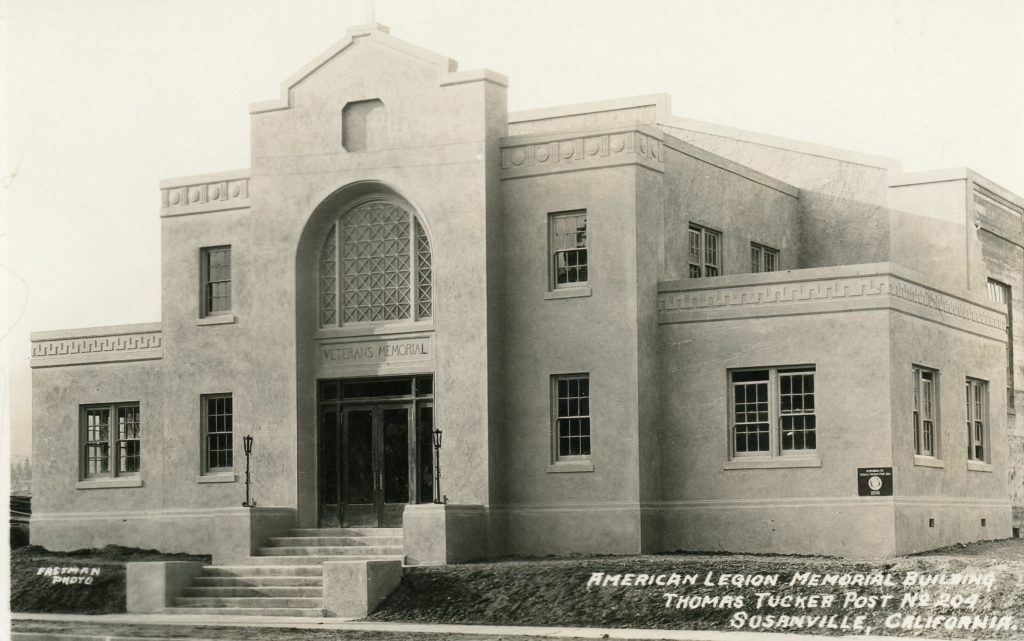
On Saturday, August 14, 1926 an informal open house of Susanville’s new American Legion building was held. After all, next week would be very hectic with the State American Legion Convention being held in Susanville. It was because of that convention that made the building a reality.
On March 6, 1926 the Lassen County Board of Supervisors held a special meeting to open bids submitted by contractors for the building. The county awarded bid of contractor T.J. Rees for $.26,750.* A second contract for plumbing and heating went to E.W. Woodward for.$1,770. It was the intention to have the building completed by July 4. That did not happen. It was not until mid-September when the Lassen County Chamber of Commerce and the Lassen County Farm Agent moved their offices into the Legion building.
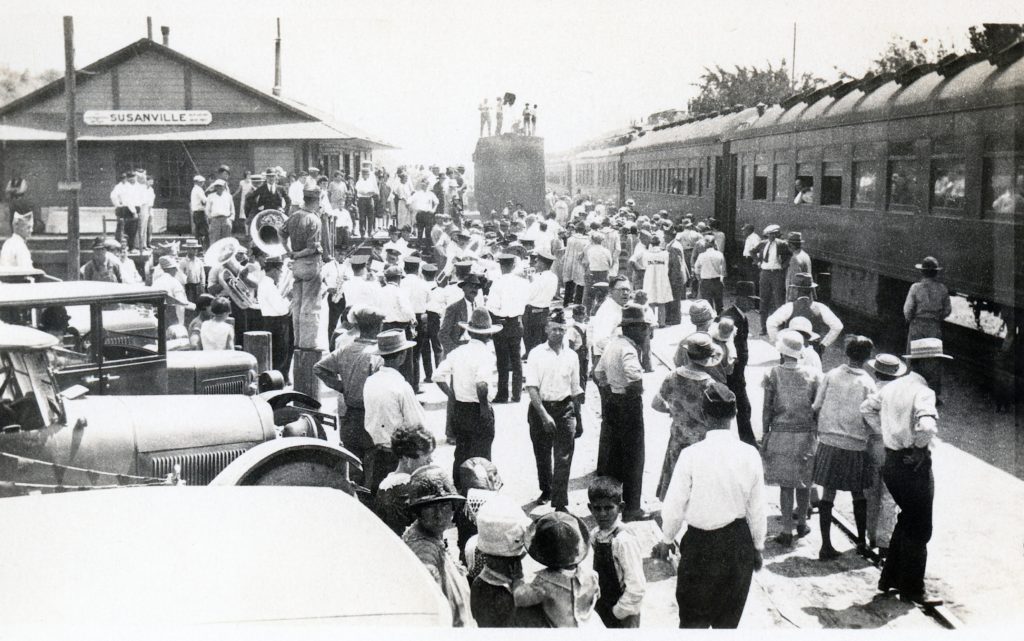
1926 American Legion Convention delegates arriving at the Susanville Depot. Courtesy of Nellygrace Stoll.
*Rees also built the Hotel Mt. Lassen and Masonic Hall in Susanville.
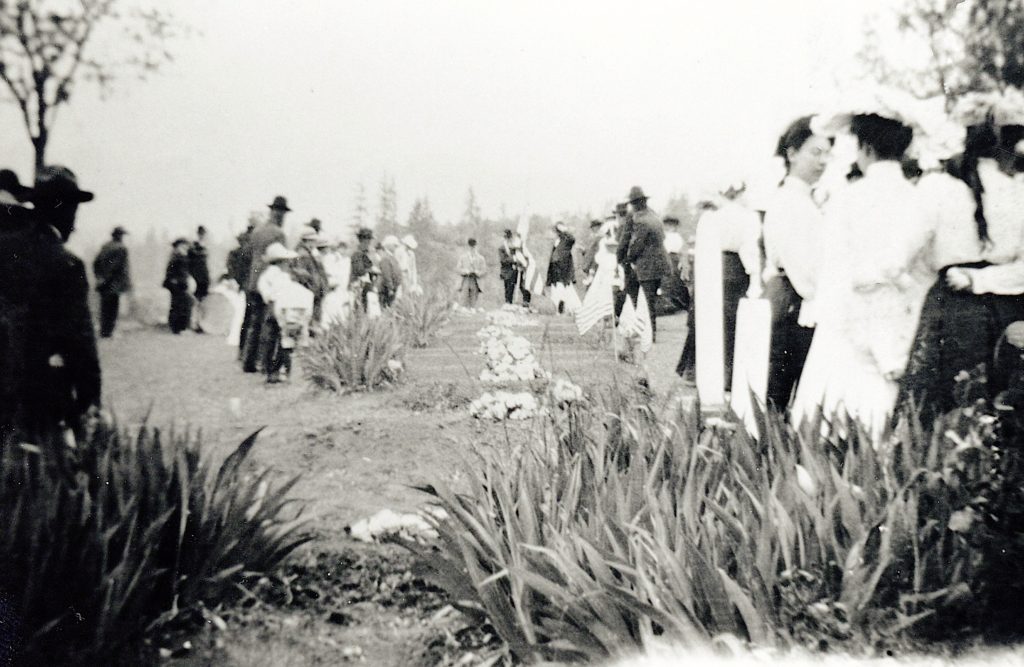
Decoration (Memorial) Day, Susanville Cemetery, 1905—Verna M. Wood
In 1915 there was no formal Memorial Day services conducted at the Susanville Cemetery. This was due to fact of the dwindling members of the Benton Post of the Grand Army of the Republic (G.A.R.) No.163 and were no longer able to lead a program. Those not familiar with the GAR comprised of Union Veterans of the Civil War. In 1916, the local parlor of the Native Daughters of the Golden West organized a Memorial Day ceremony at the Susanville Cemetery.
It should be noted when the local GAR was active, they would march from the Methodist Church to the Susanville Cemetery. Once everyone assembled, including the public, a eulogy, usually by the Methodist Minister. After which the GAR members decorated the graves of the veteran’s with flowers donated by the community.
At the same time, it should be noted the local post of the GAR more or less disbanded, citing a membership of three. They donated their American Flag to the Monticola Club. The flag was given to the GAR in 1891 by the Ladies Aid Society.
In 1920, when the local American Legion Post was established, they would carry on the tradition of their earlier counterparts.
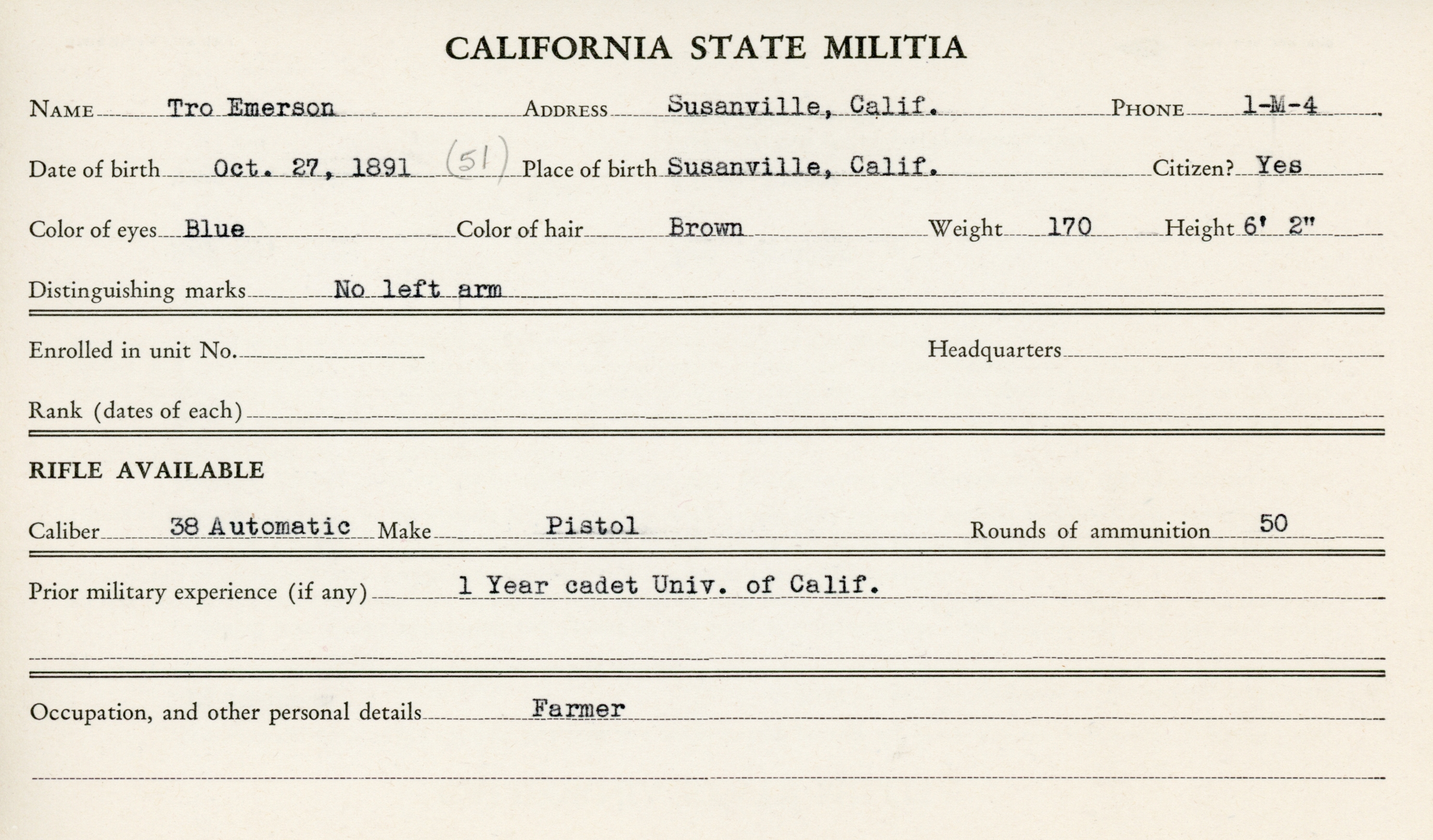
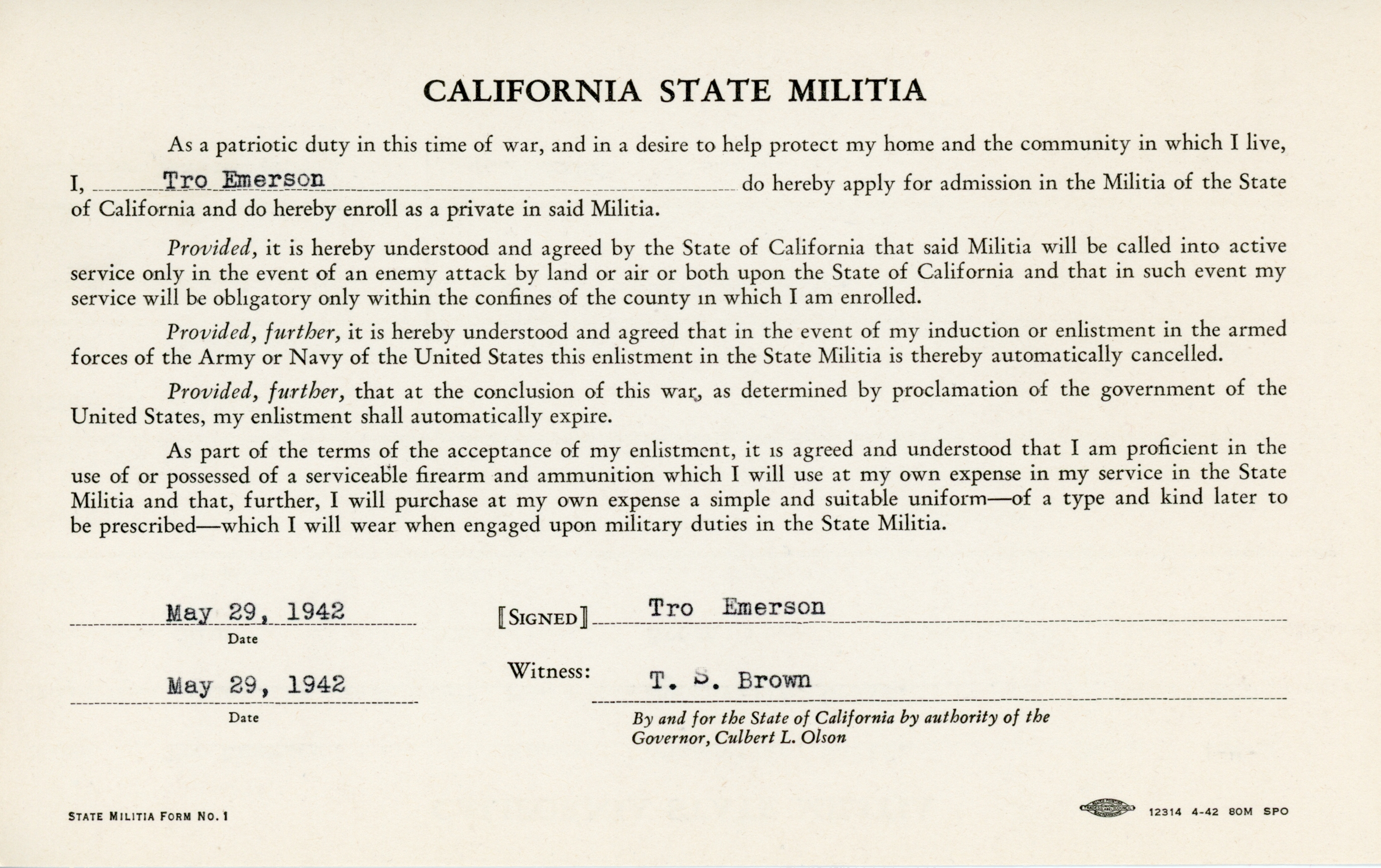
Twice in Lassen County’s history there have been local militia units of the California National Guard. The first was the Honey Lake Rangers of the 1860s. The last time was during World War II. Initially, there was to be one large unit for Lassen and Modoc counties. That plan was neither feasible or practical and was dropped.
A new strategy was drafted. Inside each county, especially in large rural counties like Lassen, several local militia units would be formed. There duties were to protect the area in case of enemy invasion. Their involvement was confined to the boundaries of the county. Uniforms, guns and ammunition would be provided to each unit. They would also be trained in guerilla warfare. In Lassen County it fell upon the Farm Advisor (T.S. Brown) to organize these units.
On May 20 1942, the first organization meeting was held in Susanville. Local units were created for Susanville, Bieber, Doyle, Janesville and Standish. By the first of June, the Susanville Militia had 70 members. It became known as Thomas Tucker Militia—named after Thomas Tucker the first casualty from Susanville in World War I. Fortunately, this volunteer force never had to be activated. At the conclusion of the war, each individual’s enrollment in the militia was automatically cancelled.
In March 1926 work began on the construction of a American Legion Memorial Building in Susanville, located across from Lassen Union High School. On Sunday April 18, 1926 a cornerstone ceremony was held. The stone made of native granite was carved with the American Legion emblem and bore the inscription sponsored by the Thomas Tucker Post No. 204. It was a simple ceremony. A time capsule was placed that included copies of both local newspapers, names of the Lassen County Board of Supervisors, and of course, a list of members of the local Legion and. Auxiliary posts.