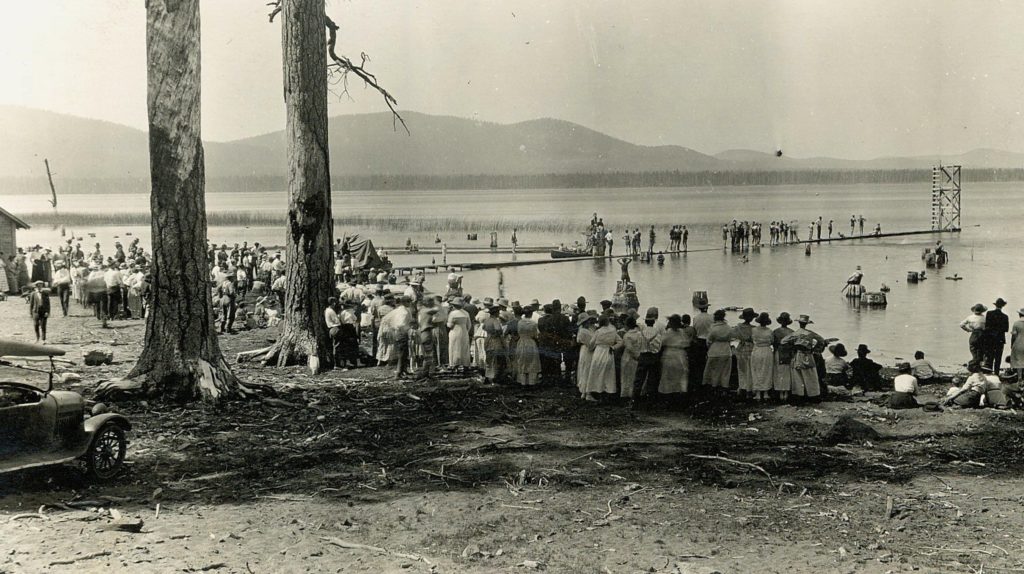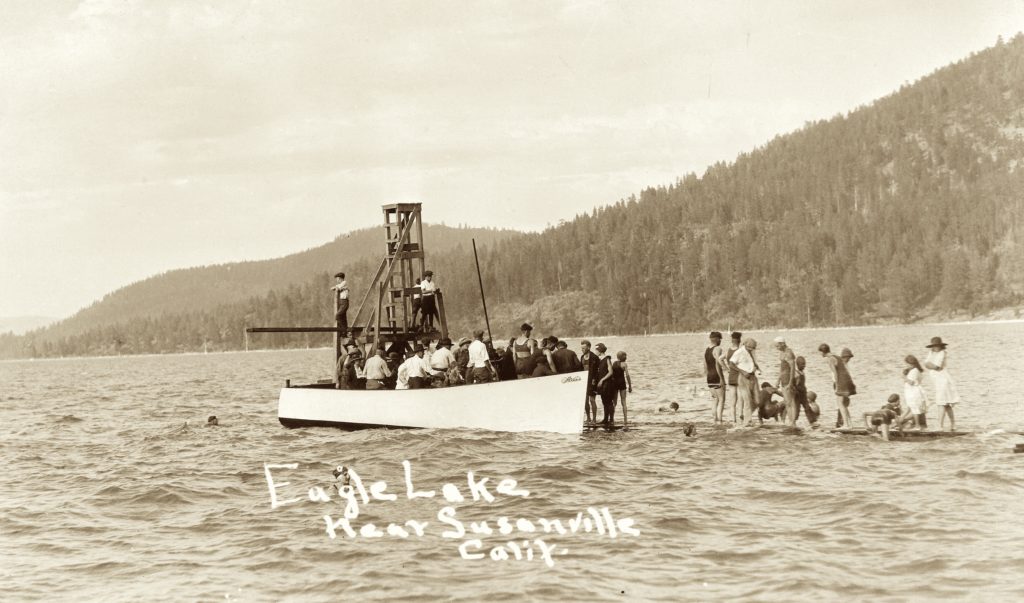
This facility was not opened to the public. Its name a bit of a misnomer. It was built circa 1918 by the Red River Lumber Company at the south. shore of Eagle Lake near present day Merrill Campground. It was used by those in the company’s management positions. Unfortunately, I do not have that much information on it, due to the nature of how Red River operated. However, It was the location of water carnivals during1921-23.
The water carnival at Eagle Lodge, 1921. Courtesy of Ed Standard
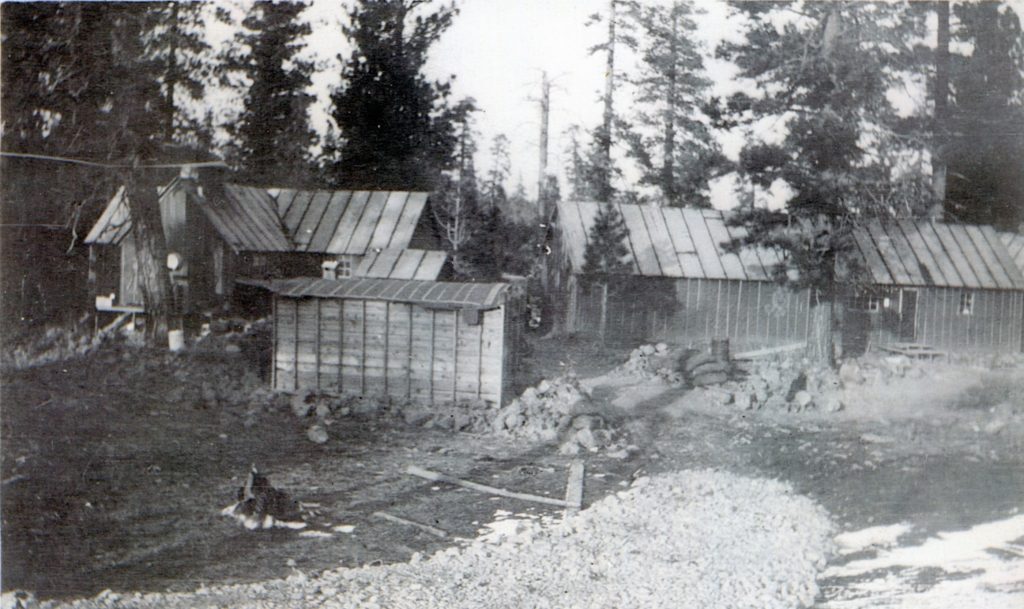
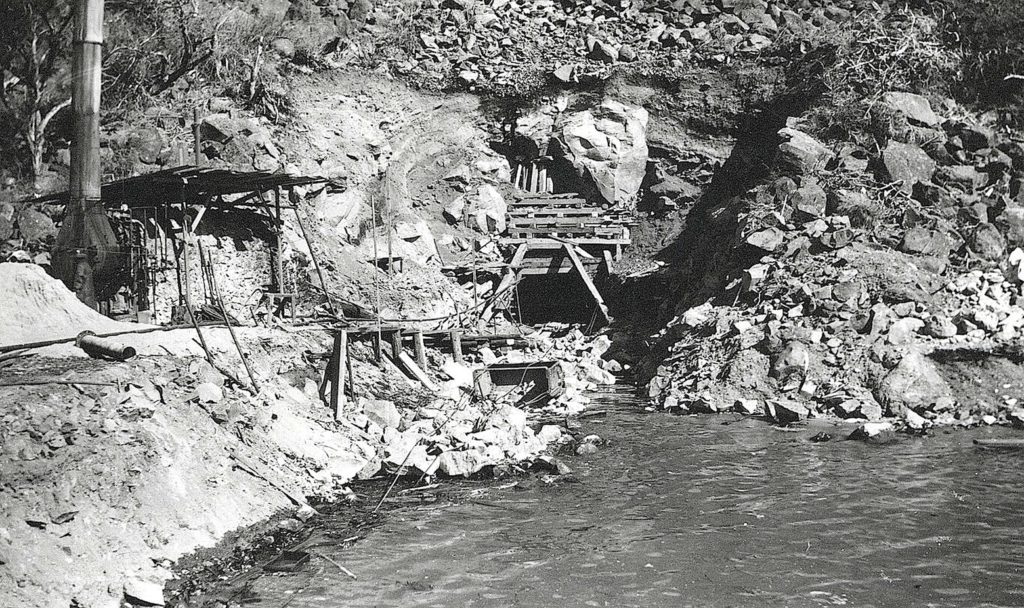
The outlet construction camp of the Bly Tunnel, 1922. Courtesy of Lola L. Tanner
Desperate actions, some times involves desperate measures. The Baxter Creek and Tule Irrigation Districts final plea to salvage the fundamental problems that plagued it from the onset of their Bly
tunnel at Eagle Lake. They were at a such low point, nothing ventured, nothing gained looked promising.
The district’s failed with their applications under President Roosevelt’s New Deal Programs. Exhausted of all avenues. their last plea was for a Civilian Conservation Corp Camp (CCC). In their petition, it was their belief, that such a camp would prove very beneficial, not just the salvation of the endangered farmers on the verge of bankruptcy, but the county at large. Such a camp, they proposed, would employ some 700 men, not including administrative staff, etc.
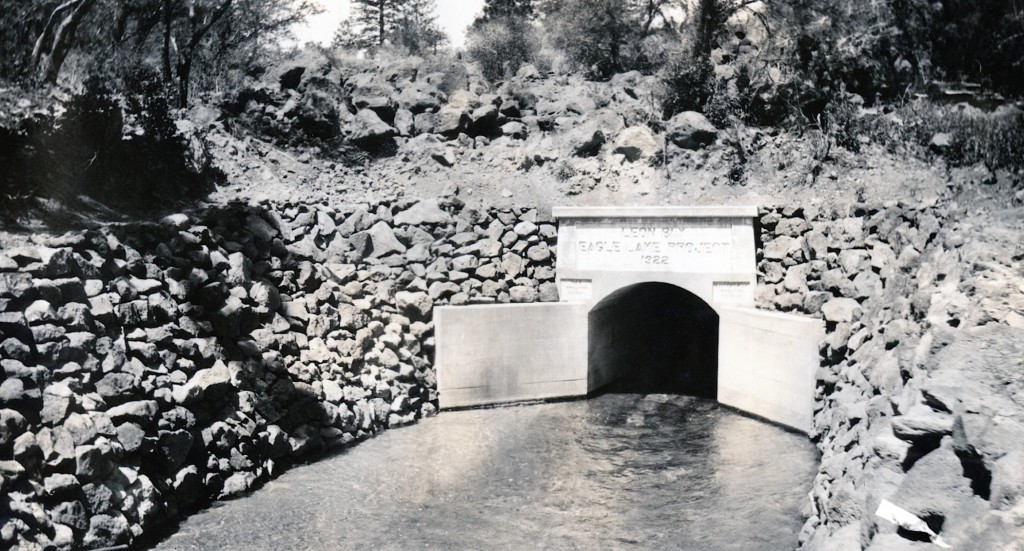
The outlet in 1924. Courtesy of Lola L. Tanner
In a special meeting held on November 1935, the Susanville Chamber of Commerce, endorsed the district’s application. It was not enough, and the application for a CCC speciality camp was denied.
It should be noted, that in the late 1940s and into the 1950s attempts were made to revive the Bly Tunnel project. However, that is another story, for another time.
The Pelican shuttling passengers at the south shore, 1914.
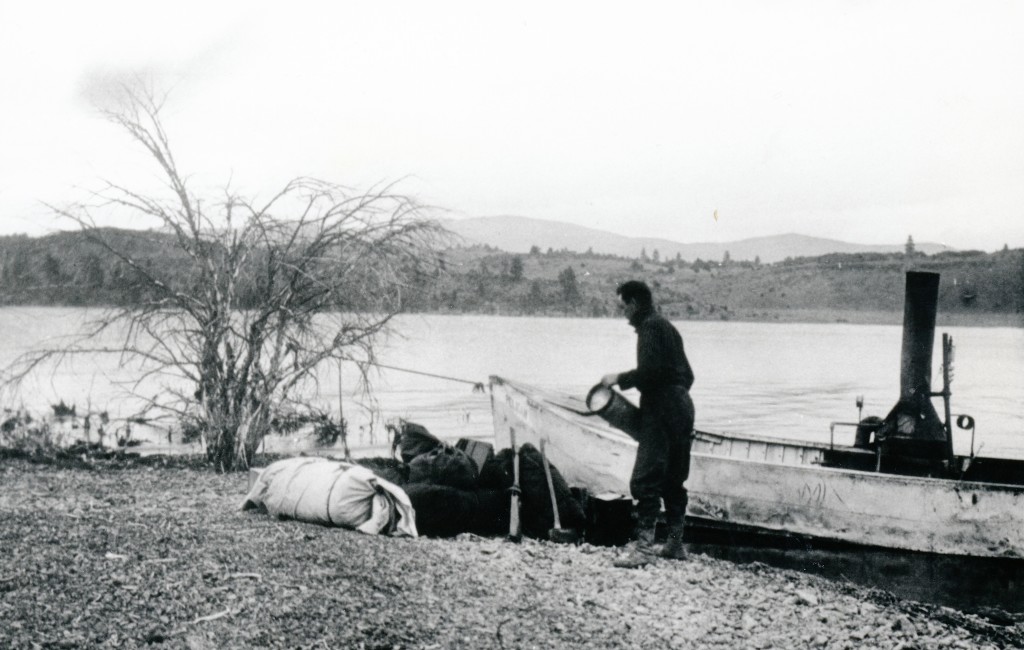
Oscar Rankin arrived at Eagle Lake in 1907, and became the first resort owner, laying foundations for the Eagle Lake Resort on the southwest shore. He constructed several boats for patrons to use on the lake. In 1914, he built The Pelican, a twenty-seven foot galvanized metal hull that was powered with a While boiler and Stanley Steamer engine. Leon Bly used the boat to do a sounding of the depths of Eagle Lake.
Leon Bly sounding Eagle Lake. Courtesy of Wyn Wachhors
Eventually the Pelican ended up at Spalding Tract. Sometime around 1953 Glen Seeber found the old hull near Spalding’s and rescued it before deer hunters or someone else might use it for target practice. It was his intent to restore it. In the February 1996 issue of the Thru-Bolt the newsletter of the Eagle Lake Sailing Association, stated that The Pelican would be on display at the Bengard residence in Janesville at their next meeting. The Sailing Association launched an effort to help Glen and recruited the historical society and Lassen College to assist. How much restoration work was ever completed or the boat’s whereabouts remain a mystery to me.
Bly tunnel inlet, 1921. Courtesy of Lola L. Tanner
The winter of 1923-24 was one of the driest for California since the1860s. This was one was more profound than the earlier one, as California’s growth had been dramatic in the last six decades.
Like so many the Golden State, the farmers and ranchers of the Honey Lake Valley were in a state of anxiety—with no snow pact, equalled dry reservoirs and low stream flows. One hand the future did not seem so bleak. The completion of the Baxter Creek and Tule Irrigation Districts Bly Tunnel at Eagle Lake could provide nearly everyone with an ample water supply. That water district agreed to sell 20,000 acre feet to the Lassen Irrigation District for $60,000–enough to irrigate 7,000 acres for that district.
While Eagle Lake had enough water to supply the irrigation needs of the Honey Lake Valley, there was a huge technical problem. The Bly Tunnel original design was the inlet was to tap the lake six feet below the surface—the contractor only did three feet. This forced Baxter and Tule Districts to hire an engineer to examine the situation.. When all as said and done, only a very limited water supply was delivered, leaving many literally high and dry.
Probably, one of the most unusual proposals to use the waters of Eagle Lake was for mining operations at Hayden Hill, located some twenty-five miles north of the lake. It just goes to show, there are a lot of creative individuals out there, past and present.
During the 1920s and 1930s, both the mining activity and the population at Hayden Hill declined. In 1934, Stratton & Stratton of Spokane, Washington consolidated the mine ownership. They had high hopes to revive the Hill. One of the main drawbacks that Hayden Hill suffered was the lack of water for milling. In 1938, Stratton & Stratton proposed to pipe water from Eagle Lake, at a rate of 2,500 gallons per minute. This scheme never came to fruition. There was no Hayden Hill revival.
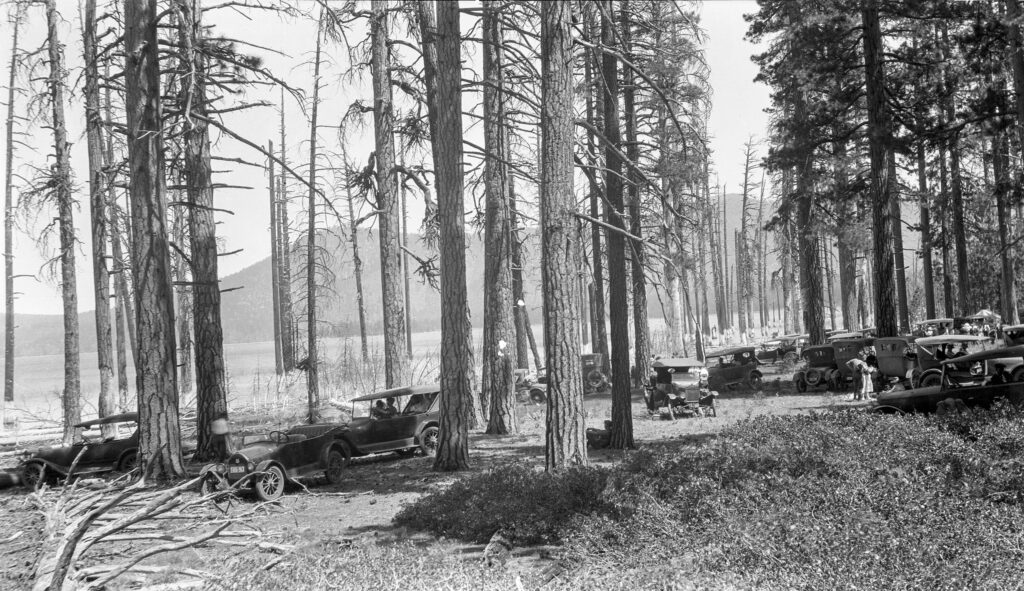
South shore, Eagle Lake during the 1921 water carnival—Ed Standard
During the 1920s, in the summer months the south shore of Eagle Lake was a busy place. It was not unusual for some events to attract two thousand visitors whether it be the lumber companies water carnivals or the local Elks lodge barbecue. This was long before campgrounds, so one setup camp wherever. At that time most of the property was owned by Malvena Gallatin—the forest service did not acquire these lands until 1947.
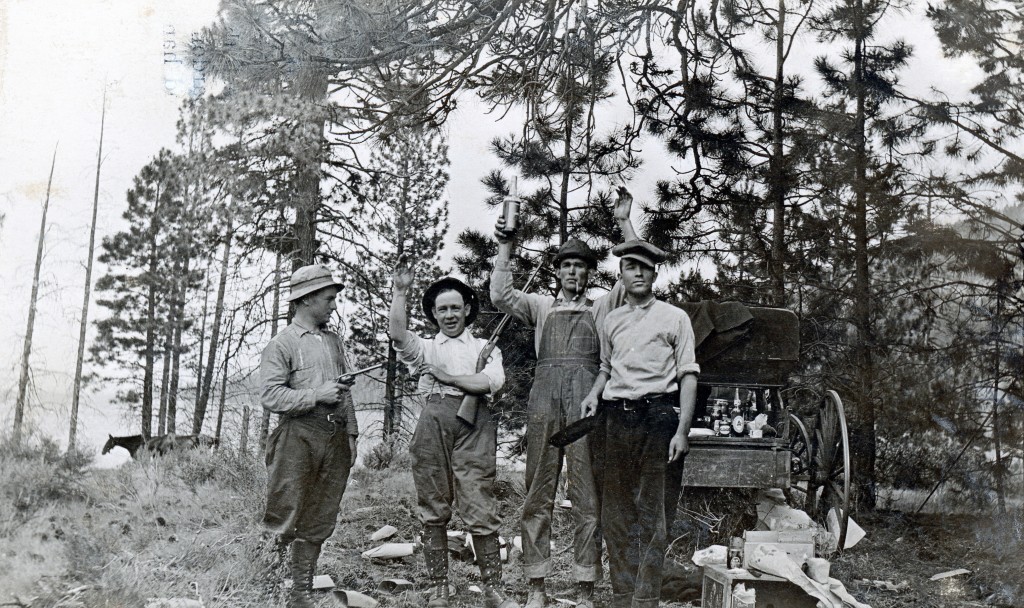
Happy campers at Eagle Lake, 1914.
In a 1924 letter Malvena Gallatin wrote: “It has always been my desire to preserve this beauty spot. It is well known that the public receives vastly more benefit and use of this shoreline property than I do. The public have been allowed access to these lands for camping, boating and fishing at all times. The Gallatin Beach and a large part of the shoreline property has been used for years by the public. It might be called a public playground, subject only to very mild restrictions.”
The north shore of Eagle Lake, 1920, where Udell proposed to build a dam. Courtesy of Lola L. Tanner
In 1910, San Francisco attorney Alva Udell came up with a novel approach to tap Eagle Lake without the aid of a tunnel. Udell proposed to tap the lake at the north end, only a mile from then Troxel’s residence (better known to many as Stones). The intention was to build a dam on the lake and a canal leading over to the Willow Creek springs. This route, it should be noted, is the lowest division separating Eagle Lake from the headwaters of Willow Creek. Continue reading Eagle Lake – The Udell Project→
Jules Hurlbut’s homestead cabin., that eventually became Spalding Tract. Courtesy of Orville Watkins
In 1914, John Spalding announced his intention to subdivide “his” ranch on the west side of Eagle Lake. However, truth be known it was not actually his. The property in question belonged to his brother-in-law, Jules Hurlbut. At the age of 8, Jules came to Lassen County with his parents, Timothy Judd and Caroline, along with his sister, Mira Eleanor. The family first located in Willow Creek Valley, where other family members resided, but would soon locate to Eagle Lake. In 1881, John Spalding married Mira E. Hurlbut.
Pine Creek, circa 1914. It sholuld be noted that John Spalding’s original homestead was on the north side of Pine Creek. Courtesy of Wyn Wachhorst
In time, Jules homesteaded the property that is now Spalding Tract. During the 1880s, Albert Gallatin went on a buying spree acquiring the majority of private properties around the lake, including that of John Spalding. Jules Hurlbut held firm, and would not sell to Gallatin. A confirmed bachelor, Jules spent most of his life at Eagle Lake. In 1937, he retired to Susanville and died there in 1941. He is buried in the Susanville Cemetery, there is no marker for his grave.
While examining the 1972 summer issue of High Sierra magazine it had a short feature entitled “Sails on Eagle Lake.” Tom Boyer, Vice Commodore of the Sierra Yacht Club of Reno had visited Eagle Lake in 1971 and was impressed what he saw. The Sierra Yacht Club at that time had sixty members and they would normally race on Washoe Lake south of Reno. On June 24, 1972 six sail boats from the Sierra Yacht Club graced the waters of Eagle Lake. According to the High Sierra it was the first time an organized sailing unit was held at Eagle Lake. It certainly would not be last. A few years later, local residents formed the Eagle Lake Sailing Association also known as ELSA. For a time it was a very active group. In addition, for awhile Lassen Community College even sponsored summer sailing classes.
Some people might find this of interest. Chico State has transferred its interest in the Eagle Lake Biological Field Station on the east shore of the lake to the Susanville Indian Rancheria. Not sure what the Rancheria’s intent is. In the past, according to Bureau of Land Management policy it must be used for educational purposes, whether this applies to the Rancheria, I do not know.. When I was on the Lassen College board, I had brought up that the college should look into it, but that went nowhere.