Category Archives: History

Hackstaff versus Rayl

Rayl
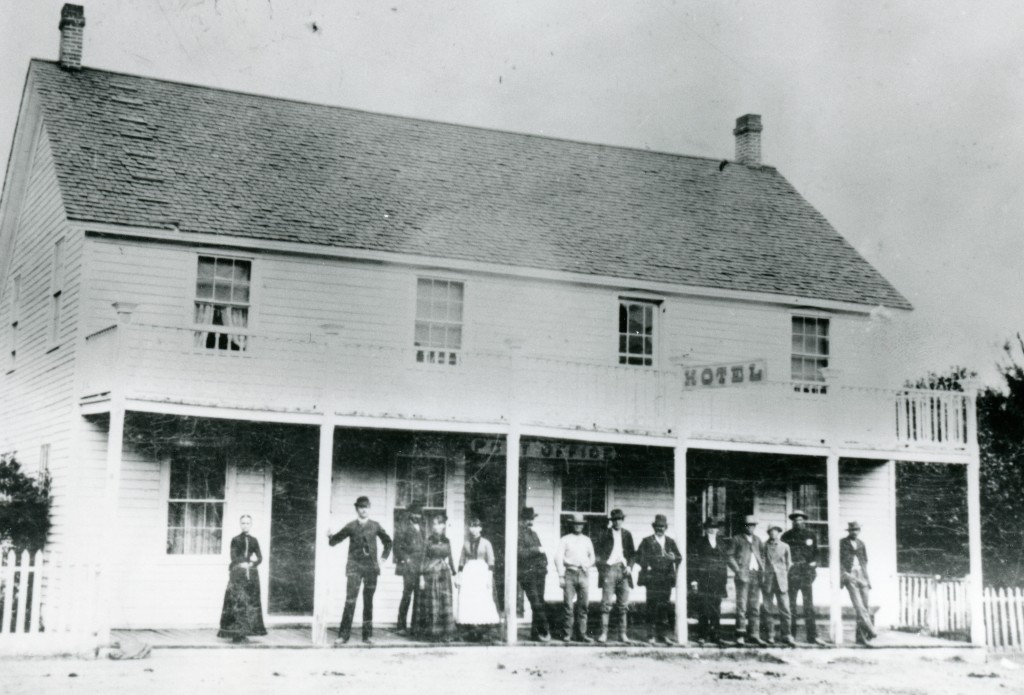
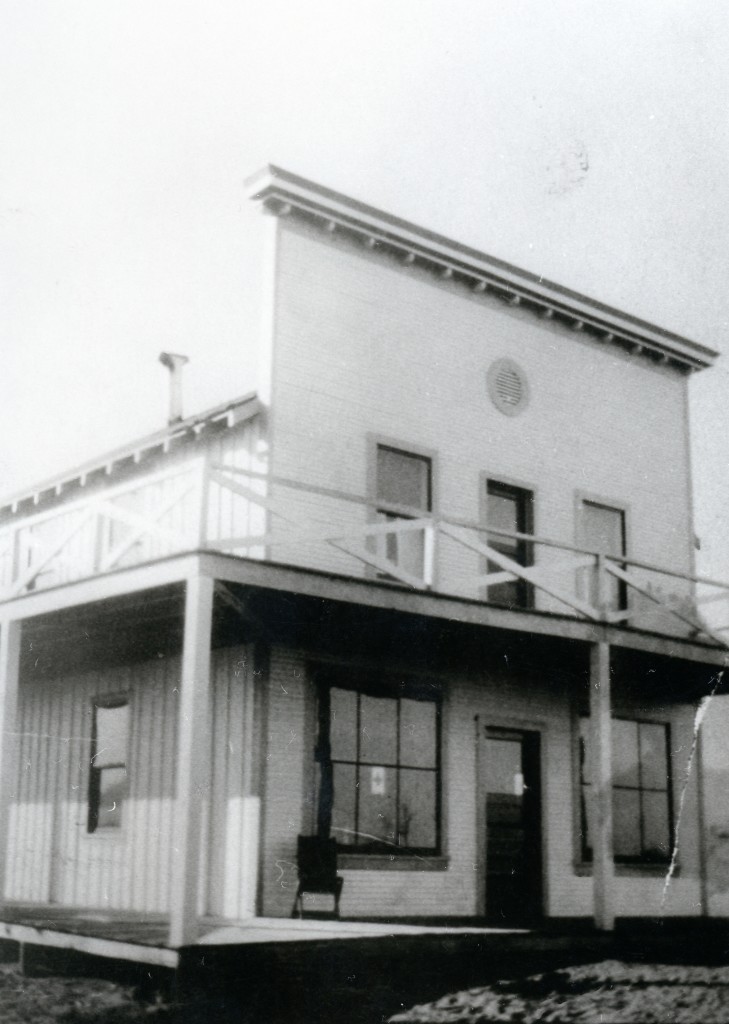
The Rayl Hotel. Courtesy of Tom Armstrong

Known today as Herlong, and it was the one-time junction of
Nevada-California-Oregon (NCO) and Western Pacific (WP) railroads. In 1915, Stanley G. Rayl arrived on the scene. When Rayl petitioned to establish a post office, he proposed the name Rayl—the NCO opposed it. Charles Moran, President of the NCO, wanted the post office named Hackstaff—in honor of his mother-in-law, Clara Hackstaff Adams.  After five months, the Postmaster General decided upon the name of Rayl, instead of Hackstaff.  This delighted Robert M. Cook, editor and publisher of the Lassen Weekly Mail, Cook wrote: “ The NCO wanted a monument to an uncle of the wife of Moran, the New York capitalist behind the NCO.  Hackstaff was never in Lassen County and no one here knows anything about him.”

When Rayl left in 1921, he assigned the postmaster duties to Cyrus Helman.  Those two men had a disagreement and fought that battle in court.  In the end, the Rayl post office closed.  On March 18, 1922, the Hackstaff Post Office was established with Helman as postmaster.  It did not last long and the post office closed on December 30, 1922. In 1927, Hackstaff’s meager population
was wiped out when the WP moved its section crew to Doyle.  The
location continued to be known as Hackstaff until the Sierra Army
Ordinance Depot was established in 1942.

Support by subscribing.

Honey Lake Valley’s Tule Confederacy

Theodore Ranch, 1892, located in the heart of the Tule Confederacy,. The property in 2023 is known as the Dow Ranch.

The Tule District of the Honey Lake Valley is the very lower end of the Susan River, where the river splits up into various sloughs.

In 1859, John Kelley of Missouri settled in this region. All was fine until 1863 when the United States Government surveyed the region. Under federal law, the most a person could file was 160 acres. Kelley had already claimed nearly 1,000 acres. Kelley concerned that he could lose his holdings wrote back home and encouraged fellow southerners to come out and join and settle on property he had claimed. Those who initially did were William Brashear, Robert Briggs, Chappell Kelley and John Saling.  In 1864, when Lassen County Surveyor E.R. Nichols who was doing work in the region, noted a number of residents had served in the Confederate Army and he dubbed the district the Tule Confederacy.

Not all the residents were southerners and there were conflicts between the neighbors. In the spring of 1864, John Purcell set fire to DeWitt Chandler’s house and claimed it a victory for Confederate States.

It is never too late, subscribe and never miss out on the region’s history.


Lassen’s Good Fortune

Susanville’s Antler’s Club, later Elk’s, 1925

Way before the infamous stock market crash of 1929 that sent the nation into the Great Depression, there were a lot of indicators before hand that the economy was in peril. The Lassen Mail’s editorial of February 8, 1928 provides and interesting glimpse of conditions and how Susanville and Lassen County were in better shape than a lot of other areas.

”Despite the optimism of the booster people, business conditions in the United States are very bad at the present time. The unhealthy commercial condition is not confined to one portion of the country. North, south, east and west are all undergoing a period of depression.

”The depression is not experienced in any single line of industry—all classes are suffering from it. Manufacturing firms complain of lack of orders and say that the orders they do receive are mainly of the credit variety.

”The situation is reflected in the stock and. bond markets. The New York Stock Exchange bottom is dropping out of the market in many lines. General Motors has gone to a new low level and steel has fallen to lowest point in years. Railroads and manufacturing companies are showing lesser profits than in former years. Oil companies, with large surplus production, are showing lesser earnings and in some cases a loss. The entire country is encountering a wave of depression.

“In sharp contrast to the situation most of the rest of the country is the business outlook of Susanville and Lassen County. While conditions are not as prosperous as in the good time of the year there is commercial slump here. Where business firms in other parts of the country are going bankrupt, the merchants of Lassen County are still going on and there is no great fear that any of them will not have a prosperous year in 1928.

”While Lassen County does not enjoy the reputation of being the most populous county in California, nor has it the greatest amount of wealth, it is far better off at all times than many of the so-called wealthy counties. Prosperity in Lassen County is unbroken and while we have no great “booms” we have no “panics” and are carrying on in the same way when the “boom” counties are wondering if they will survive the cold, cold winter.”

Subscribe

Remember Emerson Lake Golf Course?

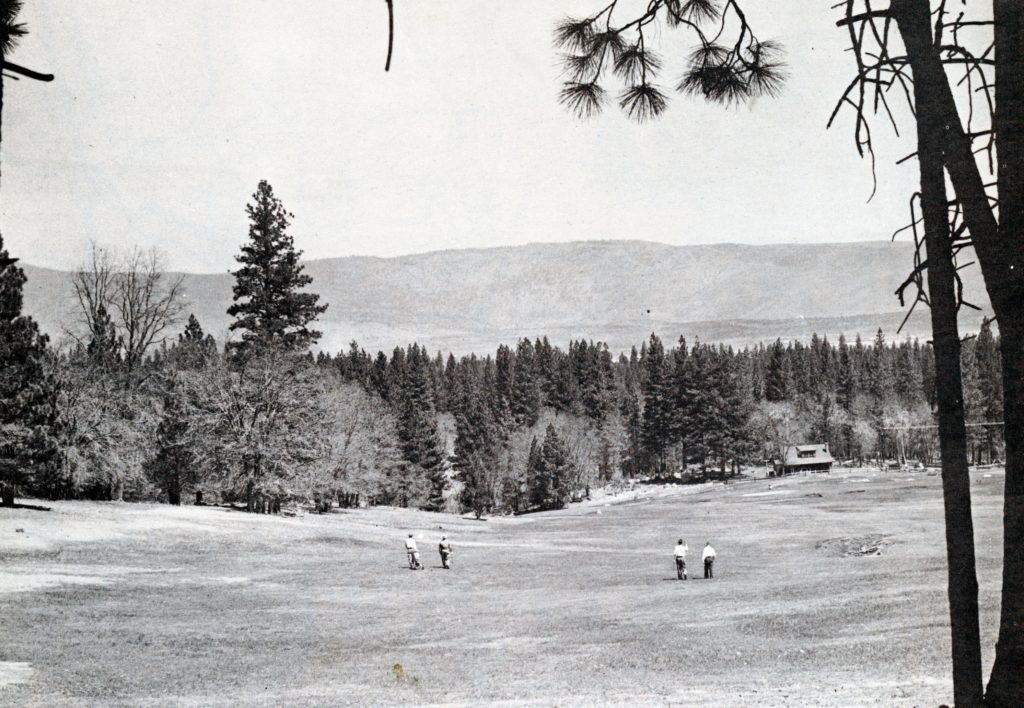
Lost Meadows Golf Course, near Peter Lassen’s Monument, was replaced by the Emerson Lake Golf Course.

In the 1960s there was a movement to have a municipal golf course. In 1967, Rollin “Rollie” Doyle Emerson (1917-1976), sold a portion of the family ranch, near Richmond School, to the City of Susanville that the latter developed into a golf course.  The Emerson family had owned  that property since 1874.

Fast forward, in the spring of 2002, Todd Sickles, manager of the Emerson Lake Golf Course, requested that the City rename the golf course to Diamond Mountain. Sickles, who had a long-term lease of the golf course, cited that with the expansion of the course to 18 holes that he wanted to create a new image for the facility and enhance its marketability.  Sickles also cited that the current name is at times misleading, as Emerson Lake is known to go dry, due to its usage for irrigation.  This issue did spark some debate.  Rollie Emerson’s son, Tro, acknowledged the problem with the dry lake, and requested that the family name remain intact and suggested Emerson Meadows.  Sickles, in the meantime, offered to construct a monument in honor of Rollie Emerson for his early day activities with the golf course and in addition, the first nine holes would be known as the “Emerson Nine.”  The City Council was divided on the issue.  Those in favor of the name change stated that marketing and financial aspects should be a priority over the region’s heritage.  On June 5, 2002, the City Council voted 3 to 2, and approved marketing over heritage and granted the name change to Diamond Mountain Golf Course.

Support by subscribing.

Where Are We—East Shore of Eagle Lake

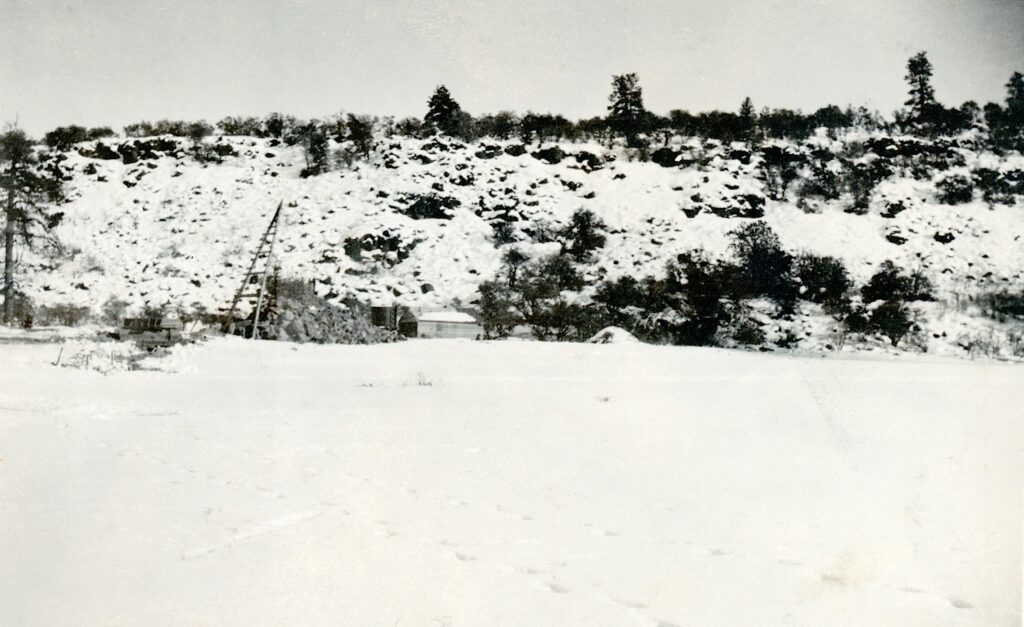
The initial set up for construction of the Bly Tunnel, Inlet December 1921–Lola L. Tanner

While the photograph does not look like much, what it depicts is the initial stages of construction work of the inlet of the Bly Tunnel at Eagle Lake. It would be another year, before major work on the tunnel was started from the lakeside.

In 1962, Lassen County received some BLM land just north of Bly Tunnel. Thus, was the humble beginning of the Lassen County Youth Camp, though it take years to construct the facilities, a lot done by donations and volunteer labor.

In 1964, the Eagle Lake Biological Field Station of California State University, Chico relocated on BLM property between the Lassen County Youth Camp and the Bly Tunnel.

Tim

Tuesday Tidbit — Bennett’s CCC Photographs

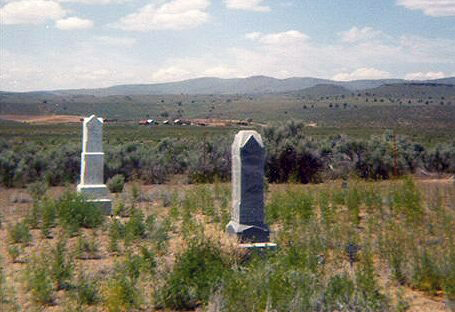
McKissick Family Cemetery, Secret Valley, 1978

One of the many photographs that C.H. Bennett took during his stay at the Secret Valley CCC camp from 1936-1938, was a Veteran’s Day Service at the McKissick family cemetery located a few miles from the camp. Earlier that year, John Daniel McKissick had passed away and was buried there. His father, John Best McKissick was known as the World’s First Champion, is also buried there.. John Daniel, it should be noted was a military veteran. The photographs are rather interesting.

On an additional note, Bennett’s daughter did include copies of clippings from. the CCC newspaper Happy Days, which provides an interesting glimpse of life there. For a time, Susanville’s Lassen Mail newspaper ran news items from the camp, so between the two sources, along with the photographs, provide some interesting aspects, not to mention a balladeer melody.

Tim

The Janesville Hotel

Janesville Hotel
Janesville Hotel

The first and only hotel in Janesville was built in 1857 by Malcolm Bankhead, which was a two-story structure made of logs. In 1872, Dennis Tanner purchased it, and tore it down. He replaced it with a much substantial larger, two-story wooden frame building, that contained 22-rooms. The hotel had numerous owners over the years. In 1913, B.R. Holmes acquired it, made numerous upgrades and changed the name to the Diamond Mountain Inn. One of its most interesting owners were the Pollocks, as in the famed artist Jackson Pollock. The hotel was destroyed by fire in 1931.

For those interested in the hotel stood on Main Street, south of the former Masonic Lodge, though that structure was not built until 1910.

Tim

Fandango Pass, Modoc County

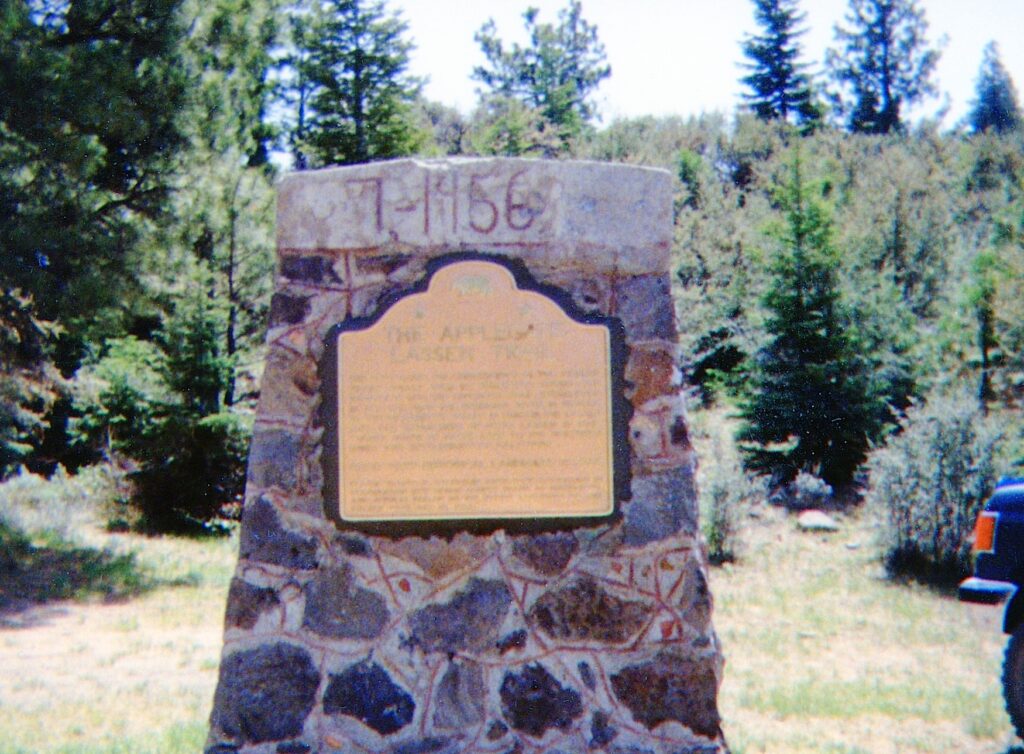
The Applegate/Lassen Trail Plaque at Fandango Pass, 1992

Back in December/January I was for the most part a shut-in due to snow and ice. While at times in nearly drove me “batty” I did use the time to sift through more archival boxes in storage. Thus, one of the finds was this photograph taken in 1992 of the restored Applegate Lassen Trail marker at Fandango Pass in the Warner Mountains of Modoc County.

First lets begin with the Applegate Trail established in 1846  by Levi Scott and the Applegate brothers. A portion of their route ventured from the Block Rock Desert going in a northwest direction to Surprise Valley and crossing over the Warner Mountains. At Goose Lake the trail proceeded to Oregon. In 1848, Peter Lassen used a portion of the same route, but at Goose Lake his route went south to the Sacramento Valley. For a number of years the pass was also known as Lassen’s Pass, but eventually became known as Fandango.

There are several variations as to the origin of the name of Fandango—which was the name of a lively Spanish dance. A common theme of various stories has to deal with cold temperatures. Most historians agree that a group of emigrants burned some of their wagons for warmth and reportedly one observer stated it was so cold that “the men had to dance to keep warm” and they named their camp Fandango Valley., that was located near the pass.

Today, one can participate in Fandango Days held in Alturas during the Fourth of July.

Support by subscribing.

An Insulted Secret Valley Resident

Karlo
Karlo, Secret Valley, 1920

In February, 1928, Susanville’s Lassen Mail newspaper reported that the population of Secret Valley consisted of fifteen people. An angry resident of the valley wrote the newspaper for a retraction. This person asserted there were thirty people living there, and this was not including the section crew residing at Karlo working for the Southern Pacific Railroad.

Tim

P.S.. When the Secret Valley CCC camp was established in 1935, the population soared with an additional 176 residents.