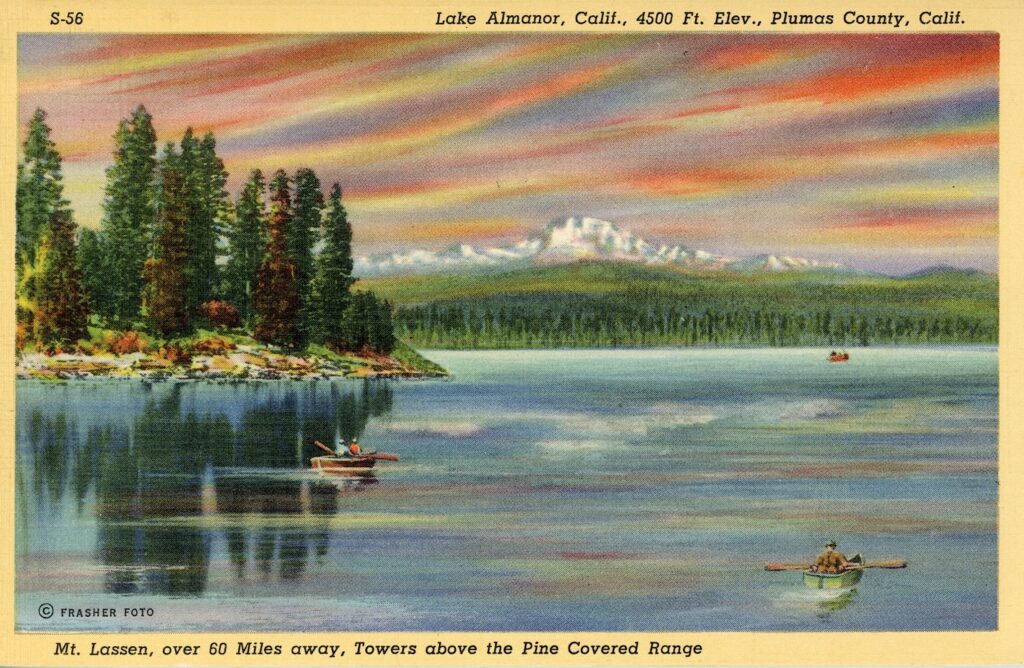
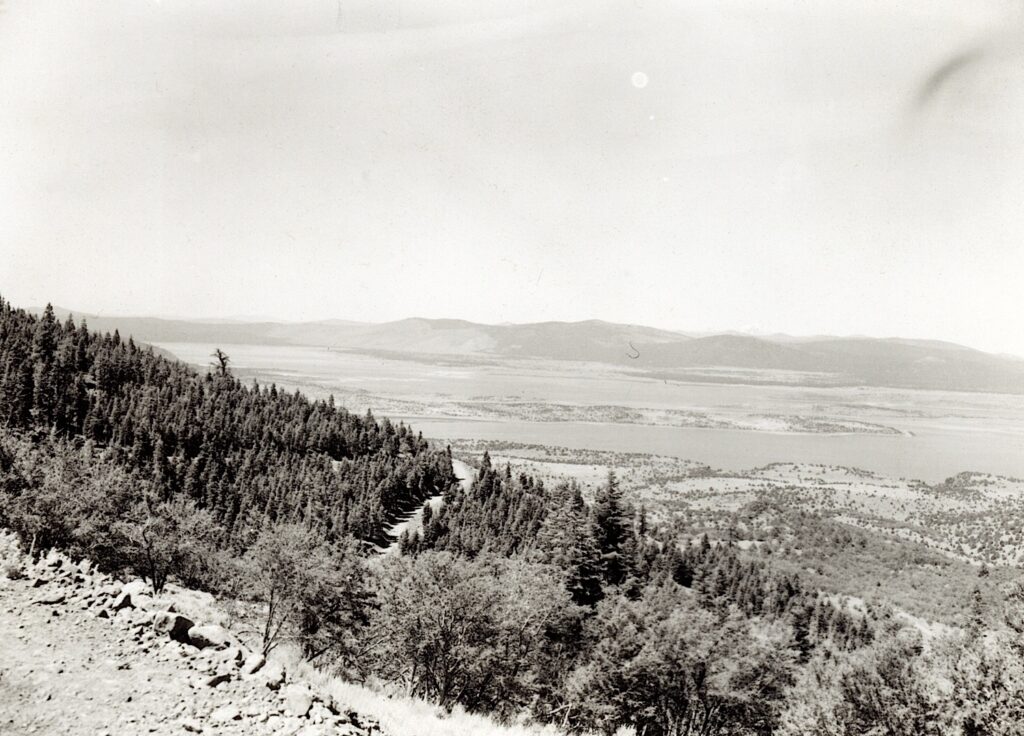
This is one of those Ebay items I came across. I am not sure what caught my attention the illustration itself, or the description on the reverse. “Lake Almanor, Plumas Co., Calif, is an artificial lake 20 miles long and covers 30,000 acre valley surrounded by heavy timbered mountains affording the finest wild game and deer hunting in the West. Since 1913, after completion of the dam which was begun in 1906, Lake Almanor stores 1,300,000 acre feet of water which contains Rainbow Trout weighing up to 16 pounds.”
While there is no date, these types of color linen postcards were popular in the 1940s and early 1950s.
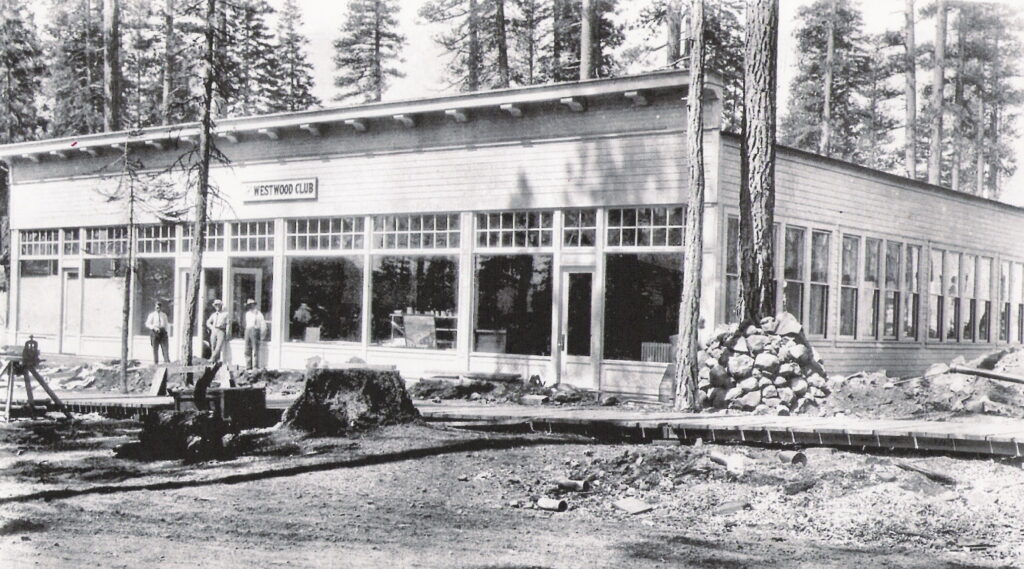
The Westwood Club was one of the first buildings constructed in that community and it was a major social hub—Westwood Museum
In 1935, with the creation of the National Labor Relations Board brought about the collective bargaining between employers and unions, which had a ripple effect in organized labor. During the late 1930s, unions big and small sprung up everywhere. Many a business even with a handful of employees became subject to union membership with a community’s union providing an umbrella for
these workers to join.
H.S. Anderson Company, who leased the Westwood Club, knew the
situation very well. On March 13, 1940, the Bartenders and Culinary
Workers Union No. 654-A went on strike, protesting the firing of
fry-cook Bill Knighton. They desired a closed shop with H.S. Anderson as their working agreement was set to expire in April. When the union signs were removed from inside the Club, this caused a general exodus of the patrons. Four waitresses—Margaret Miller, Vivian Buffo, Donna Weber, Ramson Bingham—for a brief time formed a picket line outside the Club, until the manager of the Westwood Club announced it was closed, for how long no one knew. The displaced customers found relief at Pland-Evans lunch counter on Ash Street, while the Westwood Rotary Club moved their meetings to Tunison’s at Goodrich.
A month later negotiators were brought in with little success. It
took several more weeks before a compromise was reached. On May 4,1940, the eight-week strike ended, the longest in Westwood’ history, with a Union Shop Agreement that affected the thirty workers at the Westwood Club.
The fall is a wonderful time to go exploring. For the most part the weather is ideal, the heat of summer is fading, but the chilly days are a few weeks away.
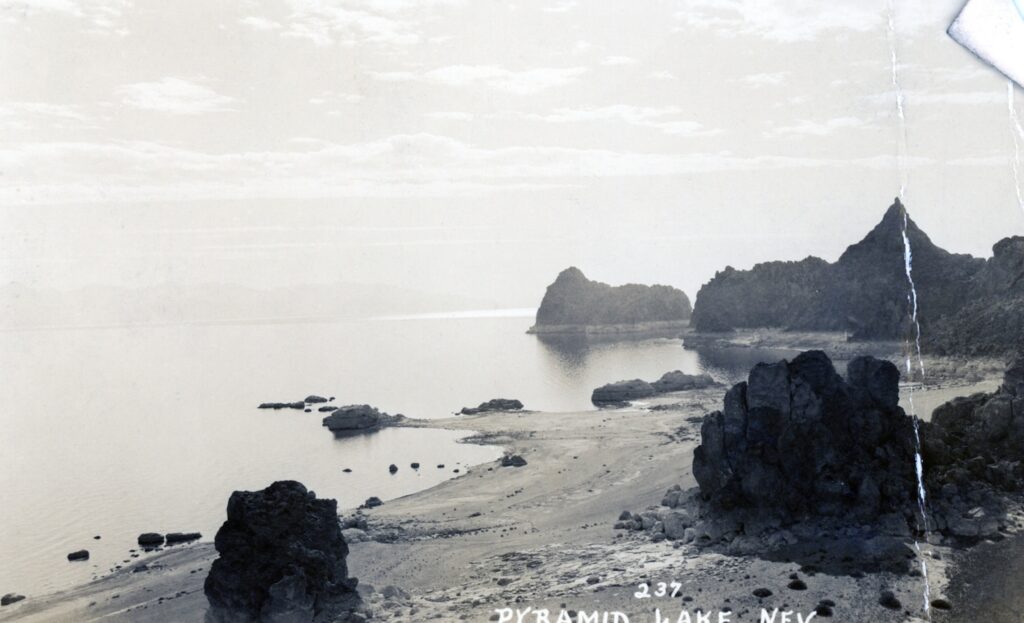
A favorite destination is Pyramid Lake, not that far for Lassenites, if you take the back way via Wendel Road. It should be noted that it is a dirt road from Nevada State line to near Sutcliffe on the north shore of the lake.
The lake was named by John C. Fremont on January 13, 1844. Fremont wrote: “. . . we encamped on the shore, opposite a very remarkable rock in the lake, which had attracted our attention for many miles. It rose, according to our estimate, 600 feet above the water; presented a pretty exact outline of the great Pyramid of Cheops. . . . This striking feature suggested a name for the lake; and I called it Pyramid Lake; and though it may be deemed by some a fanciful resemblance, I can undertake to say that some future traveller will find a much more striking resemblance between this rock and the pyramids of Egypt, than there is between them and the object from which they take their name.”
Of course, I would be amiss not to mention the lake’s famed Lahontan Cutthroat Trout. Up until the 1920s, members of the Pyramid Lake Paiute tribe would bring wagon loads of the trout to sell in Susanville.
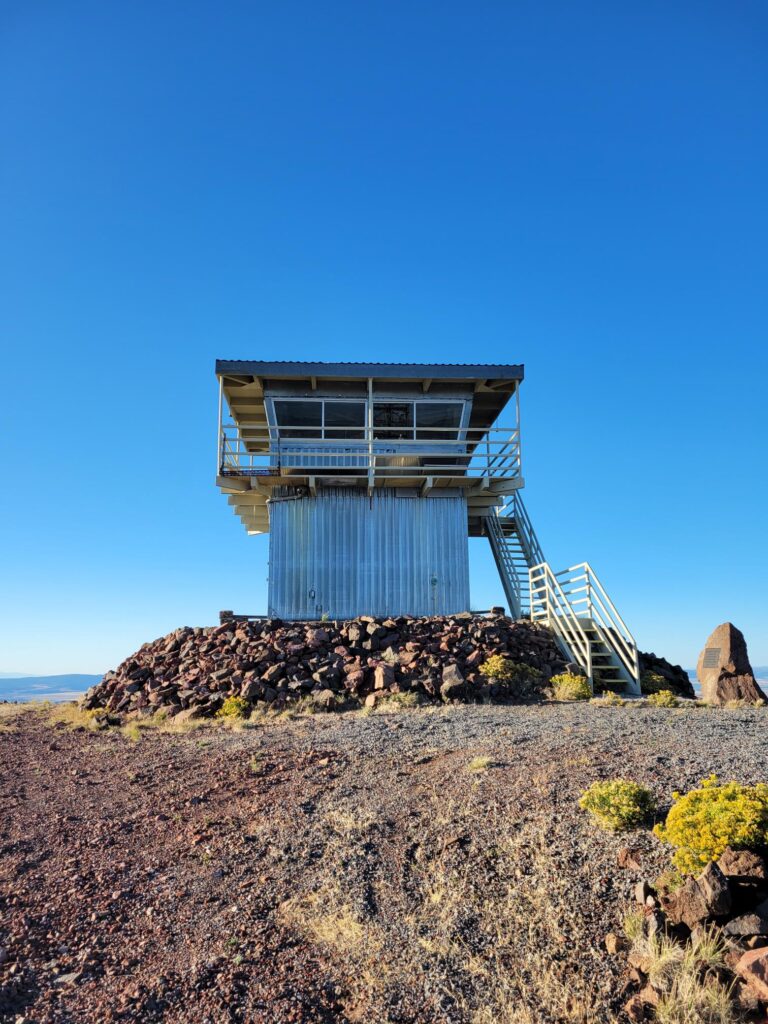
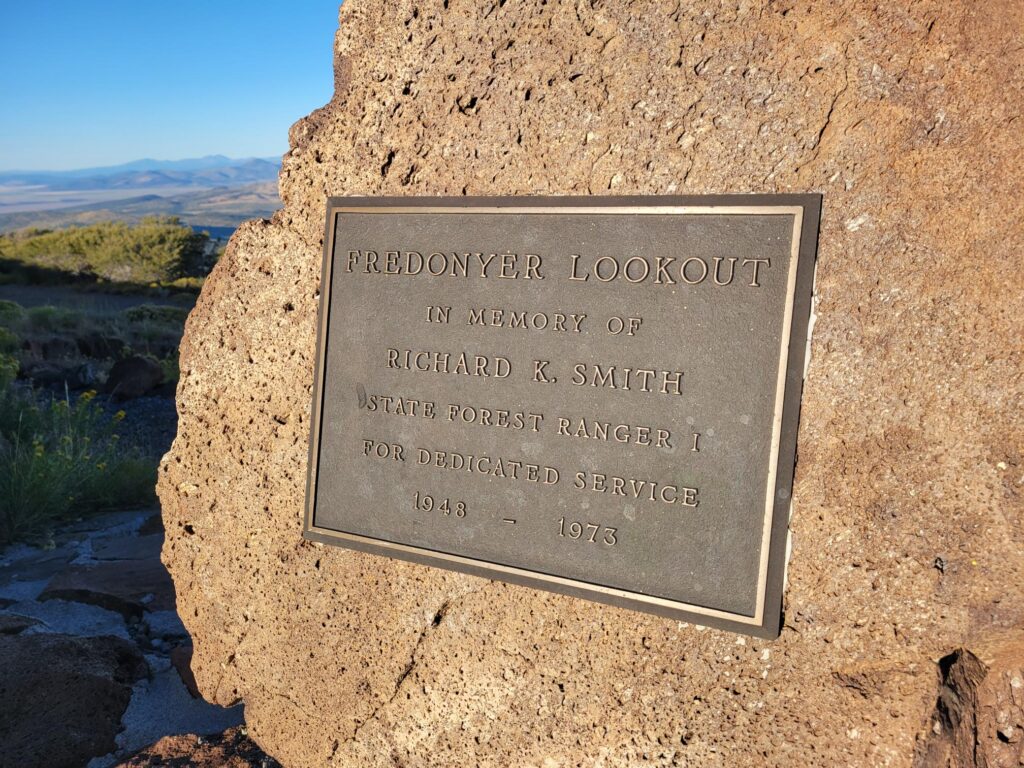
Fredonyer Lookout—California Department of Forestry, Lassen Modoc Unit
A week ago, [September 18, 2023], I wrote about how this lookout came to be. In a follow up Eric Ewing of the California Department of Forestry sent me some additional photographs. Two had to deal with a memorial plaque for Richard K. Smith, as can be seen in the above the photograph, the monument is located at the base of the stairs of the lookout.
Richard K. Smith Memorial Plaque—California Department of Forestry, Lassen Modoc Unit
So as a public service I did some research on Mr. Smith, so those who visit the site might learn more. Richard Smith was born in Brawley, California in1921. In 1948, he went to work for the California Division for Forestry until his death in 1973. Unfortunately, his obituary in the Lassen Advocate provided meager information about his life, but that was typical of obituaries in that era. Smith was buried in the Veteran’s Section at Diamond Crest Cemetery.
In June 1974, a dedication ceremony was held for the new lookout at Fredonyer. It was named in honor of Richard K. Smith who oversaw the operations at Fedonyer for many years. When more information surfaces, this post will be updated to include such material.
Susanville photographer Jervie Eastman was certainly in the slow lane the day this photograph was taken. Courtesy of Eleanor Vandeburgh.
Some one wanted to know how I amassed a large collection of historical photographs. This started decades ago, long before scanners. Back in the day, to have quality reproductions made, involved a skilled photographer to make a copy negative and print. Then, after that was done, I returned the original back to whom I borrowed from. I make sure credit is due, and whatever photograph appears, that person’s name is provided.
There are occasions when no name appears. Some of these are photographs that I purchased. Many years ago, Murl Simmons of Susanville’s Eastmans Studios allowed me to examine thousands of negatives stored in the vault. Of course, I was like the proverbial kid in the candy store. Reality, I had limited funds. I would order some prints from time to time as funds would allow.
Lassen Lodge #149 F.&A.M., 1879
Then came the age of the internet and Ebay. On that particular website I have come across some interesting finds. One such as the original Masonic Lodge in Susanville. While way out of my price range of $90 I succumbed because it was a very rare photograph. Once purchased, I asked the seller about the photograph’s origin. He bought in a yard sale in San Francisco for twenty-five cents. Ouch!
Finally, my grandmother, Lola Murrer Tanner, was a good photographer. Alas, I only have portion of her collection. The rest sits in closet, because of a difficult family relative. A sad tale, since especially with the internet, they could be shared to many.
There is, of course, a hidden collection not tapped into. I have a large collection of over sized negatives some dating back to the 1920s. I do not have the capability or resources to scan them. A few individuals in the past have offered, but for reasons unknown never followed through.
The grave of Isaac N. Roop, Susanville Cemetery, circa 1966.
During the frontier era a lot of procedures were a lot simpler then. Take for instance taking the bar examination to become an attorney-at law. For a brief time in the early 1860s the Honey Lake Valley had two Justice Courts—one for the Nevada Territory and the other for the State of California. That is a complicated story in itself. It did require practicing attorneys to have a license to in each jurisdiction, just as one has to due today.
Susanville’s founder, Isaac Roop (1822-1869) wore many hats, and one of those being an attorney. Since Roop was a high profile person back in the day, there is quite a bit of documentation about him. One item that shows a lot, was his interesting wit. A perfect example occurred when he took the Nevada Bar examination. At that hearing a lawyer attempted to provide Roop with some assistance. The bar examination was fairly simple and one of the more difficult questions was the definition of a corporation. The Carson attorney informed Roop that: “A corporation is a creature of the law, having certain powers and duties of a natural person.” When Judge Gordon Mott asked Roop to define a corporation, Roop replied: “A corporation is a band of fellows without any soul, of whom the law is a creature, who have some powers and take a great many more, and entirely ignore the statutory duties imposed on them.” Thus, with that remark, Roop was admitted to practice law in the Nevada Territory.
Entrance to the Secret Valley CCC Camp, 1937—C.H. Bennett
In November 1935, Anthony Salvato, Division of Grazing Clerk provided a report to the Lassen Mail about some of the activities at Secret Valley. “The entrance has been completed into camp. Two bridges were built on this project, one a 53 foot span and the other a 30 foot span. One cattle guard was also completed so as to eliminate endangering any cattle which might be grazing in that particular area. The construction of this road was under the supervision of Mr. E.C. Erickson who is attached to the Supervisory personnel of this camp.
“A new archway has just been put up in front of the camp. Written in black and white across the top are the letters forming ‘Secret Valley.’ I don’t think the people of Susanville ought to have any fear of missing the camp now and I know that anyone who is desirous of paying us a visit will be cordially welcomed by the whole camp.
“To the people of Susanville we extend an cordial welcome in return for the whole hearted cooperation that they have given us in making our stay here in the vicinity of Susanville, one which has been enjoyed by the members of Camp DG-13, the Supervisory Personnel of the Division of Grazing and the Army Officers here in Camp.”
Happy News which was the CCC newspaper had this to report: “The ‘show me’ boys of Missouri who go to make up the fine personnel of Co. 740, Camp Secret Valley, Litchfield, Calif., are now falling love with the sagebrush covered plains of the West.
”The official insignia of the company is the old kicking mule. It appears on the entrance gateway, shoulder patches and road signs, also unofficially on the hats and shirts of the enrollees.
”The ghostly, mysterious glamour of the place adds to the zest with which Co. 740 peavies go about their work. They ask no greater favor than this: that they be allowed to remain, so long as there is a CCC in Secret Valley!”
On September 21,1966, marked the world’s first gratitude day. While calendars are filled with so many specific days throughout the year, this one is special. Of course, I am very grateful to those who support this website to allow me to share the fascinating history of this part of California.. There is, of course, so many wonderful people who believed in me in all these years of research, and some went the the extra mile.
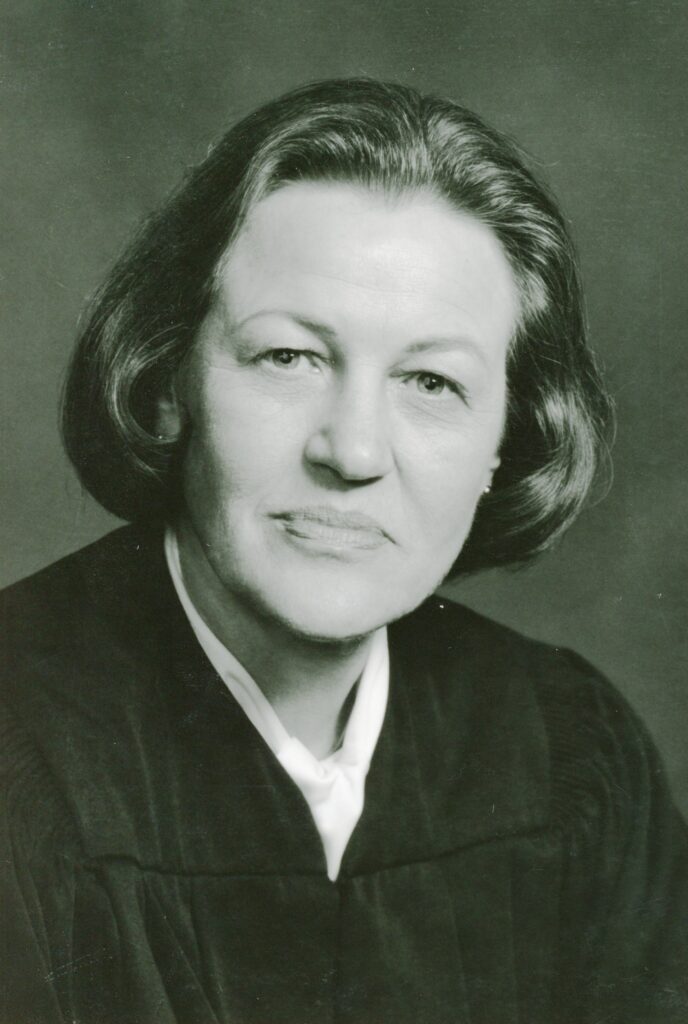
One individual, out of many, was Betty Barry Deal (1921-2017). Betty was born in Reno, Nevada to Hardin “Finn” and Edith (Elledge) Barry. She graduated from Lassen High in 1938, Lassen College in 1940 and in 1955 she was admitted to the California State Bar—and went onto an interesting legal career.
One of Betty’s passions was genealogy. Both her maternal and paternal sides were woven into the history of this region from its earliest days. This was how I became to know Betty and and had a wonderful friendship for decades. From time to time, she would send me copies of her family history, as she quipped as earthquake insurance since Betty resided in Alameda.
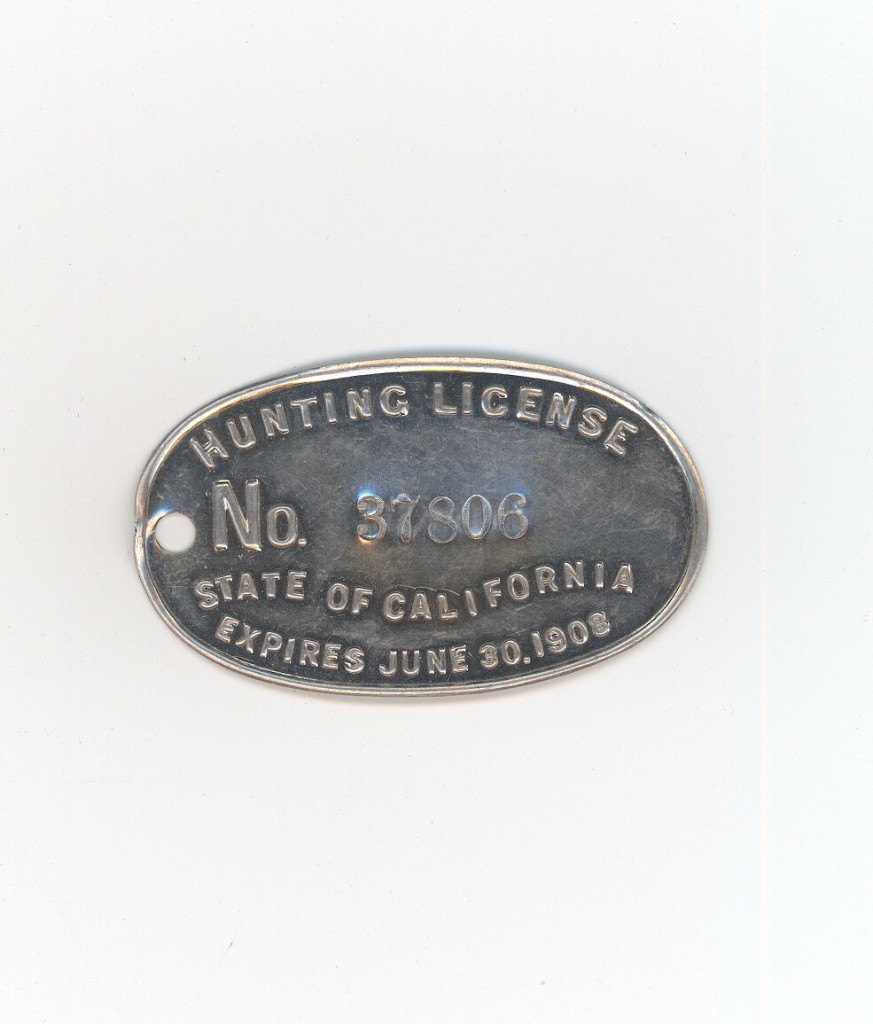
California’s first hunting license, aluminum, not paper! It was one of the many items gave to over the years by Betty.
Betty’s family from the earliest days had a penchant of saving everything. When Betty poured through a box of items, the items she did not want she sent them to me to examine. Some I kept, and the others probably should have discarded years ago. More importantly, she encouraged and supported me over the years with my historical research and writings. She was a most delightful person, for which I am grateful to have had her in my life.
Lassen Creek, July 19, 2023—Hulsman Ranch, Thank You Hannah
The fight for water in the arid west has been issue since the land was settled for agricultural and mining purposes. One of the earliest cases filed in the Honey Lake Justice Court was back in 1861 between Antone Storff and “Dutch Johnny” Tucker. Storff stated that in April 1860 he cut a ditch across government land making a diversion from Lassen Creek to be used for “mining, agricultural and household purposes.” In September 1861, Tucker turned the water off from Storff’s ditch. Tucker’s attorney, John S. Ward requested the matter to be dismissed as justice courts have no jurisdiction in determining water rights. Judge V.J. Borrette disagreed and stated it was a matter of real property damages. Ward objected to the Judge’s decision and stated he would take the mater to the Supreme if necessary. Next, Storff requested a jury trial, but Ward declared his client could receive a fair and impartial trial with Judge Borrette presiding. Borrette overruled Ward, stating that Storff demanded a jury trial and so he would not be deciding the case.
The jury was summoned and witnesses subpoenaed. During the trial it was revealed that David Titherington had purchased the property on which Storff’s ditch was located from Peter Lassen’s estate. Further, there was an agreement between Titherington and Storff which stated he could use the water when it was not in use—information Storff neglected to include in the complaint. The testimony was overwhelmingly against Storff and the jury returned a verdict in favor of Tucker. Storff was now only left high and dry without water, but he had to pay $65 in court costs.
The battle did not end there. The first case filed in Lassen County District Court in 1864 was Titherington v Storff.
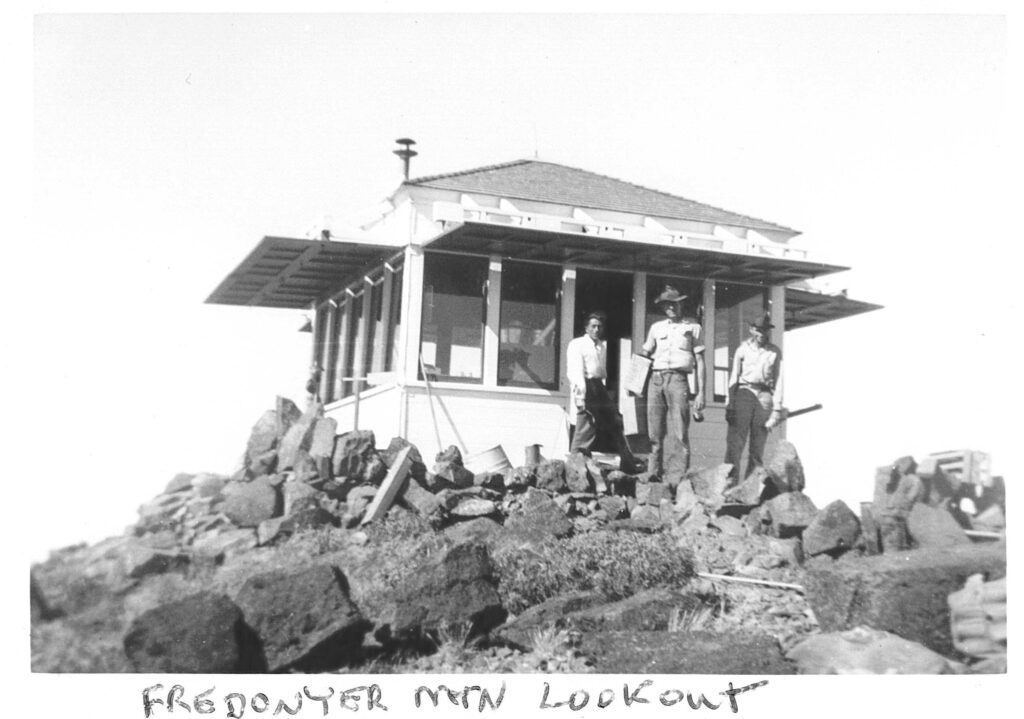
Courtesy of California Division of Forestry, Lassen-Modoc Unit
In the spring of 1937, the Lassen County Board of Supervisors were in communication with the California Division of Forestry to have a fire lookout placed on Fredonyer Peak, just north of Eagle Lake. While, M.B. Pratt of the forestry was supportive and deemed it a worthwhile project, they did not have the funds. However, as a possible alternative, Pratt contacted Chester Hunt, Regional Manager of the Emergency Conservation Work. Thus, the wheels were moving in a cooperative effort to make the Fredonyer Peak Lookout a reality. Hunt stated if the State Forestry and Lassen National Forest would provide the building materials, the Secret Valley CCC Camp would provide the labor. Everyone agreed. The CCC men had a lot of work to accomplish. First, they had a build a road from Horse Lake to the summit. (This is not the road used today.) A telephone line from Long Ranch at Horse Lake would also be extended to the summit. Finally, there was the construction of the lookout itself. Needless to say, the job got done.
View of Eagle Lake from Fredonyer Peak, circa 1960
This lookout is still manned. At an elevation of 7943’ provides stunning views of the region.