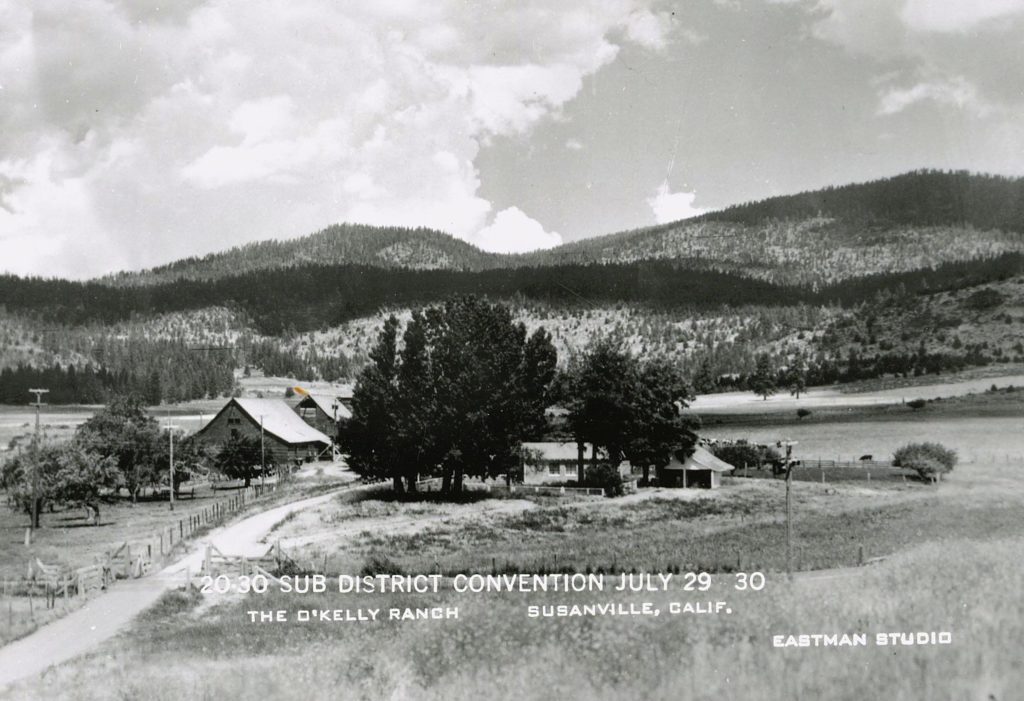
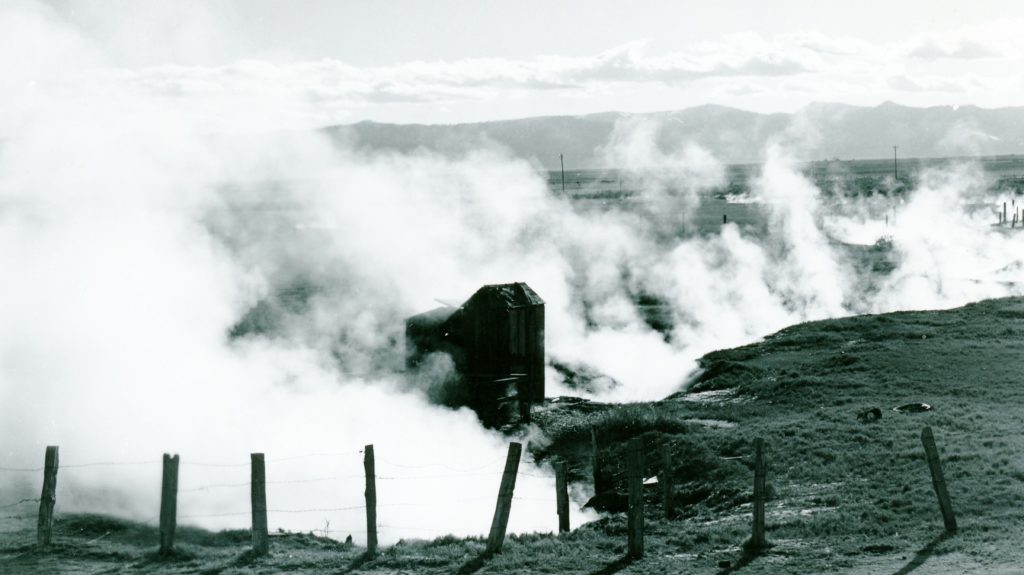
The springs are located on the mountain side behind the ranch house compound. Courtesy of Hank Martinez’
A subscriber wanted to know more about Fruit Growers Spring, also known as Bagwell Springs. These springs are located north of present day Susanville Ranch Park.
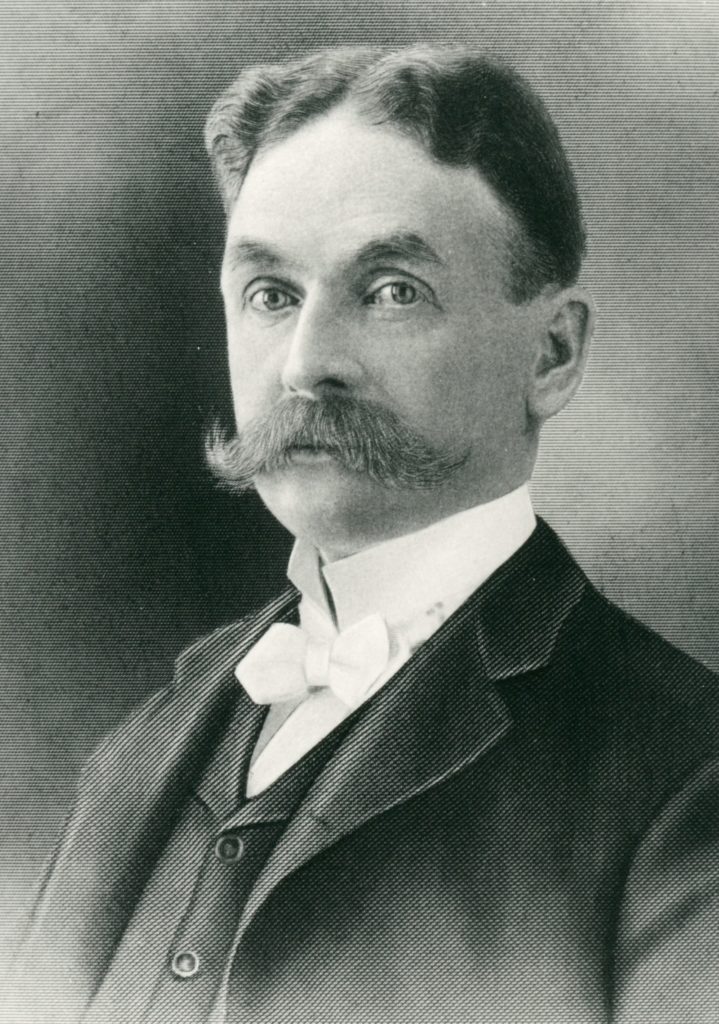
The springs were named for James Washington Bagwell, who located on 160-acres that included the springs. In 1893, he sold out to George W. Long for $300. In 1901, William Black Long claimed rights to this spring that he designated as Bagwell. In 1919, the Fruit Growers Supply Company purchased the property for its water rights. For a number of years the spring was known as Fruit Growers Spring. It appears with that designation in the decree of Fleming v Bennett—the adjudication of the Susan River watershed. In 1935, Fruit Growers sold the spring to the Republic Electric Power Company, who purchased it as an additional water source for Susanville. Thereafter, the spring was once again referred to as Bagwell. The springs are now owned by the City of Susanville, which are used in conjunction with the city’s water system.
Patrick L. Flanigan was one of those rags to riches to rags stories. In 1877, at the age of 17, he came west to Reno where he found employment milking cows. Five years later he obtained a loan from the Washoe County Bank to purchase 1500 sheep. Thus, like many before and after him became an itinerant sheep man and moved his sheep from place to place where ever he could find feed and water. (When the Taylor Grazing Act came into effect in 1934, put an end to this practice.) Flanigan, like so many others, lost over 50% of sheep during the harsh winter of 1889-90. Continue reading Pyramid Land & Stock Company→
Remains of E.C. Brown’s tugboat used on Honey Lake, circa 1940. Courtesy of Margaret Nye
Lassen County, in many ways, did not experience the harshest aspects of the nation’s financial depression of the 1930s. This is not to infer that all was good. Many of the ranchers were still self sufficient for many of their needs. While the sawmills did curtail operations, they continued to operate, where numerous mills on the Pacific Coast closed. Lassen County also benefited from one of the last major railroad construction projects in the nation, the Inside Gateway linking the Western Pacific Railroad with the Great Northern at Bieber. For Big Valley it was a prosperous era.
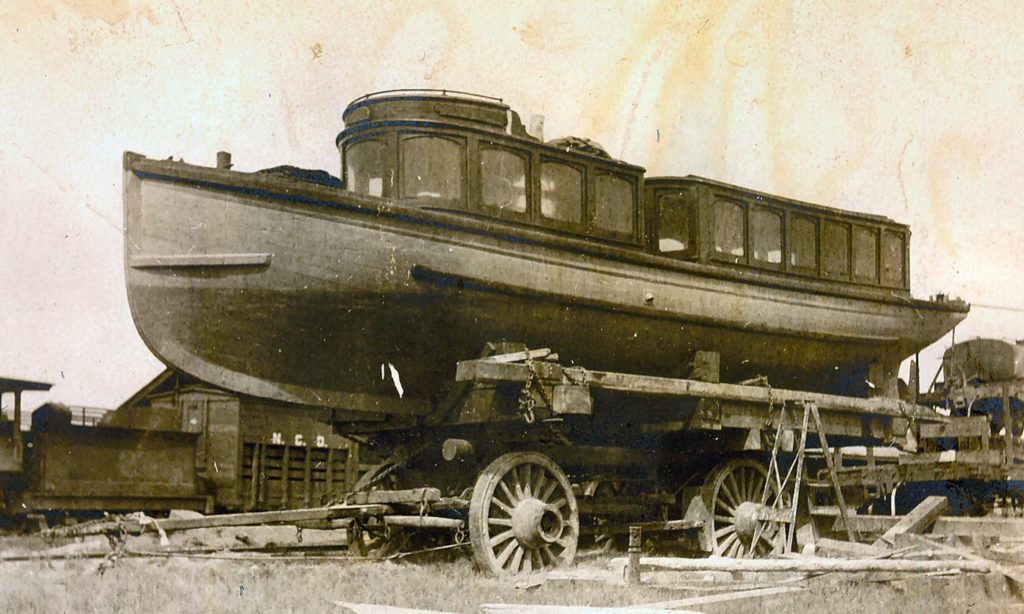
The E.C. Brown’s tugboat at Amedee before being launched, 1907. Courtesy of Marie H. Gould
However, there were some residents who were very marginalized and did whatever they could to make ends meet. There was some money to be made in selling scrap metal. Take for instance, some unknown parties ransacked the abandoned tugboat on the shore of Honey Lake and removed the engine and any other metal component. At Bly’s Eagle Lake tunnel the light rail and ore cars used in the excavation disappeared, too. Depending upon one’s perspective today, the scavengers either did a good job of cleaning up the environment or the opposite spectrum, those who like to examine old relics might be dismayed.
The first recording of Eagle Lake’s lake level elevation occurred in 1875, done by the United States Government Land Office. The surveyor’s benchmark was placed at the lake at an elevation of 5,109 feet above sea level. Their documentation has been cited continuously as a guidepost for monitoring the lake’s fluctuation. At the moment the lake level stands at 5092 feet.
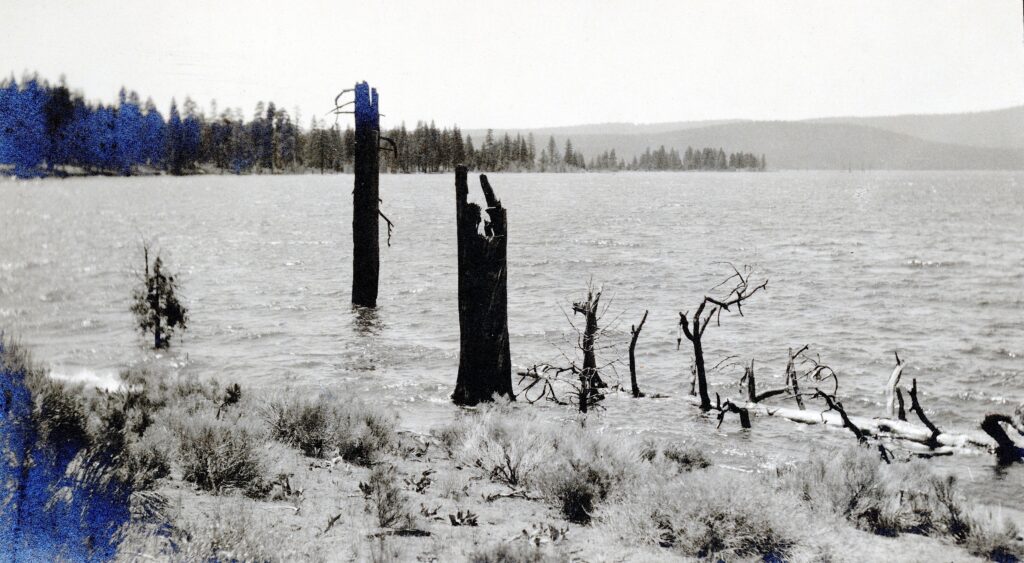
Eagle Lake began rising after the 1875 survey. In the early 1880s, the lake had encroached on developed ranch land on the north shore and the pine trees on the south shore were being inundated. Thus, at the south shore began creation of what was called the “stub forest.”
In 1915, Professor S.T. Harding began studies of the water variations at Eagle Lake. Harding, as well other scientist, were intrigued with the rising low that lake levels. After all, the lake has no outlet, but further the main water source was the spring run off. When Harding arrived on the scene the lake level had increased 13 feet since 1875. Harding focused on the stub forest to obtain data on the lake’s elevation. He studied the tree rings and the exact elevation of a number of trees. By taking the lowest submerged trees (the oldest one was found to be a 245-year old stump at the elevation of 5,116, that was submerged in 1895), he determined the lake level had to be at 5,115 feet or less from 1650 until the time it was submerged. Another stump examined placed its initial growth between 1420 and 1520, and during that time period the lake had to be at an elevation below 5,099 continuously from 1420 to 1520. In addition, Harding also examined trees at the 5,126 foot elevation that were found to be over 400 years old.
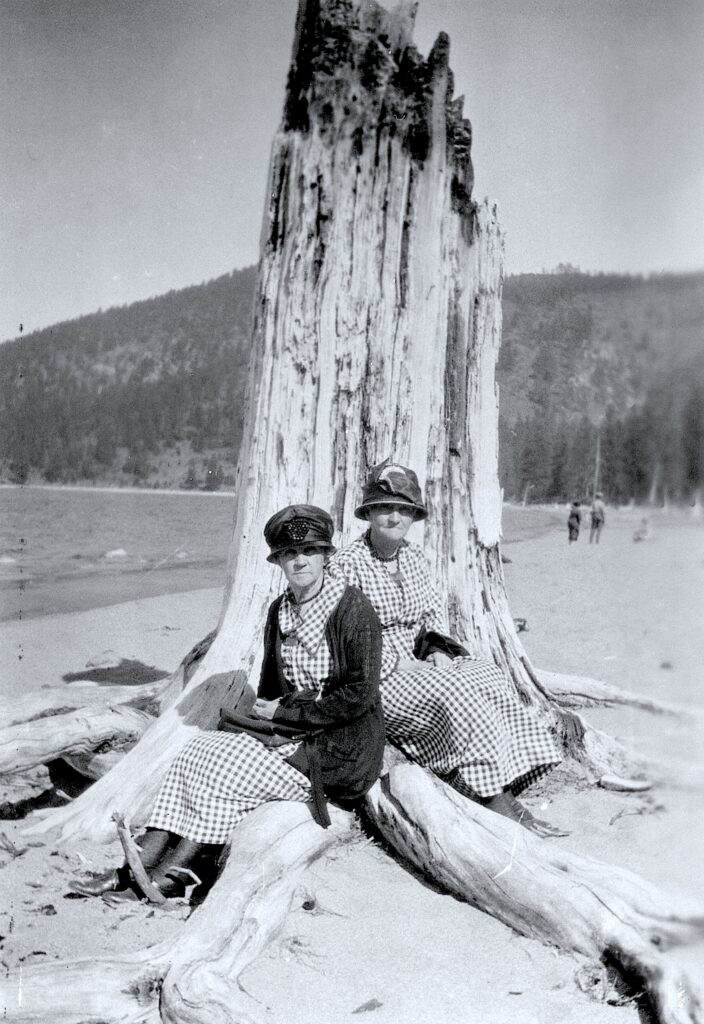
An “ancient” stump, Gallatin Beach, 1922, Leona Bars
By the early 1920s, the stub forest literally lived it to its name. In 1918, the lake began to recede, which it should be noted prior to the Bly tunnel. The inundated trees of the south shores reduced to dead snag trees, and the tops would break leaving tree stumps. It should be noted that a few stumps still existed at the south shore in the 1960s.
In the beginning of time, the school’s colors were not purple and gold. I know that sounds almost sacrilegious. Back in the earliest years of the school’s history, it was the seniors who chose the colors for the year. The first graduating class of 1907 selected the colors of green and gold and this proved popular for the next few years. The Class of 1911 were a bit more rebellious and opted for blue and white. By the end of the decade purple and gold were adopted, and its been that way ever since.
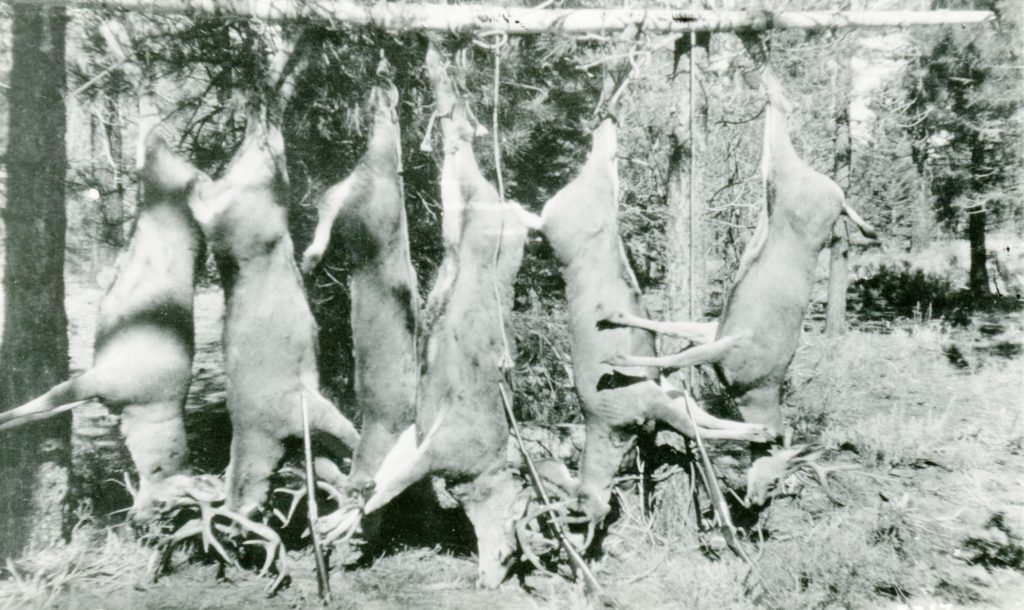
Since this end of deer season in these parts, it is fitting to examine past historic statistics. During the 1930s and 1940s, Lassen National Forest monitored the deer hunters. It was not easy task to register some 19,000 deer hunters on the Lassen. Data compiled relative to age, antlers, weight and condition of the deer, as where as the location where they killed. While there were check stations, they are also sent checkers with scales to weigh animals in the deer hunting camps.
Over 2,000 deer were killed in 1935 season on the Lassen National Forest. They consisted of 35% were forked horns; 32% had three points; 29% carried four points and the remainder 4% had five, six, seven or more points.
Wendel has had many names over the years. In the 1860s, it was referred to as Upper Hot Springs to distinguish from the Lower Hot Springs. In 1890, when the Nevada-California-Oregon Railroad (NCO) extended its line to Amedee, the Lower Hot Springs took on the name of town established next to it. Upper Hot Springs simply became known as Hot Springs. In 1899, the NCO extended its line further north and at Hot Springs established a new station named Boyd. When T.F. Dunaway became General Manager of the NCO in 1900, he renamed the Boyd station to Smithon. Two months later, in January 1901, he again renamed it to Hot Springs. It would be another fourteen years before the place became known as Wendel.
McClellabd’s Summer Camp at Eagle Lake, 1912-Pierce & Elburna McCleland
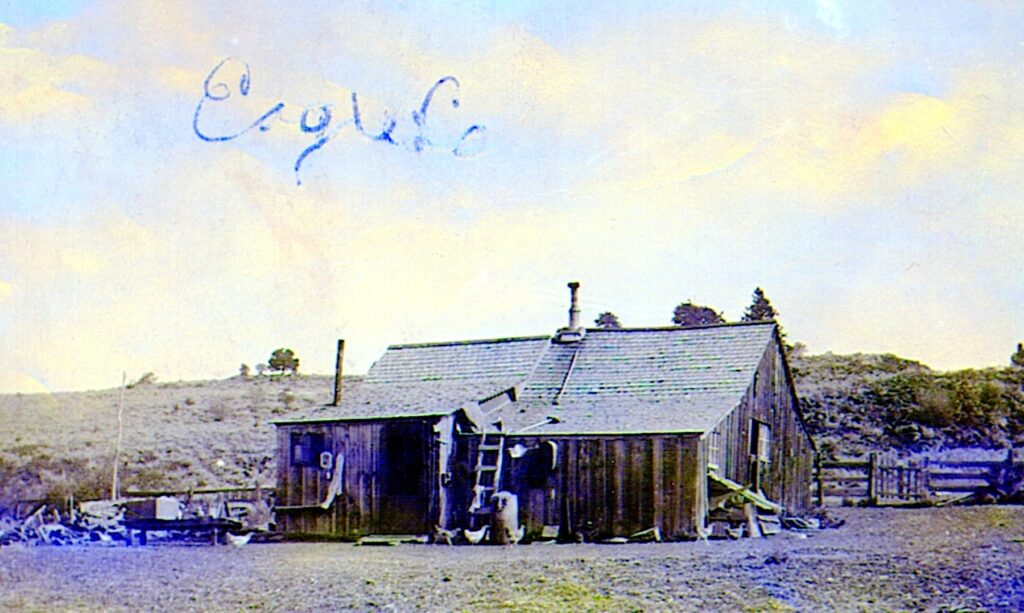
Eagle Lake’s first settler was.a thirty-three old New Yorker by the name of Levi Button, who recorded a claim to 160-acres on the northwestern shore on January 4, 1870. Button had resided in Lassen County since 1863, making living from prospecting and trapping. He built himself a cabin at the lake and resided there periodically until 1875. He then departed for eastern Oregon. Before leaving he remarked that the wildlife had greatly diminished due to the influx of livestock grazing on the surrounding mountains.
A number of individuals had become occupants of Button’s abandoned homestead. In a five years period, Isaac Adams, Frank Day, Samuel C. Dibble, Hiram Sewall and Daniel Cramer claimed possession of the place, but none them remained there for any length of time and failed to gain. title.
In the early 1880s, a German immigrant, Adolph Schuler took up Button’s abandoned claim. He had several improvements and secured 166-acre federal land patent. In 1885, Schuler sold the property to James D. Byers who had an extensive livestock operation in the Honey Lake Valley. Byers incorporated the property for summer grazing. Schuler worked as a ranch hand and. reminded on the property for most of his life. Byers who died in 1902, was a bachelor and he left the bulk of his estate to his nephew’s wife, Sarah McCleland. Since then, has it remained in the McClelland family.
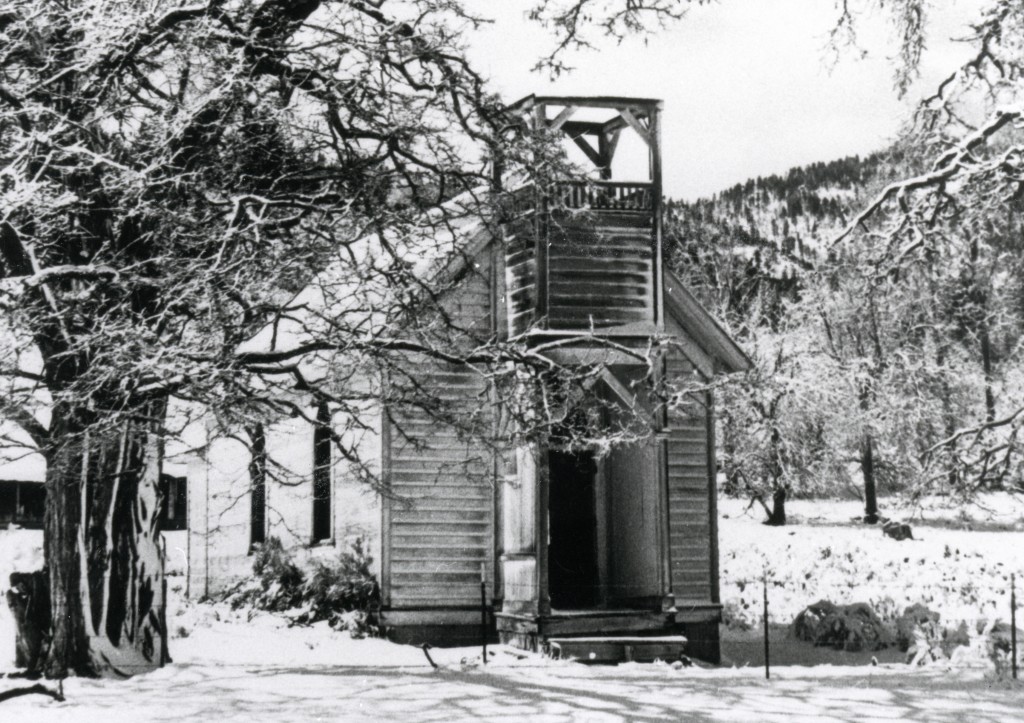
St. Mary’s Chapel as it appeared in 1971. Courtesy of Robert Williams
Five miles south of Doyle is a place known as Constantia, though not much remains today. In 1896, Henry Butters purchased the ranch and gave the place its name of Constantia. Butters transformed the place into a small village and next to his home had a small Catholic church built—St. Mary’s Chapel.
As a child, Roberta Turritin Weaver lived at Constantia from 1913 to 1923 and recalled: “The church was beautiful with stained glass windows and the pews were made from the oak trees in back of the ranch. As long as were in the big house Father Horgan came out several times a year. We were all very fond of him. My twin sister, Catherine, and I considered him a good sport since he put up with all our didedos.”
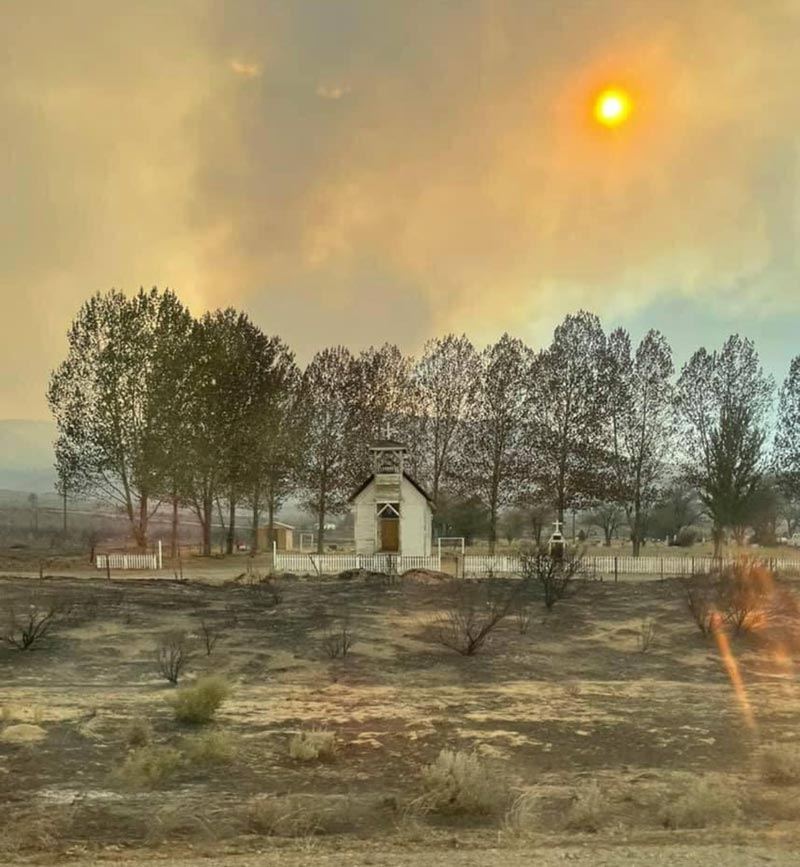
Constantia Church, Doyle, July 12, 2021—Ronda Dockstader
By the mid-1920s services were discontinued and the church abandoned. In 1994, the Doyle Historical Society moved the church to Doyle and restored the building.
On April 26, 1856, twenty settlers in the Honey Lake Valley gathered at Isaac Roop’s Trading Post and held a “mass convention” to establish a territory of their own. They named their new republic Nataqua. It was purported that the name was a Paiute word for woman. That claim is rather dubious. Nataqua Territory was a short lived affair, and it was soon replaced with the Sierra Nevada Territory.
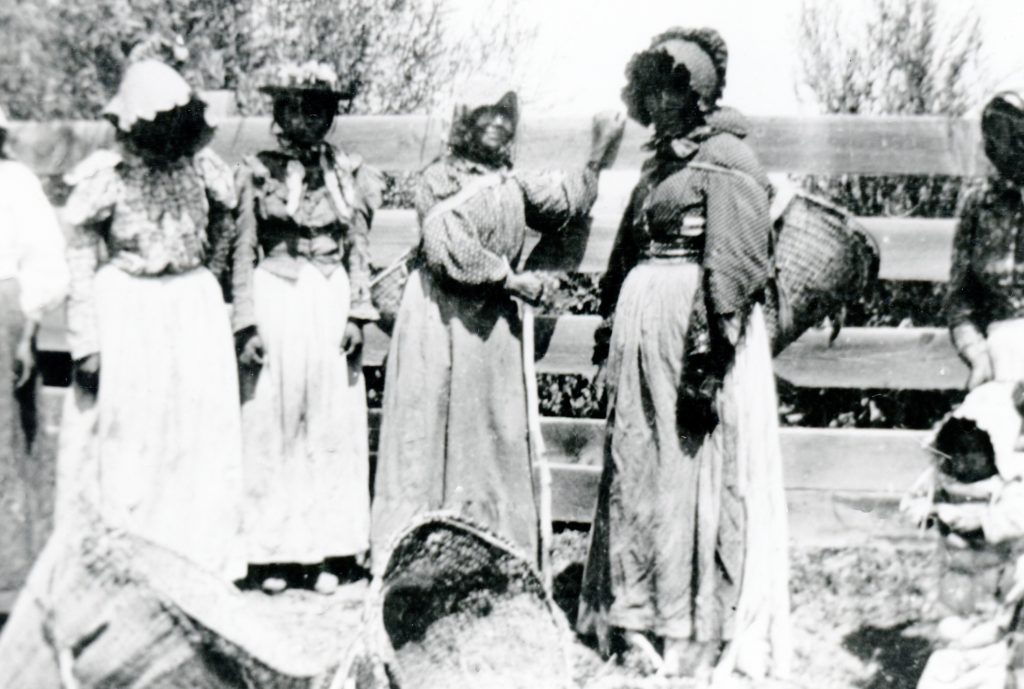
Locally, the Anglos used term Mahala for designation of Native American women. A number of these women worked as domestics such cleaning and washing. Willow Creek Valley resident Abe Tunison for instance wrote in his diary on May 28, 1877 “A Mahala was here and washed.”
During the late 1800s’ the term squaw was used infrequently and usually derogatory manner, i.e, there are many newspaper citations of a “drunken squaw.”