Category Archives: History

Dodgeville – Lassen County

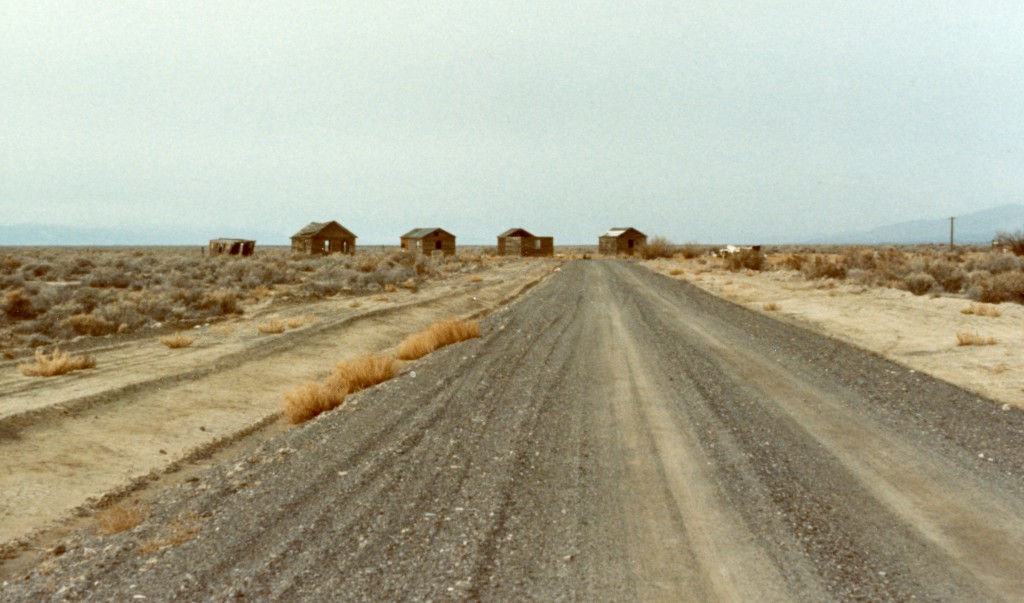
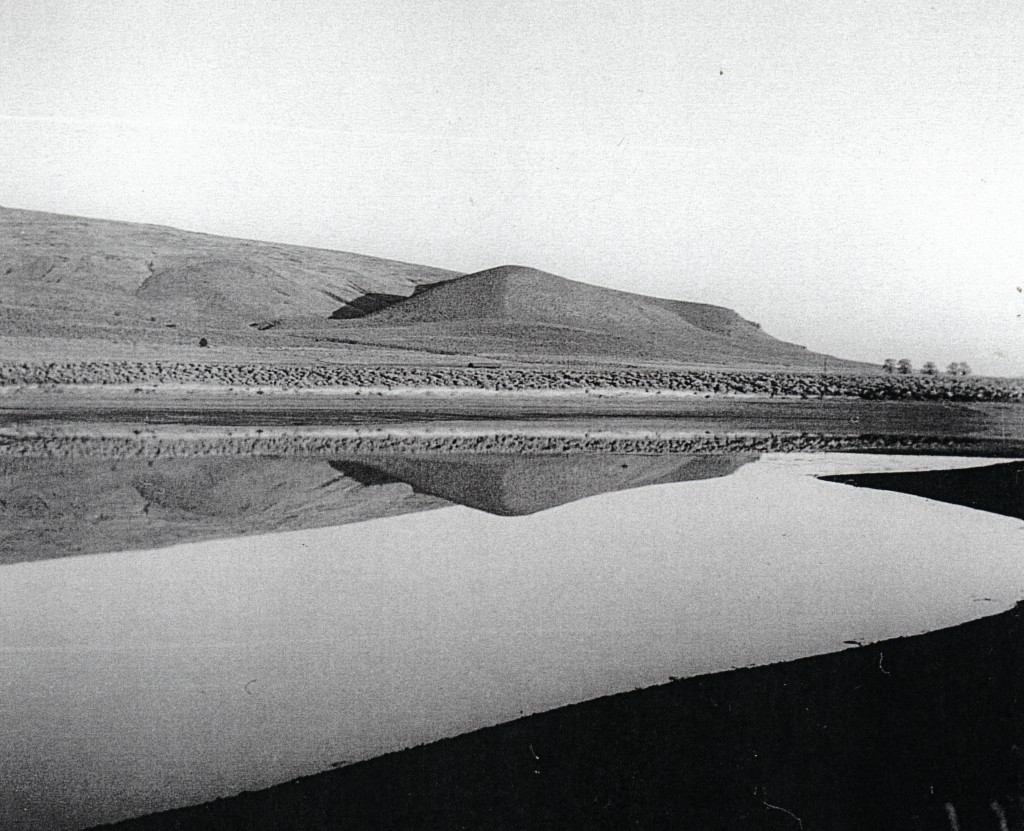
Ward Lake, October 26, 1969. Photo by D.B. Martin
This was the name of the construction camp of the Balls Canyon Reservoir Company. Established in 1889, when construction of a dam across the lower end of Secret Creek, near Belfast, to capture the spring floodwaters to create Ward Lake. It was named for Edmund R. Dodge was the President of the Company. Dodge, it should be noted wrote the Lassen County segment of Farris & Smith Illustrated History of Plumas, Lassen and Sierra Counties, 1882, among other things.

Subscribe!

Bonham School

Flanigan, 1976
Flanigan, 1976, courtesy of Christopher Moody
Established in 1887, it was originally located at the Bonham Ranch in the Smoke Creek Desert. The school closed in 1919 for lack of students. In 1929, it was resurrected at Flanigan in the Honey Lake Valley. It closed on June 20, 1969 and at that time it was the only remaining one-room school in Washoe County. Standish resident Ed Bass purchased the school and moved to his property.

Subscribe!

The Two M’s

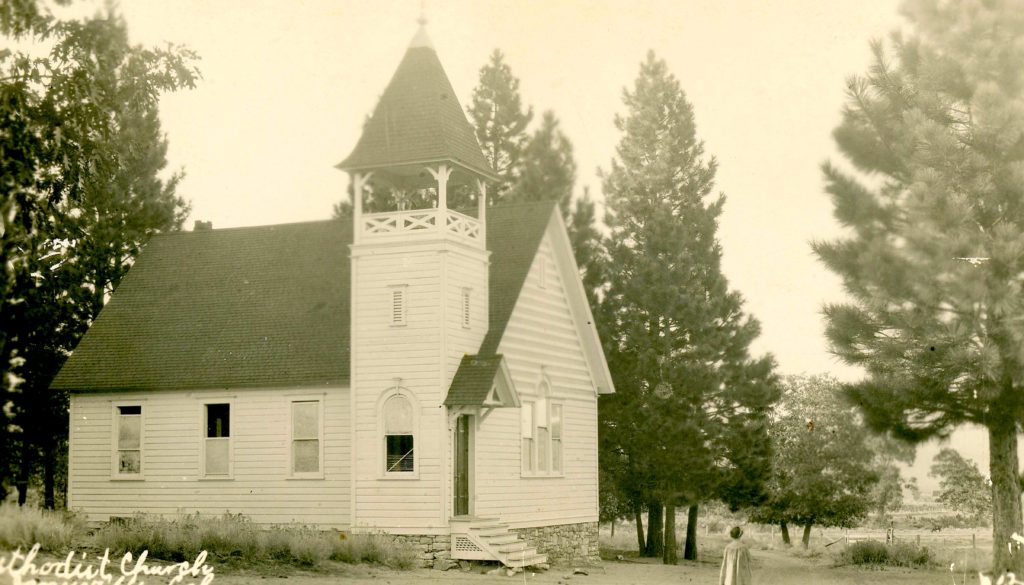
Janesvlle Methodist Church, 1911. Courtesy of Marge Foster
From the early 1860s up until World War II the two dominant social institutions locally were the Masons and the Methodist, which were hand in hand. The majority of the Masons were Methodist, and vice versa. By the early 1900s the Methodist were so predominant in the Honey Lake Valley that they had churches at Janesville, Johnstonville, Standish and of course Susanville. The Masons on the other hand had lodges at Janesville and Susanville, which have since been combined.

Donate!

Lake Almanor Cloud Seeding

Lake Almanor, 1926.
From time to time discussions have been held whether the cloud seeding in the Lake Almanor Basin area by Pacific Gas & Electric Company affects the areas to the east. In 1979, Lassen County officials thought the cloud seeding was part of the drought problem in southern Lassen County. In October 1979, Henry LaPlante of PG&E stated that the company has been treating selected storm systems for more than 25 years. He said the intent of the seeding was to increase the high elevation snowpack. Furthermore, LaPlatnte wrote, “There is no scientific evidence which indicates that cloud seeding activities in our Almanor area reduces the amount of precipitation in any other area.

Donate!

Dayton, Lassen County

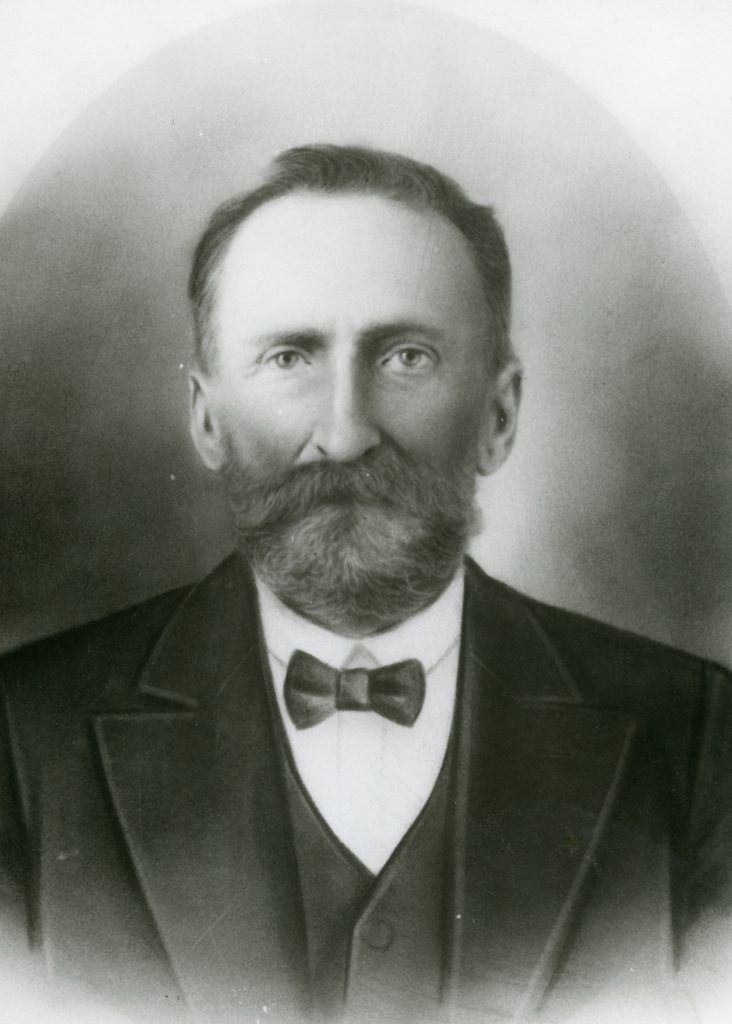
Thomas J. French. Courtesy of Elburna McClelland
This was a wide spot in the road better known as Mapes Ranch, near Litchfield. In 1868, Thomas French and Andrew Litch formed a partnership and purchased the Shaffer Brothers ranch, hence the origin of the name for a nearby school and mountain. On January 27, 1873 the Dayton Post Office opened Thomas French as the first and only postmaster. Litch at the same time opened a small store that the Shaffer’s had previously operated. The post office closed on January 18, 1875, but that was not the only change on the horizon. Later that year French and Litch dissolved their partnership.

Donate!

The Amedee Yacht Club

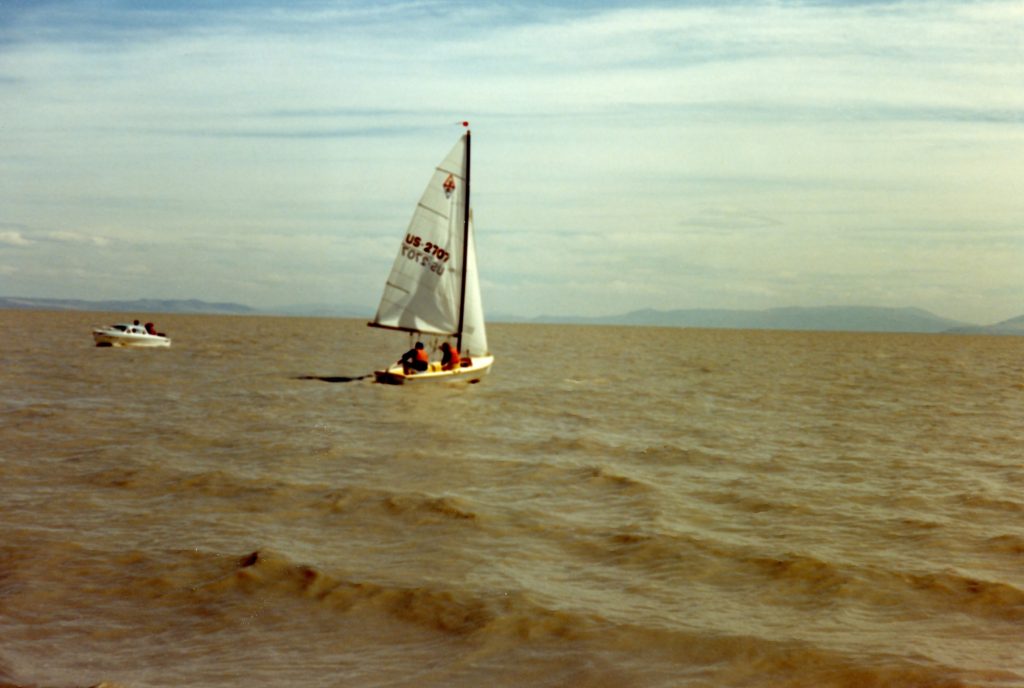
In 1987 an informal regatta was held on Honey Lake.
The early 1890s were lively times in the Honey Lake Valley. There were numerous enterprises constructing dams every where to create McCoy Flat reservoir, Hog Flat reservoir, Ward Lake, Skedaddle dam and Lake Greeno. Let us not forget the biggie, the tapping of Eagle Lake.

Adding to all this was Amedee an instant railroad boom located on the eastern shore of Honey Lake. In the spring of 1892, Charles Teague and H.B. Griffith formed the Amedee Yacht Club. S.N. “Mac” Sample had the first boat which received extensive use. On its maiden voyage in the spring of 1892 had a crew of of George Clark, captain; S.N. Griffith, commodore; E.C. Brown and L.W. Brubeck, mates and Jake Yanner, engineer.

The Amedee Yacht Club even had a backup plan should Honey Lake reach a point that if it got too low for the boats. The club cited with all the reservoirs being constructed that there would be times that the water from Eagle Lake would not be need for irrigation, and that water could be used fill up Honey Lake for sailing purposes.

Donate!
Smoke Creek Ranch

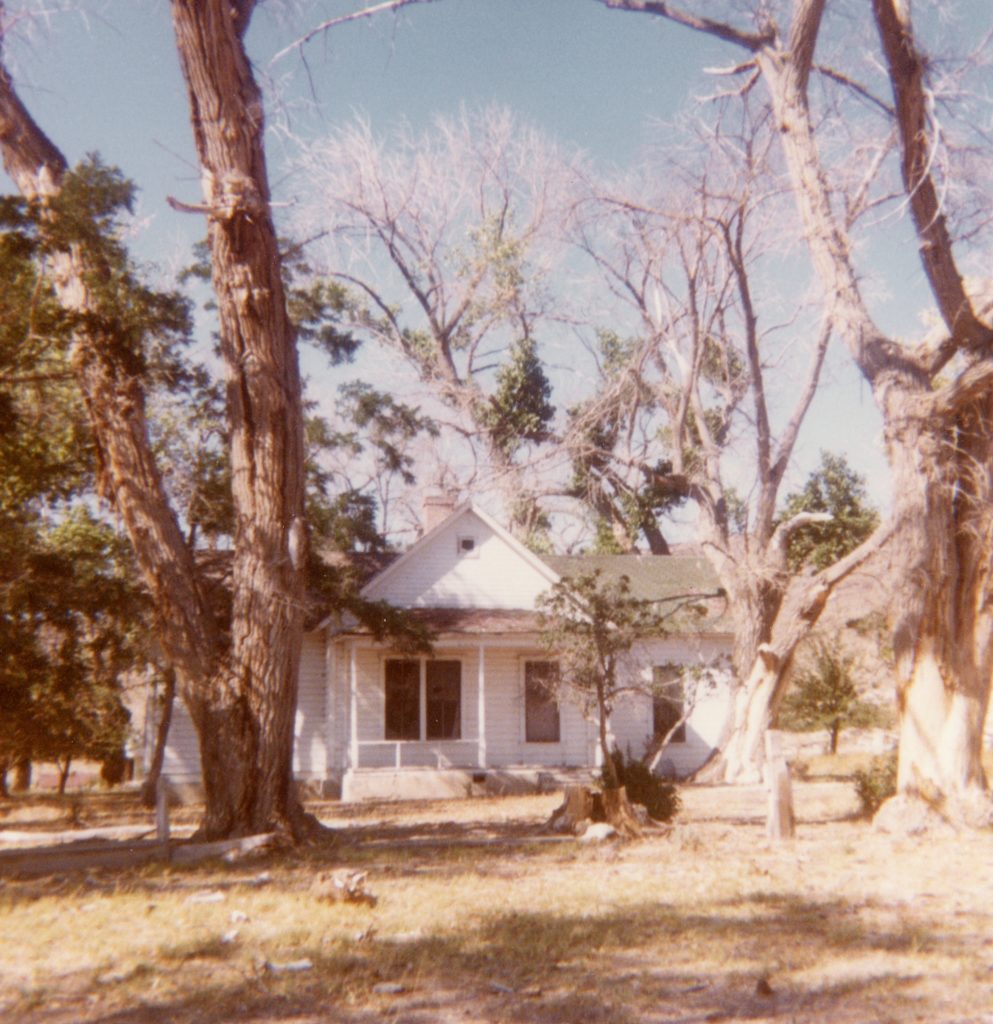
Smoke Creek Ranch, September 29, 1979

The Smoke Creek Ranch is one of the oldest ranches in Nevada, first settled by T.T. Kingsbury on May 30, 1857. It is also one that I have not had the best of luck finding information, so I am doing this post to see if anything surfaces. During the late 1800s it was owned by the Winters family of Washoe Valley. They even acquired the Shinn Ranch and George Winters planted the cottonwood grove there. One of the next owners were the Pon Brothers. I was recently in contact with some Pon descendants but they had no information. Then there was Patrick Flanigan and Rees T. Jenkins outfit among others. In 1949, Albert Freeman, then owner of the Smoke Creek Ranch, had the reservoir constructed. If anyone can enlighten me and others about this place, I would truly appreciate it.

Donate!
Local Stock Options

Standish Hall
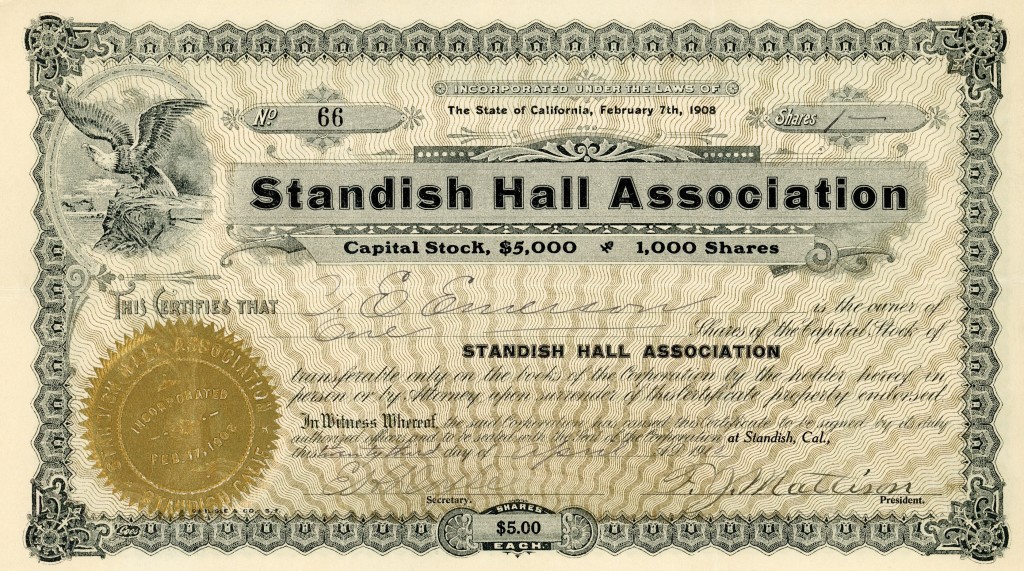
Stock certificate courtesy of Dick and Helen Harrison
In the early 1900s, locally, businesses as well as fraternal organizations incorporated as a means to raise funds. A perfect example was that of the Standish Hall Association. Incorporated in 1908, it financed a two-story building in Standish. Typical of the era, the second floor was used as a hall for fraternal organizations. The first floor, of course, was rented to commercial enterprises, with those proceeds used to maintain the building, etc.
The Standish Hall still exists in a state of arrested decay and better known to many as the former home of Neil’s Mercantile.

Donate!
The naming of Eagle Lake

Eagle Lake
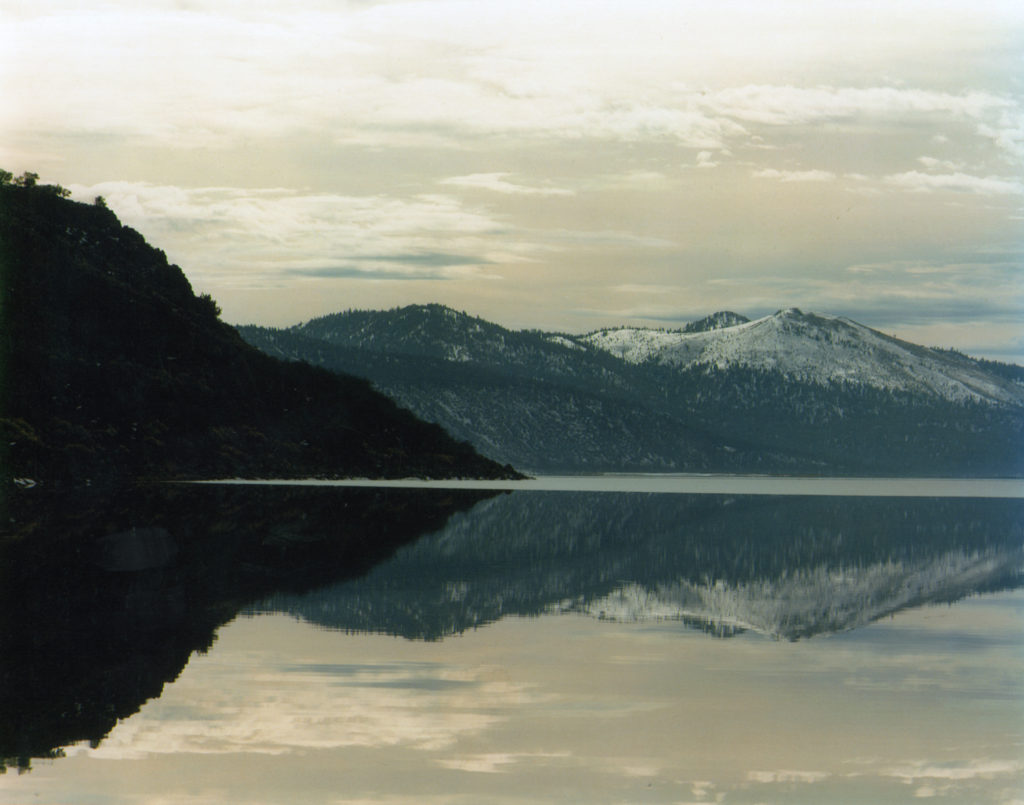
On March 3, 1853, the United States Congress passed the first Act for surveys of a transcontinental railroad route. During the next two years, government survey parties explored the West looking for feasible routes. Lieutenant E. G. Beckwith was in charge of one of those expeditions. Beckwith surveyed Northern California and Western Nevada in search of a pass over the Sierra Nevada Mountains. On July 3, 1854, Beckwith’s party discovered Eagle Lake. Beckwith wrote: “. . . soon after leaving our morning camp, the road led over a low rocky butte, from which we had a fine view of the lake, a few miles to the northeast. It is several miles in extent and is set beautifully blue in the mountains, which rise from 500 to 1,000 feet above it, covered with majestic pines. It has no outlet. We gave it the name of Eagle Lake.”
Local folklore is that the lake was misnamed for the ospreys, that are abundant at the lake, and that the ospreys were mistaken for eagles. That is doubtful, since the bald eagle population of the 1850s was much greater than it is today. It must also be taken into account that the early day explorers and settlers, too, were keenly aware of the variety of species of birds and animals. To substantiate the fact that the lake’s name was not a misnomer for the osprey, there are accounts in the 1920s by field scientists who asked the same question of the “old timers”, who replied that it was named for the bald eagles.
The Mail Bag

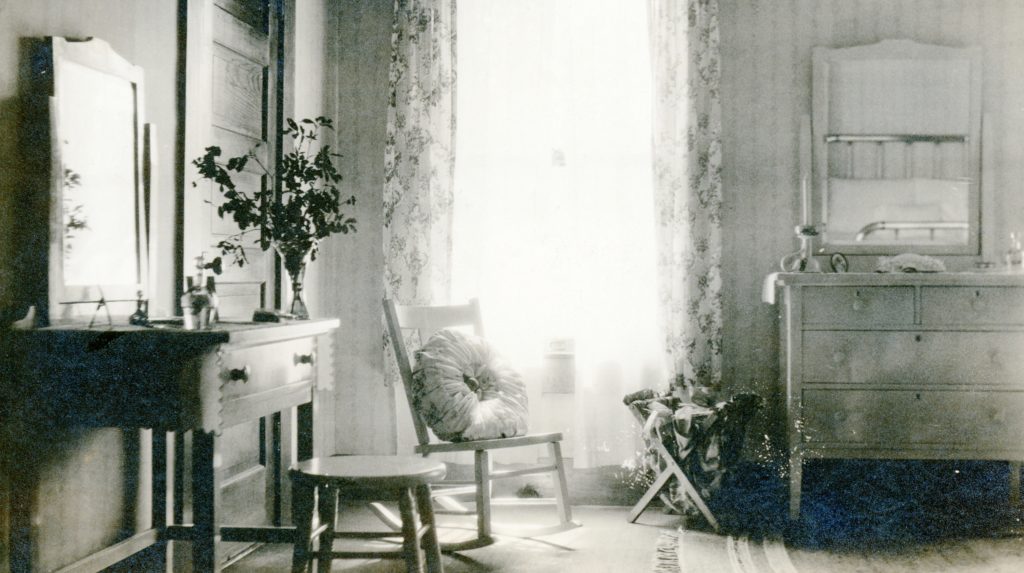
A bedroom in the Gallatin House, 1917. Courtesy of Wyn Wachhorst
There have been several comments posted last year, that a short sentence would not suffice, so I will slowly start responding. One reader wanted to know the status of Eagle Lake’s Gallatin House. Malvena Gallatin spent the Christmas of 1944 there and it would be her last visit. When she passed away in 1956, she left the two-acre parcel to her only great-grandchild, Wyn Wachhorst. When Wyn visited the place once in the 1960s the “Gallatin furniture was piled high inside,” but no one ever used it. In 1975, it was sold to the Lassen National Forest.

In the mid-1980s, Lassen National Forest Supervisor Dick Henry wanted to demolish the structure. Needless to say the battle line was drawn. The late Valerie Campbell and myself began a campaign to save Gallatin House. I will spare everyone the details, but in the end we along with so many others who fought to preserve prevailed. In 1988, the forest service issued a use permit to thirty-five acres, which includes Gallatin House for Camp Ronald McDonald at Eagle Lake. The Gallatin House has been maintained and used for administration purposes and two front rooms are intact just as it was back in the day when Gallatin’s owned it.

Donate!