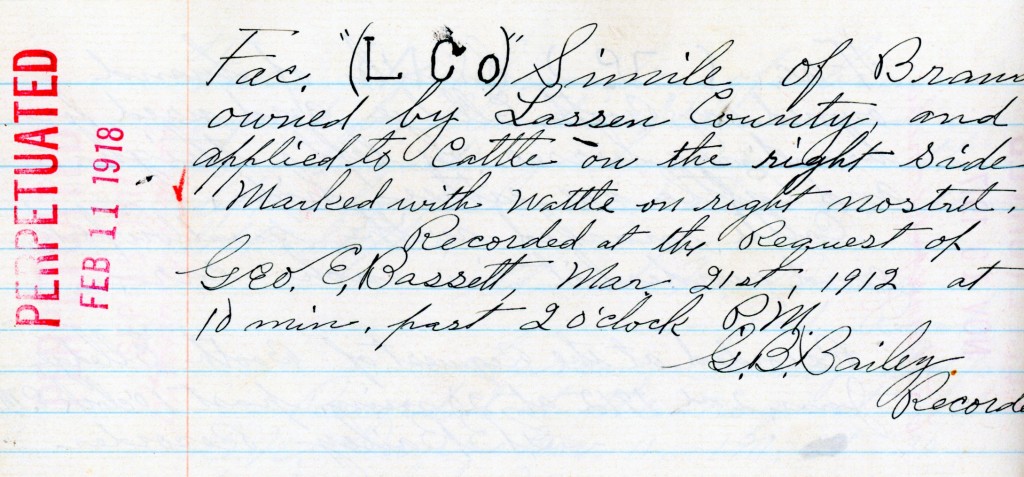
Lassen County had its own livestock brand, even though they did not intentionally plan to be in the business of raising livestock. It was all accidental. Way back in the day, and especially prior to the age of automobile, there were problems with stray livestock. Routinely the county found itself taking care of various animals, in hopes eventually the owners would come forth to claim. After a period of time elapsed the animals became property of the county. Before the county could sale the livestock, they had to be branded for identification purposes. There were other instances were the county was forced to impound animals, whether for collection fees, etc.
For those that plan an extended stay to Eagle Lake with the opening fishing season there, you might want to plan an excursion to the west of the lake and wander around Pine Creek Valley.
From the late1800s to the 1950s there was a lot of activity there. First there were cattle and sheep outfits who utilized the region for summer grazing. Many of the natural topographical features bare their names like Campbell and Logan.
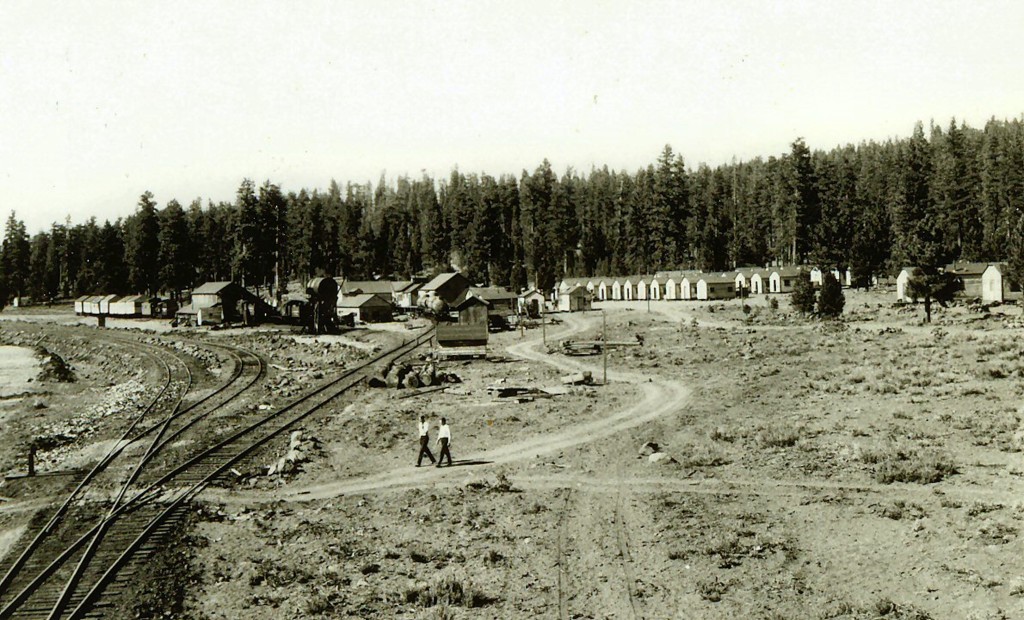
Camp 10, Fruit Growers Supply Company, 1932
In the 1920s, the Fruit Growers Supply Company made their presence with railroad logging in the region. In 1929, the company established Camp 10 on the northeastern edge of the valley. Not only was this substantial logging camp home to over 200 people, for a time being it even boasted its own voting precinct.
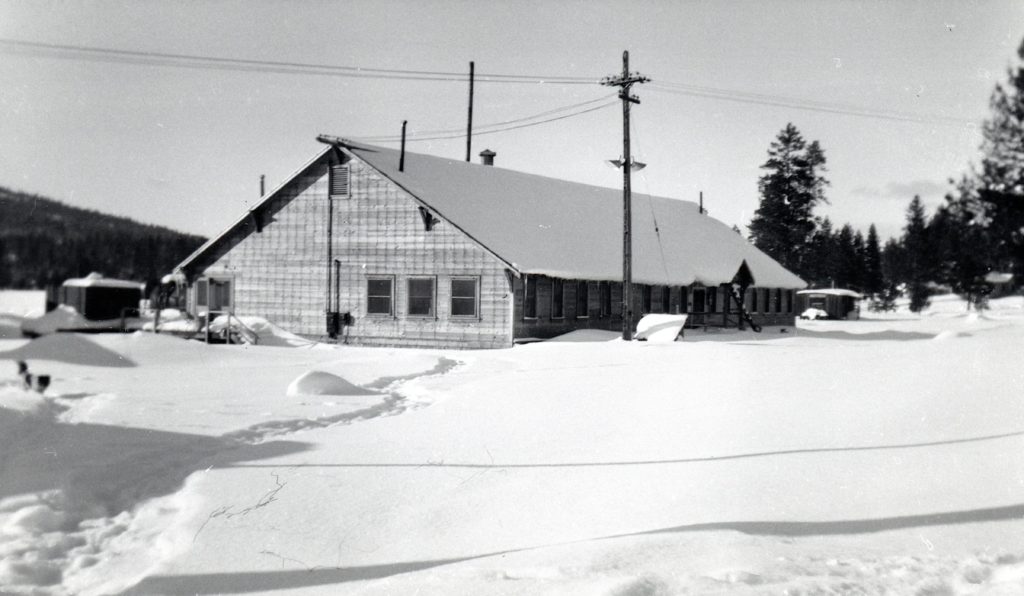
Camp 10, Cookhouse
Normally, logging camps were short lived, once the available timber cut, the camps moved on. Not so with Camp 10, it remained in operation at the same location until 1952, when Fruit Growers discontinued railroad logging. Remnants of the camp can still be found.
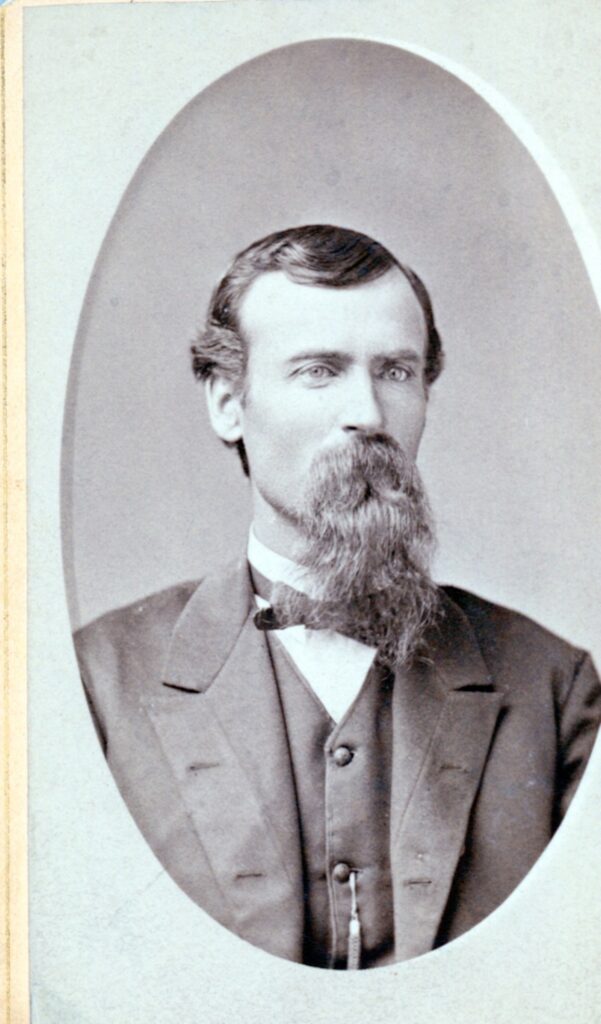
Granville Pullen (1838-1926) had developed an interest of collecting relics from the past at an early age. Since 1870 he was a frequent visitor to the Honey Lake Valley to see his sister, Susan Goumaz. In 1901, he moved near Janesville and bought a ranch. In 1914, at the age of 76, he retired from ranching and bought a house in Janesville.
Granville Pullen-Courtesy Philip S. Hall
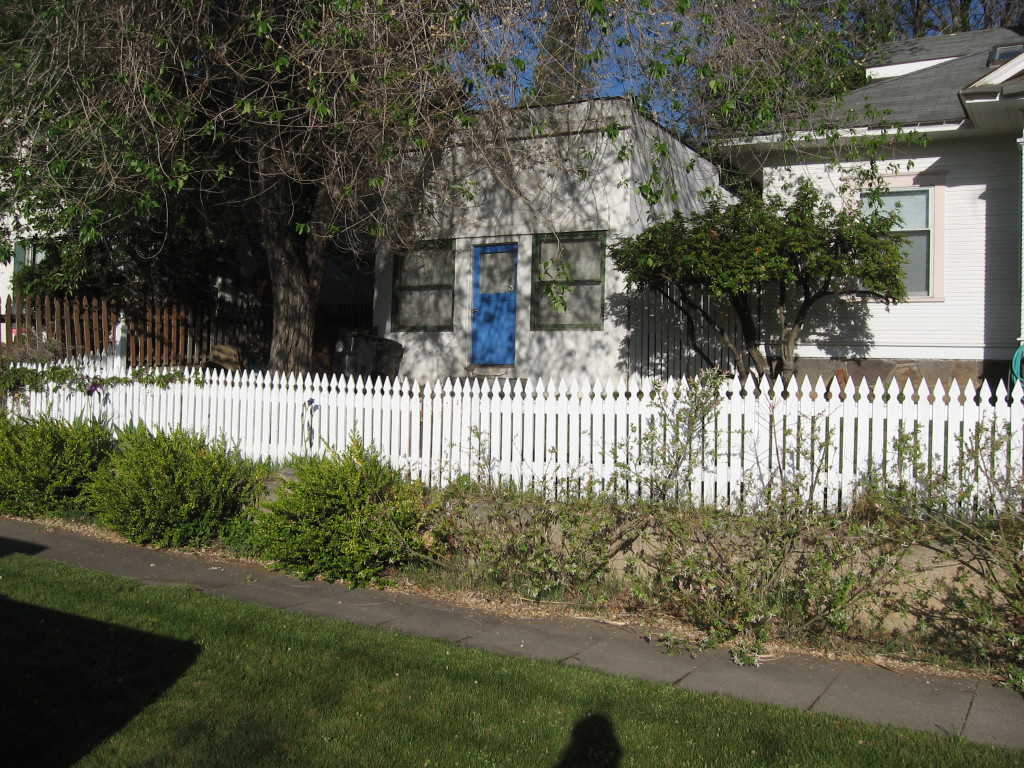
Not to be idle in retirement, he opened a small museum in Janesville to display his collection of curios. People fascinated by his collection began donating items to him. In 1920, Granville and his wife Mary, moved to Susanville and bought a home on South Roop Street. Next to his new home, he had a small concrete building built next to his for a museum. On June 18, 1921, he opened the museum to the public. When he passed away in 1926, and his wife kept the museum open for awhile, but she did not have the same passion as her husband. Over the years, she donated a portion of the collection to Lassen County. The items were displayed for a number of years in the Veteran’s building, and over time the collection slowly disappeared.
Standish School, 1911. Courtesy of Esther McClelland
Standish was a planned utopian community, laid out in 1897. As many know, the best plans do not always come to fruition. This was the case in Standish, and the school district was not created until 1906. While the formation of the school was slow to start, that was not the case for the residents to build a schoolhouse. That summer the Wilbur Brothers were hired to construct a $1,300 school facility.
It should be noted the Wilbur Brothers also built the Honey Lake and Missouri Bend schools, and all three structures are similar in design. Honey Lake school has been converted into a residence and no longer recognizable. Missouri Bend is still intact, and for awhile it has been used as a private school.*
Missouri Bend School, circa 1912—M.E.Mulroney
After World War II, rural schools faced many challenges. Thus, unification was the term of the day. On July 1, 1951, the residents of the Bridgeport, Soldier Bridge and Standish School Districts agreed to consolidate and form the Shaffer Union School District.
*The abandoned Standish School was torn down in the 1960s.
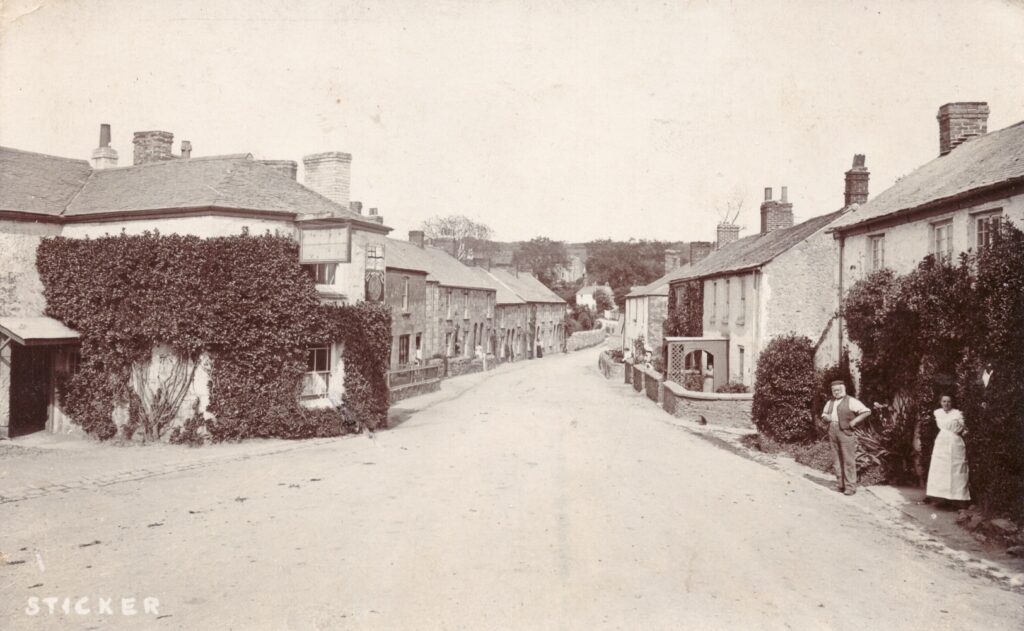
Sticker, Cornwall, England, circa 1911-Ecla smith Penfold
The sorting through loose documents and photographs is a challenge for me, but it has to be done. After all, some items, such as today’s featured photograph would mean little to anyone, but with a little narrative brings another perspective.
The old Smith homestead, also known as the Brubeck field. November 19, 2015
My great grandmother, Jane Smith Tanner was born there in 1846. In 1869, with her brother, John P.M. Smith and her mother, Mary, settled in the Honey Lake Valley, near the present day of Fleming Unit, of the Honey Lake Wildlife Refuge. Shortly thereafter, she married William Martin Tanner. After nineteen years of marriage, she was widowed, with four children ranging in age from four to eleven. She remarried to Charles Adams, who not only she endured his physical beatings, but then he sold the Tanner property, absconded with funds, leaving Jane destitute. She died in 1899, a ward at the County hospital and is buried in the Susanville Cemetery.*
Fast forward, in 1998, I made the journey to Cornwall to visit, Orin Smith, her nephew, my grandfather’s first cousin, who was named for Orin Dewitt of the Honey Lake Valley.
Tim
*Her three sons, Bill, John and Charlie sought refuge with the Ravenscroft family. While that name not be familiar to a lot. a Ravenscroft descendant was in the national news of late. His name, Spider Sabich, a former Olympian skier, was murdered by Claudine Longet, who recently passed away. Sabich was also a member of the Galeppi family. Bonus tidbit for the seasoned residents, Jack VanDorn’s mother was a Galeppi. So much useless information stored in my head. On the other hand, to use a old phrase “I do know where the bodies are buried”
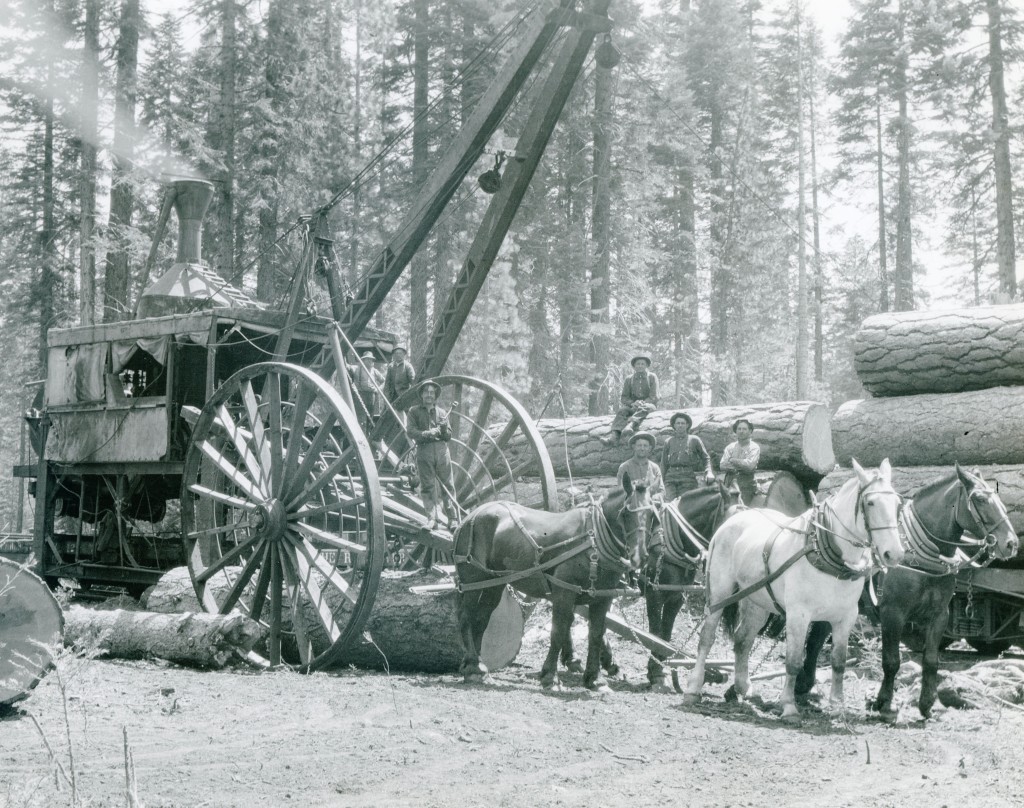
Red River Lumber Company, with Big Wheels and a McGiffert loader in the background. Courtesy of Hank Martinez
Logging operations of the early 1900s was extremely labor intensive. Motorized equipment was still in the experimental stages. One of the best advancements was the development of the Michigan Big Wheels, which everyone just called them big wheels. The wheels were a simple but efficient way to transport fallen logs to a landing, wherein they were then loaded onto railroad cars. The big wheels in time would become a key component in revolutionizing logging methods.
Horses provided the power to operate the big wheels. The name big wheels stems from their size ten to twelve feet in diameter. It was necessary for that size, in order to straddle a log and navigate moderate terrain. The logs were attached to a twelve foot tongue and with a lever, the driver could not only elevate a portion of a log in the front thereby making it easier to drag, but could loosen or tighten the cable, for braking purposes. One big drawback of big wheels was that it required a great deal of labor. Most big wheel logging camps employed as many as of 150 men. Two thirds of them worked as “swampers.” It was their job to remove brush, tree saplings, rocks and other debris that could injure a horse’s leg.
By the late 1920s, both Fruit Growers Supply Company and the Red River Lumber Company had replaced the big wheels with motorized Caterpillar “cats” Tractors.
Jacob Murrer’s unmarked grave, Willow Creek Valley, May 14, 1978
With Memorial Day or with the older generation, Decoration Day, around the corner, there are a dozen or so graves throughout the county where the person for a variety reasons, were buried on their property where they died. This was of course, prior to 1900, and prior to laws enacted where burials were required to be placed in a cemetery. Some of these graves are well marked and others are not. From time to time, we will explore these graves.
For the inaugural, we start with Jacob Murrer, who happens to be my great-great-grandfather. On July 1, 1876, Jacob Murrer, at the age of 49, dropped dead while tending J.P. Wallace’s livestock at Round Valley. The family brought Jacob’s body back to Willow Creek Valley for burial on the land he claimed. It was a simple matter of economics to bury him on the ranch, rather than bringing the body to Susanville for a formal service. The family had little means, and it did not help that Wallace owed Murrer $253 for back wages and other services. While the family’s financial improved over the years, a formal marker was never placed. His grandson, Alfred Murrer, always placed a salt lick there for many years as an impromptu marker.
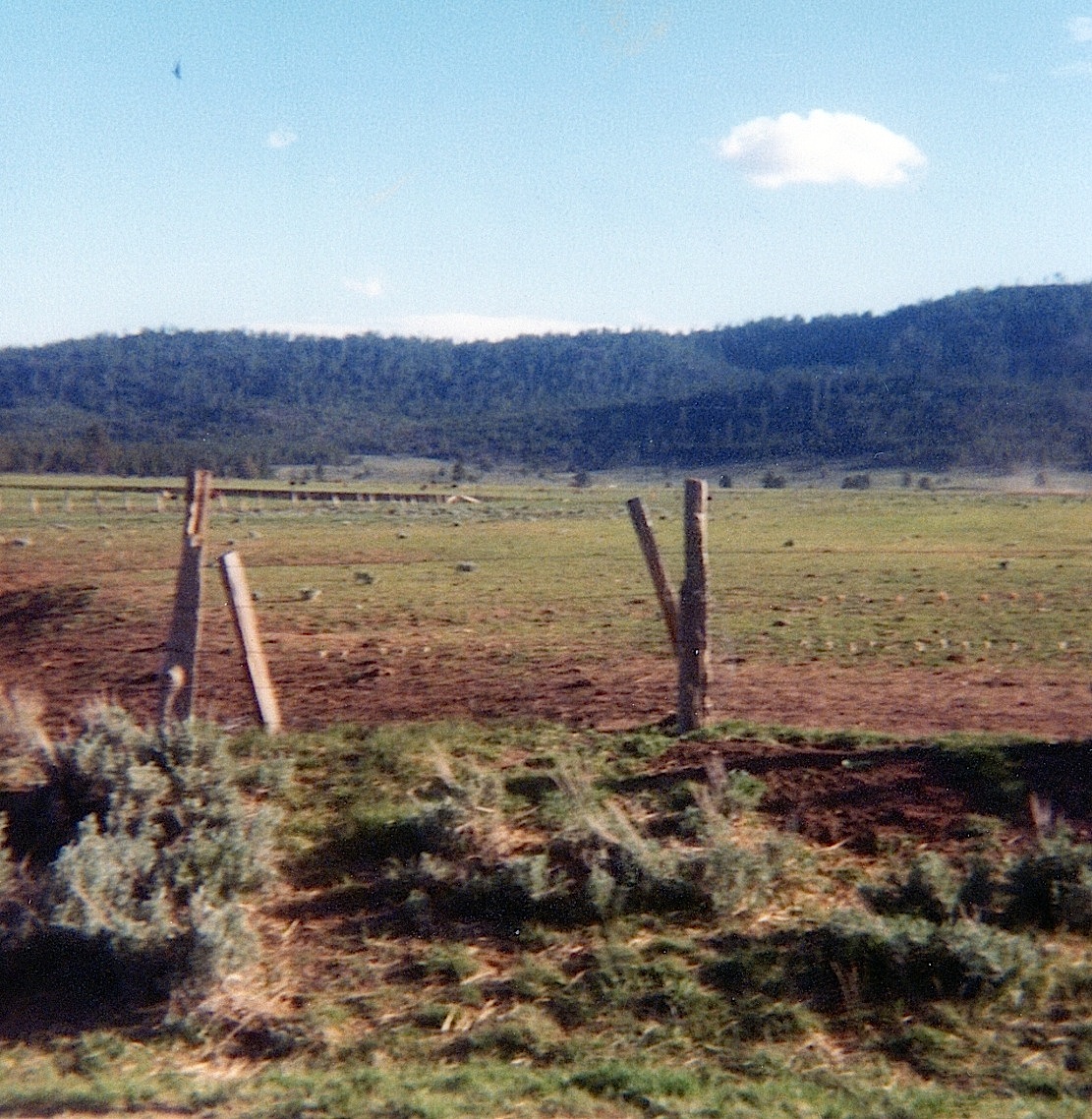
Tanner Ranch, with Skedaddle Mountain in the background
The far west was certainly not immune to the various political/social impacts of the nation’s Civil War.
Take for instance, there was once a district in the region known in the Honey Lake Valley as the Tule Confederacy. So name by a land surveyor, in the early 1860s, as he noted there was a large contingent of settlers who were southern sympathizers. Yet, by 1900, the term had been shortened to the Tules. In the last few generations this term, too, has faded away. Some may also heard the region known as the latter term of Seven Bridges.
It should be noted, the Skedaddle Mountains was so named by a term southerners used in the Civil War used to “flee.”
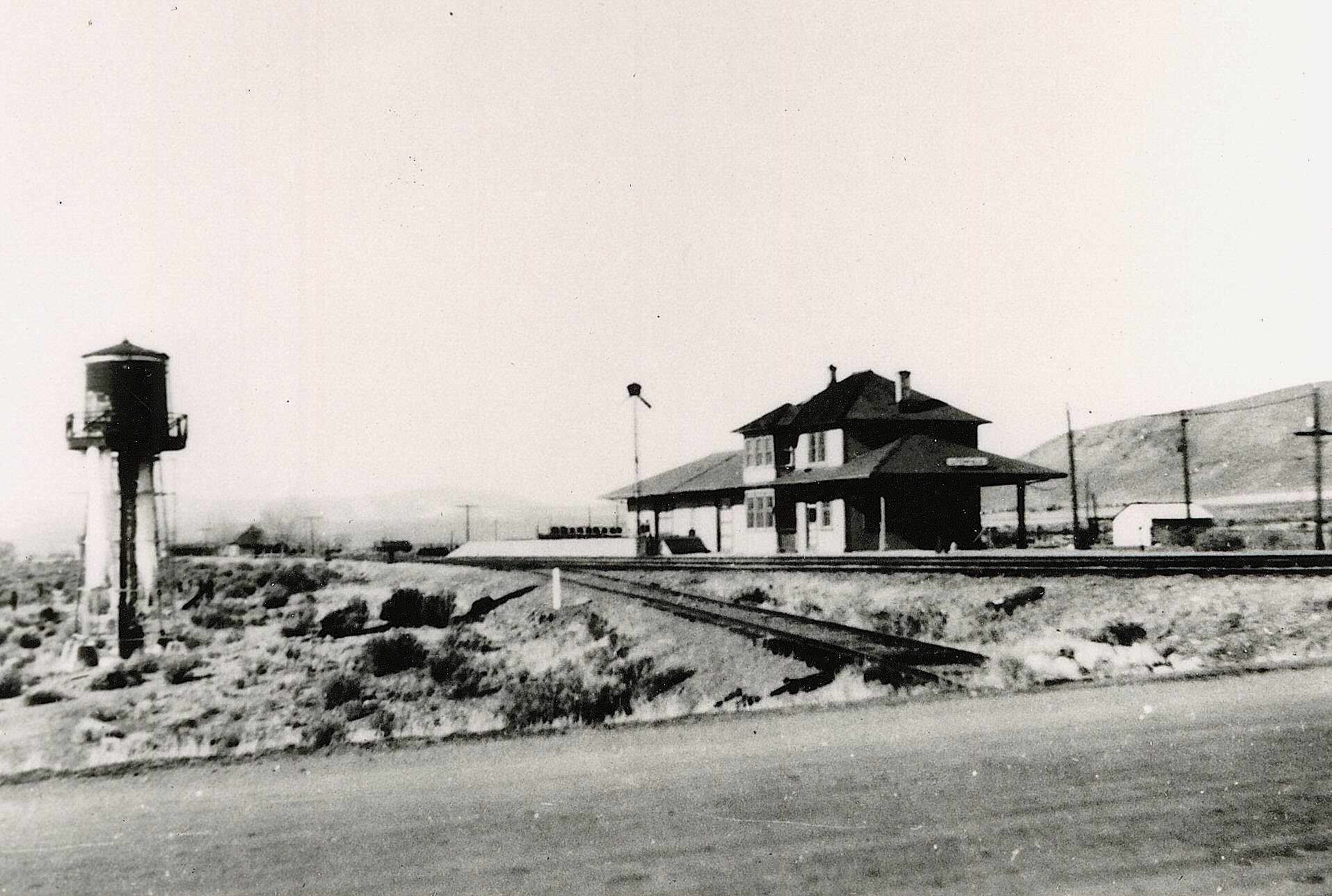
Litchfield Depot of the Fernley & Lassen Railroad, 1947. Courtesy of Camilla Moody
The Russian Thistle, (Salsola tragus), is best known too many as the iconic “tumbling tumbleweed.” Ironically, it became a symbol of the American West, yet it is a non-native plant. As its common name indicates it origins are from eastern Russia. Some sources indicate it was accidentally introduced in 1873 by Russian emigrates to South Dakota. The seeds from the plant are initially disbursed by wind. It is believed that many a railroad stockcar were imbedded with seeds, that allowed for them to be scattered throughout the west.
The plant did not make its appearance in Lassen County until 1914. While the Fernley & Lassen Railroad bought prosperity to the region, it also introduced this noxious invasive weed. The first plants were spotted along the railroad right-of-way. For the next two years, major efforts were undertaken to eradicate it, but it was a lost cause.
North Roop Street, Susanville, 1931. Courtesy of B.R. Zimmerman Collection
Awhile back I had an inquiry about 100 North Roop Street. While I am tardy to answer that, but as a bonus I will have a few more observations to add. The older houses on the street, are actually located in the 200 block and beyond. At the moment, I am still overwhelmed of the first round of boxes of the move containing a vast assortment of research material. However, there is still a pickup load of boxes still to arrive. I am understand that event may be Sunday, to avoid another month of storage fees. Please be patient during this transition process.