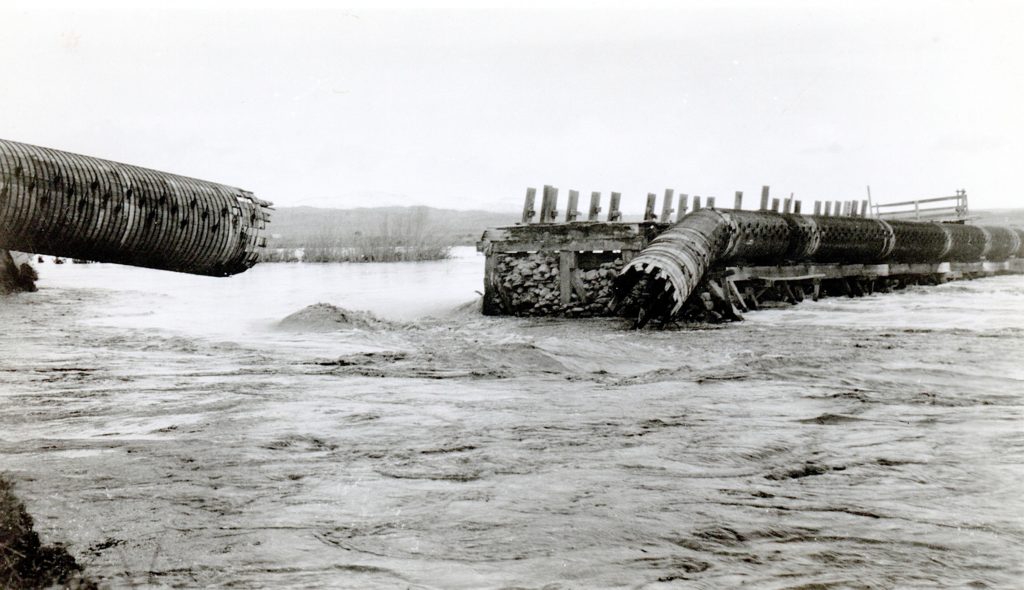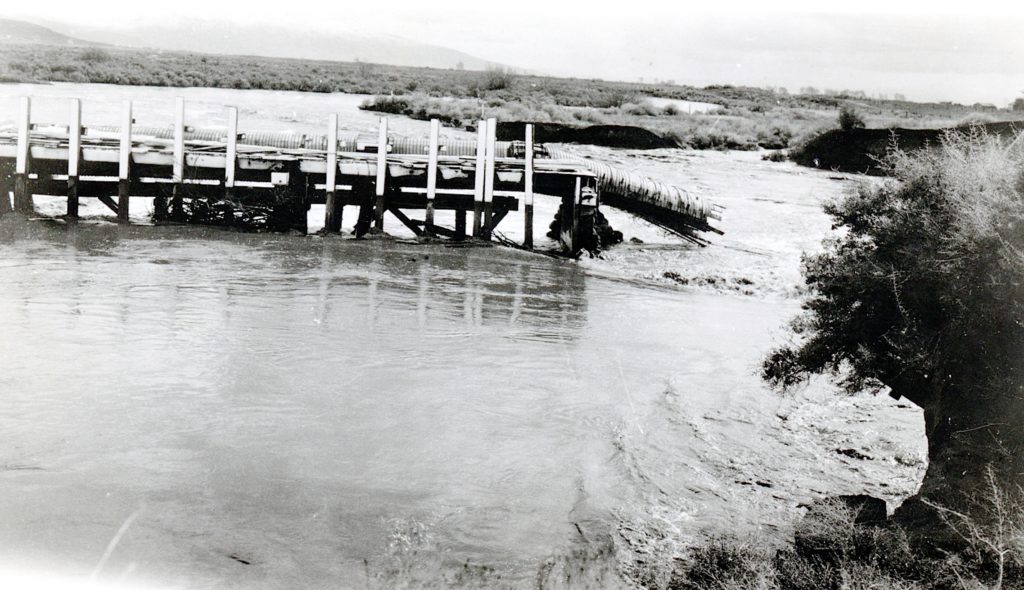
Piute Creek at Grand Avenue, April 1938–Betty B. Deal
On March 13, 1983, Susanville’s Memorial Park was once again flooded, transforming it into a lake. It was the third consecutive winter in which the event transpired. The perennial flooding of Piute Creek was due to an inadequate culvert under Main Street, which allowed the water to back up and flood the park. It was not until 1998, that the problem was rectified.
The Susanville Coca Cola Plant as it appeared in the 1950s, during the Lassen County Fair Parade. Courtesy of Margaret A. Purdy
Season residents may recall there was a time that Susanville had its very own Coca Cola Plant. The original bottling works was established around 1914 by H.W. “Pop” Wharton. It was located at 906 South Alley between South Weatherlow and Union Streets. The building, painted a chocolate brown, is still there and converted into apartments.
In 1923, Howard L. McMurphy took over the complete operation. It was an interesting and lucrative time to be in soda business with Prohibition. It saw not only the local production of Coca Cola, but a local line of the Mt. Lassen brand of sodas.
Sometime in the late 1920s a new plant was constructed at Main and S. Sacramento Streets. For many the star attraction was the large picture window on Main Street, where people on the street could watch the assembly line of the sodas being bottled.
In 1967, Phyllis McMurphy Beard dissolved the Susanville Coca Cola Plant and the local production of sodas ceased.
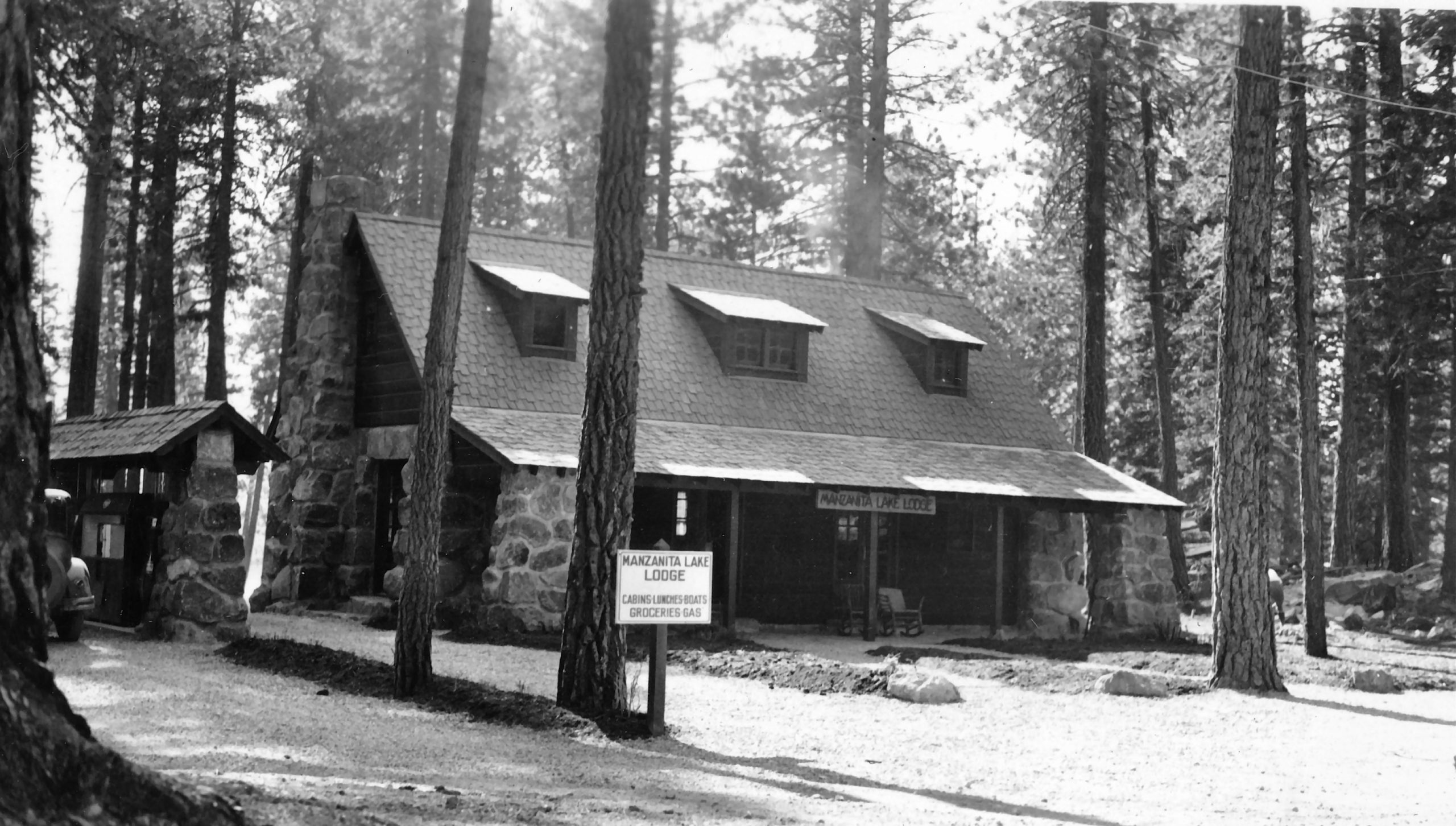
Many people may not be aware that when Lassen Volcanic National Park was established in 1916, it did not include Manzanita. Lake, however, it is one of the most photographed spots in the park, with Lassen Peak in the background.
In 1928, Lassen Park Superintendent L.W. Collins approached Pacific Gas & Electric who owned the lake for a possible sale. The lake had no potential for hydroelectric development, but Collins feared that PG&E would develop a resort, or create a subdivision for summer cabins. Nothing materialized.
In 1929, Congressman’s Harry L. Englebright’s park expansion bill that included Manzanita and nearby Reflection Lake was approved. In that same year, National Park Service Horace Albright met with PG&E officials concerning Manzanita. Albright informed the company that they did not have the funds to purchase the lake at this time, but he was able to persuade the company not to sell the property to developers. The company agreed. Negotiations continued and in 1931, the park purchased Manzanita Lake at the bargain price of $15,000.
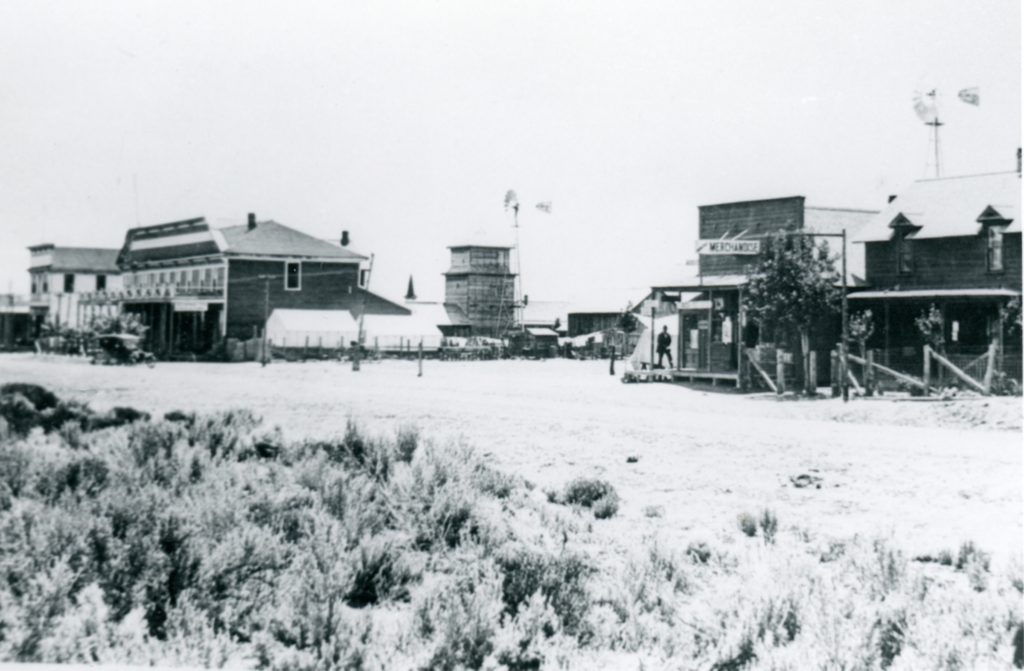
A view of Hayden Hill looking towards Silva Flat, 1909. Courtesy of Dallas & Joyce Snider
This 831-acre reservoir is located just south of Hayden Hill. It was so named for John Silva (1855-1904), a native of Portugal, who purchased 80acres near the base of the town from Lewis Hanson for $800. Silva was a sheep rancher by profession. When he died in 1904, he was buried in the Hayden Hill Cemetery.
In 1919 Homer Jack filed an application with the Government Land Office to construct a reservoir that would flood the flat with spring run off. It was not until 1924 when the reservoir was constructed to irrigate southeastern Big Valley, where the water is distributed by Juniper Creek.
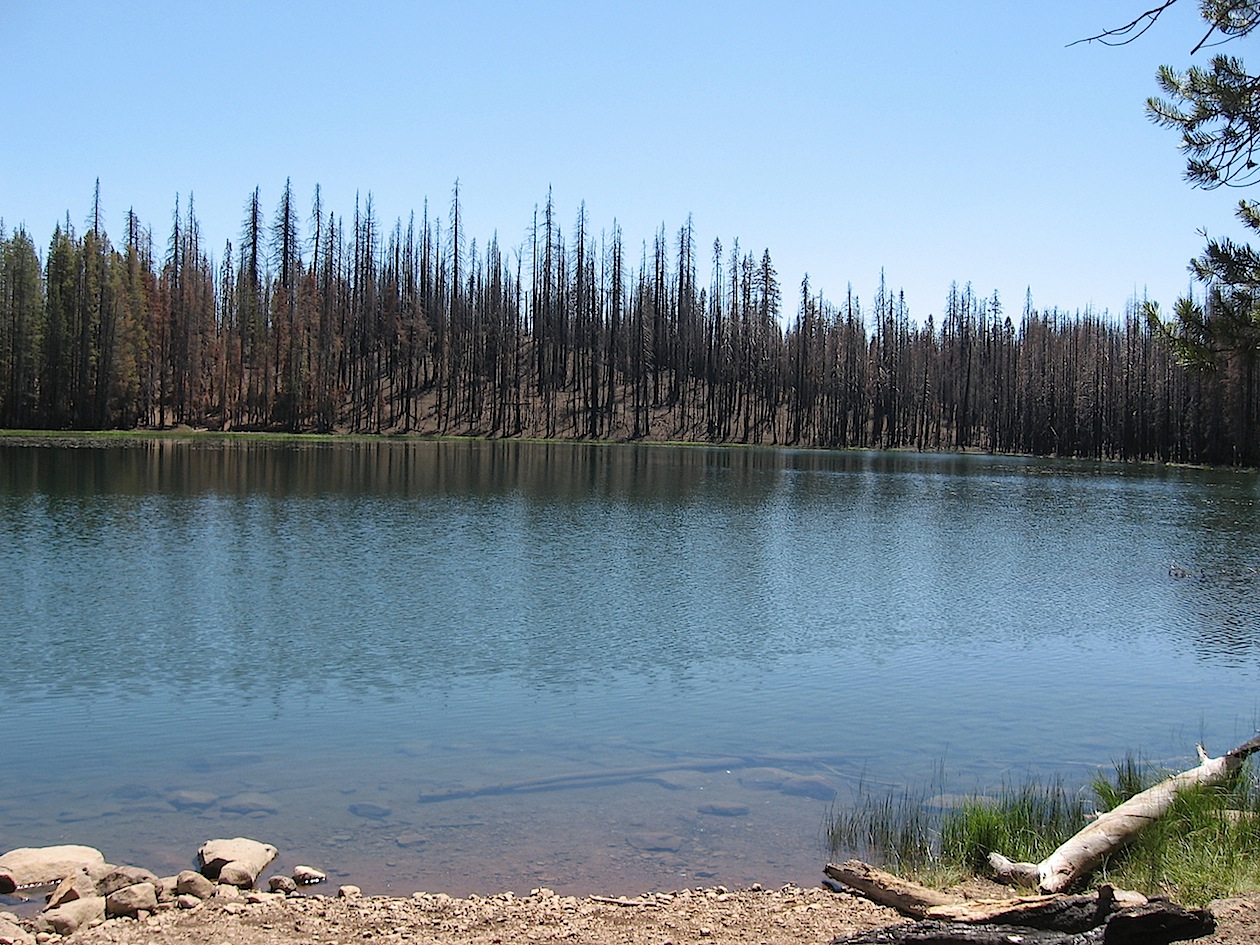
Silver Lake at an elevation of 6,472’ was named sometime in 1870s for the silver like reflections of the water surface when the wind blows. In 1924, the Lassen National Forest Service surveyed summer home lots and offered them to the public on a 99-year lease.
On May 28, 1938, Lurah May Stubblefield was granted to operate a seasonal post office there, that she christened Lake Nokopen. Stubblefield was the only postmaster and the post office closed on June 29, 1940. The name Lake Nokopen may have been attributed to the Boy Scouts organization, that held summer camp there during the late 1920s and 1930s.
In July 1892 George and Socrates Harrison, Susanville contractors were rebuilding the porch steps of the Steward House Hotel located on the northwest corner of Main and Gay Streets. They discovered the remnants of a historic relic—a small cannon.
According to Adam D. Elledge (1827-1924) the Plumas County officials brought the weapon with them in 1863 during the episode that became known as the Sagebrush War. It was never used. After a truce was held, it appears someone “liberated” the cannon and hid it the corner of the foundation of the Steward House which was under construction. A year later, it was removed, and it was noted it was fully loaded. So it was discharged, but not in a good way. The muzzle was plugged and sent shrapnel of the cannon into the area, a piece that struck and tore a big hole in the Susanville School a few blocks of way. At least no one was injured. The remains of the cannon were put back in its original hiding place, until it was unearthed in 1892 and given to Elledge.
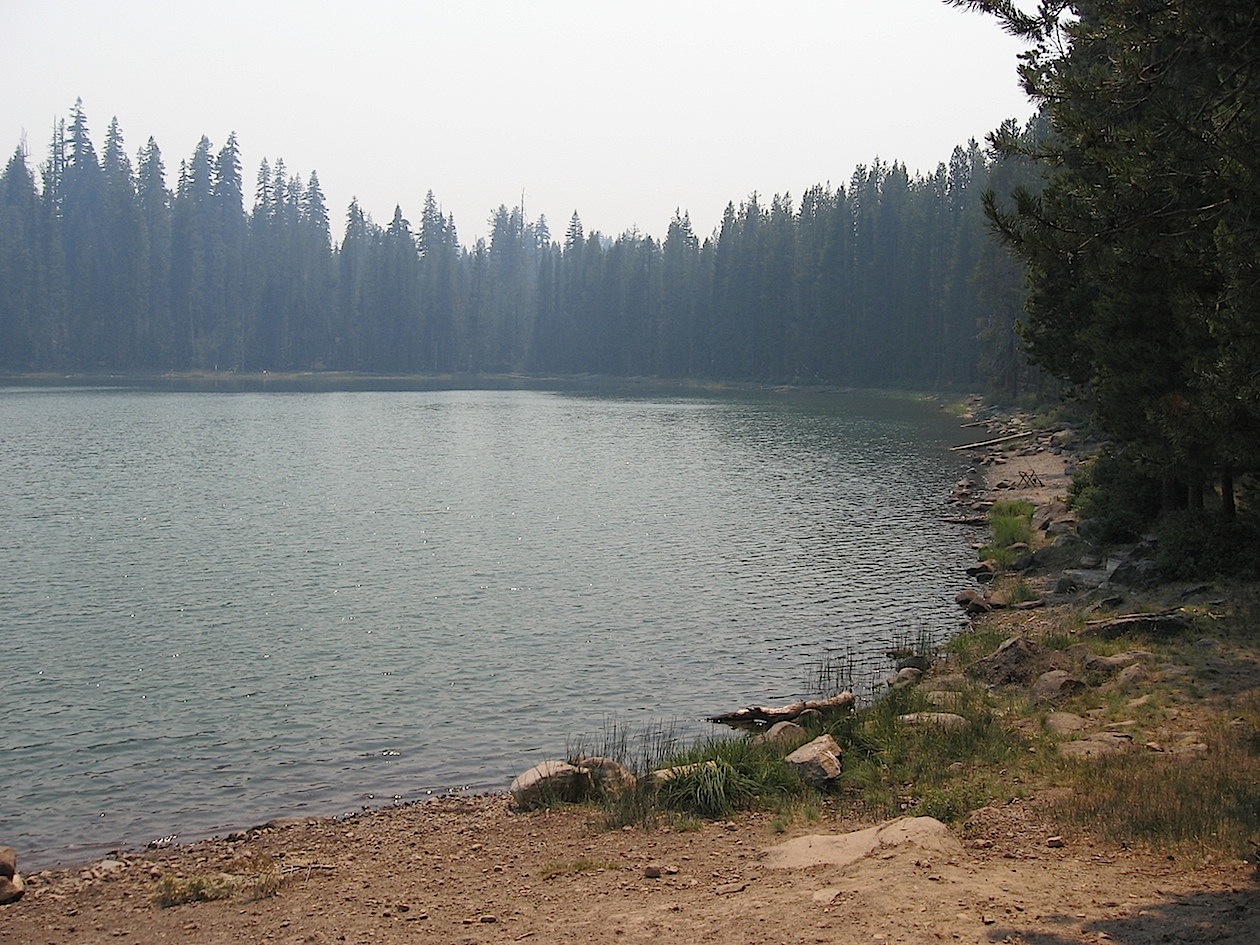
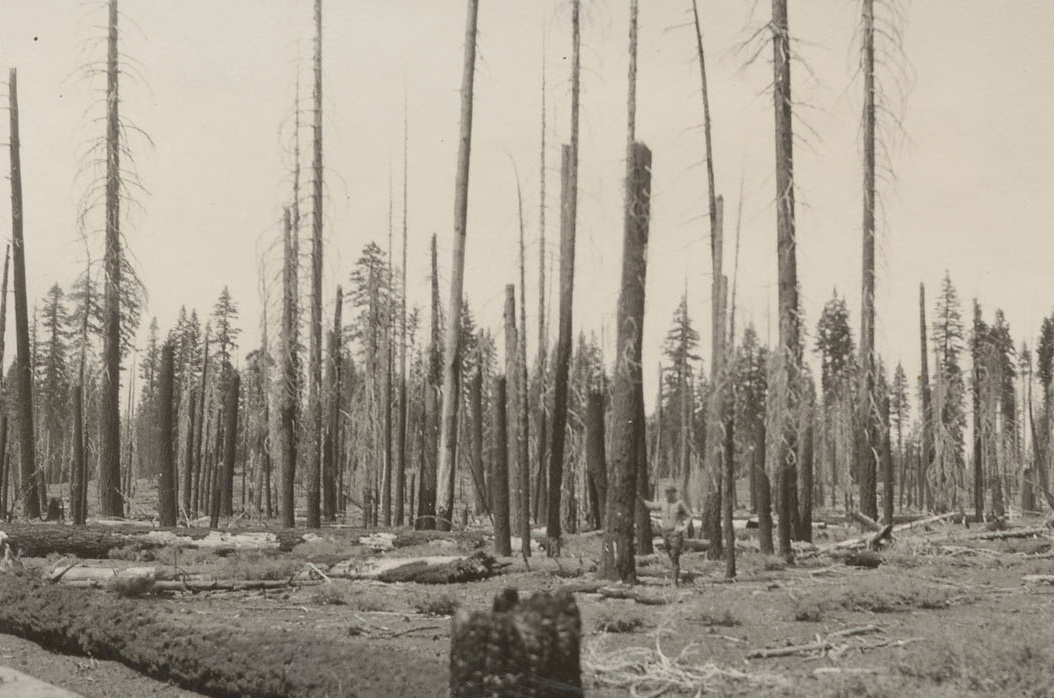
It has been a popular summer destination since the 1870s. Unfortunately, while visiting there last summer, smoke from the Dixie Fire that started two-days earlier some fifty miles away, had already descended on the lake.
Horse logging with big wheels, at Fruit Growers Camp B, north of McCoy Flat Reservoir.
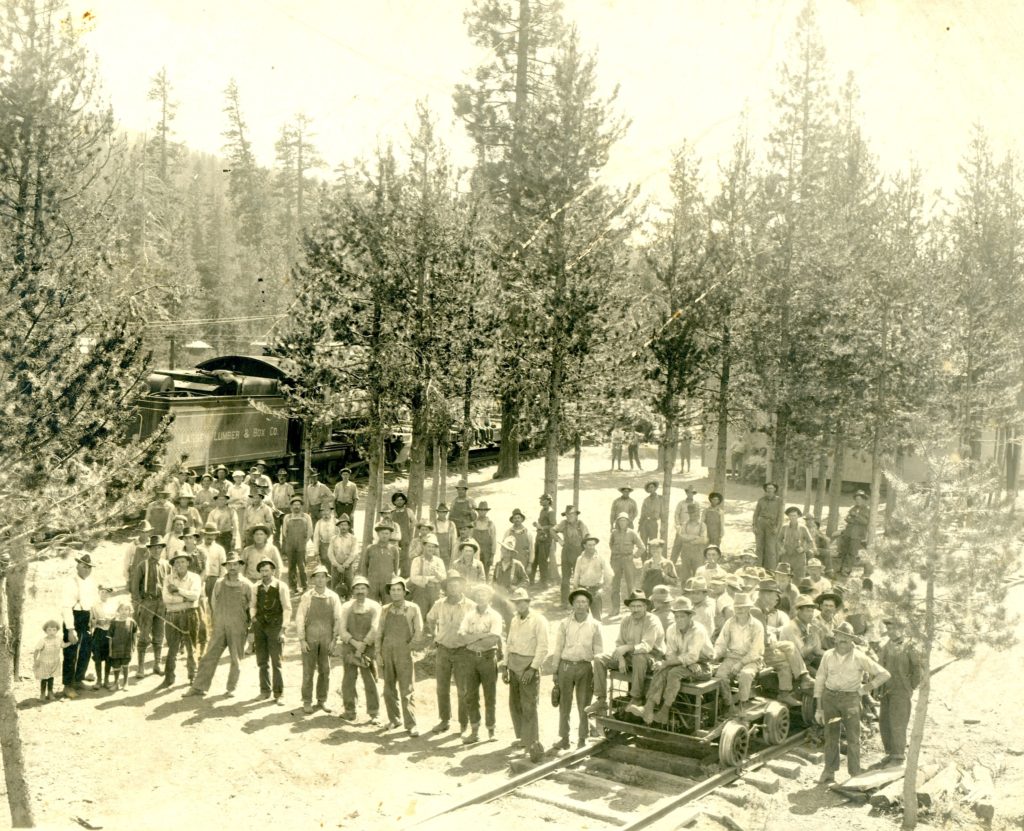
There were many enjoyable aspects when I researched the logging/sawmill operations of the Fruit Growers Supply Company aka Fruit Growers. For starters they kept well detailed records. Their annual reports are a compelling read, and one just never knows what you can find in them.
Fruit Growers 1947 annual reported highlighted many interesting facts, it being the company’s 40th anniversary. Take for instant, the following:
”The Susanville mill was completed and began cutting timber late in 1921. When cutting started, logging in that area was done with horses. Fifty-two horses were bought locally, 60 in St. Paul and 22 in Iowa. The total of 134 horses had an average cost of $276.67 and the harness for them totaled $13,247.07.
“Four horses would skid with wheels about 2200 feet per load. Modern Diesel D8 tractors bring in about 5,000 feet.”
Note: This originally appeared on January 8, 2018, so it might be familiar to some. For some odd reason in August 2021 it garnered a lot of attention from first an internet search and then spread on social media. While seasoned subscribers may recall it, there are new ones who may find it of interest.
From time to time discussions have been held whether the cloud seeding in the Lake Almanor Basin area by Pacific Gas & Electric Company affects the areas to the east. In 1979, Lassen County officials thought the cloud seeding was part of the drought problem in southern Lassen County. In October 1979, Henry LaPlante of PG&E stated that the company has been treating selected storm systems for more than 25 years. He said the intent of the seeding was to increase the high elevation snowpack. Furthermore, LaPlante wrote, “There is no scientific evidence which indicates that cloud seeding activities in our Almanor area reduces the amount of precipitation in any other area.”
Left to Right: Garfield Vogt, Les Cottingham, Orrin Myers, Fred Hansen, Roy Hopkins, Unknown—Vivian Hansen
The Standish Meat Market was an early day enterprise of Fred Hansen. When it first opened it was located on the north side of Todd Hemler’s Standish Livery Stable. What a peculiar arrangement to the say least. As business increased Hansen moved to a second location and branched out in carrying groceries. One of his newspaper advertisements caught my attention with the statement “Local-killed Meats.”