Category Archives: History

Mountain Maidu Bear Dance Update

The final segment of the bear dance along Baxter Creek, 1900. Sponsored by Anna Stewart

“One of the truths about historical research is that it is never finished. So many sources are consulted, there are always more to be added. There are certainly more sources of information about early Bear Dances and about early Mountain Maidu life that I could not get to when researching this book.” — Leigh Ann Hunt, Preface for the 1996 Edition of Rite of Spring: A History of the Mountain Bear Dance .

Rites of Spring is Leigh Ann Hunt’s thesis for Master of Arts of Anthropology at California State Unversity, Sacramento, 1991. I met Leigh Ann back in the 1980s when she is doing her research. In 1996, the Lassen County Historical Society published Leigh Ann’s thesis. I am not if it is still available, though I highly recommend it.

One of notable inclusions is Edith Young’s notes, a field matron in Susanville, who was only such employee in the Greenville Agency of Bureau of Indian Affairs. Young was in Susanville during the 1910s, and I, too, have some of her  observations, and I think a possible photograph of her. I will add it to my to do list.

Tim
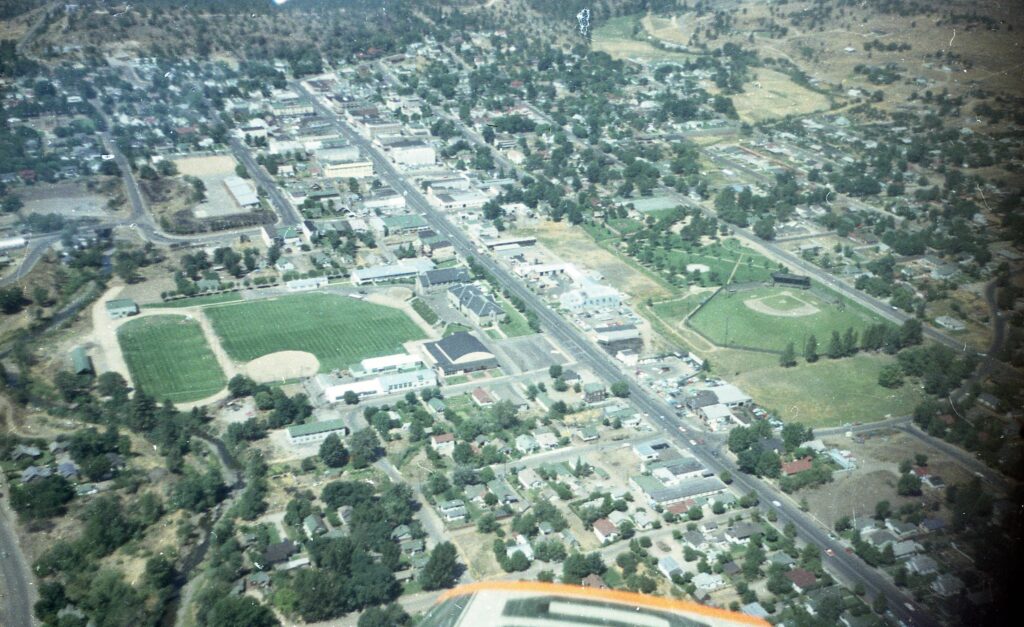
 

A Susanville View, 1960

Aerial view os Susanville, 1960

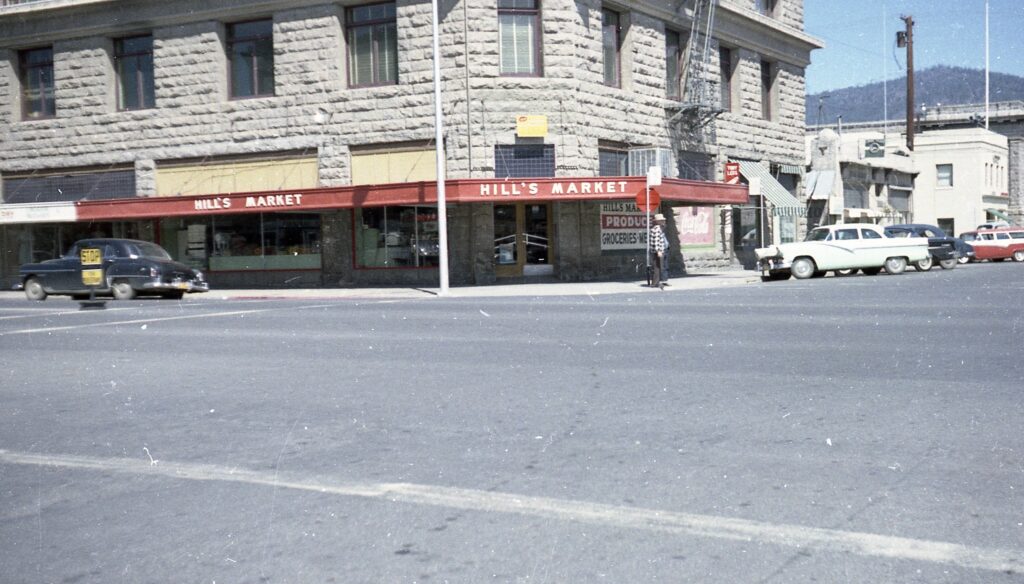
Here is your Tuesday Tidbit. Whether you are an old timer or new to the area, there have a been a lot changes. The Lassen High School campus, has completely changed, There is no Susanville Supermarket. Of course, the latest victim that is no longer there, the baseball grandstand at Memorial Park.

Tim

Susanville’s Hollywood House

150 North Lassen Street, Susanville, 2002

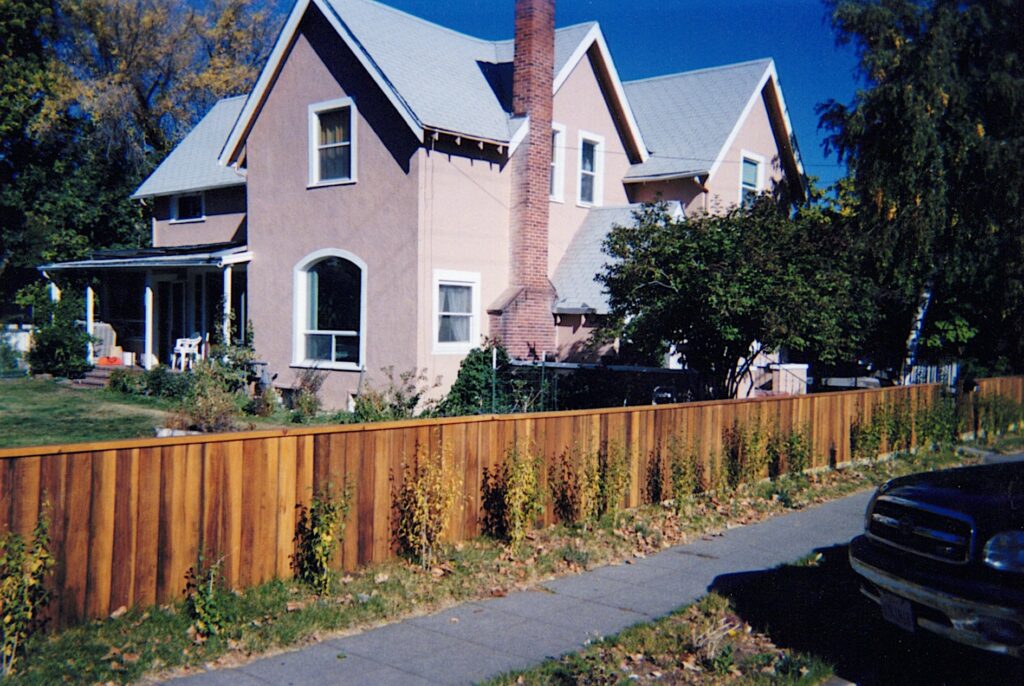
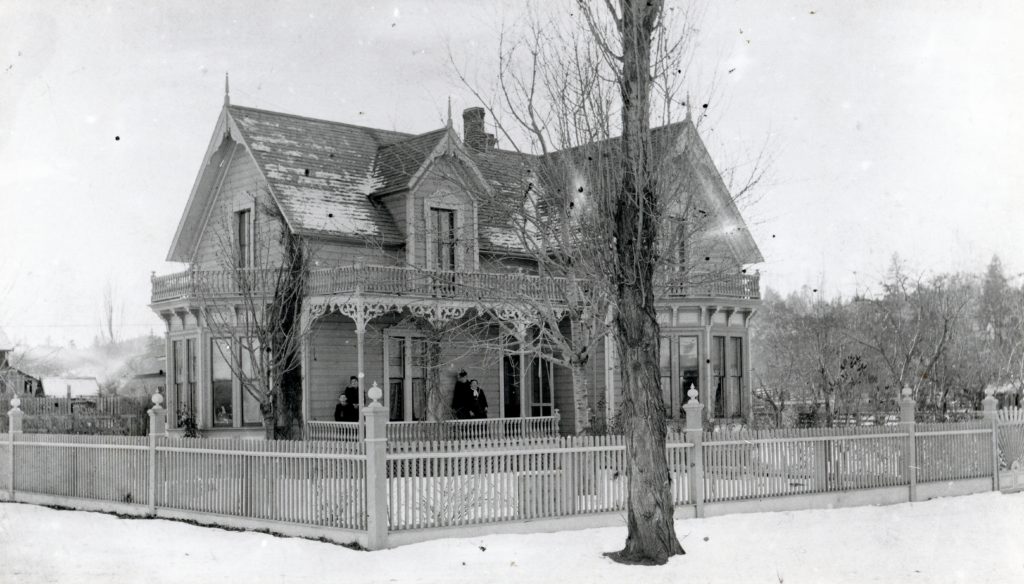
And then there was Max’s Mausoleum post. Sound confusing? I thought about this unusual landmark that was created in the 1920s, as a part Hollywood motion picture production. During the 1920s and 1930s a number of Hollywood films used the region as a location, thanks in part of Susanville’s native son, Ephraim “Ephie” Asher.

Asher, was the only child of Morris and Fannie (Greehn) Asher. He was born on September 1, in either 1887 or 1888 in Susanville. There is some discrepancy as to year he was born. His son, William, thought it was in 1890. In 1887, his parents had a house constructed on the corner of North Lassen and North Streets. They moved in February 1888. This was the house Ephie was raised and he attended local schools. Since there was no high schools, he would receive his higher education in San Francisco. By the mid-1910s, after a stint in New York City, involving the motion picture industry, he located to Los Angeles became associated with Universal Studios as producer and production manager. Thus, he had an influence as locations. His son, William Asher, had a lengthy career in the Television industry and he was producer of such shows as I Love Lucy and Bewitched. It should that he was married to Elizabeth Montgomery, the star of Bewitched.

Tim

M.O. Folsom-Rancher Turned Capitalist

M.O. Folsom–Lassen Lodge F&AM No. 149

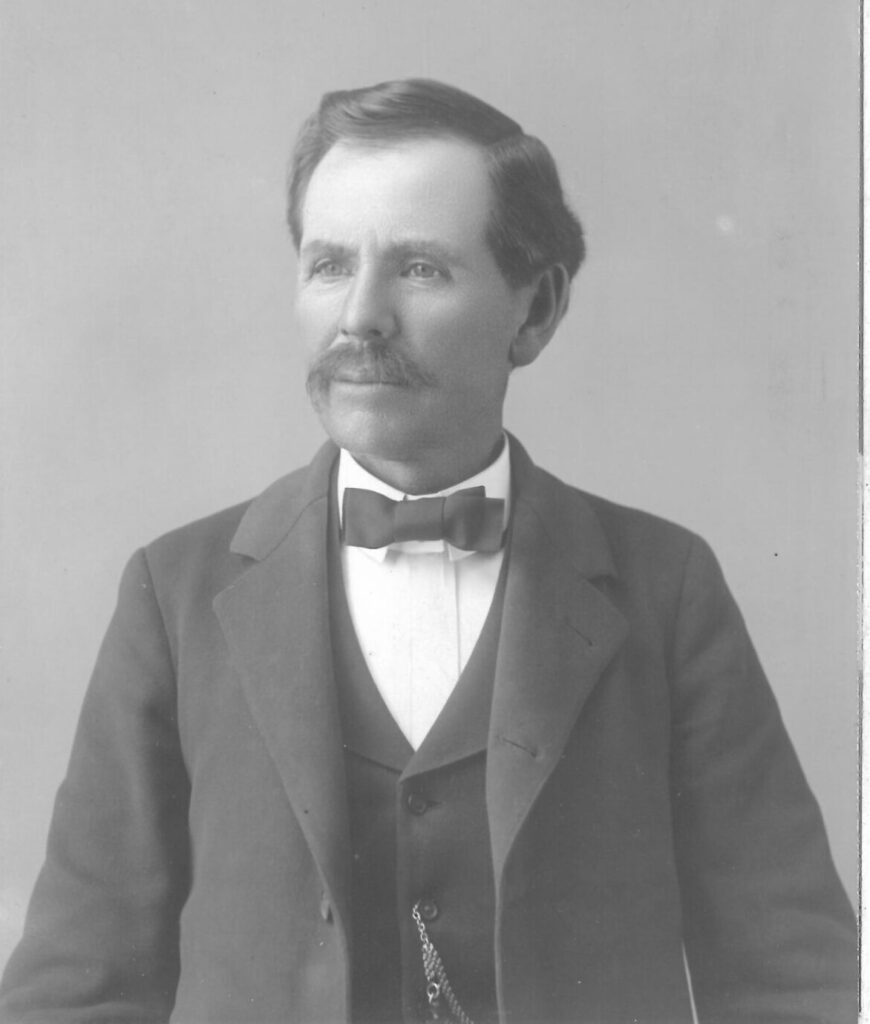
In 1871, M.O. Folsom (1845-1931) moved with his family from Virginia City, Nevada to Willow Creek Valley, just north of Susanville. In 1873, he became a partner with his brother Louis, when they purchased 600 acres in the Willow Creek Valley.  When his father passed away in 1903, He took his possession of that ranch. In 1908, Folsom sold ranch to the Hill & Lonkey Land & Livestock Company and moved to Susanville. It should be noted, that his father, Orman, dabbled in real estate, and purchased Hank Landt’s Clear Creek property. In 1909, the younger Folsom sold it to the Red River Lumber Company for $6,500.

In 1911, M.O. Folsom entered into the subdivision field, with his East Addition to Susanville. This we explored, and you can read about it here.  The subdivision did not meet his expectations, though not a failure, the real action was the south side of town where the railroad was located. Folsom, however, did serve on the committees to secure the Fruit Growers Supply Company and Lassen Lumber and Box Company’s mils.The mills more than tripled the town’s population, thus a golden opportunity for island speculation. For instance, in 1922,  Folsom sold a parcel land to the Susanville School District for $9,000 the future home of Lincoln School.

Folsom also had a benevolent side. In 1929, he offered the future site of Memorial Park to the Susanville Rotary Club at a bargain price. It was a complicated affair that ultimately fell through. He also owned what now known as Hobo Camp, along the Susan River, near Susanville. It was known as Folsom Park, a favorite picnic spot among locals.

Folsom passed away in 1931 and is buried in the family plot in the Susanville Cemetery. In 2005, his granddaughter and only heir, Mary Dale Folsom, still owned several parcels that once belonged to her  grandfather.

Tim


Lassen Volcanic’s Hot Rock

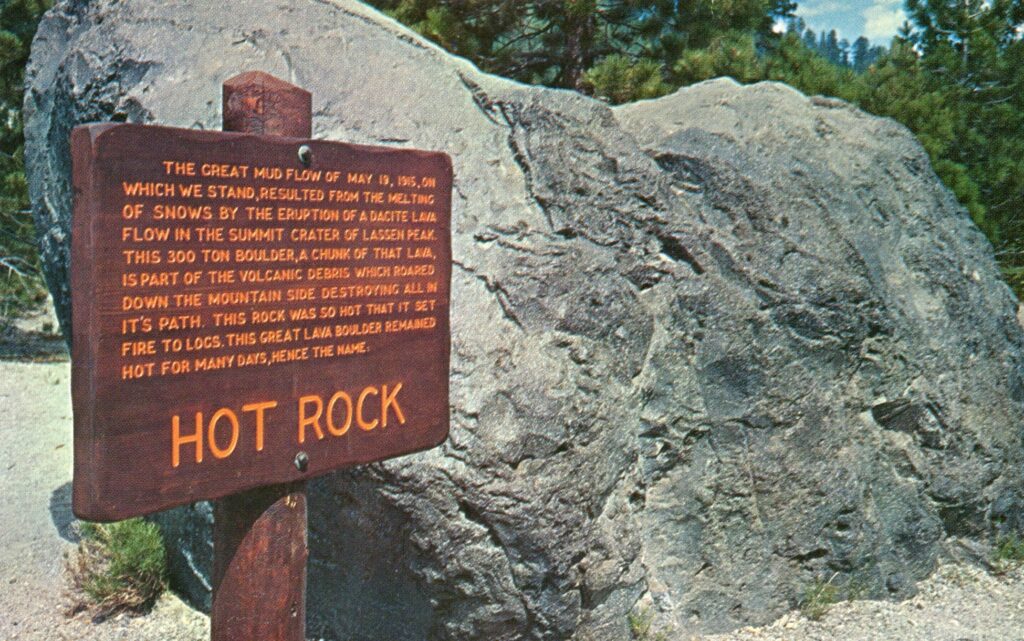
Hot Rock – An Eastman Studio postcard

A reader sent me this vintage 1970s postcard of Hot Rock. It is one those unusual features in Lassen Volcanic National Park.

Hot Rock was of many remnants of the Lassen Peak eruption of May 19-20, 1915. First, there was a blast dacite lava and with great force that created boulders, large and small. But, there is more. The lava melted the heavy snow, creating what would became known as The Great Mudflow. When B.F. Loomis visited  this site on May 21, what became the Devastated Area, he noted this large boulder, was still hot, and hence its name. Schaffer. (1981) estimated that at time of the eruption the rock could have exceeded 1600F. It should also be noted, that looks can be deceiving.  The rock is like an iceberg. It is estimated that the 300-ton boulder is buried under of twelve and eighteen feet of mud in its final resting place.feet, so one only sees a small portion of the boulder.

Tim


William Greehn – A Pioneer Merchant

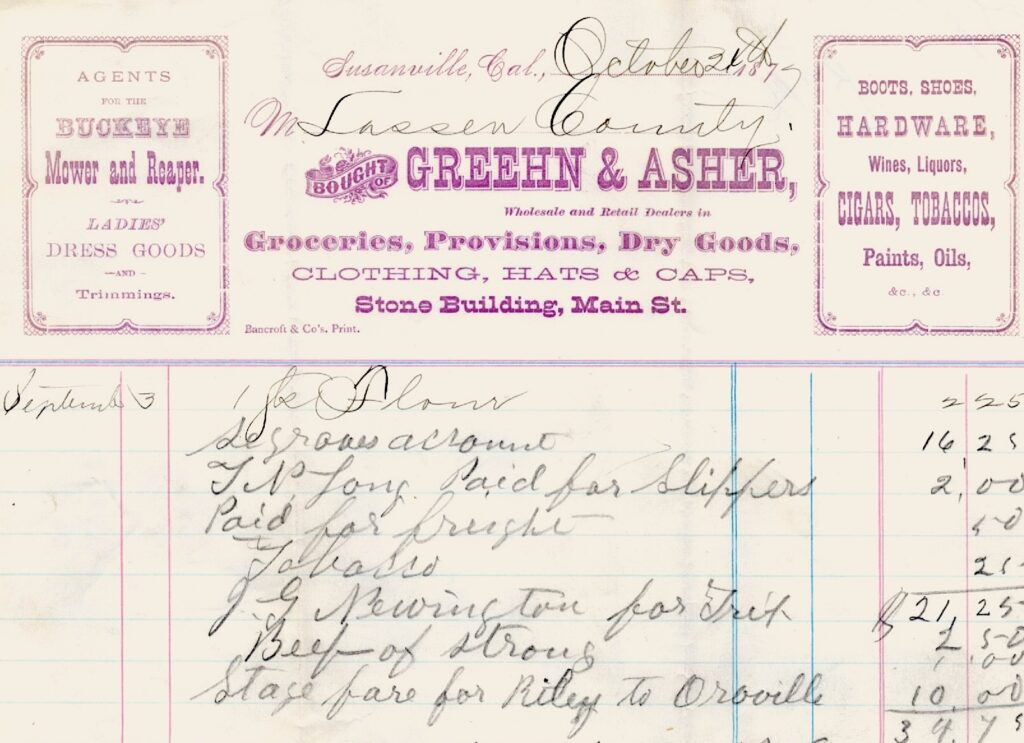
A Greehn & Asher Invoice

In 1864, German immigrant, David Goldstein, along with fellow countryman, William Greehn arrived in Susanville and opened a general merchandise store. They named their enterprise D. Goldstein & Company. In 1871, they dissolved their partnership and Goldstein moved on to greener pastures. In 1874, Greehn entered into a partnership with Morris Asher. It would eventually be a life changing  event for the two men.

In 1882, Morris Asher married Fannie Greehn, William’s oldest daughter. In 1887, Greehn relinquished his interest in the store, and devoted himself full-time as a lending institution. There were no banks in Susanville, so those who had financial means, lent money. Of course, the borrowers not only had to sign a promissory note, but mortgage any real property they might possess to the lender, in this Greehn. Those that had defaulted on their loans, Greehn took them to court and usually became owner of the borrower’s real property. Greehn would eventually own quite the portfolio of real estate, like what would become known as the Five Dot Ranch in the Willow Creek Valley, the Leonard residence, which became known as the Susanville Elk’s Lodge and the Bremner Sawmill on the Susan River. In 1902, Green retired and moved to Byron, Contra Costa County, where his daughter, Hattie Grunauer resided. He passed away in 1907.

The William Greehn residence 734 Cottage Street, 1886.

Morris Asher continued with the general mercantile business. In 1912, in 700 block of Main Street, he had a stone business building constructed, which embedded in the stone named the  Greehn Building in honor of his father-in-law. It still remains today.

Greehn’s descendants have made last lasting impact in the motion picture and television industry, and we will explore that topic shortly.

Tim


Susanville School Bonds, 1899

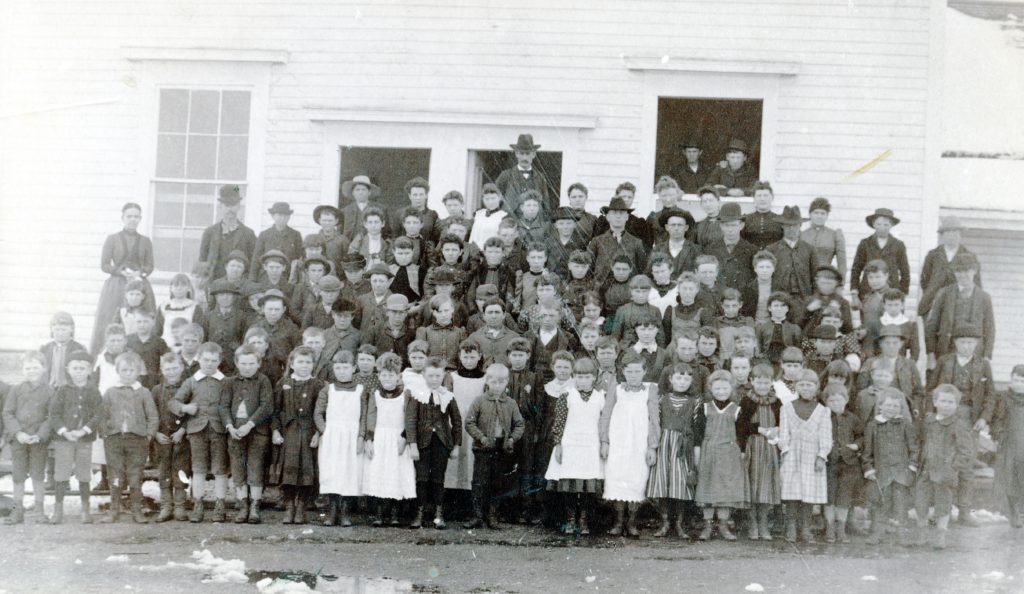
The Susanville Grammar School, early 1890s. Courtesy of Juen Chappuis.

The Susanville School District, technically is the oldest, since it was established in 1863, before Lassen County was created in 1864. The first school was located on Cottage Street, and the site it still used for educational purposes. However, I have heard that the property might be for sale in the not so distant future.

In 1873, a new school house was built to replace the existing one. Time and an increased of school age population had taken its toll on the structure. Eight years later an addition was made.

By early  1899, the Susanville School District agreed to go the voters for a bond measure  to replace the current school building. Some stated the building was an actual disgrace to the community. Another opinion voiced “It was poorly constructed, old, dingy and dilapidated, there is no longer any possible justification for its continued use. On June 2, 1899, the voters of approved the $12,500 bond measure to build a new two-story brick schoolhouse by a vote of  84 to 19.

The Susanville Grammar School, nee Washington, as it appeared in 1948.

One would think with the bonds past, it would be all systems to go. The State required that the school district to hold a special meeting as to a future school site. Several meetings were held. When the trustees next meeting it was to be vote on,  but there was no quorum. It was not until late December when the issue was settled. It was decided to build on the current site. The school grounds would have to be enlarged and the trustees voted to purchase the adjoining vacat lot. In  March 1900, that the contract to build the new school was awarded to Reno contractor, C.E. Clough. In 1948, that building was condemned

Support

Burrus vs. NCO Railway

Thelma James, J.H. Pefley, Unknown and William Clayton, Amedee Depot, January 14, 1911

The NCO trains were not known for reliability for being on time, that many passengers of the day could attest. The following is a very unusual case.

Lassen Advocate 13 July 1917 2;1 – Burrus Gets Damages. The decision of the Nevada Supreme Court awarding $5,000.00 damage to Joseph Burrus against the Nevada California & Oregon railway for breach of contract, has been finally determined by the United States Supreme Court in favor of Burrus.

Joseph Burrus engaged a special N-C-O train for $125, in 1911, to carry his son Kirchie, who had contracted blood poisoning as the result of frozen feet, from Doyle to Reno where he was to be placed in the hospital for treatment. When the train arrived in Doyle, Burrus was notified that the train had to proceed Amedee for oil. It developed later that the train went to Amedee for the purpose of loading snow bound passengers, and that passengers were allowed to board and get off the train on the route between Reno and Doyle. Burrus brought suit against the company, holding that the train was not a special, as stipulated in the contract, and that the train was delayed unnecessarily. He asked $20,000 damages. The case went through the Washoe district court, through the Nevada State Supreme Court and finally to the United States Supreme Court.

Support

Susanville’s Perplexing Street Names

North Street, Susanville
Look east on North Street from Weatherlow during the 1938 flood. Courtesy of Betty Barry Deal

Did you ever notice that North Street runs in an east-west direction? It does not make sense, until you go way back when Susanville was first surveyed. There you find the answer to this perplexing issue. You see, North Street was most northern street in the town. The same thing happened in the 1920s with an adjoining subdivision to the south, in which South Street became the most southern street. And here is trivia about North Street. When town, as mentioned was surveyed in 1863, Roop Street ended at Weatherlow. In 1910, it was extended to Hall Street. This met with teamsters glee to avoid the muddy bog on Main Street created by Piute Creek.

North Roop Street, Susanville, 1931. Courtesy of B.R. Zimmerman Collection

Another peculiarity is that of Roop and Weatherlow Streets and that they should be reversed.. This was pointed out to me  many years ago when Eleanor Vandeburgh and I worked at the museum. After all, her reasoning was, one would think Weatherlow Street should have been designated as Roop, since it went to his original home. Weatherlow lived at the end of Roop Street, though it did not extend that far, since his original home located  at Susanville Ranch Park. On the same token, Weatherlow Street went by Roop’s original home.

Tim