Personally, this latest storm was over-hyped for the region. Some forecasts called for feet of snow, but in reality it was inches. Anyhow, lets examine some big storms that occurred several years apart.
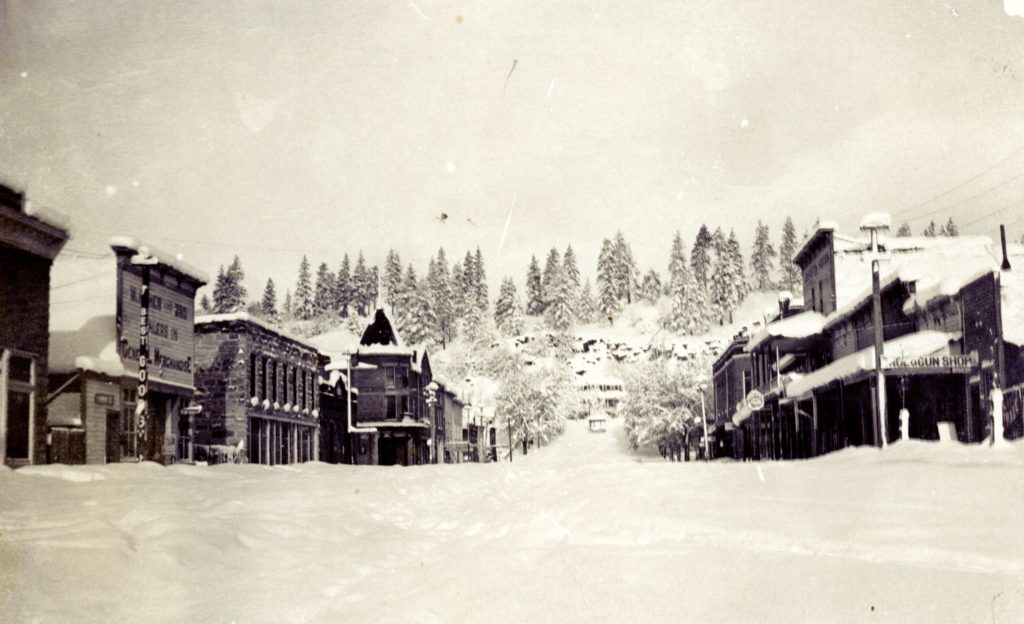
1911- On January 13 there was three foot of snow in Susanville, but the big snow still had not hit. Then it really began to snow. Six days later the storm finally ceased, five feet of snow had fallen and the depth on the ground now reached eight feet! In January 116 inches of snow had fell in Susanville, with a total precipitation of 11.59 inches.
Construction of the Fernley & Lassen Railroad, west of Susanville, January 1914. Courtesy of B.R. Zimmerman Collection
1914 – In January was another repeat of 1911. Susanville once again had eight feet of snowfall. This, of course, did not stop the railroad construction crew between Susanville and Westwood.
1916 – On New Year’s Day a snowstorm hit Susanville and dropped four feet of snow in two days. For the month Susanville received nine and a half feet of snow for the month of January. When it was not snowing it was bitter cold. On January 30 the temperature dropped to minus fourteen below zero.
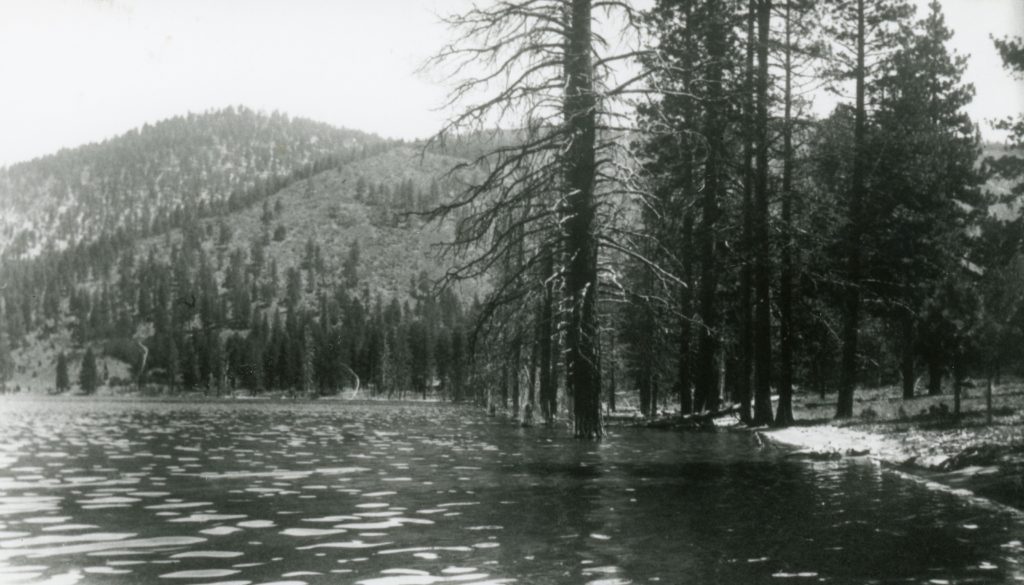
Gallatin Beach and Peak, 1916. Courtesy of Wyn Wachhorst
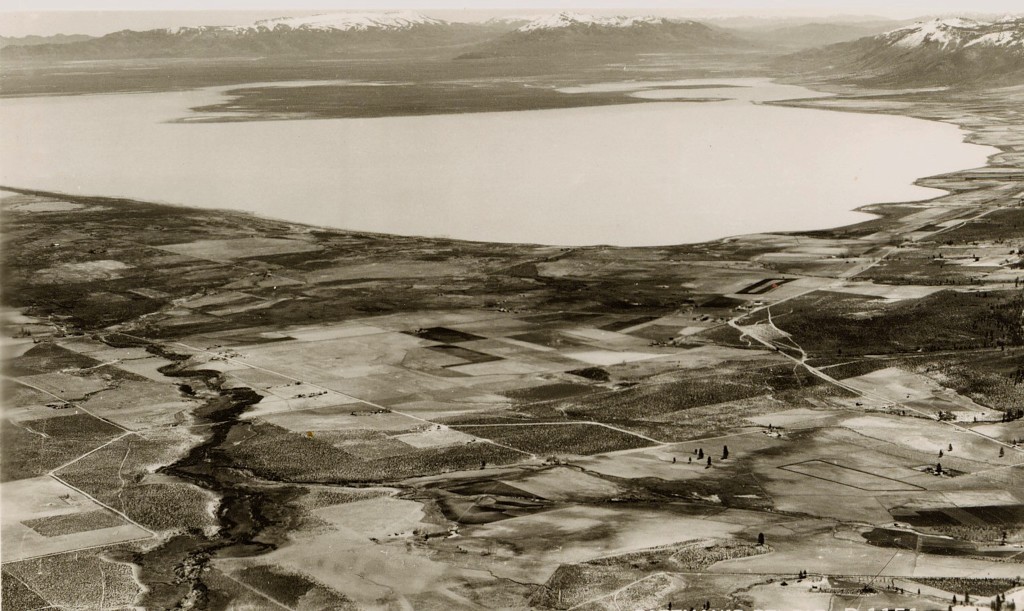
Eagle Lake was a beneficiary of these wet winters. In 1917, the lake reached its highest recorded water level.
In January 1860, Dexter Demming was brutally murder at his cabin at Willow Creek Valley by a band of renegade Indians. A posse was formed to search for the Paiutes. The posse encountered them at Snowstorm Canyon. A skirmish occurred, but it was in vain, for the Indians had the upper hand due to the rugged terrain. The posse’s efforts was not a total loss, for they did recover some of Demming’s belongings.
Back in Susanville a meeting was held to determine what the next course of action should be. Some where of the opinion they should go en masse to Pyramid Lake to confront Chief Winnemucca. about Demming’s murder. Cooler heads prevailed and two men, Captain William Weatherlow and Thomas J. Harvey, were designated to make the diplomatic visit with Chief Winnemucca.
The two men met with Winnemucca and prevailed upon him to turn over the tribal members that committed the murder. During the course of conversation Winnemucca was evasive. In conclusion, and by surprise, Winnemucca informed them, the settlers could purchase Honey Lake Valley for $16,000. Upon payment Winnemucca stated there would be no livestock theft, murder or mayhem. This revelation left the two men bewildered.
From a historical standpoint, Winnemucca’s offer is a complete surprise. It has never been revealed who advised the sale of Honey Lake Valley and equally important how the price was determined. Weatherlow and others felt the offer was nothing more than blackmail. Whatever the case may be, tensions became intense and finally that spring escalated into the Pyramid Lake War of 1860.
North Lassen Street, Susanville, showing City Fire & Hall, circa 1930
Tuesday, is primary election day in California, so I thought it only fitting to have an election story—oh do I have many having spent many years working as a county election official. One of the most disheartening aspects is when there is low voter turnout. The general public is not aware, just how much work and preparation is involved. Okay, enough of my soap box and on to the story at hand.
The April 1930 Susanville City Council election turnout was pathetic, only eighteen votes cast! Robert M. Cook, editor and publisher of the Lassen Mail wrote:
”On Monday of this week three men were up for election as members of the city governing board. Exactly eighteen votes were cast in the election booth. That number on the face of it shows there is no local interest in how the town is run or who runs it. And the men who are on the town council board are the men who say how and where the taxpayer’s money shall be spent.
”It seems reasonable to suppose that interest, more or less, would be cenetered at election time on whom should occupy places on this governing body. The few votes cast last Monday would indicate the reverse.
”Whether or not he or she should cast a vote is up to the individual concerned. And if a person is not concerned to the extent of casting a vote then adverse criticism should cease.
”The job of councilman carries with it nothing but work and grief. There is no salary attached to the office, nor rarely any credit for work done. It is more or less of a wonder that any one would take the office as a gift, let alone having to ‘run’ for it. The different men who hold places on the board should be given a vote of thanks for accepting the responsibility they do. Instead all they get is a lot of knocks by persons who are too indifferent to express their choice of whom they want through the medium of the ballot box.
”The office of councilman is an important one and should not be treated indifferently. If there is not any interest shown in who runs the town and does the work of planning and directing, then you can’t blame the powers that be if no interest is shown on their part.”
A ladies “smoker party”, circa 1920. Courtesy of Juen Chappuis
April 1, is not only April Fool’s Day, but the official date of Lassen County’s creation. More on that later on April 1.
Since it kind of the doldrums of this time of year, I was thinking of maybe combining the two events and just a have fun jovial celebration on that date. During the early 1900s around these parts, it was not unusual for some fraternal organization or individual(s) to come up with some wild themes like in 1914 the “Parade of Horribles.”
A 1912 float to resemble an airplane, that was a failed event. Courtesy of Leona Byars
The possibilities are endless. May be an organization would sponsor a fund raising dinner the night before which would culminate with the coronation of the next day’s Fool for the Day. Get the legal community involved and they could select a “court jester” to accompany the Fool for the Day to promote various community projects. Let’s not stop there, engage law enforcement community to select a Bailiff to accompany that duo. Make it a community wide event, tap into the students at Lassen College for their creativity among other things. After all, we could use a day of merriment and hi jinx. We could use a Tom Foolery Day.
The Amedee Post Office had the unique distinction of its opening and closing dates. The post office was established on New Year’s Eve, 1890 with Lewis Brubeck as the first postmaster. It should be noted that many of the railroad agents, also served as postmaster over the years. So, it was 100 years today on Leap Year Day 1924, witnessed the closure of the Amedee Post Office. The post office and town was named for Amedee Depau Moran, one of the owners of the NCO Railroad.
The east side Honey Lake Valley residents were not completely without mail service like they are today. Located between Amedee were Stacy and Wendel, both railroad communities. Stacy resident Allison Newman, who my Dad introduced me to him as the “mayor of Stacy.” Newman was that town’s postmaster for decades until it closed in 1951. The Wendel Post Office closed in 1993.
Spread the word, and encourage a friend to subscribe.
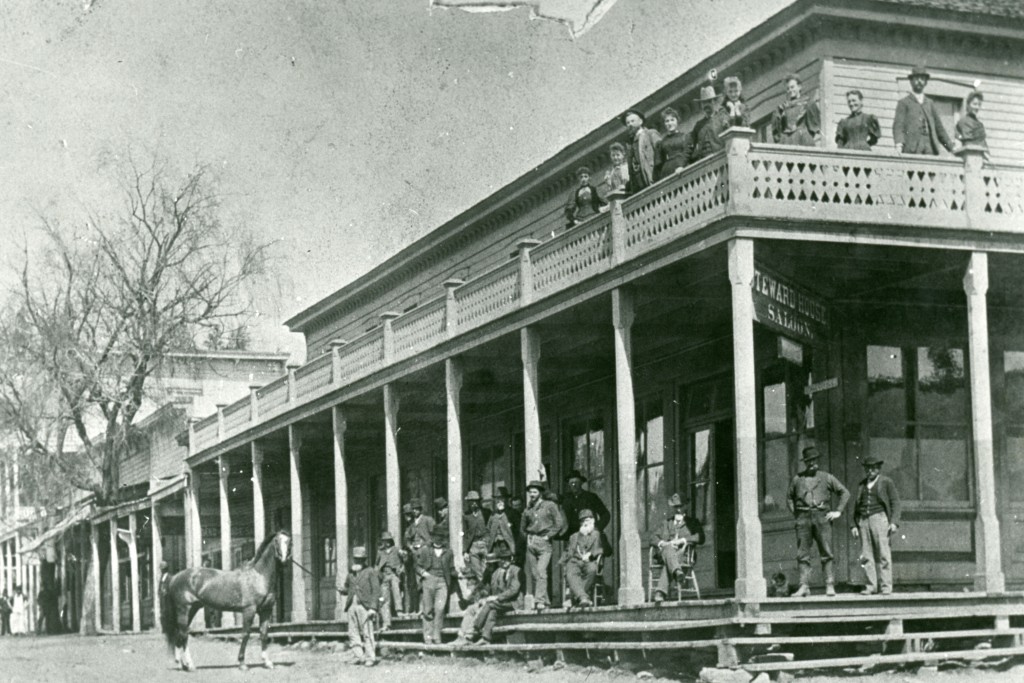
Susanville’s Stewart House, 1881. It sometimes was used as a hospital. Courtesy of Dallas & Joyce Snider
It was druggist that played a key role in medical care, as physicians were few and far between in the pioneer era. In the summer of 1860, Dr. Zenas J. Brown arrived in Susanville and began dispensing drugs from a canvas tent. He met with commercial success and at 802 Main Street, he had an octagonal drug store built—which the locals gave him the nickname of Doctor Eight Square. The following year he was joined Dr. Robert F. Moody, and Moody would become sole proprietor of the firm within three years. Dr. Brown it should be noted introduced the first apple trees to the region, which at one time was a major export crop.
Then there is Dr. Zetuz N. Spalding’s arrival to the region in 1857, and would later be the founder of the venerable Spalding Drug Store. One of Spalding’s earlier advertisements noted his many skills: “Z.N. Spalding, Physician, Surgeon and Accoucheur. Teeth extracted without pain, by use of Anaesthetics.”
It should be noted that the first Lassen County Hospital was not built until 1883. Those who were indigent were housed in a local hotel. The innkeeper would then submit a bill to the county for reimbursement.
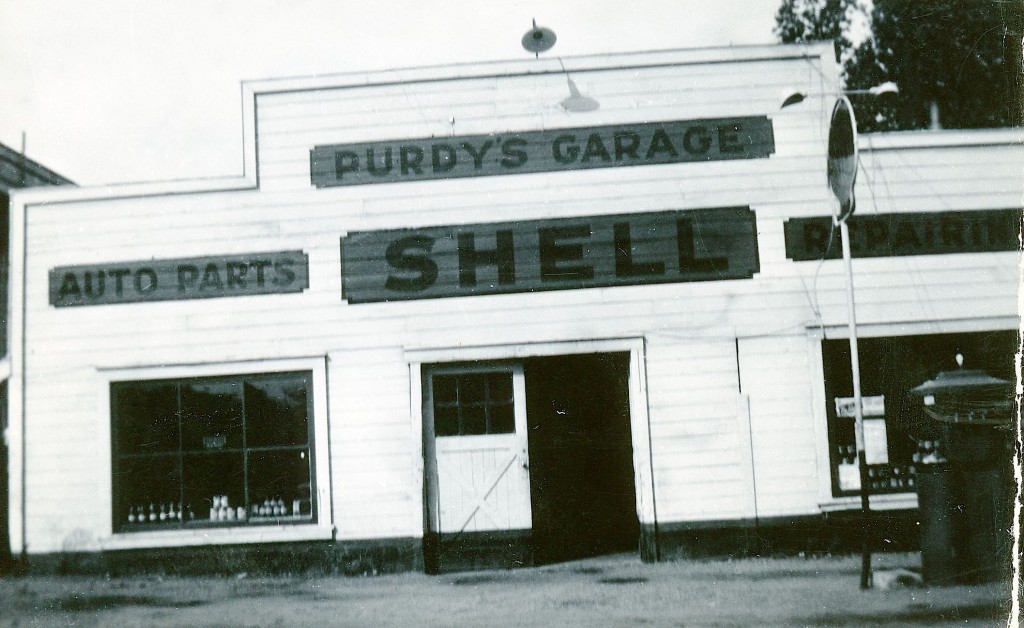
Purdy’s Garage, date unknown. Courtesy of Margaret Purdy
Some one wanted to know about the history of Susanville’s T&A Lounge located on the corner of Main and Sacramento Streets. In 1939, my grandparents, Ira and Margaret Purdy bought the Main
Street frontage between Sacramento and Spring Streets. My grandfather had a gas station and garage on the corner of Main and Spring Streets. Ira sold the vacant lot on the corner of Main and Sacramento to Tony Tonin and Al Surian—hence the name T&A. It was a short lived partnership, but Surian’s son, Gino, still owns the establishment.
My apologies for using a photograph of Purdy’s Garage instead of one of the T&A. I am still in that transitory period with issues transferring scans, hopefully the transition is just a few months away.
Leona Jackson at Susanville’s SP Depot, 1919–Lola L. Tanner
In 1913-14 when the Fernley & Lassen Railroad was built through a major segment of the Honey Lake Valley, the residents rejoiced. This was especially true for the agricultural community. While there was the NCO railroad, many deemed it expensive and unreliable. There was also other issue, its depots were not conveniently located.
Yet, on the other hand, no one knew what to expect when the Red River Lumber Company established its company town of Westwood. The agricultural community was overwhelmed that it had a large local market, and thanks to the railroad it was easy to get their products to Westwood. The scenario would repeat itself with establishment of the lumber mills—Lassen Lumber & Box Company and Fruit Growers Supply Company—in Susanville. The bottom line, it came as a total surprise that the railroad would create a large local market for local products. The region witnessed an increased local production in the agricultural sector, that allowed for more export of produce by rail.
The 101 as it appeared in 1941. Courtesy of Dina Matteucci
The 101 Nite Club was perhaps the liveliest of the four roadhouses between Susanville and Westwood. It is also the least documented, providing a challenge to unearth its story. The club took its name from the 101 Ranch and was located directly across from the ranch house. The operators leased the property from the McKenzie family, owners of the 101, but what the arrangements were is open to speculation, since those documents were never recorded.
The 101 was established in late 1937 or early 1938 by Old Town resident Steve Actis. It was a large structure containing a bar and dance floor and live music was a part of the routine operation. In addition, there was a separate gas station and restaurant and a number of cabins behind the club. The cabins were rented out to loggers, but also provided housing for the musicians who performed there.
In 1941, one those musicians, Ray Orlandi, along with his new wife, Dina, took over the operations of the 101. However, it was not until June 6, 1942 that a bill of sale was recorded wherein Orlandi paid Actis $2,000 for the establishment. The Orlandi’s tenure would be brief for they decided to purchase Tony’s a bar in Susanville, later known as the 802.
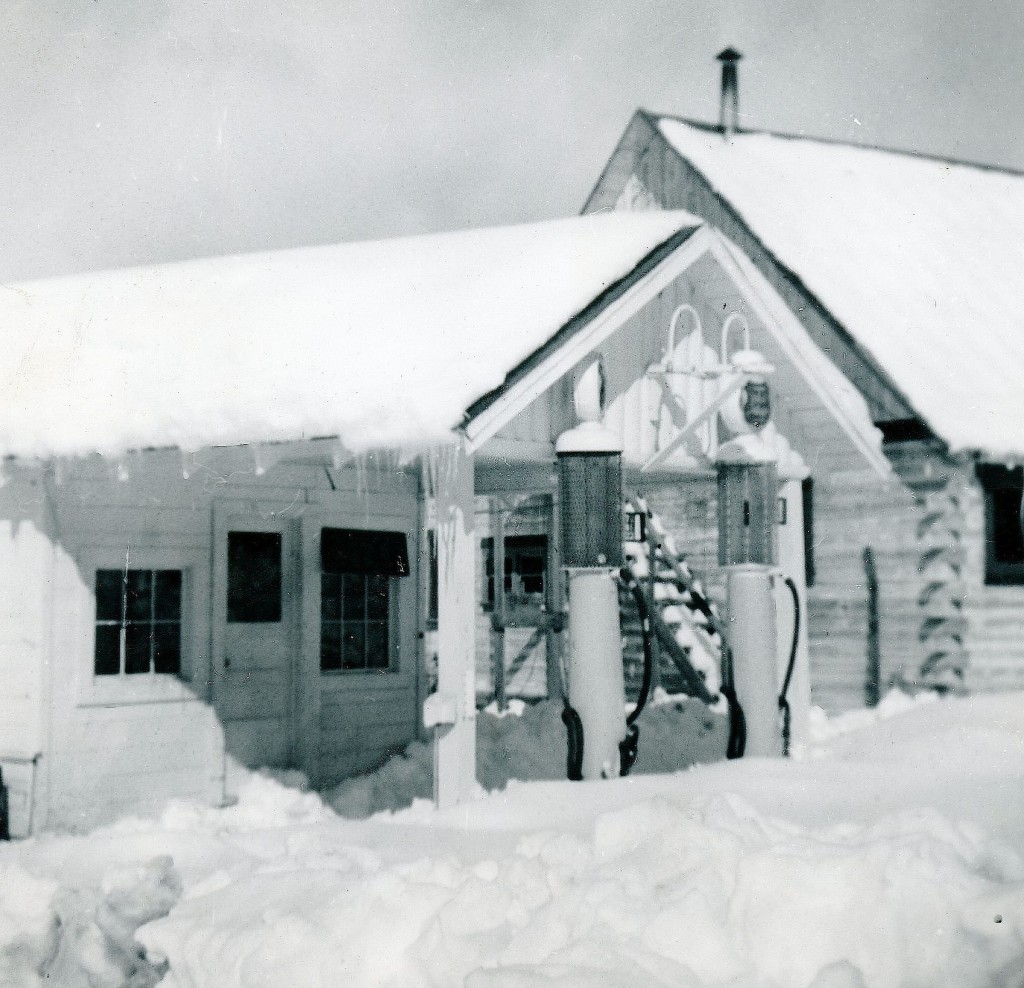
The gas station at the 101.
In 1943, succeeding the Orlandi’s were Dom and Pearl Falletti. As Jacqueline McKenzie Leininger recalled her father, Jack and his brother Abner leased the 101 cattle operation from their mother, Lulu McKenzie. Lulu was not pleased with the bar, especially the fights and the loud music it generated on Saturday nights. Jacqueline fondly remembers the Falletti’s and noted: “Dom and Pearl ran the 101 Bar, and their daughter Betty was Bobi Lynn McKenzie’s [Abner’s daughter] best friend. There were little houses in back of the bar where loggers lived. Pearl was known for her Italian meals and Dom would take care of the bar. There were terrible fights, one night a man was sliced open with a knife and rushed to the Westwood hospital.
“Abner and his crew of cowboys would use the back part of the bar to tie their horses and hide them from Shirlie, Abner’s wife. They made the mistake of tying the horses too close to the bar and Shirlie could see the horses switching their tails. Bobi would be sent across the road on her horse to fetch the men home for lunch.”
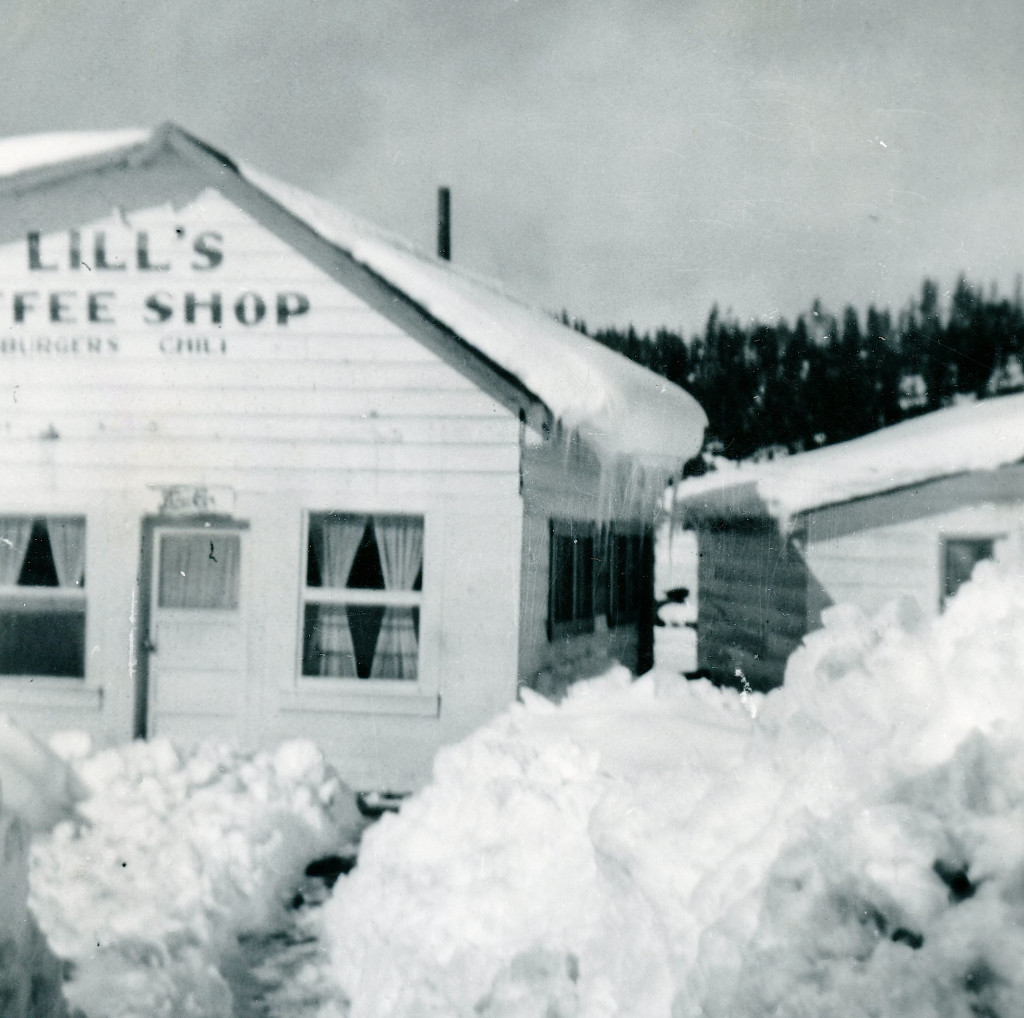
Lill’s Coffee Shop at the 101
For reasons unknown every couple of years there was always a change in the operators of the 101. In May 1946 Falletti’s sold to Paul Fenoglio and Everett Curry. Whatever happened to Curry is not clear, but in June 1947, long time Westwood resident Earl Felion replaced Curry as Fenoglio’s partner. In January 1949, Felion bought out Fenoglio. Earl, with his wife, Ruth became the last operators of the 101. On April 26, 1952, the Felions sold the inventory and fixtures to Duane and Mary Bouchard for $1,500. The 101 Bar, not the building, was relocated to Standish to become known as the Wayside Inn.
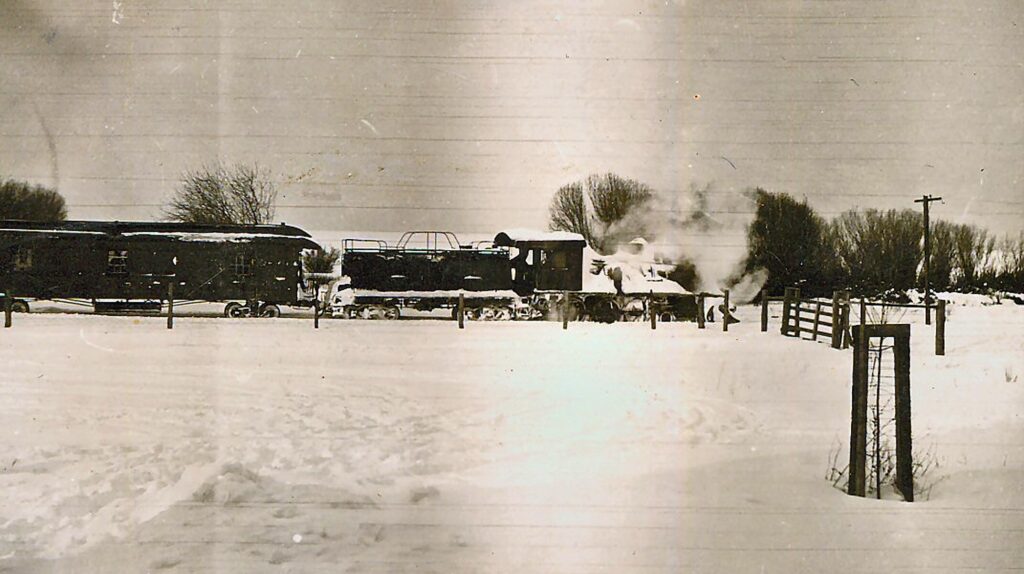
First of all, I am not sure where I am going with this. While examining photograph scans on my old computer I came across this photograph of a NCO train at Likely in 1916.
When I was a growing up, I was very naive and gullible. I was told that Likely received its name, since it would be “likely” to meet a Flournoy there. Actually, there is a lot of truth to that statement. In 1871, the patriarch John D. Flournoy settled in Modoc County, which then was still part of Siskiyou County. The Flournoy family is still part of the fabric of that area.
Likely was originally known as South Fork, it being located along the South Fork of the Pit River. Thanks to the internet one can choose what ever version of the naming of Likely they prefer. However, as a person of principle, I will stick with primary sources. From 1878 to 1882 the community had its own post office named South Fork.
In 1886, the residents petitioned the Postal Department to re-establish the post office. The South Fork name denied. Three more names were submitted—all denied. As folklore has it, at a meeting that one person stated “Its likely we will never agree upon a name.” Thus, the origin of the name Likely, and the Likely Post Office was established on April 13, 1886 with Marx Lauer, first postmaster.