This was a Pleistocene lake that covered a large portion of Northwestern Nevada and extended into parts of Northeastern California. Approximately 10,000 years ago, the lake began to recede, leaving behind remnants such as Pyramid and Honey Lakes. Lake Lahontan’s greatest depth was estimated at 920 feet at Pyramid Lake. To give a better perspective, locally, Susanville’s Elk’s Lodge, if it existed at the height of Lake Lahontan, would have been a beach front house. Around the Wendel region, but not excluding other locations one can see shore line terraces when the lake receded.
This map is illustrative about tomorrow’s topic: petroglyphs.
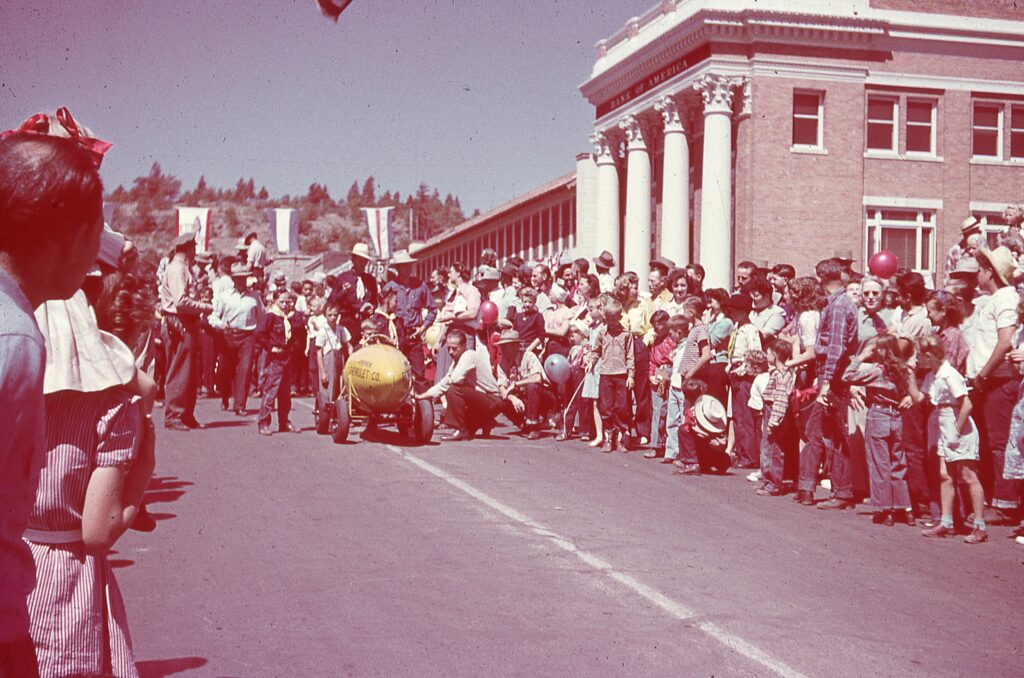
In the late 1940s, soap box derby races held in Susanville. In normal circumstances I would venture to the library to examine the Lassen Advocate newspaper on microfilm. I know this sound like broken record, but until my housing situation is resolved, it really limits my research ability. Who knows, there might be a reader could enlighten us. Anyhow, I thought there would be some that would enjoy this photograph.
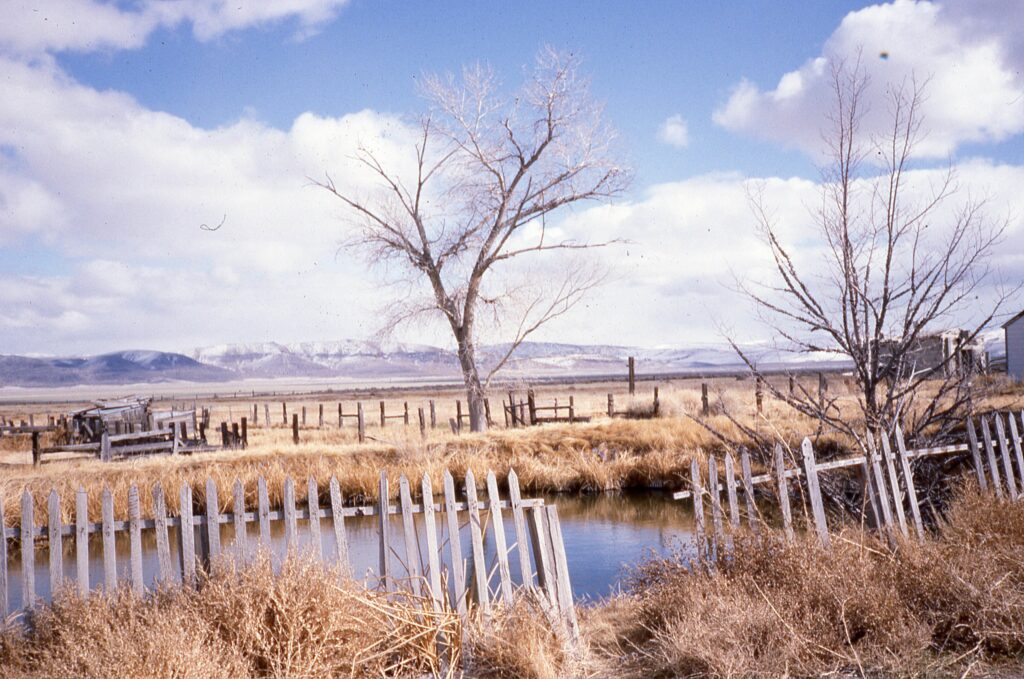
This is a prominent feature of the old Bonham Ranch of southwestern Smoke Creek Desert. Early day travelers referred to it was Rotten Egg Spring, due to its sulfuric smell. Early day folklore stated that the spring was bottomless. Jack Bonham stated the spring had a depth of thirty feet.
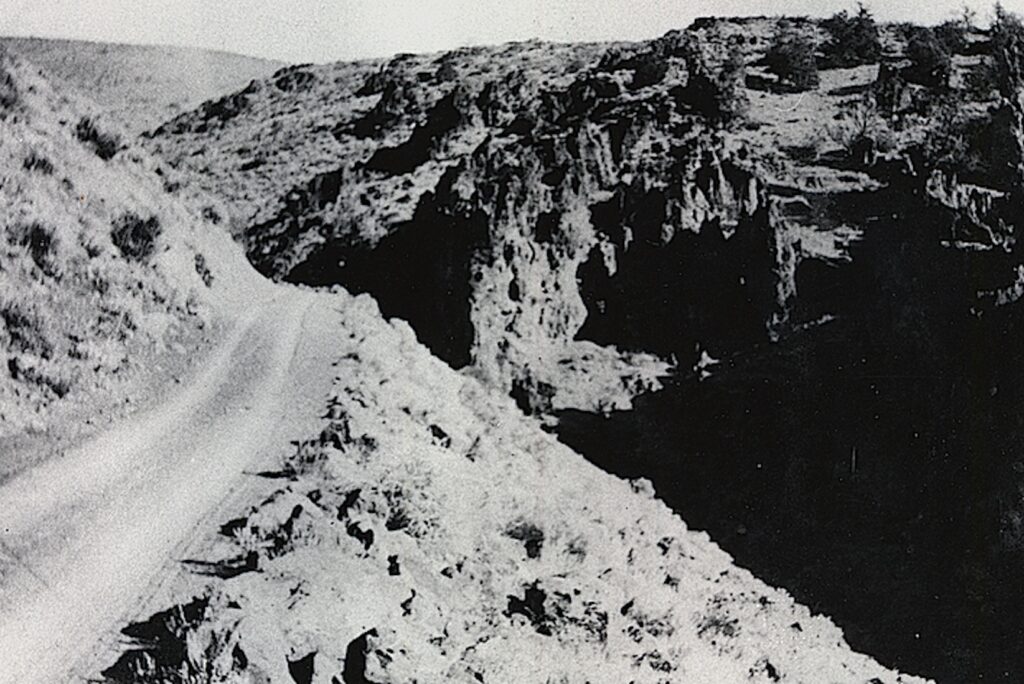
There were a number of Hollywood films that used Lassen County locations in a number of movies. Susanville native, Ephie Asher, had a lot of influence as a Hollywood producer, and members of the Asher family are still in that business. One the last films shot here, was released in 1939 and called “The Good Samaritan.” Featured in the film was Antelope Grade and some scenes near Westwood. I have never had the an opportunity to research it further to ascertain about its availability, because it is one of those items that are on to do list, but never seem to get around to.
The interior wall at the Pioneer courtesy of Lassen Ale Works
For an unknown reasons, I have received several inquiries of Lassen County Brands. While in normal instances I would oblige, but due to the circumstances of pending my move, these will be put on hold and other requests until my life is stable. Thank you for your patience.
Red River operated numerous logging camps from 1913 through 1944 when it sold to Fruit Growers. The camps were assigned numbers, though in no particular order. The majority of the camps were short lived and only had a span of one to maybe three years. One of the more interesting camps was Camp 33, but referred to as Town Camp, as it was located less than a mile west of Westwood. What made it unique was that Red River’s company town of Westwood would experience from time to time a housing shortage for its employees.. On occasion, this camp was used to house mill workers instead of loggers.
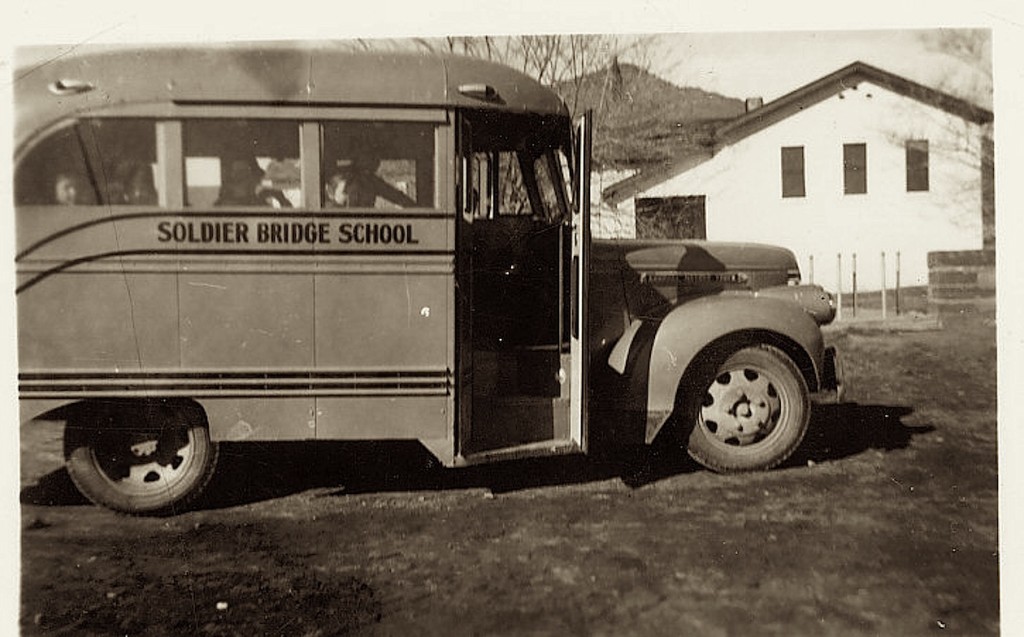
Today, is the memorial service for Norma Story Stampfli (1932-2026). Norma graduated from Soldier Bridge School at Litchfield. Soldier Bridge was the first school in what would become the Standish District. It was established in March 1865 and the original school was located near Mapes Ranch.
In the early 1920s the school was relocated to Litchfield. On February 25, 1929, a $10,000 bond election was held to build a new schoolhouse at Litchfield. The bond was narrowly approved, 40 for and 37 against. The opponents retained an attorney, Ben V. Curler, to file a protest against the bond measure, the school district, and the County Board of Supervisors, the latter having had the authority to sell the bonds. The opponents argued that there were only 34 students and no prospect of any increase in student enrollment. In addition, they stated, the majority of the voters supporting the bonds were non-taxpayers and while most of the property owners favored a new building, they thought the proposed cost too excessive. On April 10, 1929, the school trustees and the County Board of Supervisors held a joint meeting to seek a solution. They agreed on a smaller school, only $6,500 in bonds was issued to construct the school. In 1951, Soldier Bridge, Standish and Bridgeport Schools were consolidated to form the Shaffer Union Elementary School District.
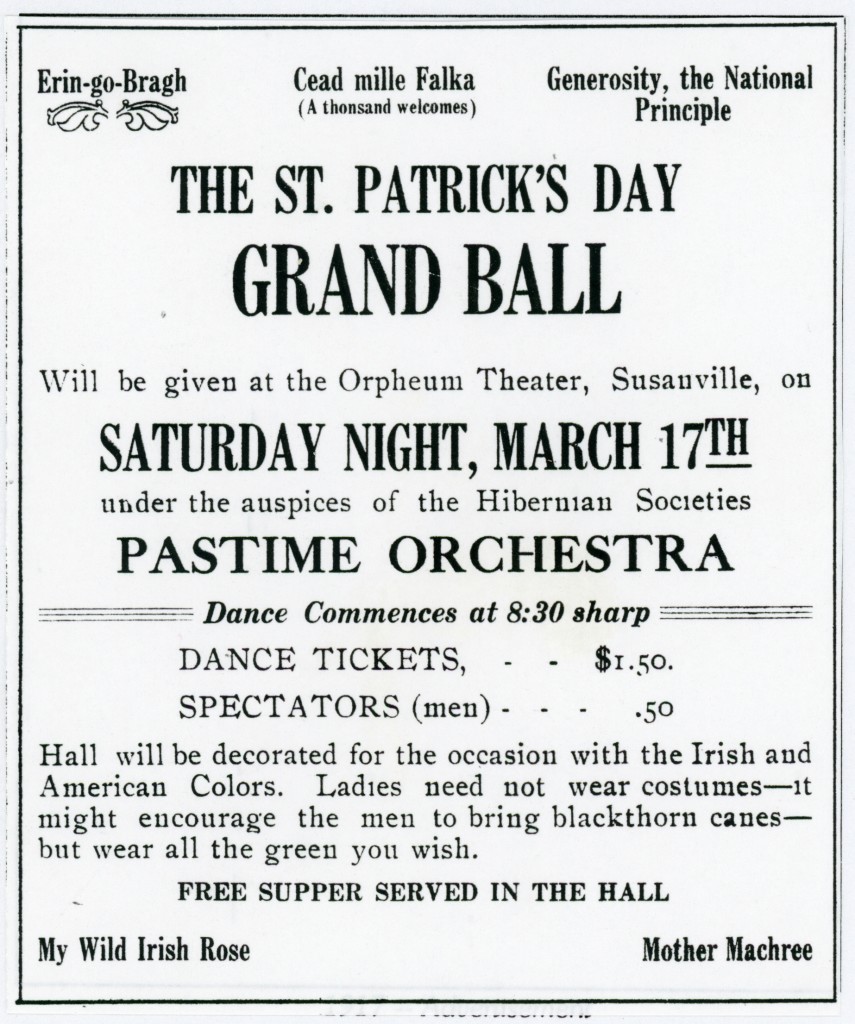
1917 Advertisement of the first St. Patrick’s Dinner
Who knew back in 1917, when Father P.J. O’Reilly announced that Susanville’s Sacred Heart Church would celebrate St. Patrick’s Day, that it would be an enduring tradition.
Father O’Reilly’s first event was nearly an all nighter. As was the custom of the day, entertainment and dancing occupied the first half of the evening. Then at 11 p.m. a supper was served and then the dancing resumed into the “wee hours of the morning.” At the conclusion, Father O’Reilly commented that it was a very successful affair socially and financially.
Dennis Tanner’s residency in Lassen County was brief but a busy one. Upon his arrival in 1871, in Susanville, he installed a skating rink in the first floor of the Masonic Hall. The following year, he purchased the Janesville Hotel, if one could call the crude structure that. It had been built in 1856, before Janesville existed. Tanner dismantled it, and built a two-story 22 room hotel. In 1874 he sold to McClelland and Byers for $3,500. His next venture was a general store at Milford, and then had a brief stint as a innkeeper of the Milford Hotel. In 1878, Tanner relocated to Ukiah where he operated another hotel until his passing in 1898.