Another year, another milestone. For those that has just tuned in, it was on this date, I made my debut at Susanville’s Riverside Hospital.I am grateful, that my lifespan is longer than the Riverside that was built in 1921 and torn down in 1969. As tradition continues, this is my day off.
Zamboni Hot Springs, located in Long Valley just south of Constantia and the place has been widely known as Great Basin Pottery. In the 1970s numerous changes were taking place and not just in Lassen County but the nation as a whole. Of course, there was an element in the youth that promoted a back to nature movement. After all what could more natural than soaking au natural in a hot spring. These young folks studied geography/geology and had penchant to locate obscure springs such as Zamboni. The timing was an exquisite as Zamboni had all the right elements–the property was more or less vacant, easily accessible, yet hidden from view and equally important, it has just right temperature, as so many of the hot springs were too hot. Once discovered, it became a popular gathering spot, especially with students from Lassen Community College.
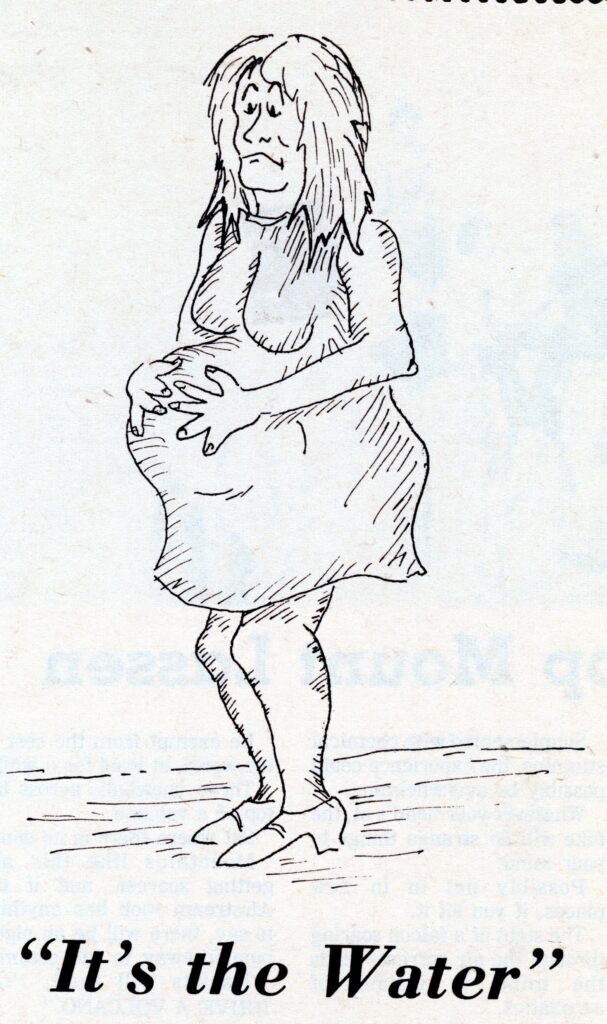
The college’s newspaper, The Cougar first carried a story about the springs. The paper ran a brief follow up story with a drawing a very pregnant woman. The caption stated, “It’s the Water.” In addition, the paper wrote, “If you can remember the closing of Doyle [Zamboni] hot springs.
“As a follow-up, we wish to run an account of an incident told to this reporter by a store-keeper in Doyle.
“It seems that the Army ran tests on the water in the hot springs and discovered that a sperm cell could live in the water for a period of four hours.
“When asked to comment, spokesman for the Army could not answer.
“As a public service, we have a picture above a very unhappy visitor to the Doyle hot springs, with her Sad tale.”
Back by a somewhat popular demand are the calendars. As usual there are always an interesting mix historic photographs. Among those featured are Susanville Logging, 1951; Baxter Creek Siphon, 1936; Hilke Piper, 1931; Lassen Monument, 1959; Cinder Cone, 1939 to name a few.
One has three options to purchase calendars:
1) Locally, you can purchase them at Margie’s Book Nook.
2) You can purchase direct online by clicking here
3) You can also email me to place your order, and it will be sent with an invoice.
Important Notice: There are only 50 calendars available, and once sold out that is it.
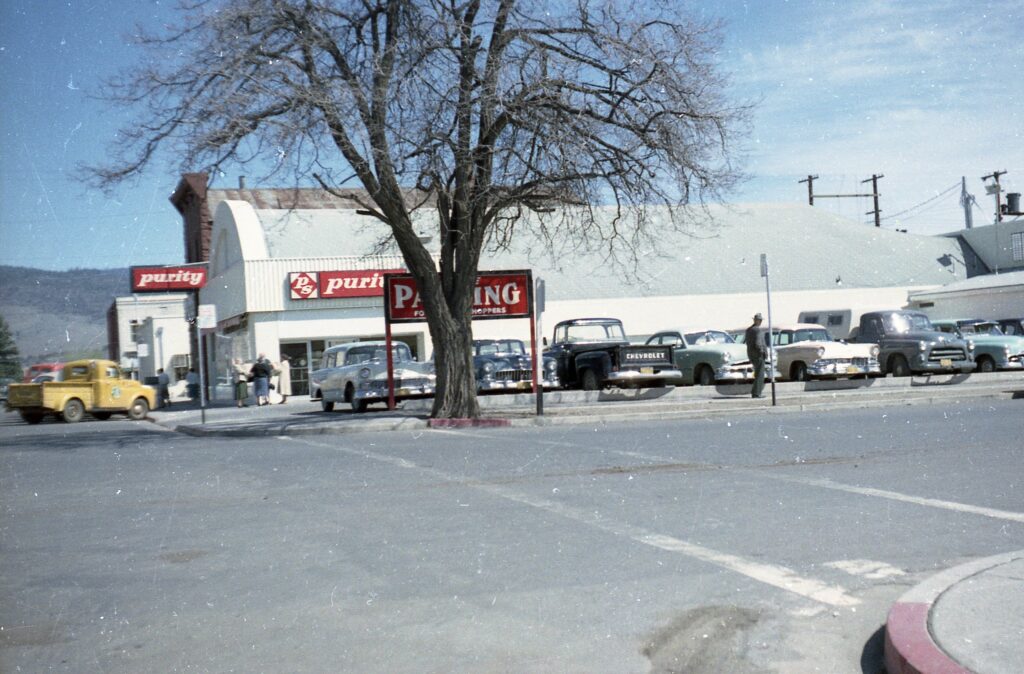
Purity Grocery Store, 65 South Lassen Street, Susanville, 1960- Another dumpster dive salvage
In the early 1920s, chain stores slowly started making inroads at Susanville, though some thought them to be a menace. One of the first grocery chains was Purity, and they opened in the Star Hotel building on the northeast corner of Main and Gay Streets. In the summer of 1938, they purchased a vacant lot on the northeast corner of Cottage and Lassen Streets and shortly thereafter constructed a store, which the building still exists. Purity closed its Susanville store in the mid-1960s, and Food Lane took over the location. Food Lane lasted nearly a decade and then it closed. Taking its place was Chicago Title Company, who operated at the location until the mid 2010s. The building is now occupied by Community Church.
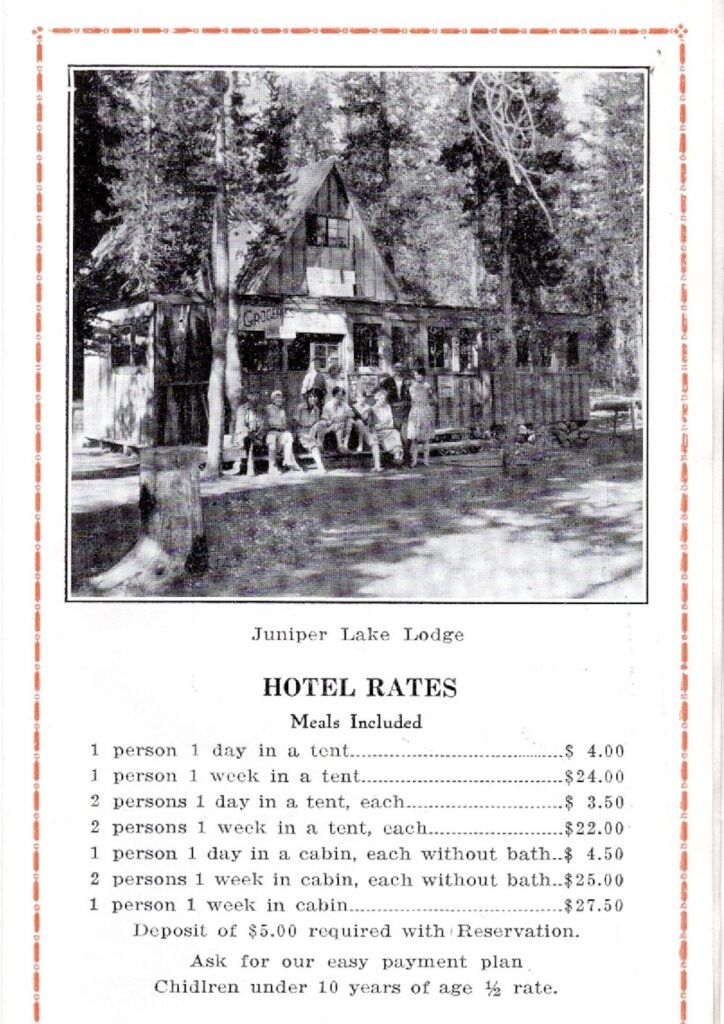
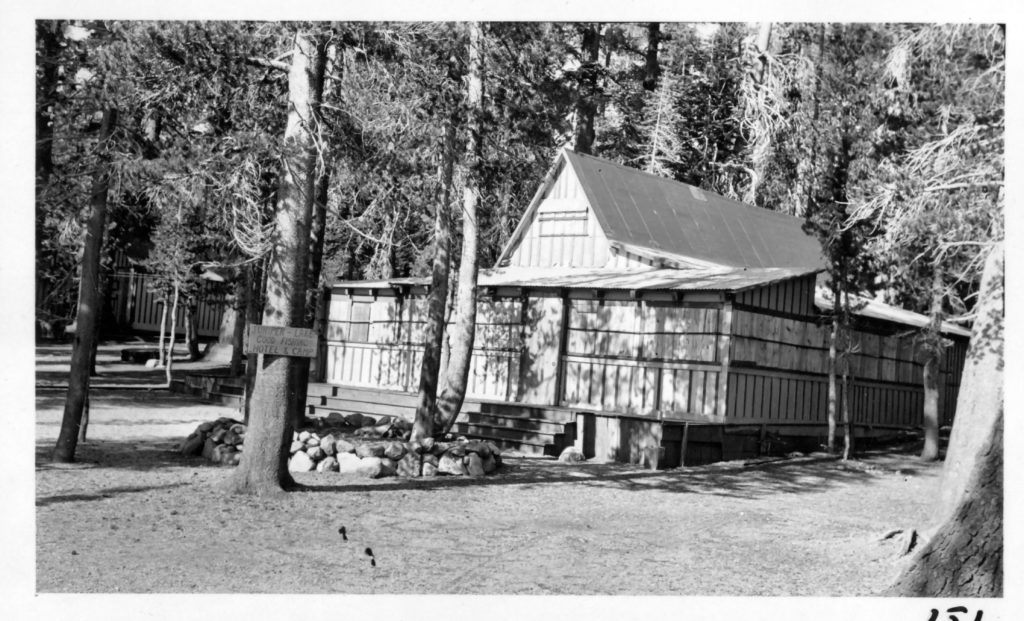
Staying inside a national park overnight can be pricey. Lassen Volcanic National Park accommodations has always been sparse. The Sifford’s Drakesbad Resort that the family owned from 1900 to the 1950s, would eventually cater to the well-heeled residents of the San Francisco Bay Area.
Juniper Lake Lodge — National Park Service
The Snells who owned Juniper Lake Resort east of Drakesbad, was primitive by Drakesbad’s standards. Nonetheless, one could rent a tent there for one night in the 1930s for four dollars. For a couple it was seven dollars. While that might not sound a lot today, the average prevailing wage just happened to be four dollars a day!
Small railroad communities are transient in nature, and not necessarily noted for their longevity. At first, NCO’s railroad town of Amedee, located on the east side Honey Lake might break that cycle. In 1891-1892 was it peak boom years, then a gradual decline.
As with most communities in general, a cemetery was an after thought, until a death occurred, that created a need. This was exactly what happened at Amedee. In September 1894, Samuel & Harriet Johnstone, infant daughter, Cora Aline passed away. The bereaved parents had her buried on the hillside overlooking the town and Honey Lake. The next interment was twelve-year-old Mabel Brubeck who died of pneumonia. There were two other burials, one for baby boy Rogerman, date unknown and the last was for Robert Isigheit, who on died 22 February 1913, at the age of 66.
Amedee Cemetery
Some former residents, thought there might have been 11 burials, but I have never could find a record of such. Then there was a strange occurrence. In 1955, Thomas Ogilvie, Lassen County Surveyor plotted out the cemetery. His map contains 79 plots, not including three existing graves. It is interesting to note the property then and now is private ownership.
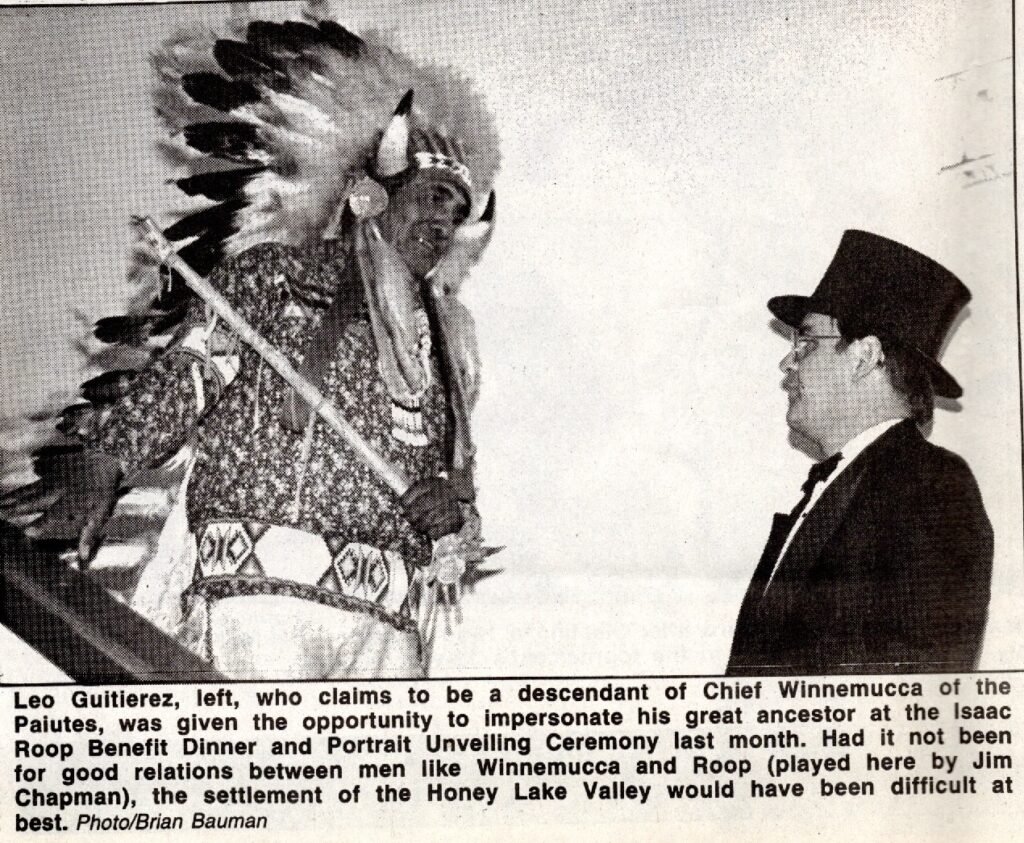
In the early 1990s there was a local lobby effort to have a portrait hung in Carson City for Isaac Roop, he being the first Provisional Governor of the Nevada Territory in 1859. Nevada officials agreed to a portrait placement, but private citizens would have to pay for such a portrait. Fundraisers were held.
Once such fundraiser occurred in April 1994, a month after the portrait was hung. The Lassen County Times covered the event which included Chief Winnemucca’s treaty with the local settlers and the Papoose Meadows Massacre of 1866. I have covered this with Version One, Version Two and Version Three. At this dinner, there is now a Version Four. Without further ado here is the published account.
“Harold Dixon, who consider himself a local Indian historian, provides some insight into that historic treaty.
“Young Winnemucca, according to Dixon, was a Paiute Indian born near present day of Litchfield in the Honey Lake Valley. He was chief of the Wadatkut band of the Paiutes who for centuries roamed the Eagle Lake and Honey Lake areas, as well as other areas of Northeastern California, Oregon, Washington and Nevada.
“Winnemucca was related to Old Man Joaquin who was best known as being the only survivor of the Eagle Lake Massacre (1862) in which 80 to 100 Paiutes were killed by the local settlers.
“According to Dixon, the massacre occurred at Papoose Meadows, and the settlers who did the killing had actually journeyed to the area to take revenge on Pit River Indians who had reportedly been stealing cattle.”
Unfortunately, this account is full of factual errors, but since it is published, some might take as factual to quote and perpetuate it.
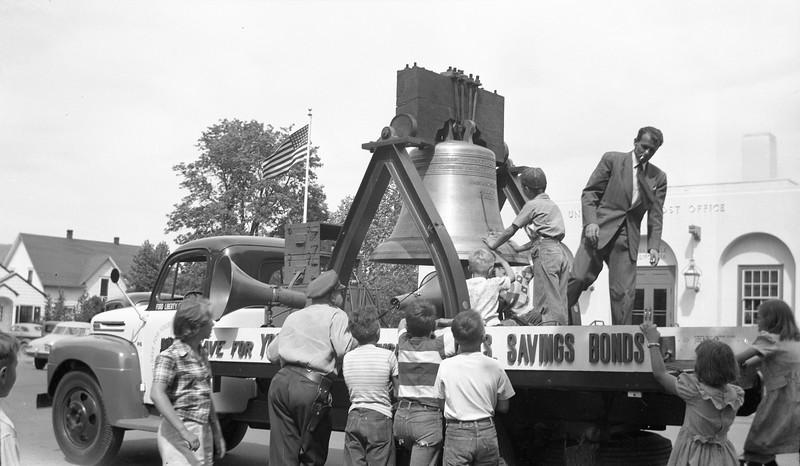
A Liberty Bond Float, Lassen County Fair Parade, 1944 – Margaret Purdy
Happy Veterans Day to all the veterans out there. I came across this Lassen County Fair parade float for the purchase of Liberty Bonds during World WarII. My maternal grandmother Lola (Murrer) Tanner (1899-1973) purchased the Liberty Bonds every month during that War.She never redeemed them. It was a nice windfall for her three daughters, as the bonds paid for the inheritance taxes for the ranch estates. That is not typo on estates. My grandmother was a savvy businesswoman, but she never finalized my grandfather’s John Tanner estate who died in 1945.
This may be somewhat of a public service announcement, but do you have a will or trust, and a obituary? Your heirs will thank you if took care of business.
The Charles Hartson ranch house, circa 1915. Courtesy of Dorothy Stone
The Hartson Slough is man made, named after Charles Hartson. In 1881, Hartson filed on 160 acres of sagebrush land near Honey Lake, in the Tule District. However, Hartson needed more water to not only reclaim this parcel but to expand. In 1889, Hartson worked as the construction superintendent of the Ward Lakes Reservoir. Hartson made a deal with the Balls Canyon Reservoir Company, the company behind the project, that, for a portion of his services, they would give him a share of water rights. This gave Hartson the water he sought to reclaim his land. He built the slough to convey the water to his ranch. By 1901, Hartson owned 1,500 acres of land, half of which was planted in alfalfa. In that same year, Hartson & Sons ranch was one of the first in Lassen County to incorporate..The incorporation document is unique that normally a town designated as the principal place of business. Hartson & Sons stated “that the business to be transacted shall be at the farm headquarters on the lands owned by this corporation near the shores of Honey Lake.”
Hartson Barn, July 26, 2019
It was Honey Lake that resulted in the downfall of Hartson Ranches. In 1909, they were heavily invested in the Standish Water Company.That company built a pumping plant on Honey Lake with miles of irrigation canals. The patriarch Charles Hartson retired in 1910 and moved to Susanville. He turned the main ranch over to his son, Frank Hartson. Frank Hartson sold out Frank Wood in 1926. The house was destroyed by fire on May 4, 1935.