Tag Archives: Susanville

Med Arnold Remembers the Old Time Fair

Lassen County Fair, 1891. Courtesy of Carl Illig

Susanville resident, Med Arnold (1885-1967) recalled the fairs of past, which we explore today. Med wrote: “Every fall we had  two-week fair consisting of races, a livestock show and exhibits of all kinds. Many of our local people owned race horses, both runners and harness horses. Other horses were brought in from all parts of the country. There was usually six running races and a couple of harness races each day.

”The mile-track was situated just east of our ranch, and not far from our orchards. The large grandstand, betting ring, restaurant, paddock and stables were on the south side of the track, and the judges stand was on the north side. All of these buildings were situated somewhere in the neighborhood of what is now North Street, but some distance below Memorial Park. I have seen hundreds of dollars in the betting ring, all in gold coins. The present day  crop of gamblers are pikers compared to the old-time bettors.”

Support


A $40,000 Investment Pays Big Returns

Construction of the FGSBox Factory, Susanville, 1920—Ed Standard

When Fruit Growers Supply Company decided to build a sawmill and box factory in Lassen County, they initially wanted to locate either in or adjacent to their timberlands. Fruit Growers Manager Frank Hutchens consulted with the Lassen National Forest which suggested two sites—Pine Creek, near Bogard Buttes and the Pine Creek estuary at Eagle Lake. There was a third alternative—Susanville.

Susanville’s business community  was eager to have Fruit Growers build their mill there. So much so, they offered a cash bonus. A total of $41,130 was pledged by 243 residents if the mill was located At Susanville. Hutchens was impressed. On August 13, 1919 Fruit Growers agreed to the location of the mill at Susanville.  In October, a check was for $40,070 was presented to Fruit Growers (a handful of individuals reneged on their pledges.

In 1920 construction began on the mill which with cost over runs exceeded over two million dollars. An additional $245,000 was spent to construct employee housing. When the mill opened on April 16, 1921 they initially employed 1,500 people. The initial monthly payroll exceeded $100,000. That $40,000 investment by the community far exceeded expectations!

Support

Susanville’s Kiddie Train

The little locomotive on display at the Lassen Museum, August 26, 2021–Jim Chapman

In the spring of 1957, the Susanville Elementary Parent Teacher Association (PTA) announced big plans for that summer’s Carnival to be held in Susanville’s Memorial Park. It was a bold concept and to make a permanent addition to the park—a Kiddie’s Train. Charlie Weston and large group of volunteers were in charge. They built a replica of a New York Central steam engine.

On. Friday evening, July 12, 1957 was the PTA’s Carnival. While there was an assortment of activities such rides on Shetland ponies, the train was the star attraction. Over 1,000 people rode the train. It was a busy night since the train could only carry 16 to 20 passengers at a time.

For the remainder of the summer, rides were offered on the evenings of Wednesday, Saturday and Sunday. Though on Sunday afternoon’s rides were also offered. The price ten cents a ride.

At this time, I do not know how long it operated, though I would say probably about eight years. If anyone happens to know that answer or has other information they would like to share, it would be greatly appreciated.

Subscribe

Why Realtors Have a Bad Name

Susanville’s original plot map filed in 1863.

Susanville’s founder, Isaac Roop, happened to be the town’s first realtor. In 1861 he began selling town plots, though it was not until 1863, when Roop hired E.R. Nichols survey the initial town.

Roop, as the old saying phrase goes, did a “land office business” as a real estate agent. During his eight years that there are records for, he sold 194 lots for a grand total $34,143.50. A nice tidy sum, especially considering Roop never owned the land.

When a U.S. Government Land Office was opened in Susanville in 1871,  it was discovered that Roop had never taken the proper procedures to procure title to the townsite. Thus, owners of town lots were vulnerable to claim jumpers, who could file a patent process with the Government Land Office and become the rightful owner of the town. It literally took an act of the U.S. Congress to rectify the situation and on May 20, 1872, Congress approved a townsite and vested title in all lots to the District Court Judge. The judge then had the task to reissue deeds to the current owners to the town lots.

Fredonyer’s Claim to what would become Susanville, which he filed in 1857 and can be found in Book A. Mining Claims, Lassen County.

Support

Susanville’s Oak Avenue

The Oak Avenue abandonment map, 1882.

This was one of the original streets of Susanville, and an interesting one at that. Oak Avenue was located between North Pine and North Roop Streets. It started at Nevada Street and extended beyond Willow Street. It should be noted, North Roop Street ended at Willow Street. However, Oak Avenue only extended forty feet from Nevada, due to the fact there was no right-of-way. In December 1882, a petition by the residents of the area, requested the Lassen County Board of Supervisors to abandon Oak Avenue. The board obliged and  so no more Oak Avenue on paper.

Support

Date Line September 1, 1948

Susanville, 1946

The following came from a newspaper clipping file from the Oakland Public Library. “Lassen County Resources Are Tapped By War—McClatchy Newspaper Services, September 1, 1948.

”Susanville—A 10 year growth which embraces industrial and agricultural expansion and increase in population has culminated in the unification of Susanville into an incorporated city looking ahead to further progress.

”A decade ago the city was emerging from the depression. Lumber and sawmills which had not operated for periods ranging from two to several years started resuming operations and the last of the Works Projects Administration were begun.

”Spurred by war demands for lumber and minerals, Susanville became the center of countywide expansion during the war which reinvigorated this area.

”The population growth had a marked effect. Susanville experienced the housing shortage which other sections of the country also experienced. More than 100 residents undertook the building of their own homes in 1946.

”Community concerts were obtained for the residents and a city park created and constructed. A well equipped clinical hospital has been established. A public golf course was opened and a museum constructed.”

Subscribe

Susanville’s Bandstand

Main Street, 1906
Looking west on Main Street, at Lassen, 1906. You can see the bandstand in the background. By the way, the gentleman crossing the street is Dr. W.E. Dozier. Photograph courtesy of Betty Barry Deal

Before summer ends, what better way to commemorate it than  once upon time  American classic the outdoor bandstand. It is a little known fact that Susanville had its own bandstand, briefly.  It was located at the top of Main Street, best known today as the triangle plot beneath the Elk’s Lodge. It was through the energetic efforts of the Mountain Echo Band. that was the reckoning force. In September 1902, the octagonal bandstand was constructed and even adorned with electrical lights. On September 14, 1902, the bandstand was dedicated by the Mountain Echo Band  with their first concert. Two weeks later it was focal point of royal pageant during the county fair.  A few years later the Mountain Echo Band disbanded and the bandstand fell into disrepair. By 1906, one observer said the relic had become eyesore on the community. In 1908, it was torn down.

Subscribe

Susanville Boardwalk

Cottage & Pine Streets, August 16, 1982

That was how the Sacramento Bee described the event, when a lumber truck overturned at the west entrance of Susanville spilling a load of lumber on August 16, 1982. A truck carrying a load of Collins Pine lumber crashed into the retaining wall on the west entrance in Susanville, careened out of control, rolled over scattering lumber across Cottage and South Pine Streets. The driver sustained minor injuries. Faulty brakes were to blame for the accident.

Cottage and Pine Streets, August 16, 1982

Tim

American Legion Memorial Building

Veteran’s Memorial Building, Susanville, 1926

On Saturday, August 14, 1926 an informal open house of Susanville’s new American Legion building was held. After all, next week would be very hectic with the State American Legion Convention being held in Susanville. It was because of that convention that made the  building a reality.

On March 6, 1926 the Lassen County Board of Supervisors held a special meeting to open bids submitted by contractors for the building. The county awarded bid of contractor T.J. Rees for $.26,750.* A second contract for plumbing and heating went to E.W. Woodward for.$1,770.  It was the intention to have the building completed by July 4. That did not happen. It was not until mid-September when the Lassen County Chamber of Commerce and the Lassen County Farm Agent moved their offices into the Legion building.

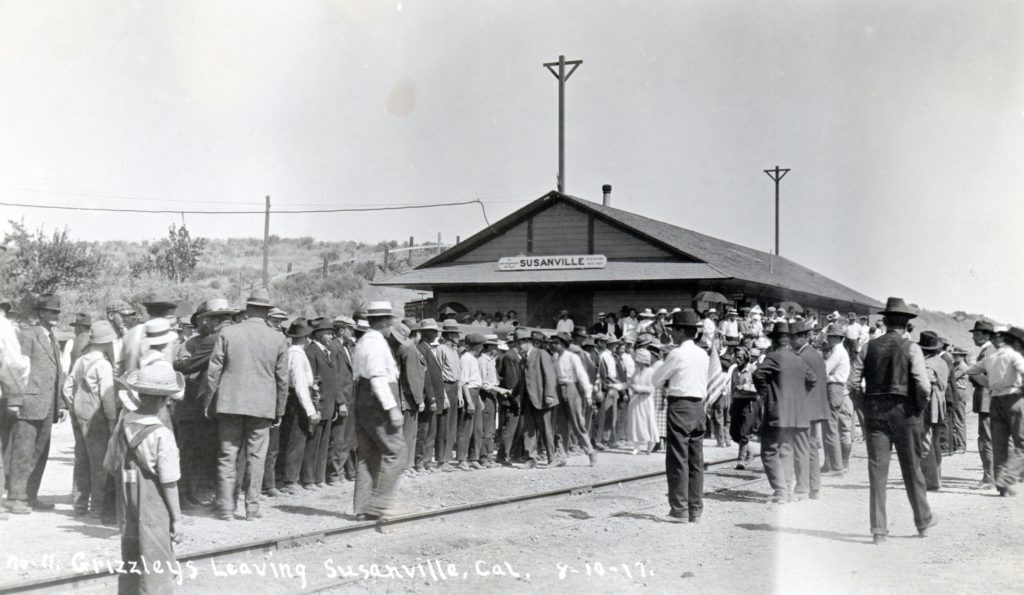
1926 American Legion Convention delegates arriving at the Susanville Depot. Courtesy of Nellygrace Stoll.

*Rees also built the Hotel Mt. Lassen and Masonic Hall in Susanville.

Support

Susanville’s Brick Building Boom

Oakes and Philbrook’s furniture store under construction at 800 Main Street.

On June 6, 1900 a destructive fire wiped out a major portion of Susanville’s business district on the south side of Main Street from Roop to Union.  But prior to fire, the Susanville School District had hired Reno contractor C.E. Clough to construct a two-story brick school to replace the wooden one on Cottage Street at a cost of $12,500.

As noted yesterday, was the construction of Emerson’s three-story brick hotel. Clough kept really busy. On August 29, 1900 the Methodist Church hired him to build a brick church for the wooden destroyed earlier by fire at a cost of $4,739. Next up was Oakes & Philbrook Furniture Store at the southeast corner of Main and Gay Streets. That building along with the Methodist Church are the only two still remaining.

The Susanville Grammar School, nee Washington, as it appeared in 1948.

Donate