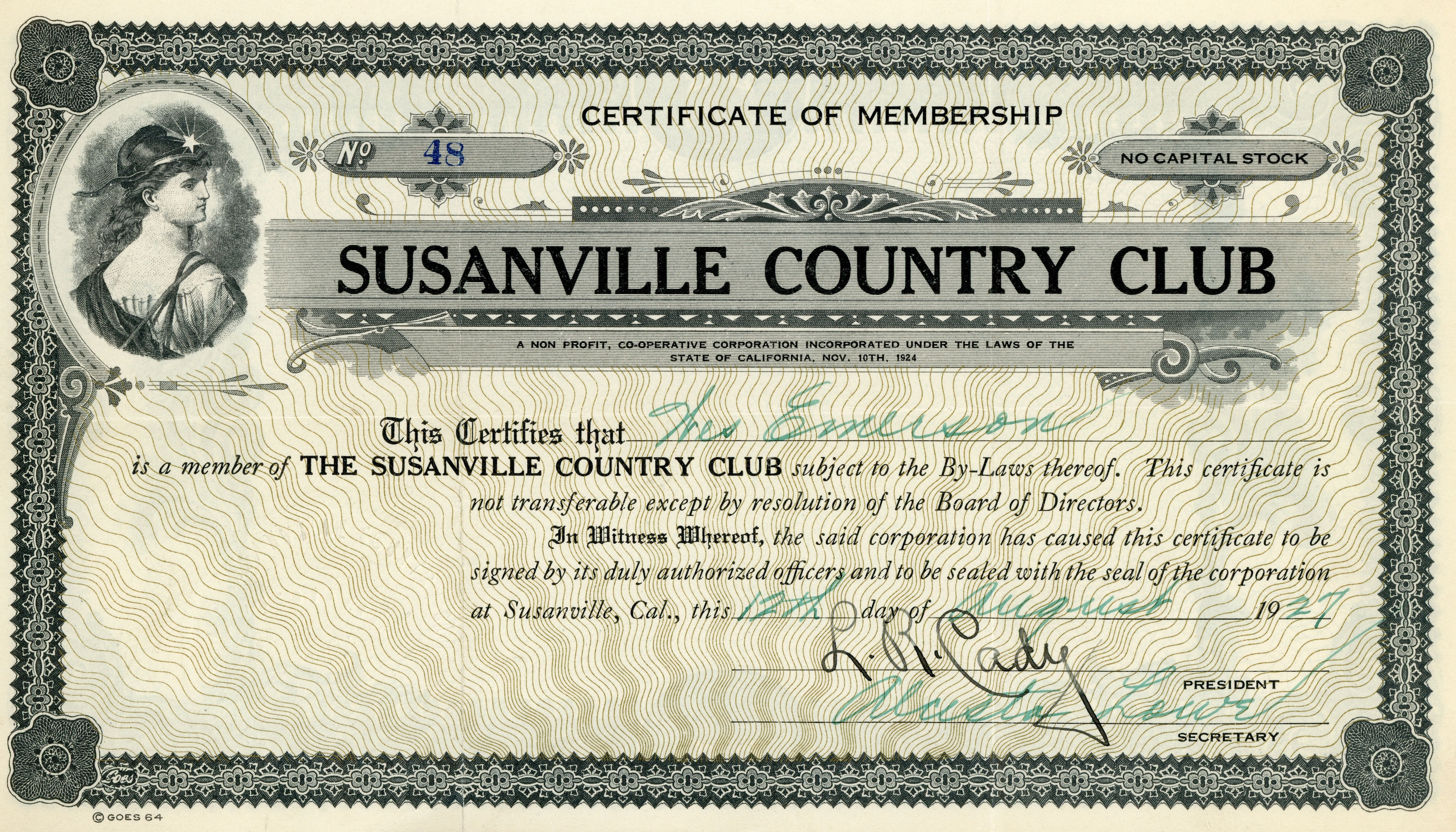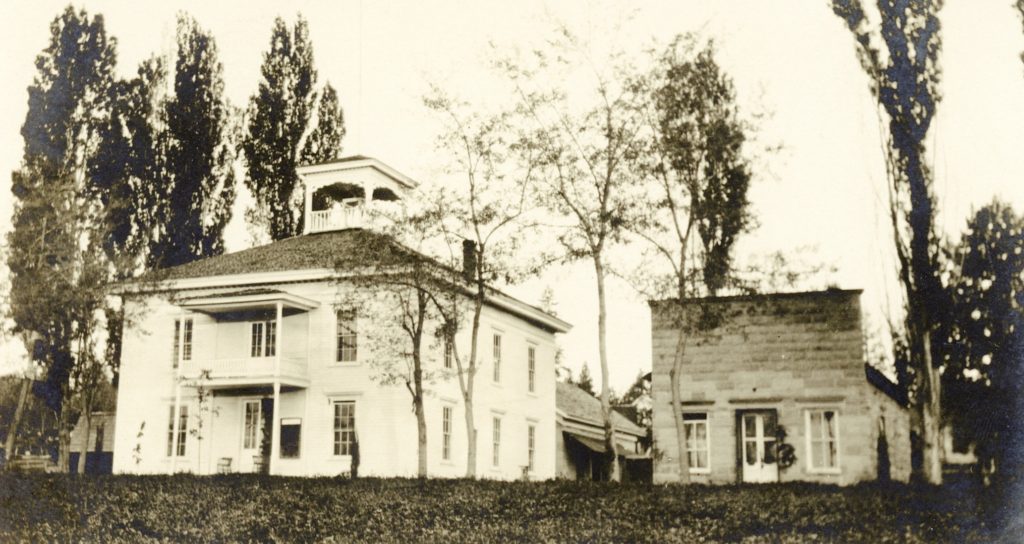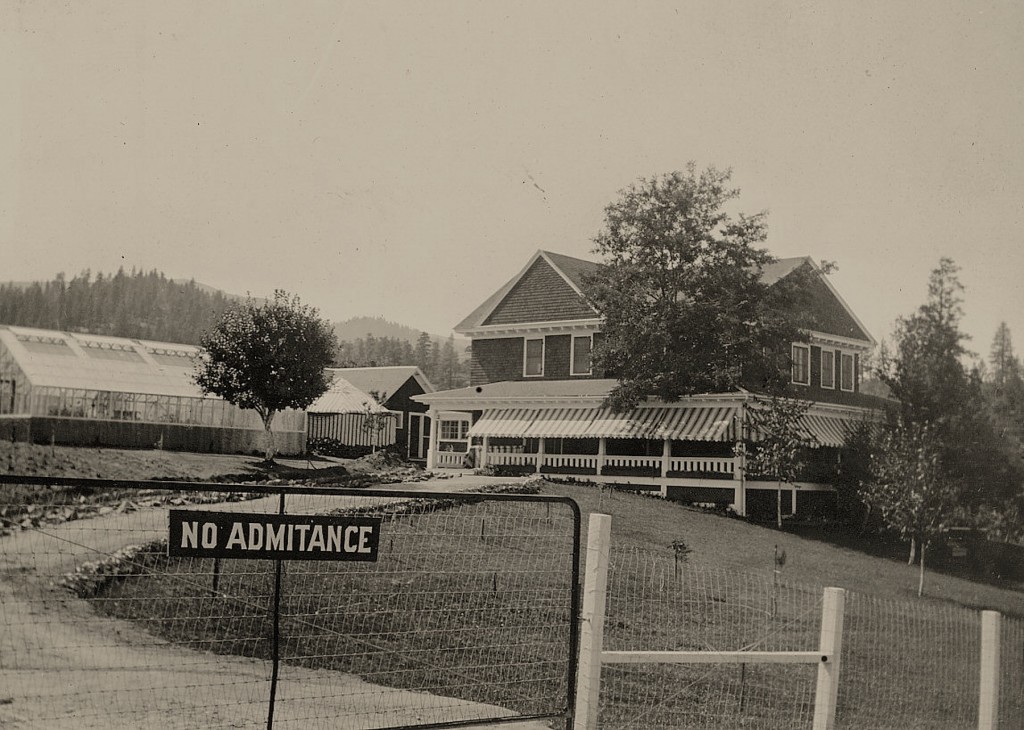
Susanville’s The Big Store as it appeared in 1916. It is now the home of Margie’s Book Nook. Photograph courtesy of the Worley family
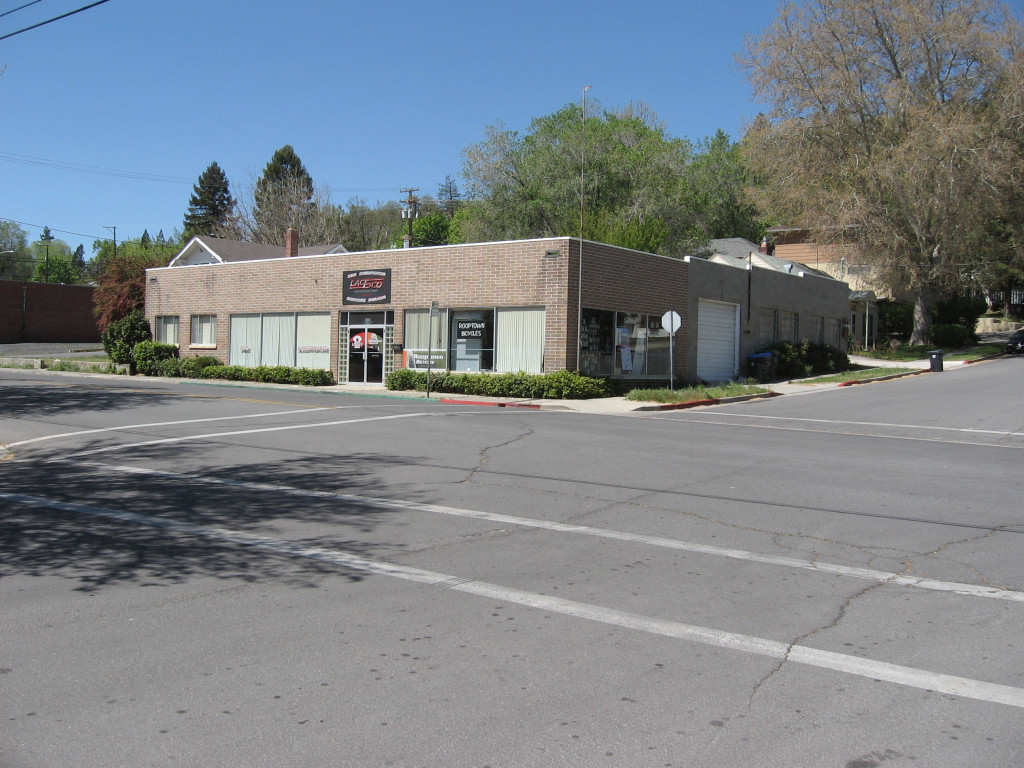
Mark your calendars for April 1 when Margie’s Book Nook celebrates forty years in business. The store had its humble beginning at 28 North Lassen Street, next to Fred’s Barbershop. Several years later, the store needed to expand and moved a block away to 35 North Gay Street. After several years passed, the store again needed more room. Another move, not quite a block away to the current location at 722 Main Street, next to The Pioneer.
I am not sure all the festivities planned for Saturday, April 1 but will be a lot of fun. More information and some of the store’s history can be found their Facebook page.
Fredonyer’s Claim to what would become Susanville.
In the spring of 1857, there were only two cabins in what would be latter known as Susanville. By summer a nucleus of a hamlet had developed and some thought it should have name. In August 1857, two names were proposed for the settlement around Roop’s trading post—Natauga and Fredonyer City. The Red Bluff Beacon reported: “The citizens of Honey Lake Valley are divided in opinion as to which names shall be given to their new town at the west end of the valley. Natauga in the Piutah tongue signifies woman and Fredonyer is the name of the gentleman who claims to be the first white man that ever beheld the beautiful valley. A gentleman who arrived here on Sunday last had in his possession an instrument in writing signed by fifty men declaring their preference for Natauga. An equal number are said to be as enthusiastic for Fredonyer. Simple and unimportant as this question is it said is to be creating quite a jealous feeling between the two rival names. They have no politics at Honey Lake and must have something to cavil about.”
Fredonyer City was the chosen name. However, it was more or less ignored and the place simply referred to as Roops. It should be noted that Fredonyer on April 11, 1857 filed a claim to property occupied by Roop with the Plumas County Recorder.
The Susan River near Johnstonville, just before the bridge floated away—G.L.Morrrill
Note: This originally appeared on March 17, 2021. I thought with the latest weather predictions, will we see some kind of repeat of March 1907.
March 1907 was no doubt one of the wettest on record.The storms were widespread across Northern California, practically turning the Sacramento Valley into one vast lake. After all there no reservoirs such as Oroville and Shasta to retain some of the flood waters.
On March 16, 1907 it began to rain in the Honey Lake Valley. It was one continuous downpour and after 96 hours eight inches of rain drenched the region. Tremendous flooding was to be found everywhere. The majority of the bridges were either washed out or so severely damaged they were unsafe to cross. However, a lot of property damage was minimal. F. Peissker of Susanville suffered one of the biggest casualties. He was located on Richmond Road near the Susan River and the flood waters swept away some 100 cords of firewood, which was how he made his living.
The respite from the wet weather was brief. Two days later it began to snow. By March 22, forty inches of heavy wet snow blanketed Susanville. Travel was brought to a complete standstill. It took a two-horse team seven hours to haul mail one-way from Janesville to Susanville.
In all, some 13 inches of precipitation was recorded that month.
As of March 1, meteorologically speaking is the first day of spring. So with that in mind, I am going to add a spring in my step, and step away from scanning photographs for the Tuesday tidbit for awhile, because I am also experiencing technical difficulties in that department.
What is interesting about this photograph of Susanville’s Inspiration Point, is that prior to the 1930s when the “point was developed” the best natural spot were the flat boulders before approaching the point we know today. The next time you happen visit, take in the surroundings and notice the difference. By the way, when looking down to see the Susan River, it just happens to be the natural divide between the northern Sierra and southern Cascades.
In the spring of 1928, the newly formed Susanville Businessmen’s Association first undertaking was to review the City of Susanville’s finances. It was in their opinion, operating the city was just too costly. A committee of five—L.R. Cady, B.F. Lyle, Hardin Barry, A.J. Mathews, J.A. Pardee—were appointed to investigate the matter.
In their report, they wrote: “There has been a general idea that the cost of our city government is excessive. Your committee secured comparative figures from towns of somewhat similar characteristics, such as Alturas, Yreka, Nevada City and Lakeview, Oregon. In each instance although the cost of city government in these towns was materially lower than the cost of the administration of affairs of Susanville, in the brief time at our disposal it was impossible to make an intelligent comparison in as much as it appears that possibly Susanville is receiving a service such as the other towns in question do not apply. Whether or not we are getting the value received for the money expended is difficult to determine without a more thorough investigation, therefore we would respectfully recommend to the incoming board of trustees that they give this matter such necessary attention as will permit them to arrive at an intelligent conclusion with reference to the cost of government in Susanville.”
In the end, they had a hidden agenda. They did not like the special property assessment for the paving of streets and for sidewalks. However, in time, they realized having paved streets and sidewalks was a worthwhile investment.
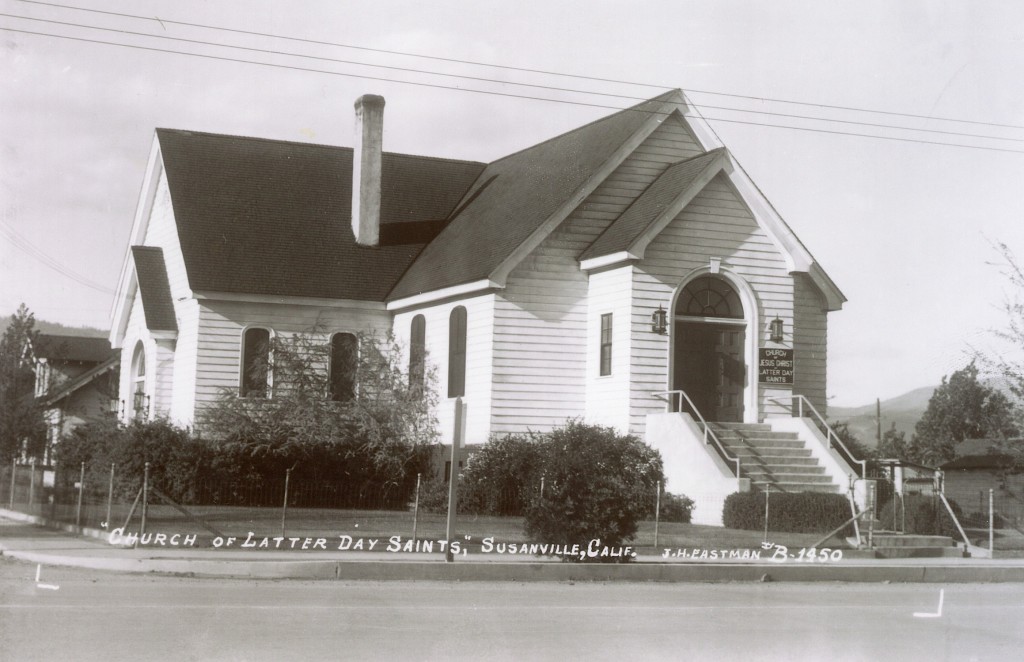
This Eastman postcard I purchased awhile back on Ebay, the price in my range of $5.79. There were several items after reviewing allowed me to figure out when it was taken. The Christian Science Church on the corner of Mill and South Lassen Streets was constructed in 1938. Also built that year, was the Purity Grocery Store on South Lassen Street across from the Methodist Church. Both buildings, by the way, still exist, just under different ownership.
On South Roop Street, where the current Lassen Municipal Utility District building is located, appears as a vacant lot. Work on the construction of that building started in the fall of 1939. It should be noted that building was originally constructed for Safeway.
Emerson’s Store, Left to Right, Bill Lewis, Jim Mapes, Todd Hemler, 1916. Courtesy of Prentice Holmes
This is a bit different, I came across an interesting display advertisement in the Lassen Advocate for Charles Emerson’s store. The store’s motto by the way “We Are Here to Stay.” By 1907, Emerson’s enterprise included his hotel and store in Susanville, as well as a store and creamery in Standish. Below is the ad copy, I found it amusing, may be its a personal taste.
”The mummy aint had no fun fer more’n than five thousand years.” Moral: Don’t be a mummy.
Probably what you need right now is a pleasurable vehicle. We have lots of them and want to get vid of ‘m all. (Old Man Studebaker told us confidentiality we could have a few more when we paid for these.)
Your best girl or your mother-in-law may be pining for fresh air. Our mission in life is to separate you from your wherewithwall so if you want anything with wheels we can make a quick trade—Emerson.
The area south of Railroad Avenue to Modoc Street was a housing development of the Lassen Lumber & Box Company for its employees. The above photograph I received from someone back East who found the photograph in a book at a garage sale. One never knows where a piece of history will show up.
Shasta Street, Susanville, September 22, 2022
It should be noted that the Lassen Lumber & Box Company designated this particular area as its “Italian Quarters.” Both Lassen Lumber & Fruit Growers Supply Company hired numerous immigrants, at one time there was a large Filipino population.
In the 1920s, Prohibition may have been the law of the land, enforcing it in Susanville or in Lassen County—as in most other places was quite a different matter. There was, of course, that local authorities had no arresting powers—bootlegging was a federal offense. To compound matters the region was in an economic boom time, where in less than twenty years the population had tripled.
To understand just how widespread the problem with bootleg joints was, it was summed up by one observer in 1923. Using the nickname “Friendly George” he wrote: “This man’s town has become a beautiful city and as to bootleggers, I just over there a stranger on the Fourth of July. I asked a taxi driver to take me to one. Well, he said, I know 34 places but I don’t known ‘em all. Quite an improvement from four saloons. Yes, it is Prohibition, but hard to convince me it is Temperance.”
The Gem Saloon, Susanville, 1908. B.R. Zimmerman Collection
Susanville’s Gem Saloon, operated by B.R. Zimmerman was always in search of the latest innovative gadgets to entertain his customers. In the fall of 1907, he installed his latest attraction, which as predicted would garner a lof ot public interest—a electric piano. The Lassen Advocate provided the following description:
”It is of the regulation upright piano size and any performer can perform upon it the same as an ordinary instrument. But should there be no pianist available you only have to ‘push the button’ the electric motor starts and you have only. to look pleasant and listen to a brilliant rendition of the very. latest and best music. The instrument is a beauty and should prove a winner in public favor.”