Tag Archives: Susanville

Tuesday Tidbit – Hudson’s Gas Station

Hudson’s Service Station, 504 Main Street, Susanville, California.

Some one wanted to know if I had a photograph of the gas station located at Main and South Roop Street, Susanville. Well, here it is. I remember it, but it had been closed for a long time. The site is now a vacant lot.

Back in 1950s and 1960s there gas stations galore, then referred to as service stations. Back in the day, at the same time, there were plenty of bars, too.

Tim

Susanville Country Club

Susanville Country Club, 1931. Courtesy of Fred and Alyce Bangham

In the spring of 1924 witnessed the development of Susanville’s first golf course. It was an outstanding success that gave birth to the Susanville Country Club.  For the new organization the timing was exquisite. It just happened that in the summer of 1924, the Lassen Lumber & Box Company purchased George Wingfield’s summer home some eight miles south of Susanville along the base of Diamond Mountain. Equally important one of the lumber company’s executives, A.G. Breitwieser was a big proponent of golf.

In the fall of 1924, not only had the local “duffers” outgrown the first golf course, that a golden opportunity came there way. The Lassen Lumber & Box offered the Wingfield property to the Susanville Country Club at a bargain price of $20,000.  It was reported that Wingfield had spent $335,000 to develop the property.

Stock Certificate issued to Wes Emerson

The club sold stock to finance the purchase. In addition, the club offered an exclusive 100 resident membership and 50 non-resident.  The cost $250. that, however, included a lot to build a personal cottage. In addition, there was a a five dollar monthly dues. This was not a deterrent and within a few short weeks, the club had a full charter membership.

The good times did not last that long. In the fall of 1931, L.R. Cady and Frank Coffin purchased the property, thus ending a chapter in the Susanville Country Club.

Never miss a story, click here.


Church of Jesus Christ Latter Day Saints

LDS Church
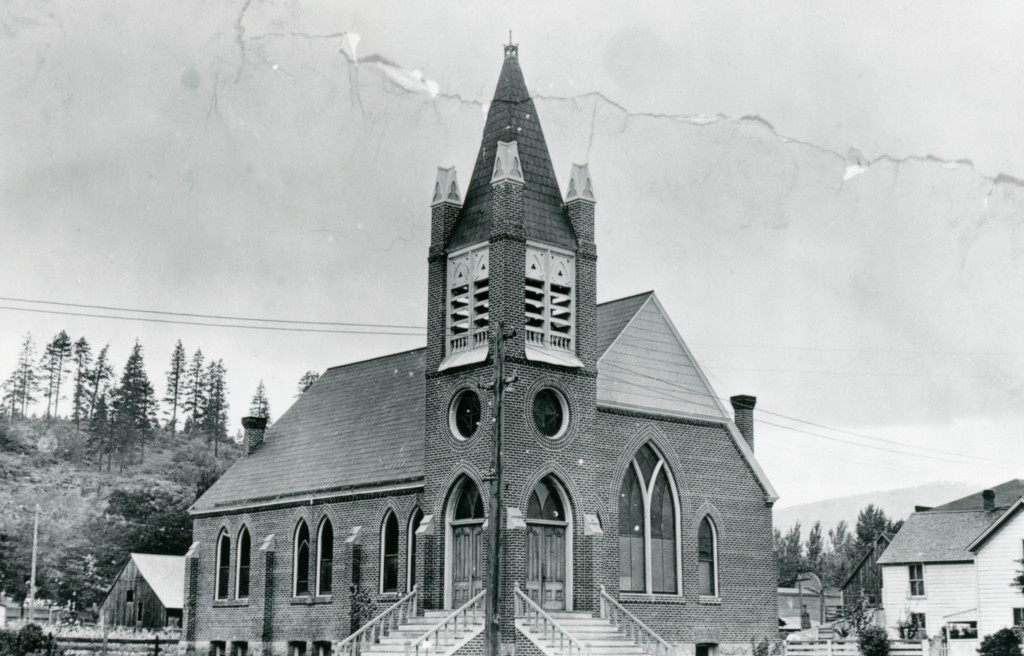
The LDS Church was located on the corner of Main and North McDow.

The Church of Jesus Christ Latter Day Saints, also referred toas Mormons were slow to make an appearance in Susanville. It was not until1911, two missionaries, Elders Harry Janson and L.R. Halverson arrived in Susanville, though it appears their stay was brief. It was not until 1922, that the members of this church organized in Susanville. The initial families included those of Frederick Johnson, W.K. Davis, William Mortimer, Afton White, James C. White, John Heath and Peter F. Olsen.

Initial services were held in member’s homes. By 1924, their numbers had grown and they rented the Knoch Hall  for $2.50 a week. From there they moved to the Orpheum Theater and later to the OddFellows Hall.

Like so many religious institutions, they wanted a church of their own. On November 13, 1927, discussions were held to build a chapel. The site chosen was the northeast corner of Main and McDow Streets. On November 10, 1929, the church was dedicated by Heber J. Grant, President of the Church of Jesus Christ of Latter Day Saints

Thirty years later the members had outgrown the church. They selected a new site on Richmond Road. On November 5, 1961, groundbreaking ceremonies were held for the $300,000 chapel.

Support by subscribing.

Susanville’s Edsel Dealership

80 N. Roop St.
80 N. Roop Street, Susanville, May 3, 2015

For a brief time, Susanville had its own Edsel Dealership though it did not last long. In 1957 it was housed in a brand new building at 80 North Roop Street.  Of course, Ford’s Edsel automobile was a failure and the model soon abandoned. Many seasoned residents will recall this building housed the California Department of Motor Vehicles for many years. It is now the home to Lasco and Rooptown Bicycles.

Tim

Gov. Brown Opens New Facility at Susanville

Humboldt Times, July 14, 1963

Supposedly, today marks the closure of the California Correctional Center on the eve of its dedication sixty years ago. The following is an extract from the Humboldt Times of Eureka California about the dedication:

”Before a throng of enthusiastic home townsmen, plus scores of interested correction officials. from other Western States, Governor Edmund G. Brown Saturday [July 13, 1963] dedicated the California Correctional Center the nation’s newest concept in corrections.

The $9 million institution for 1200 inmates is a pioneering idea, the first of four such centers to be built in California.

”In a former timber economy now reverting to agricultural and recreation, business leaders of Susanville and Lassen County look upon the new facility as their own. They threw a banquet for state Senator Stanley Arnold of Susanville, author of the enabling legislation for the entire program, and the laurels were almost unprecedent.

”Besides the stimulus of actual construction, the new facility has 260 Department of Corrections employees and 30 from the Division of Forestry. These are permanent, mostly with families, and their annual payroll is more than $1,750,000”

Support by subscribing.

Susanville’s Fruit Growers’ Subdivision

Sunkist Street, 1921. Courtesy of Ed Standard

In 1919, when the Fruit Growers Supply Company decided to locate its second lumber mill at Susanville, they thought that community would come forth to provide housing for its workforce.  It kind of happen. Yet, Fruit Growers with over 1,000 employees for its Susanville operation, was too much for the community to handle. To be able to attract a stable workforce, Fruit Growers only option was to develop its own residential district next to the mill. Those streets all have names associated with the citrus industry, such as Sunkist.

For those not familiar with Fruit Growers, it is a purchasing agent for co-operative then known as the California Fruit Growers Exchange comprised of citrus growers. In 1907, the Exchange coined the brand Sunkist and in 1952, they renamed the Exchange to Sunkist.

Never miss a story, click here to support and subscribe.

Susanville Bans Fireworks

A 4th of July 1907 entry in the parade held in Susanville. Courtesy of Lola L. Tanner

Note:  This is a perennial post, because it has merit and in my opinion they should be banned permanently. In Susanville’s early years as an incorporated city, it was remarkable what the council did. One of their actions, I still support today, and that is the prohibition of fireworks. The first time they banned fireworks was in 1906, following the aftermath of the San Francisco earthquake and fire. It was also a nod to the insurance companies who suffered tremendous loss from that event. It was their belief, as well as many other communities, that this preventive measure would reduce the risk of fires.

In 1912, the City once again banned fireworks. The Lassen Advocate applauded the city and wrote: 21 June 1912 – “No Fireworks on the Fourth. We desire to congratulate our Board of Town Trustees on their action in placing the ban on all kinds of fireworks on July 2, 3, and 4. This action has been taken by large and progressive cities for years past, and we are greatly pleased to note that the smaller places are falling into line. Fireworks do no good and may do a world of harm. Fires may be started that will blot out blocks of cities or towns; little boys and girls all over the United States have lost fingers, hands eyes and in many instances, their lives from the dangerous pinwheel and firecrackers. Let them yell all they will, let them spend their money for ice cream, candy—anything on earth but the fireworks.”

In 1916, the Monticola Club appeared before the Susanville City Council asking for a ban of fireworks for the 4th of July. Their answer was no. The council assured that the utmost care would be done, but they were not going to deprive children of the festivities. In 1926, due to the tinder dry conditions,  the City banned fireworks for fire, health and safety reasons.

Spread the word, and encourage a friend to subscribe

Who Wants to Buy a Courthouse?

Lassen County Courthouse and Hall of Records, 1908–David Zoller

In June 1915, Lassen County voters approved a bond measure to build a new courthouse. It would be constructed on the site of the existing one. In September 1915, the old courthouse was put on rollers and moved to the property line along Lassen Street. It would remain in place there and used until the new courthouse was completed, though eventually many of the county offices were relocated in the county jail.

In November 1916, the county advertised for bids for the sale of the old courthouse in anticipation of moving into the new facility. Plenty of people inspected the building. The county did not know when the building would be available. In January 1917, the county received two bids for the structure one from Sierra Packing Company for $50 and the other from Charlie Emerson for $60. The county rejected both and decided to auction it off. When that event would happen no one knew. There were delays in moving into the new building, one of the big obstacles was that of the cost of furniture. During the first week in April moving into the new courthouse began in earnest.

On April 28, 1917, the auction was held with Johnstonville resident George Bennett’s winning bid of $85. Bennett immediately sold it at a higher undisclosed amount to Susanville resident Dan Armstrong who tore down the building and used it for scrap lumber. Armstrong, it should be noted in 1920 subdivided his property east of Weatherlow Street to Foss Street, which over the years the majority was purchased by Lassen Union High School.

Subscribe

Closure of the Susanville Depot

Susanville Depot, 1970.

On October 12, 1979 the Southern Pacific closed the Susanville depot, one of the last vestiges of the Westwood Branch. Of course, it did not come as a surprise. About the only activity there was an occasional REA truck at the loading dock, but that company went bankrupt in 1975.

Depot 78
Susanville Depot, September 1978.

When the depot was built in 1913, it was a lively place. In 1927, an addition was made to accommodate the increase of passengers and freight. Changes were on the horizon. In 1933, the Southern Pacific discontinued passenger service. Another blow came in 1955 by two events. Fruit Growers Supply Company announced that summer it would close its Westwood mill. In December 1955 a torrential flood damaged the railroad tracks between Susanville and Westwood. Instead of making costly repairs, the Southern Pacific simply closed that segment. By 1970, there were only two lumber mills in Susanville—Coin and Sierra Pacific. Thus, the depot outlived its usefulness.

Subscribe


Lassen Weekly Mail

For over a fifty year stretch Susanville was home to two newspapers the Lassen Advocate and the Lassen Weekly Mail. Since 2020 the community is no longer served by a newspaper.

On October 25, 1886, the Mail made its debut on the streets of Susanville with Nevada newspaperman Benjamin M. Barney at its helm.  Barney, however, lacked capital for his new enterprise and made M.B. Bransford, a partner. In addition, he borrowed $1,088.38 from Robert Tremain to purchased a new printing press.  In 1891, Bransford became sole proprietor and  moved the printing office into the Masonic Building.

In 1893, the Masonic Building and much of Susanville’s business district was destroyed by fire. Bransford abandoned the newspaper, and Tremain who was still owed money for the printing press, took over the paper. Tremain’s son, Joseph Mellow operated the paper and eventually purchased his parent’s interest.

Tremain had newspaper experience, and even worked at a time as foreman of the Lassen Advocate. Tremain’s journalistic endeavors bordered on the mundane, with the exception of one big topic, the Red River Lumber Company. Tremain and Red River’s owners, the Walkers became real cozy. This paid big dividends, and the Mail published the inside scoop on all of Red River’s proposed activities.

In 1911, when Susanville was on the verge of tremendous growth, Tremain sold the newspaper, and soon ushered in the era of the Cook family, more about that later.

Support by subscribing.