Tag Archives: Schools

Ash Valley School

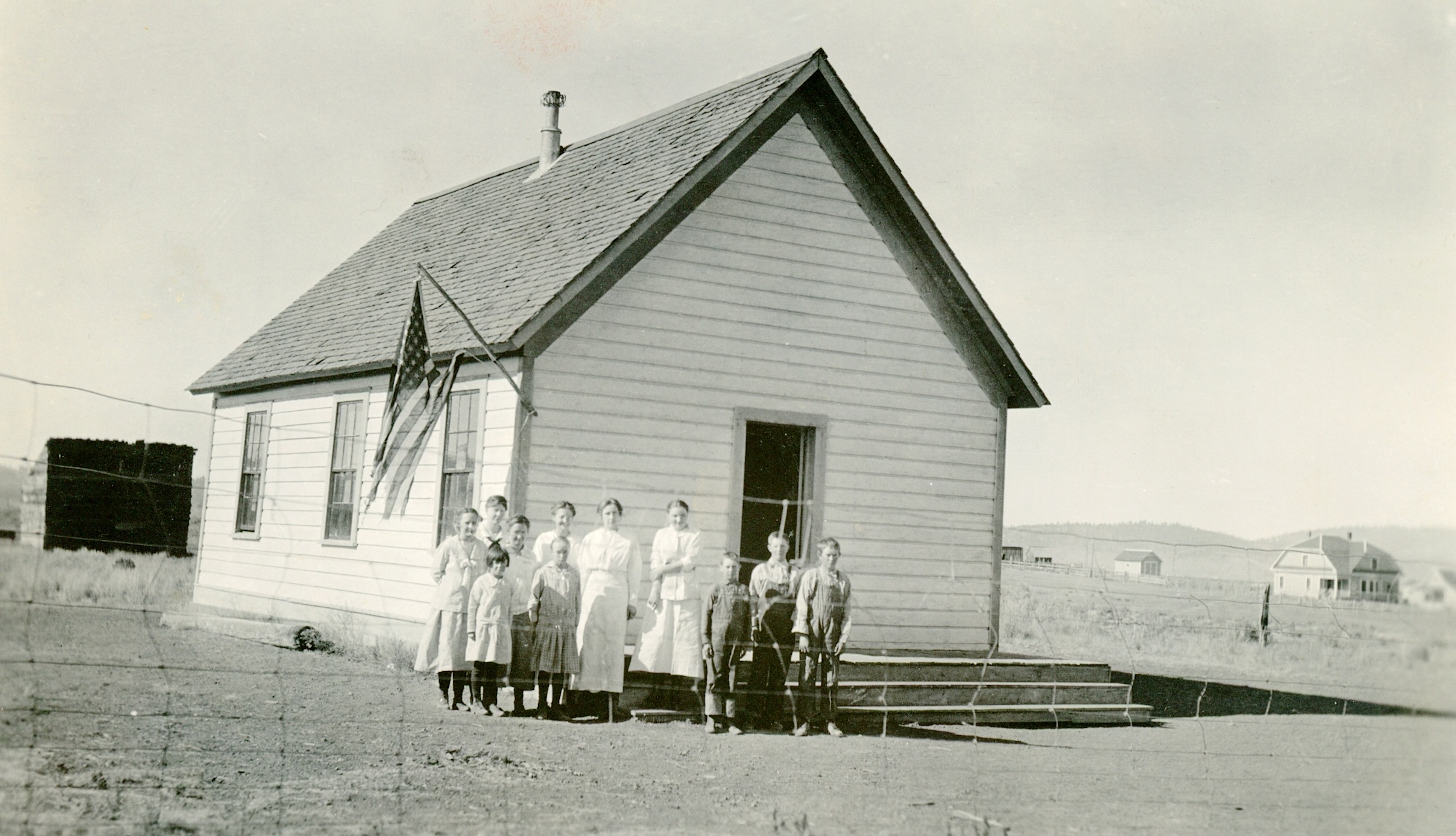
Ash Valley School, 1916

In July 1875, eighteen Ash Valley residents petitioned for the formation of a school district. The Board of Supervisors tabled it. The petition failed to enumerate how many children resided in the valley. Of note, the majority of the petitioners were bachelors. A year later, a new petition was submitted that informed the Board there were fifteen children in the valley—the petition was approved.

Sometime in the late 1870s, the residents worked together to construct the schoolhouse. Records are not clear, but between 1917 and 1919 the school was closed. In July 1920, the residents requested the school be re-established and the request was granted. In 1923, the school closed again, as Julia A. Norwood, County Superintendent of Schools stated there was not a sufficient number of students. Norwood, on an optimistic note, ordered that the school’s fixtures and equipment remain in tact. The records, again, do not indicate when the school re-opened. At the County Board of Supervisor’s meeting of August 20, 1929 the minutes state: “Mrs. Mary Bath, Mr. & Mrs. J.T. Bath of Ash Valley appeared before the Board in the interest on emergency school at Ash Valley. It appearing that the proper showing had been made for this school, Mr. Bath is advised that a teacher would be designated.” This problem occurred again in 1934, when the school trustees were not able to secure a teacher and it was designated as an “emergency class.” The Board hired Jessie B. Madison for its teacher. The school closed for a final time in 1941. The last students to graduate were John Bath and Martha Bath in 1938. In September 1946, the Board of Supervisors declared the school as surplus property and ordered its sale, yet no buyers came forward.

Ash Valley School
Ash Valley School, as viewed from the cemetery, 2002.

It should be noted the school is located on a 40 acre parcel that also contains the Ash Valley Cemetery.
Support

An Interesting Editorial

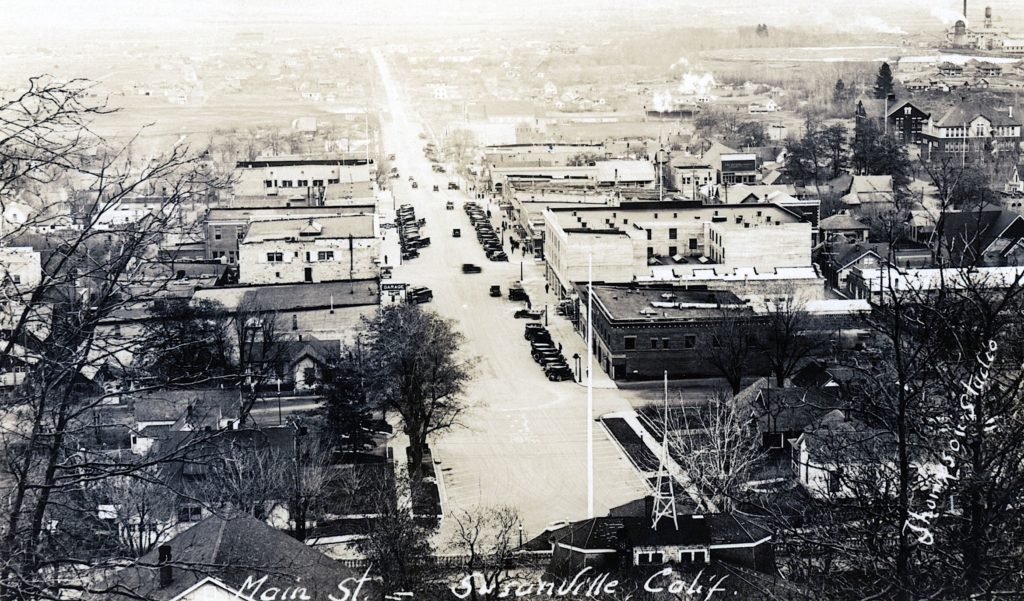
Main Street, Susanville, 1926.

The following editorial appeared in the Lassen Mail on July 9, 1926. It is interesting in a few aspects. There is a story, inside the story about elections/politics, and is only fitting since Tuesday is Election Day.

Buy Where You Earn. There is much talk these days of boosting Susanville and there are many activities that are making it better known, wealthier, bigger. The American Legion Convention will bring it state wide attention and will undoubtedly cause many people to make this their home.

But with all this there are many people who talk Susanville and act elsewhere. What of the man who talks of the great future of Susanville on the street corner and buys his clothes, his automobile, his printing and even his groceries in another city? His words are mere bombast but his buying his needs in other places is one of the worst blows that civic industry in this place can sustain.

A candidate for office approached a business man in Susanville and asked for his support in the coming election. The business man, after explaining that there was nothing personal in his refusal, told the candidate to go to Montgomery Ward for his political support. The candidate did his buying from the mail order house and the mail order house should support him in the election.

A man supports those who support him. You cannot expect business or co-operation if you are not willing to give the same thing in return.

Susanville goods are of the same quality and Susanville prices are just as cheap as those of other cities. The person who is mislead by cheap prices is losing out in the long run. The man who is buying his goods out of town is not gaining either financially or otherwise. If he does this he cannot expect local people to trade with him.

Local trading, of whatever nature, is beneficial to everyone. It increases industry and will increase population. A bigger and better Susanville is the aim of every public minded citizen and the best way to realize that ideal is to encourage home industry and stamp out the man who makes his money in Susanville and spends it in some other city.

Support

Lincoln School Remodel

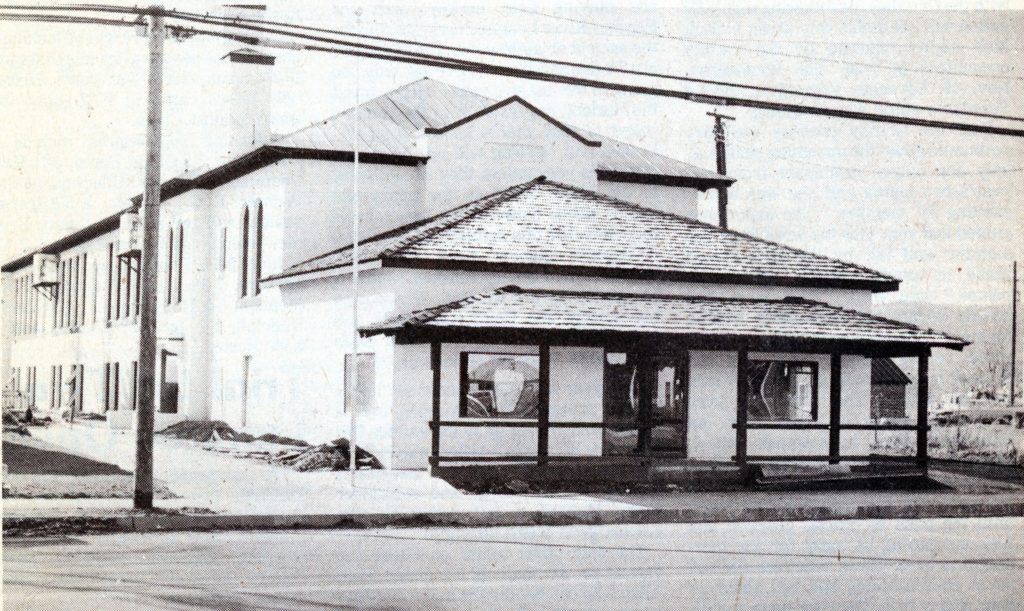
The Lincoln School Remodel—Lassen Advocate, November 21, 1975

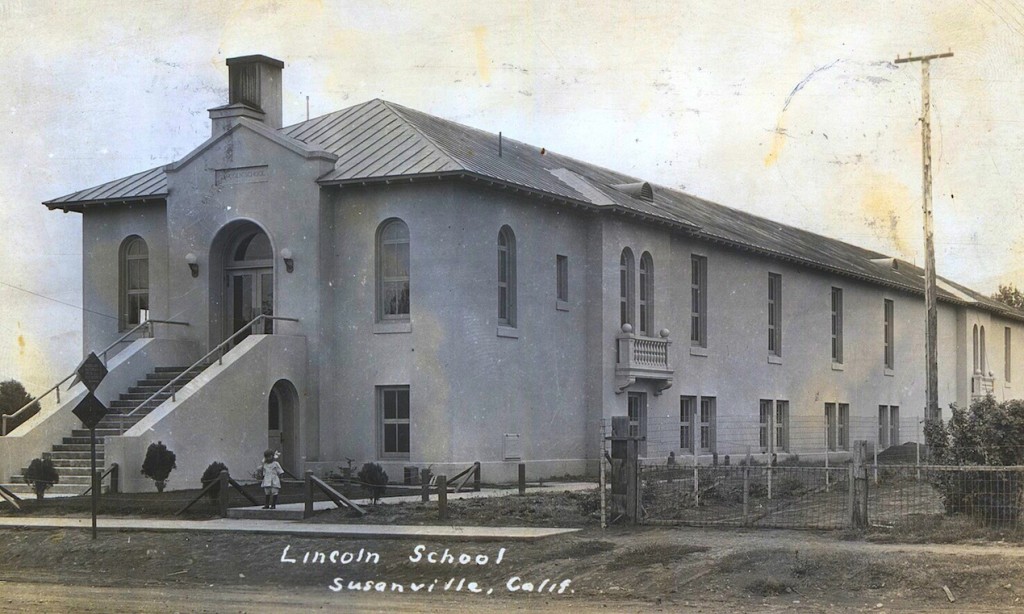
At the end of the 1966-67 school year, Lincoln School was closed, being replaced by the newly constructed Diamond View School. For a brief time Lassen College used the facility while its new campus was under construction.

In July 1975, Victor Bullard of Placerville purchased the shuttered Lincoln School.  Bullard had the building remodeled. An addition was made to the front of the building, replacing the old exterior staircase. On December 1, 1975 the Eagle Lake District of the Lassen National Forest became the new occupants of the building. Previous to this, the District’s office was located in the former Paul Bunyan Lumber Company office.

Lincoln School
Lincoln School, 1924

Tim

Lassen High’s First Principal Unexpected Departure

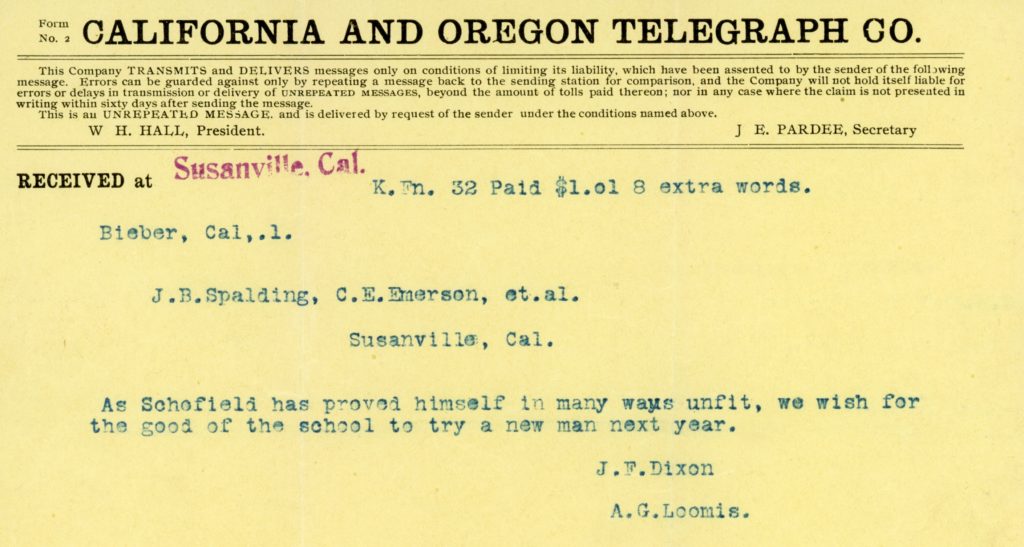
While sifting through my Lassen County Schools file, I came across something that caught my attention. It was a telegraph envelope addressed to J.B. Spalding, a Lassen County High School Trustee. Someone wrote on the envelope “Please Preserve.” The above illustration was the content of the telegram from Lassen County Superintendent of Schools, J.F. Dixon.

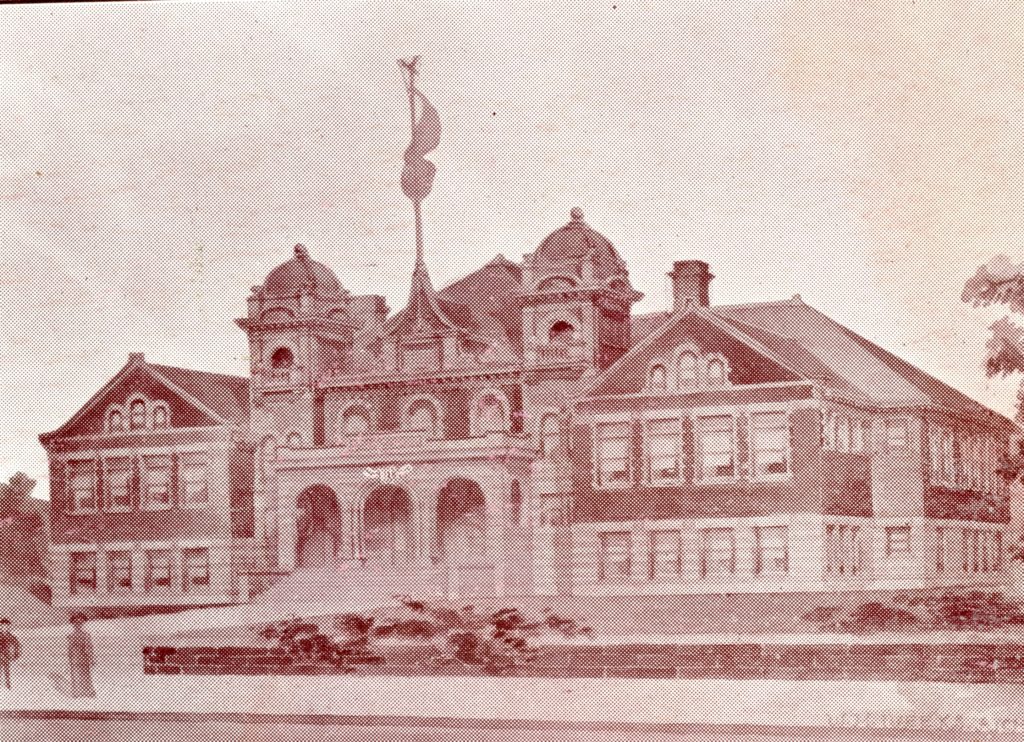
It should be noted that Professor Frank C. Schofield was hired as the first Principal/Instructor for the Lassen County High School in the fall of 1903. A second instructor, George Barton assisted. In an 1906 account spoke highly of Schofield: “Under his efficient management rapid progress has been made in all departments, and the attendance has largely increased, the number of pupils registered the first year having been but forty, which in the second year sixty names appeared on the roll.” Among other items, Schofield oversaw the construction of the high school.

W.H. Weeks rendering of the new high school.

In June 1910, Professor Schofield surprised the community that he was leaving for Palo Alto, California to take year sabbatical from teaching. Was the above undated telegram the impetus?  We may never know. Schofield never returned to Lassen and spent the rest of his educational career in Palo Alto where he died in 1935.

Support

Juniper School, Lassen County

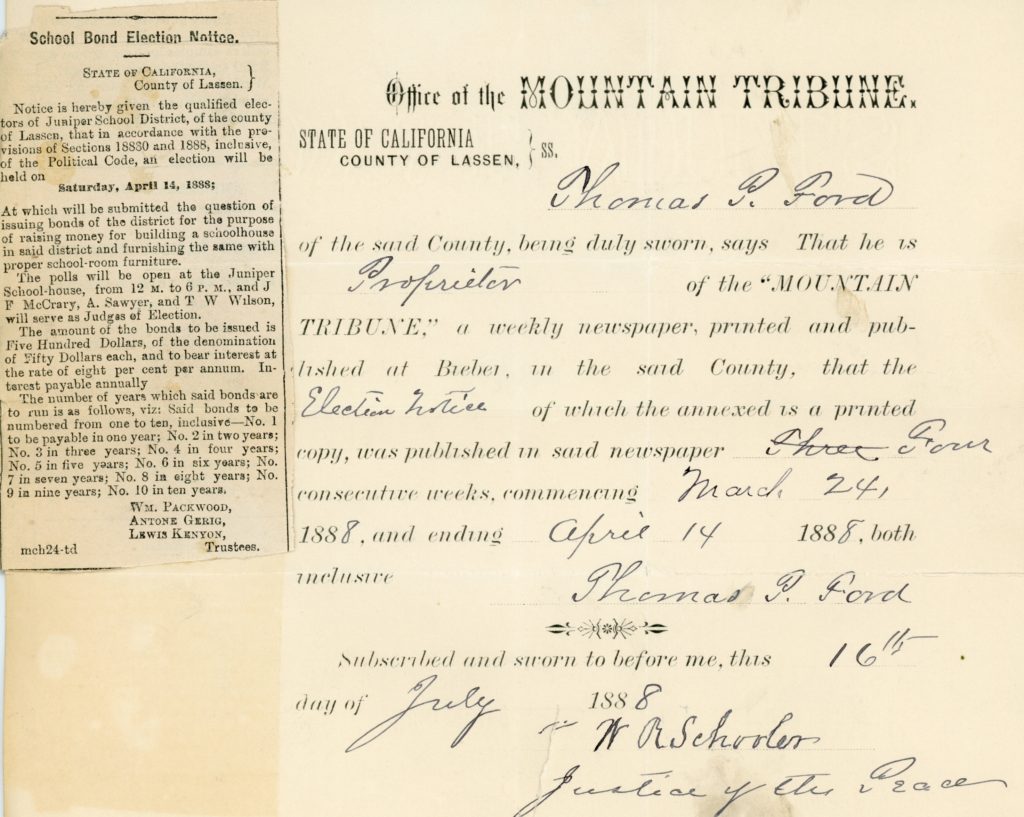
This was the third school district established in Big Valley, on the Lassen County side. The other two were Providence and Pleasant Butte. The Juniper School served the residents of the southern end of Big Valley. The district was established on November 5, 1877. On November 1, 1884, the voters of the district had two measures before them. One was for a school site and the other for a bond measure for $400 to construct the school. The bond measures were rejected and no site was determined. On April 14, 1888, an election was held to issue a $500 school bond measure and it was approved by all twelve voters. On August 27, 1889, Charles M. Kenyon donated one acre of land for the school and it was constructed.  In 1924, the school closed for two years, for lack of students.  Again in 1937-38, the school closed due to the decrease of students. It operated during 1939-40 with Reva Snell as the school’s last instructor.  It then closed for a final time and annexed to the Bieber School District.  The abandoned schoolhouse was sold on June 8, 1942, to Mike Roufs who tore it down and used the lumber to expand his mechanic shop in Bieber.

Support

The Delayed Standish School

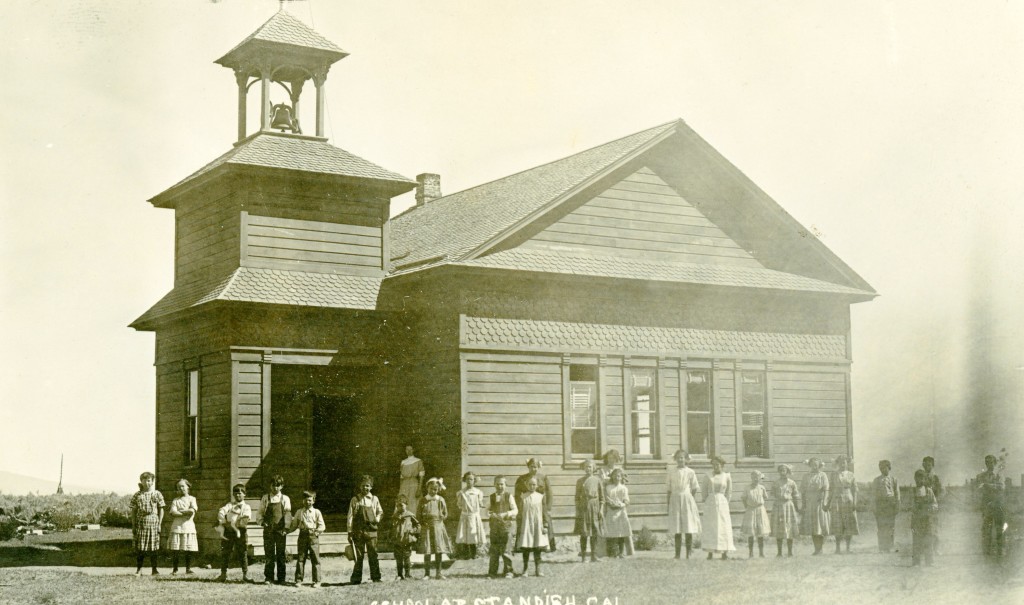
Standish School, 1911. Courtesy of Esther McClelland

Yesterday, we explored how Westwood was slow in building a church. Over the mountain at  Standish it had a church early on, but did not have a school. However, there were two nearby schools—Bridgeport on Chappuis Lane and Honey Lake at the intersection of Alexander and Lambert Lanes. On December 30, 1905, eleven Standish residents, who had a combined total of 22 school age children petitioned to form a new school district from territory served by Honey Lake School. It was granted.

Standish School, to the far left, teacher Miss Esther Pierce, 1911—Esther McClelland

On Saturday, June 2, 1906 a school bond election for $1,300 was held. All ten voters approved it. That summer the Wilbur Brothers constructed the school. The brothers also built Honey Lake and Missouri Bend schools, each with a distinctive bell tower. In 1950, Honey Lake School was annexed to Standish, due to a lack of students. On July 1, 1951 the residents of Bridgeport, Soldier Bridge and Standish School Districts approved to consolidate and form the Shaffer Unified School District. The Standish School was subsequently closed and torn down in 1967.

Support

Graduation Season

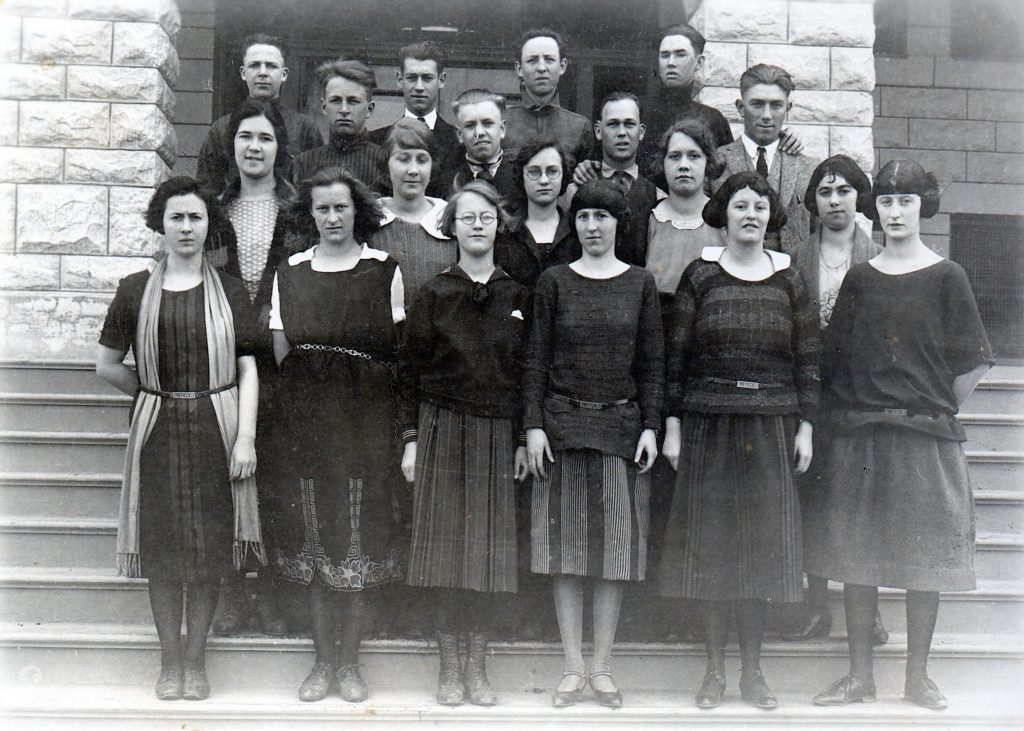
Lassen Union High School, Class of 1922—Betty B. Deal

It is “Pomp and Circumstance” season across the country. Locally, it began with the commencement ceremony at Lassen College on May 27. It was then followed by the various elementary school districts and culminating with the high schools—Big Valley, Herlong, Lassen and Westwood. Congratulations to all those graduates, especially since they experienced some challenging times that few had ever to deal with—Covid 19. Do I have any wisdom to share? Well maybe and it might not be the best, since it was a long time ago when I graduated from Lassen High, I think the wisest decision is just not to say anything.

Tim

Politics and Schools

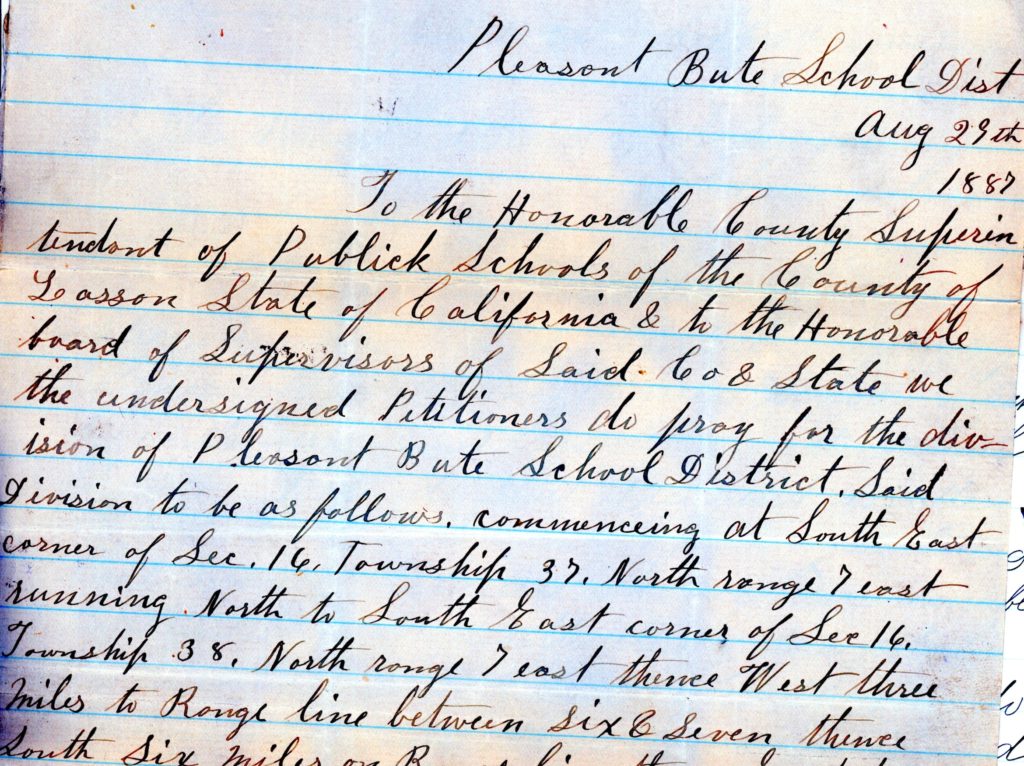
Pioneer School Petition

Some things never change and politics and schools is one. I can verify this first hand, having served as a trustee on the Lassen College Board. The stories I could write about that ten year tenure—Mormon Massacre anyone?

Today’s story is about an odd short-lived  or should I say  a ghost school district in Big Valley—Pioneer. Its name is rather peculiar since a half dozen schools in that region had already been established.

On August 23, 1887, residents on the west side of the Pleasant Butte School requested that a new district be established on the grounds: “The School House being so situated now that the greater portion of the Schollars in the Division we mention cannot attend the greater portion of the time on account of the Sloughs being full of water.” On September 27, 1887, Myra Parks, Lassen County Superintendent of Schools, informed the Lassen County Board of Supervisors that she personally inspected the conditions and recommended the Pioneer District be formed, that creating a new district would not be detrimental to Pleasant Butte. In October 1887, the request was granted.

Then things got weird. In January 1888, the Pleasant Butte School District residents on the east side petitioned the Board of Supervisors to rescind its action that had created the Pioneer School. They stated that the original petition provided “fake, fraudulent and misleading facts.”   At the February 1888 meeting of the Board of Supervisors, approved their request and the Pioneer School District was abolished.

Support

Preparing for a new Lassen High School

Lassen Union High School

When the trustees of Lassen Union High School made the decision to a build a new school, time was of the essence. Glenn Wemple, who was on the board, informed me that they did not want to make the same mistake as what happened to the Orland High School. These types of school hold a tremendous amount of emotional attachment in their respective community. Orland moved slow and it created a great deal of anger and resentment.

Akol & Associates of San Francisco were hired as the architects for the new school. The estimated cost to construct a new campus on site of the existing was $2,317,410. It would be done in two phases. For Phase One, bids were required to be submitted no later than April 12, 1967. Five bids were received and initially the trustees took no action. A week later, the trustees rejected all bids. New bids were solicited for no later than May 15.  On May 16, 1967 the trustees accepted the bid of C&J Construction Company of Reno, Nevada. On Friday afternoon, June 23, 1967 a groundbreaking ceremony was held behind the main school building.

Support


Oak Grove School, Lassen County

Oak Grove School, circa 1905.

In the fall of 1882, W.H. Sifford led the effort for a new school district on the west side of Honey Lake.  The two nearest schools were nearly five miles away in either direction—Milford to the south and Lake to the north. In May 1883, the Oak Grove School District became a reality. The nucleus of the student population came from Clark, Decious and Raker families. It should be noted that the Wales, Wilburs, Lindsay, Fisher and Grass families also contributed to the student population. Like so many rural schools in 1920, the enrollment had declined to such an extent it was closed.  In 1922, with no indication that the school would be resurrected,  it was annexed to the Lake School District. The school was torn down in February 1926.

Support