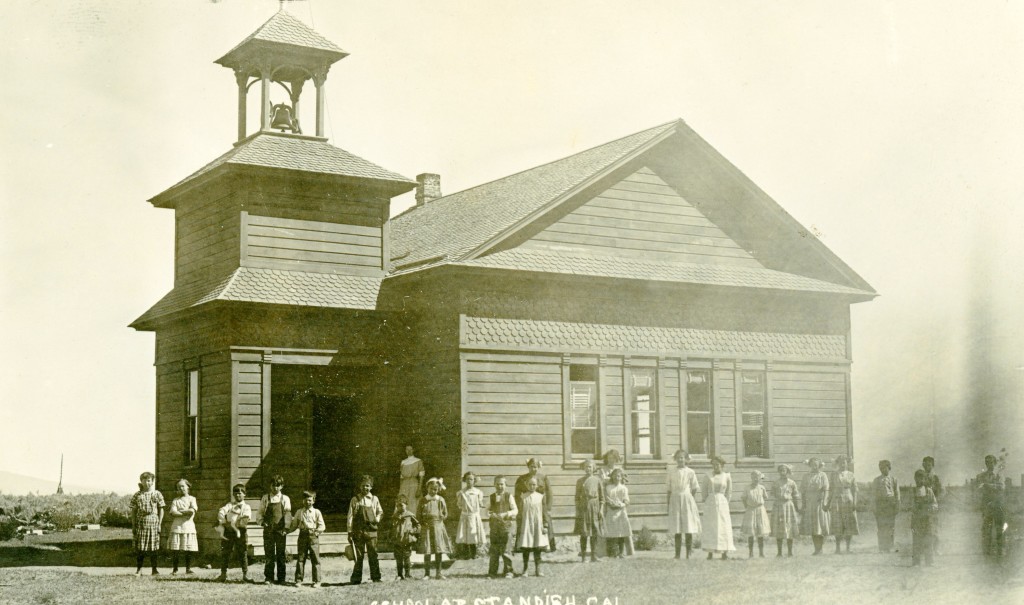
Standish School, 1911. Courtesy of Esther McClelland
In 1920, in the Standish region there were five school districts—Bridgeport, Honey Lake, Poplar, Soldier Bridge and Standish. In the late 1940s, there was a movement to consolidate rural school districts. In 1951, the voters of Bridgeport, Soldier Bridge and Standish Districts agreed to consolidate and form Shaffer Union School District. It should be noted that Poplar School closed in 1935 due to a lack of students. In 1950, Honey Lake School was annexed to Standish.
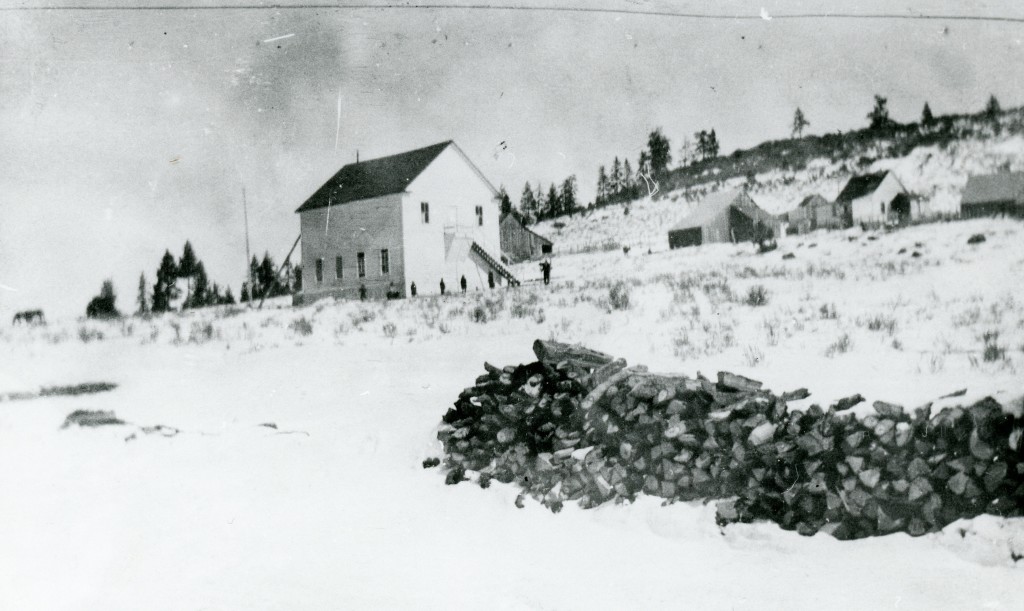
Lassen County’s mining community of Hayden Hill went through many boom and bust cycles. The school closed for the last time in 1925 for lack of students. The fate of the school building is conflicted. On April 18, 1931, long time Hayden Hill resident J.S. Owens offered to purchase the two-story building from Lassen County for $125. It appears the county did not accept the offer, but it did raise awareness. On June 1, 1931 the county placed the school on the market. Fred Bunselmeier and Lloyd Walsh purchased it, but the records did not disclose how much they paid for it.
The flooded culvert, 1938. Courtesy of Margaret Purdy
On this rainy day, it seems to be an appropriate topic. What is known today as Arnold Field at Lassen High School was originally a agricultural field, prone to flooding from the adjacent Susan River. After the spring floods of 1938, it was decided to construct a levee along the river to prevent future flooding. Once this was accomplished, the high school made more improvements including a new athletic field. In 1939, it was dedicated Arnold Field, a tribute to Med Arnold. Med was not just a member of the first graduating class of 1907, but was a coach for the school’s sports teams for many years.
The Calneva Branch of the Lassen County Free Library, 1920.
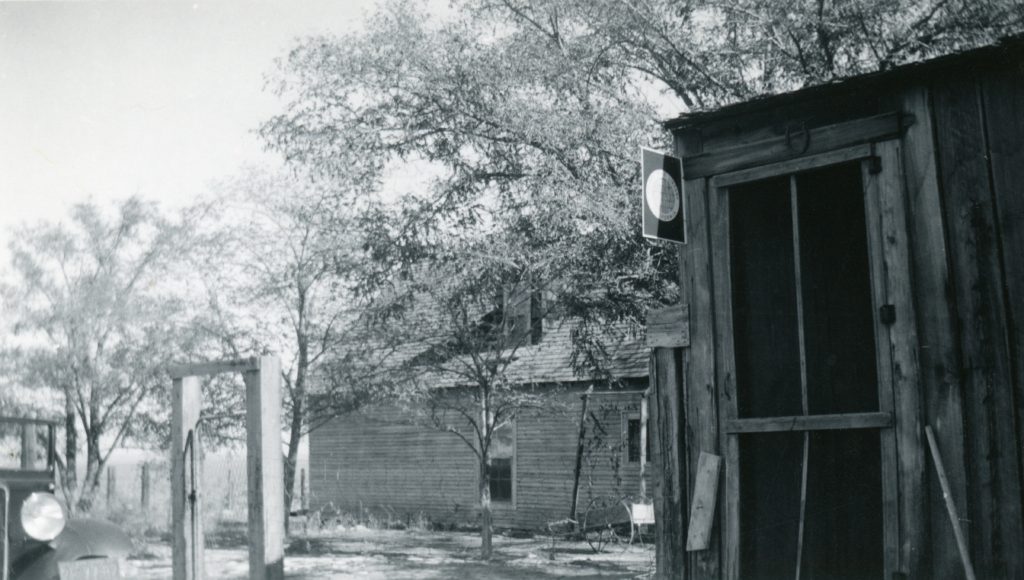
In January 1915, the residents of Calneva, a Western Pacific Railroad station in eastern Honey Lake Valley desired the break away from the Fairview School District and form their own. In their petition, they stated nineteen scholars resided in the proposed district. Their request was granted on February 2, 1915 by the Lassen County Board of Supervisors. The new district was named Fort Sage. The school was located in a small one-room building on the Harry Hill homestead. It was later moved to the Aldrich House, a larger building, located in the center of the district. In the summer of 1918, the school was on the verge of being suspended, as enrollment declined to four. The trustees persuaded County Superintendent of Schools, Julia A. Norwood, to keep the school open, as they promised an additional four students would attend in September. The request was granted. The school’s existence was brief and it was closed in 1924. In 1926, the furniture from the school was purchased by the Janesville School District.
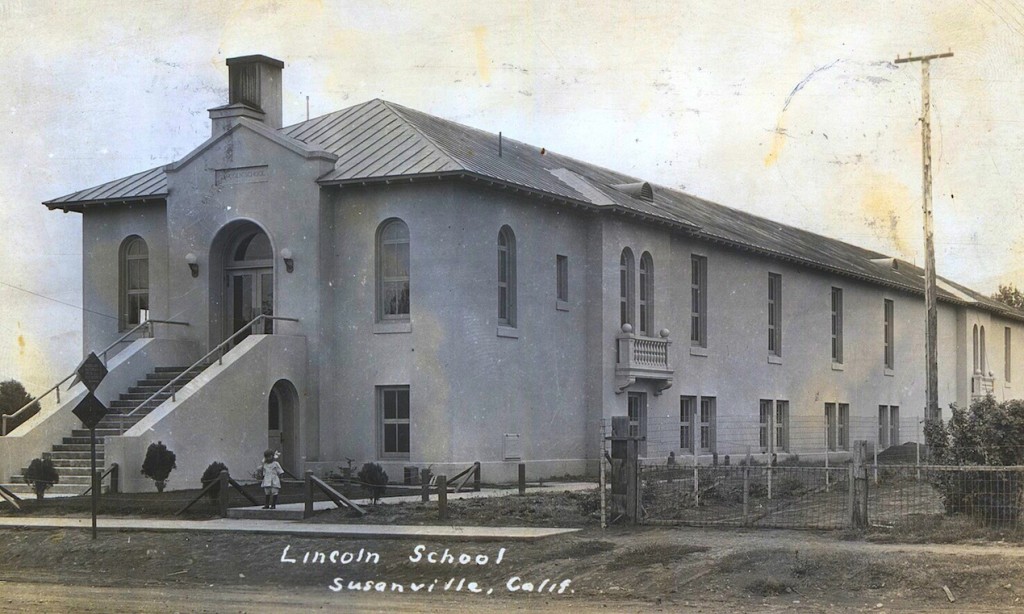
Lincoln School, 1924Today, there are frequent news reports about obesity in children and adults. This was not always the case. In January 1930, 682 students of the Susanville Elementary School District were weighed and measured and it was found that over one-fourth were under weight. This was considered an alarming figure and it was decided that the children be give proper rest periods after school. In addition, it was recommended the children be given milk and lunch at school.
Westwood High School, circa 1925. Courtesy of Hank MartinezOn February 19, 1927 the Westwood High School was destroyed by fire. Such events are news worthy. In this particular instance how the fire was contained was quite unusual.
It was one o’clock in the morning when the fire alarm was turned on. When the firefighters arrived they found the high school fully engulfed in flames. There was little they could do, as it was impossible to save it. They focused their efforts not only to contain it but also to keep it from spreading to the Grammar school located next door. The heat was so intense that it was impossible to enter the building to salvage its contents. Because of the extreme heat the houses across the street began to smolder as if they were going to spontaneously combust. An unusual firefighting technique was developed for this particular instant, and credit was given to Fletcher Walker for this ingenious idea. With the majority of the town gathered to watch the fire, Fletcher recruited citizens to start throwing snowballs at the endangered houses to prevent them from catching fire. It worked!
As Ted Walker recalled, “Fletcher assembled a large number of bystanders into a snow-ball brigade. This force bombarded the nearby houses with snowballs and succeeded in keeping the roofs and sides of the houses sufficiently damp so that the houses were saved. Shingles and sidings were afire many times, but in each case the blaze yielded to the snow-ball treatment.”
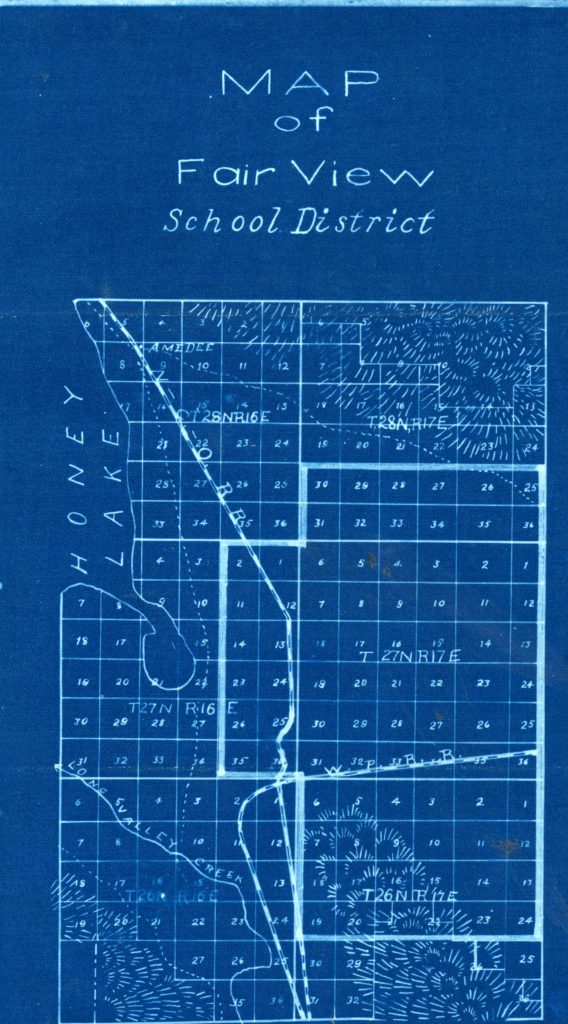
Fairview School District Map, 1910.In January 1910, east side residents of Honey Lake petitioned for the formation of a school. They cited that there were twenty-seven eligible students in the proposed district. The nearest school was at Amedee, and the majority of the petitioners resided some 12 miles distance. However, the Lassen County Board of Supervisors did not approve the new school until November. The residents built a schoolhouse in the center of the district, since there were no towns in the area. That would suddenly change with Calneva Station established by the Western Pacific Railroad and Stacy on the Southern Pacific. In 1915, Calneva experienced a boom of sorts, and separated from Fairview to form the Fort Sage School. Fairview continued on even as the population dwindled and in 1936 the school closed for a lack of students.
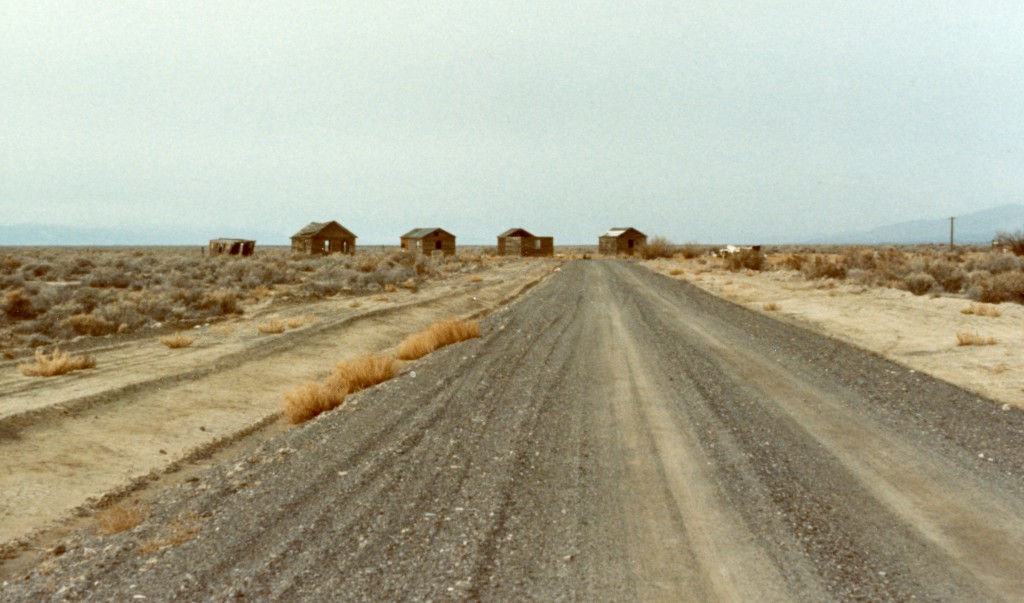
Flanigan, 1976, courtesy of Christopher MoodyEstablished in 1887, it was originally located at the Bonham Ranch in the Smoke Creek Desert. The school closed in 1919 for lack of students. In 1929, it was resurrected at Flanigan in the Honey Lake Valley. It closed on June 20, 1969 and at that time it was the only remaining one-room school in Washoe County. Standish resident Ed Bass purchased the school and moved to his property.
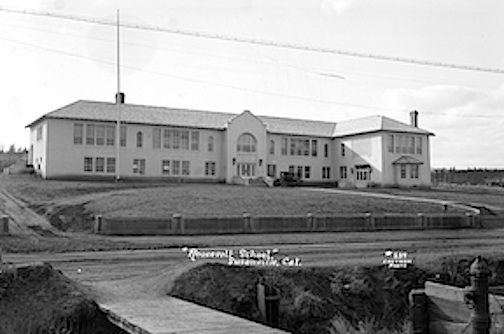
Roosevelt School, 720 Richmond Road, SusanvilleSusanville’s Roosevelt School building located at 720 Richmond Road has been used for offices by Lassen County. It was built in 1925 at a cost of $44,816 and closed as a school in 1967. As the county no longer has a need for the building, it is currently examining the various ways to dispose of it.
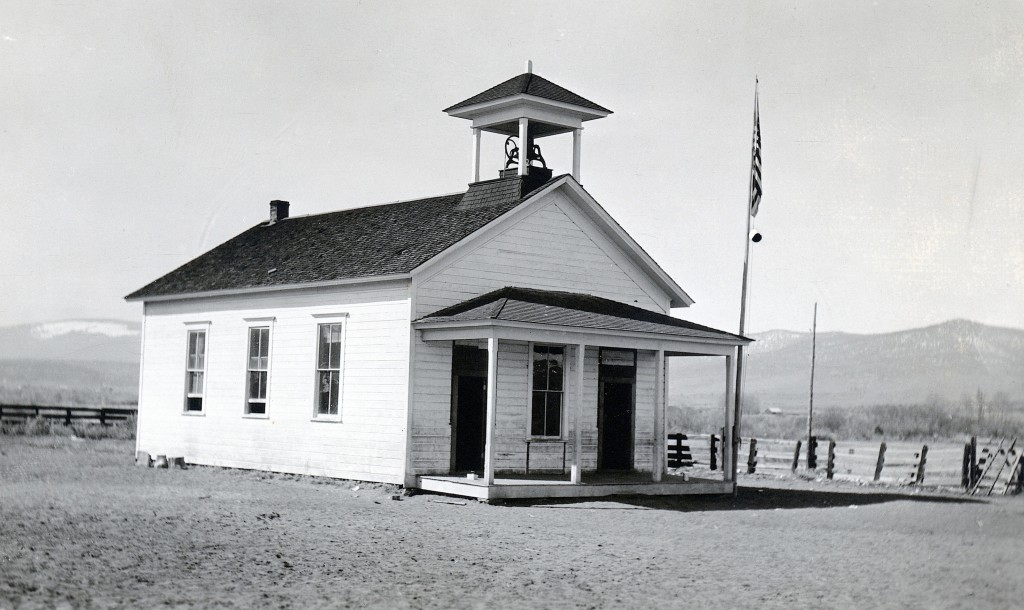
Johnstonville School, 1916Yesterday marked the 1,000th post that started on February 12, 2015. One of those posts concerned Johnstonville School. It was one of the original Lassen County school districts established in 1864, but was originally named Susan River School District. In February 1878, the name was changed to Johnstonville. On January 20, 1961, a groundbreaking ceremony was held to build a new school to replace the old one. School board members, Harry Reuck, Mary Barr and Leroy Cramer, broke the ground for a new four-room schoolhouse which would cost the district $134,518. When completed the old school house located on an adjoining parcel was sold and converted into a private residence.
Donate!