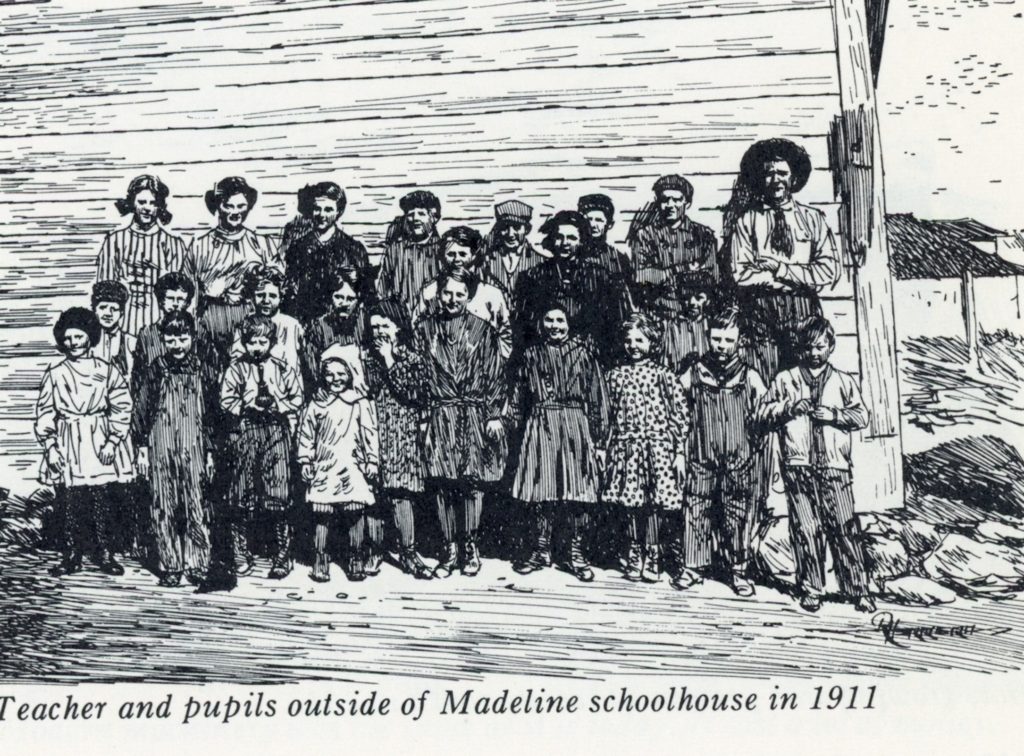
While the vaccination debate rages on, I thought I would share this early day observation from Margaret “Peg” Woodrich of the by gone days on the Madeline Plains. She compiled a small history, “The Early Days of California’s Madeline Plains.” She wrote: “The teaching methods of those times are long since forgotten. Each schoolroom had in its entry a bucket of water and a tin dipper from which all the youngsters drank, exchanging measles and whooping cough with democratic cordiality.”
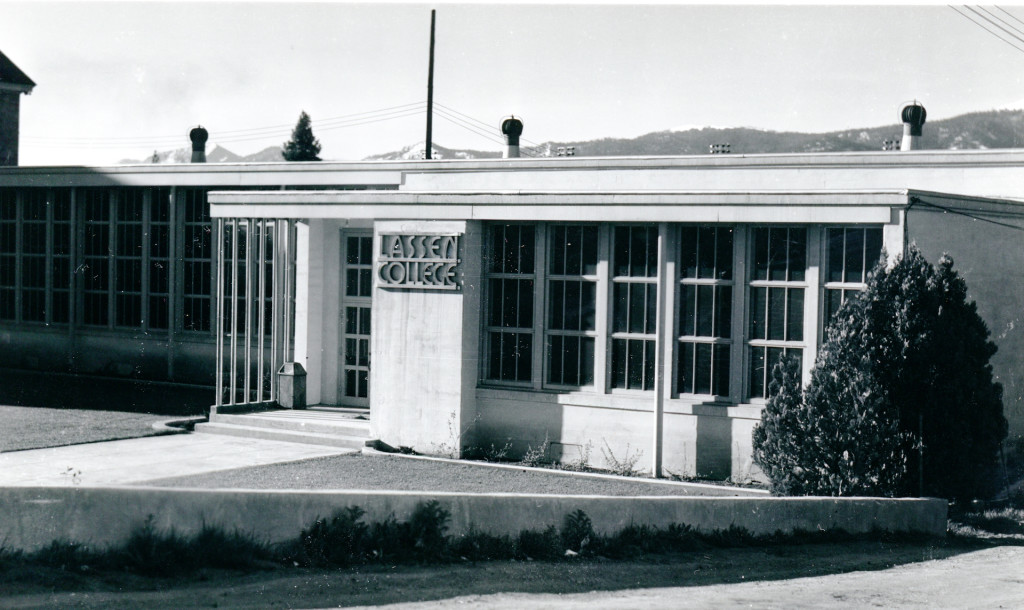
Lassen College on the Lassen Union High School campus.
In 1965, Lassen Community College severed its ties with Lassen Union High School. The college then began the process to locate and build a campus of their own.
During that process college officials decided to expand its territory with neighboring counties of Modoc, Plumas and eastern Sierra. After all, for nearly forty-three years residents of those counties took advantage of the opportunities made available to them at Lassen College.
On June 4, 1968 the voters of those counties, as well as Lassen, would decide if it was to be a four county community college. A college spokesman stated, “We want quality education in this mountain area at a reasonable cost.” The ballot measure ran into trouble with Plumas County, whose residents planned to annex to Peralta College in Alameda County. The major hurdle was the tax issue to fund the costs to build a new campus. While the Lassen voters approved the measure, the neighbors did not.
In the summer of 1964, Robin McVickers and Fred Toler formed the Northlands Holding Company for their newest endeavor. The two men purchased four of the old Fruit Growers Supply Company’s apartments on Alexander Avenue in Susanville from the Eagle Lake Lumber Company. The buildings were completely renovated, became known as the Riverside Apartments when they were opened in September 1965. One building, in particular, was dubbed “The Chateau.” This building was specifically set aside as a dormitory for Lassen College students and could accommodate fifty-six students. This apartment complex still exists and is known as the Parkview Garden Apartments.
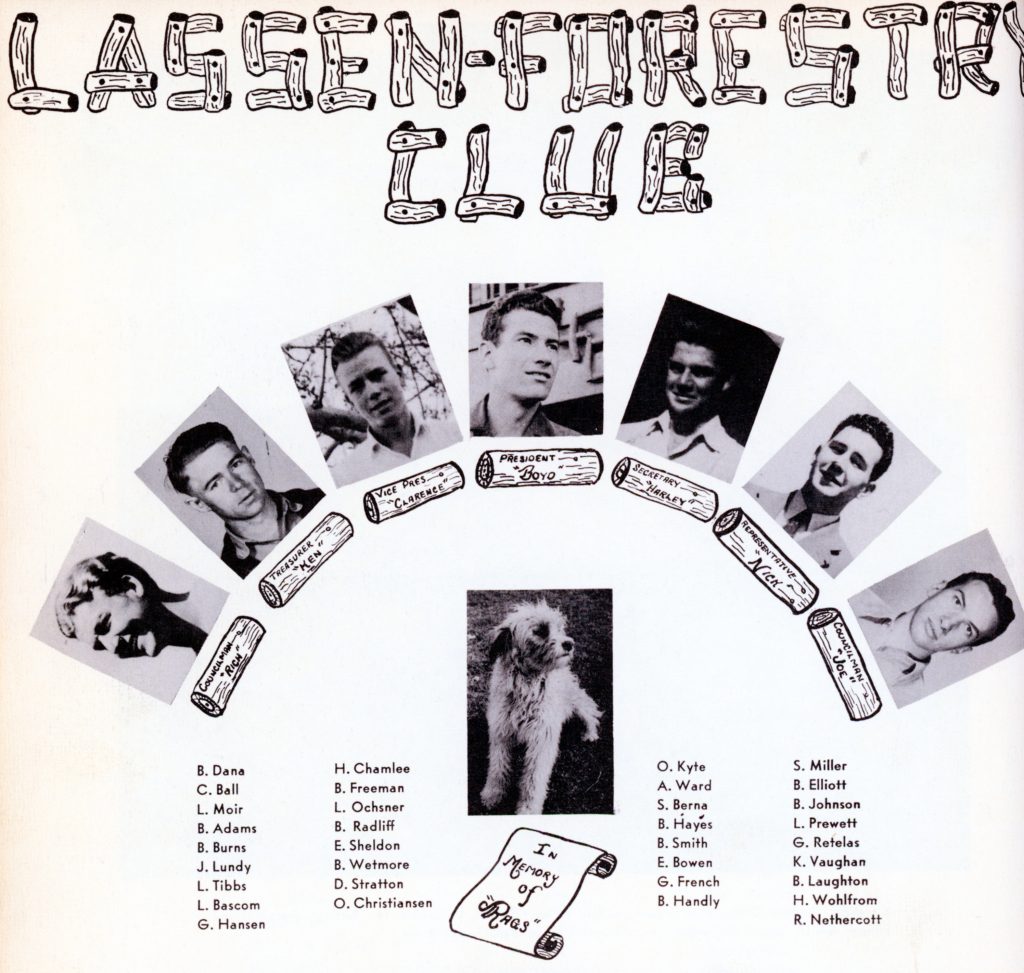
On September 19, 1935 a Technical Institute course in forestry was offered at Lassen College. There was a lot of enthusiasm for the new course, not just from the college, but the timber industry who would benefit by its graduates. However, there were critics who thought the initial cost to implement it was expensive compared to other traditional vocational courses.
By the time the second semester began word had spread and there was tremendous interest from outside the region. When the fall semester of 1936 began the enrollment at the college had nearly doubled which was attributed to the forestry program. It was a turning point for the college. For the school to thrive it would need to seek out students from other areas, as the local tributary schools was not sufficient enough for the college to expand.
Awhile back I wrote about Lassen College’s first student newspaper the Jaysee. It turns out a few years earlier that the college had a publication called the Lassen Jay-See. On December 17, 2000 Francis “Fritz” Riddell sent me a copy for the archives. It was Vol. 1 No. 2 dated March 1938. It contained twenty-six pages of short stories by the students and fourteen pages of local advertisers to support the endeavor.
It is September, which is traditional back to school time, though these days in California many schools start their fall session in mid-August. The students at Ash Valley undertook an unusual social studies project. In September 1936, they entered a wild flower exhibit at the California State Fair. The exhibit contained 60 different varieties, 20 of which were found in the school yard. For their efforts they received as trophy as they placed third in the competition in this particular division. The students who prepared the exhibit were: Grace Bath, John Bath, Martha Bath, Patricia Nixon and Mary Lou Nixon.
For those not familiar with Ash Valley it is located between Adin and Madeline.
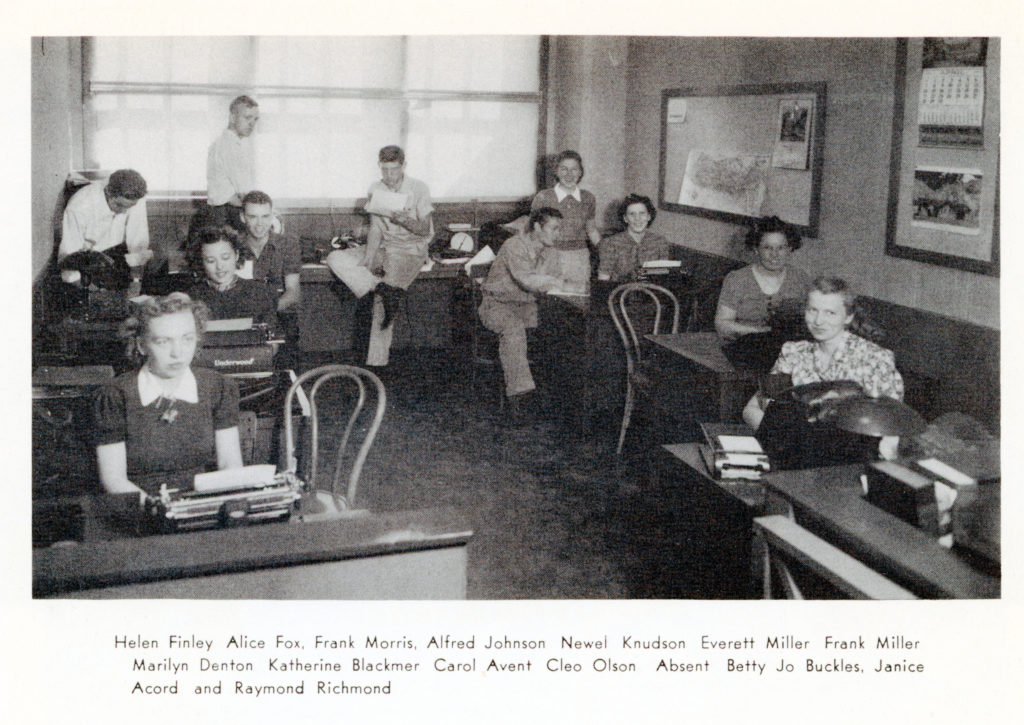
This was the name of Lassen College’s first student newspaper. How it came to be was pure accident, as it was not planned. In September 1939 the college offered a Creative Writing course. It was a venue for students to practice writing news article and general composition.
At the beginning of the second semester the class published a mimeographed newspaper, the “Jaysee.” By February the paper came out on a weekly basis. There was no assigned editor. Instead to give everyone an opportunity for a hands on approach, each week everyone rotated assignments.
The initial paper was financed by selling candy bars at the basketball games. In April it was deemed necessary that it would need an advertising department to finance future issues.
Fast forward to the Spring of 2019 and a new online student newspaper is now published at Lassen College known as “The Paw.”
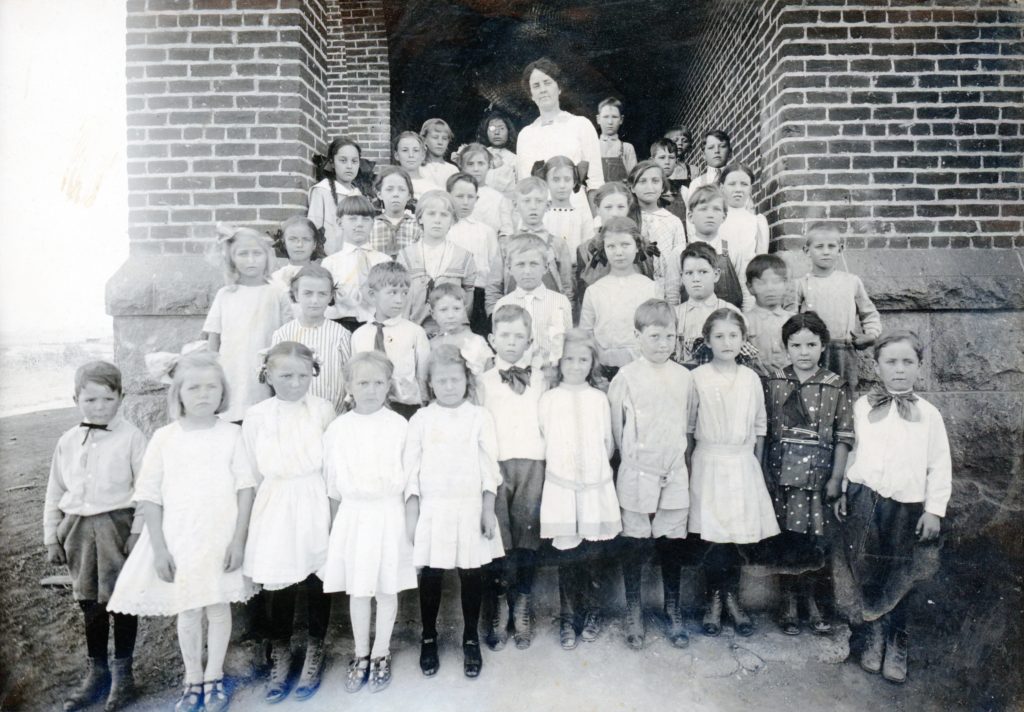
First Grade, Susanville Grammar School, 1914, teacher Mrs. Tom W. Wilson—B.R. Zimmerman Collection
It seems of late, that on a almost daily basis measles is in the news. There was a time when other communicable diseases made headlines. Locally, in the spring of 1916 a scarlet fever epidemic hit Susanville. Not to take any chances, school officials closed the Susanville Grammar School for a week, hoping that would be sufficient enough. It was.
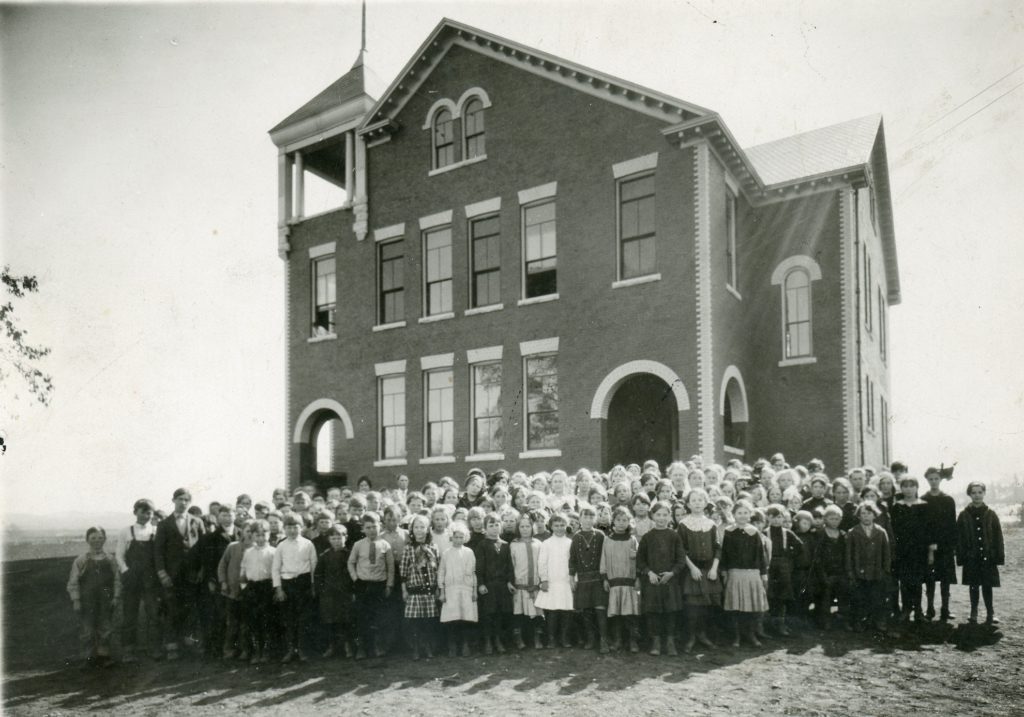
The grammar school, 1915. Courtesy of Royce Houston
On June 2, 1899, the voters of the Susanville School District approved a $12,500 bond measure to build a new school, to replace the existing two-story wooden structure built in 1873. It would be a slow process for a new school to become a reality. First, it took some time to find a buyer for the bonds. Then there was a question whether to retain the same location or move to somewhere else. In December 1899, it was decided to remain where the existing school was, but to purchase an adjoining vacant lot to enlarge the school grounds. In March 1900, the District awarded the contract to build a two-story brick building to Reno contractor, C.E. Clough. It is interesting to note, that four substantial brick buildings were constructed at the same time, the Emerson Hotel, Methodist Church and Oakes &Philbrook Furniture Store.
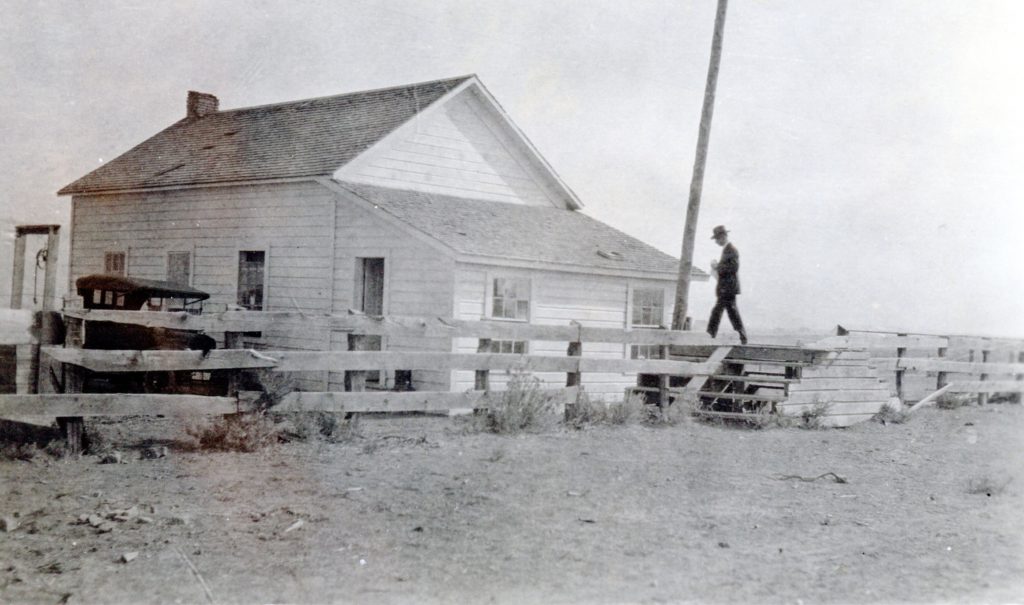
In 1871, the residents of Big Valley on the Lassen County side, petitioned the Lassen County Board of Supervisors for a school district there. While there was a public school in Adin, that was under the jurisdiction of Siskiyou County, as Modoc County had not yet been created. The Big Valley residents were included the Willow Creek Valley School District and that school house was nearly forty miles away. With that thought in mind, the petition stated, “It is frequently impossible for their children to attend school on account of high water, deep snows muddy roads, etc.” The petition was signed by seventeen residents and combined they had twenty children eligible for school. The Board obliged and created the Providence School District on November 10, 1871. A school house was built two miles south of Adin. In 1953, the school was annexed to the Adin Joint Unified District. The school house then became the property of the Providence Farm Bureau.