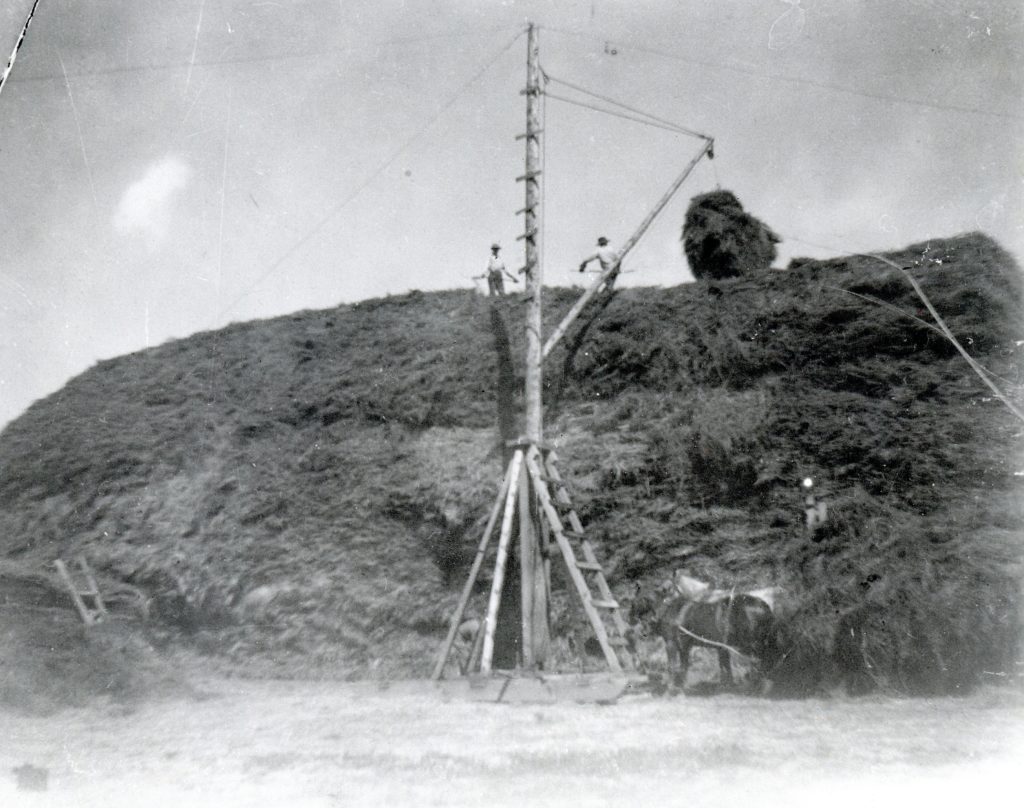
The film includes a scene of the hay derrick (above) in action. This photograph is the hay stacking at the Titherington Ranch, near Standish, 1908. Courtesy of Betty Gorbet
Lately, I have been working on my technical skills, which is always an interesting experience for me. Sometimes I succeed, and well on other occasions I have new challenges. My goal is put online a historic video, though viewing would only be for paid subscribers. So if you are experiencing some technical difficulties, the culprit is probably me and working on this feature.
The particular film that I refer to is a short feature of the entire operations of the Vic Christensen ranch near Likely. It was done in 1939 as part of Encyclopedia Britannica’s educational films of the era. Unlike the 1925 Fruit Growers Supply Company’s film, this one is narrated. Stay tuned.
In 1877, Thomas Abner “Ab” Ramsey arrived in Janesville from his native Iowa. In Janesville, he had numerous relatives, as his mother was a McMurphy. In February 1882, he went into partnership with John T. Masten to purchase the Benjamin Wood ranch in the Tule District of the Honey Lake Valley, each paying $2,000 for the 400-acre ranch. It should be noted that Masten had been a resident of this district since 1872, who had purchased the adjoining John M. Kelley ranch (now Tanner 2016). Within two years, it was no longer just a business proposition, but a family affair when Ab Ramsey married Masten’s daughter, Minnie, on Christmas Eve, 1884.
More changes were on the horizon when in 1886, they sold the ranch to the Dotta Brothers. (Seasoned residents will know this property as the old Bailey Ranch, now owned by Jay Dow). In the meantime, Masten purchased a 640-acre just south of Susanville on Richmond Road from David Knoch for $12,000. The two families relocated to their new home.
In 1892, Ab Ramsey purchased the Marc Bantley place on Johnstonville, about halfway between Susanville and Johnstonville. It should be noted that at all three ranches they had dairy cows.
In 1907, John Masten and his wife Amelia decided it was time to retire, after all he was now 74 years old. Ab Ramsey purchased Masten’s ranch and the Masten’s opted to retire at Pacific Grove, commonly referred to as Honey Lake Heaven. A little over ten years later, Ab and Minnie Ramsey would follow suit. In 1919, his sons, Frank and Roy took over the Richmond Road property, and another son, Masten the Johnstonville Road property.
In 1940, Masten sold the Johstonville Road property to Millard Ulch and moved to Likely. The Richmond Road property was a different story. Frank Ramsey died suddenly in 1921, and his wife Grace continued with the ranch later marrying John Millsap. Over the years, they eventually purchased Roy Ramsey’s interest. In 1960, Grace Millsap sold the ranch to Les and Lyn Allen.
Abe Jensen probably has the distinction of the youngest person to record a livestock brand, which event occurred on October 11, 1917, when he was only nine years old. Albert Abel Jensen, was a member of a pioneer family. He was the great- grandson of Henry C. Stockton, who was one of three original Lassen County Board of Supervisors appointed by the governor in 1864 to organize the newly formed county and was elected to that office on May 1,1864, serving one term. It should be noted that in 1863, Stockton settled to the west of Devil’s Corral, along the Susan River and operated a sawmill. The property still remains in the family, with Abe’s nieces and nephew in charge.
Abe was a Lassen High graduate of 1926, and continued his studies at Stanford where he graduated in 1930. He continued with the ranching activities like his father, Bert. It should be noted that Bert was instrumental in resurrecting the Lassen County Fair in 1922, and the property that is the current county fairgrounds belonged to Bert Jensen. Besides ranching, Abe served as the Lassen County Fair Manager from 1946 to 1968. In 1973, Abe, and his wife Adelaide moved to Reno, where he passed away in 1989.
Never miss a story, click here to support and subscribe.
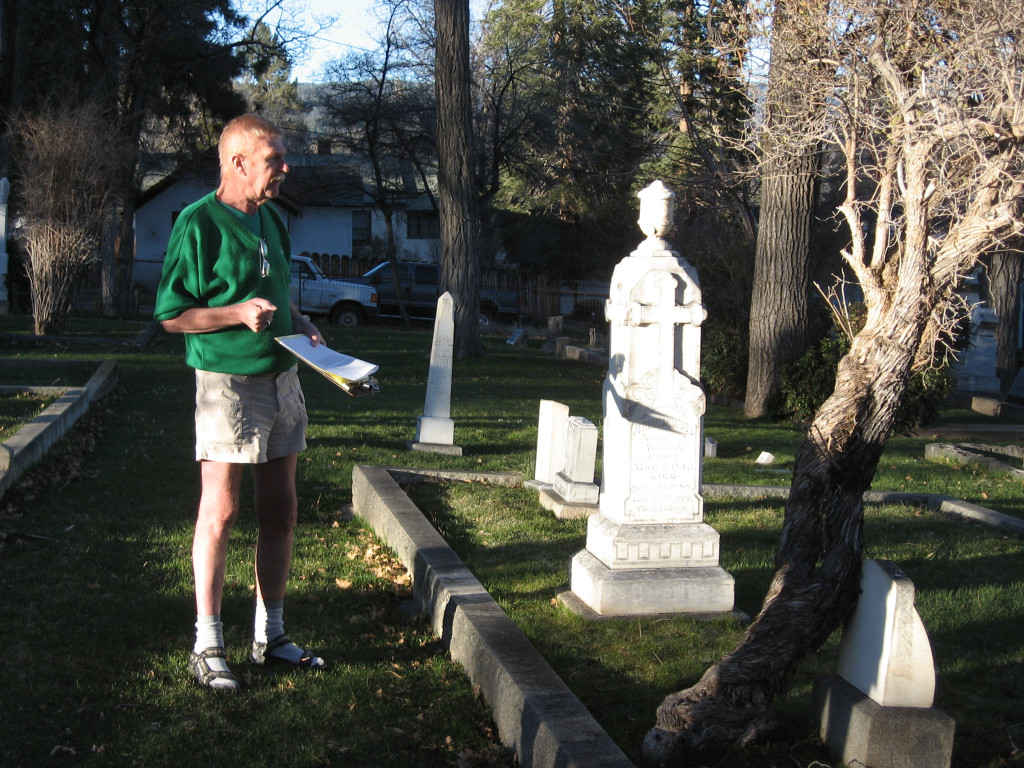
The grave of Jeremiah Wood at the Susanville Cemetery. March 17, 2016
Jeremiah Wood (1819-1889) was a true ‘49er arriving in California in that infamous year and spent most of his life mining in Nevada County. In the meantime, two of his sons, John and Denis came to Susanville in 1872 and opened up a meat market/butcher business. In 1887, Jeremiah came to Susanville to spend his final years with his son Denis, who by the way expanded operations into ranching, and six generations later the family carries on the tradition. This is truly remarkable, after all the old saying goes the first generation makes it, the second uses it and the third loses it. Only 13 percent of family owned businesses make it to the third generation. On a final note, the Wood Ranch still uses the brand that Denis created back in 1875, the DX.
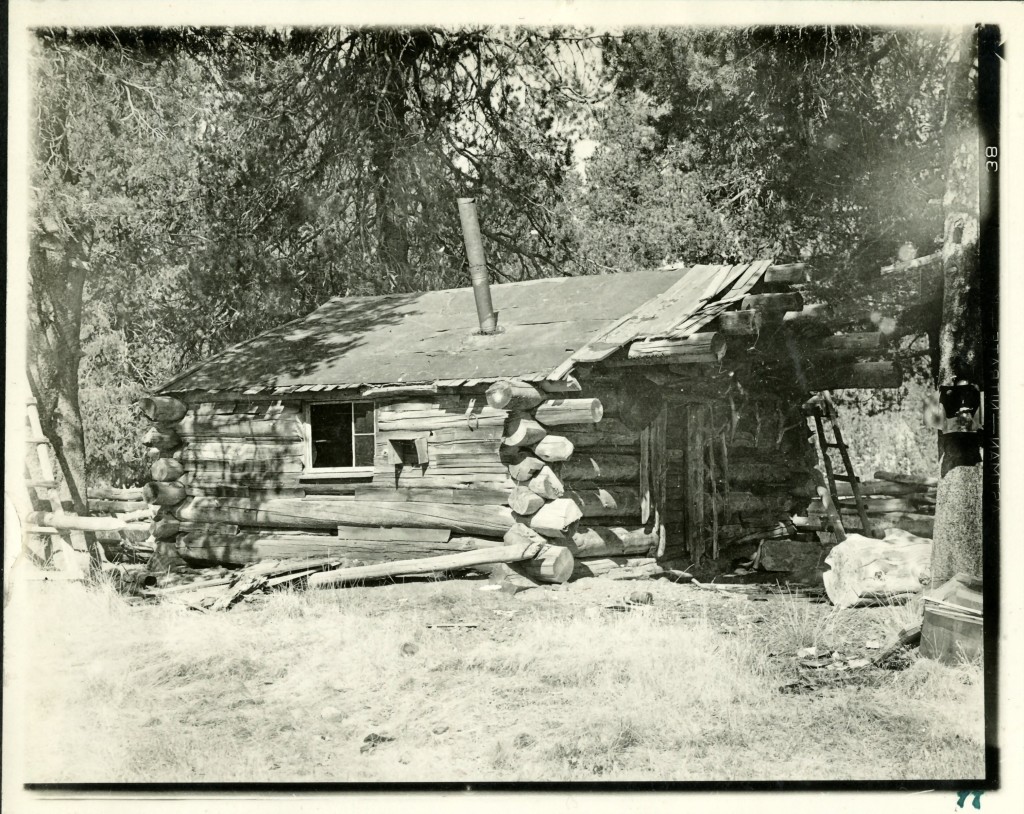
Logan’s cabin as it appeared in 1930. Courtesy of National Park Service
On the evening of November 11, 1885, Griffin Logan, foreman for J.S. Cone’s sheep operations, was murdered at his camp in the vicinity of Badger Flat, located in the northern section of Lassen Volcanic National Park, by Vincente Olivas, aka Mexican Ben. Olivas worked as a sheepherder for Cone, went crazy, and shot Logan for no apparent reason. He then threatened to kill four more men there, but his pistol repeatedly misfired, thus their lives were spared. The fate of Olivas took a strange turn of events. He turned himself in to the authorities. A trial was held in Susanville, where he was found guilty of Logan’s murder. His attorney filed a motion for a new trial and his sentencing was postponed until January 26, 1886. Housed at the Lassen County Jail with Olivas was inmate Holden Dick. Dick had been arrested and convicted for the gruesome murder of Samuel Shaw on the Madeline Plains. Dick was sentenced to death, but no date was set, as his case was being appealed to the State Supreme Court. Sometime in the middle of the night of January 23,1886, a vigilante mob broke into the jail and removed Dick and Olivas to a nearby woodshed and lynched them.
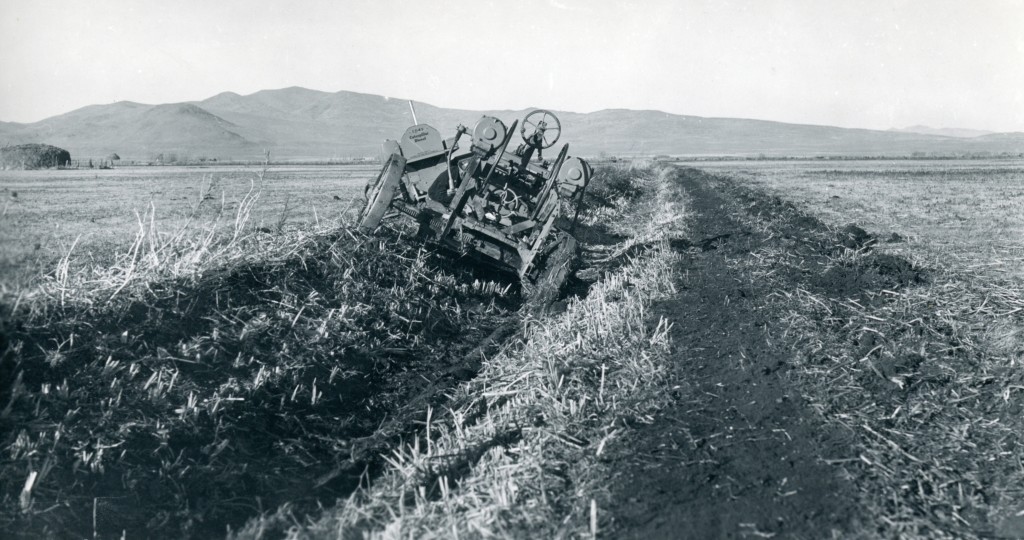
A slight problem cleaning the irrigation ditch on Tanner Ranch, 1936.
Progress is being made on the Pioneer Brand book. I thought a sample entry beginning with my own family and that of the brand of Lola L. Tanner that appears on the wall of that local institution. My grandmother Tanner would have had a royal fit, if she knew about it, she being a tee-toler.
Lola, was the eldest child and only daughter of Ed and Mary Murrer. Born 11 September 1899 at the family ranch in Willow Creek Valley, she had her first dream dashed in a hurry. In 1924, a debonair ranch hand Jim Scott, came a courting Lola. It was a whirlwind romance and they were married the following year. Only after a few months of matrimony, Scott forged his father-in-law’s name on a bank note for $500 and skipped town. He did not get far, and was arrested in Reno, Nevada. The marriage was annulled, and Scott repaid the money. However, this was his modus operandi for decades to come.
In 1927, Lola married Honey Lake Valley native, John Tanner. Like, Lola, his initial dreams were dashed early when his father, William, died in 1890, when John was only seven years old. His mother Jane, remarried to Charles Adams, an abusive type, so John along with brothers, William and Charley sought refuge with the Ravenscroft family and later at the Gibson Ranch. It should be noted that John’s father, William, had settled at Soldier Bridge in 1870 and registered his brand as the 20. That brand would be modified to the 30.
John and Lola made their first home near Standish, that John and his brother, William had established in 1915. In 1928, an opportunity arose where the Capezolli’s desired to trade their ranch with Tanners, and a deal was struck. Over the years, the Tanner’s expanded and bought the adjoining Hartson, Stamplfi and Whitehead ranches. While John and Lola have passed away many years ago, their three daughters: Joyce Cunha, Mary Rea and Ardene Purdy still own the ranch.
I am pleased to announce that the index of Book A, of Lassen County Brands is now online. This covers the period from October 20, 1864 when Thomas Watson was the first person to record a livestock brand to February 13, 1918, when the last brand recorded was for F. Lanigar & Son.
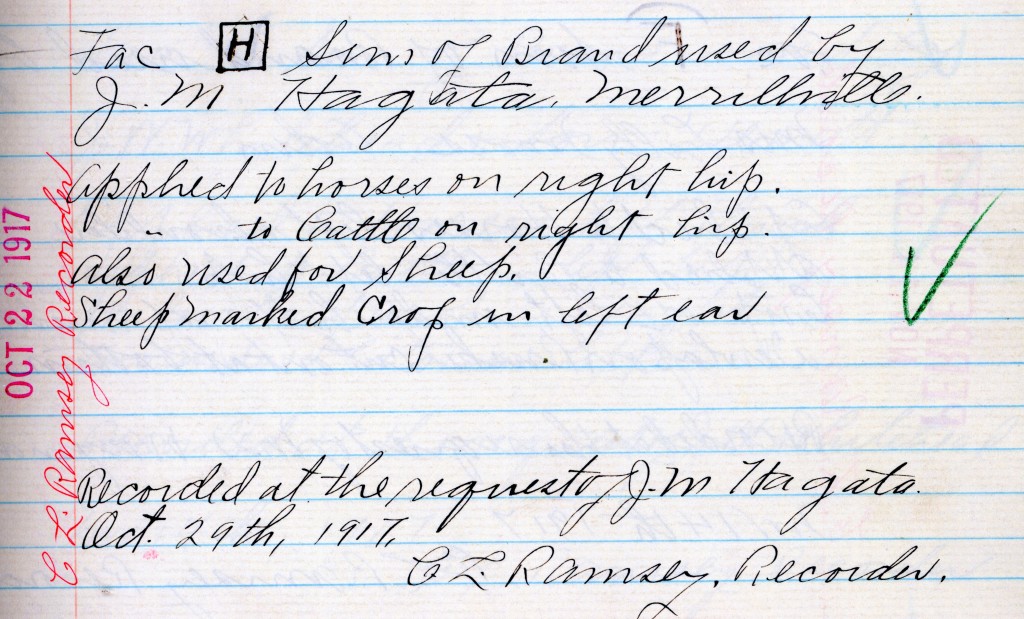
The index is quite interesting, especially who recorded their brand and who did not want. Take for instance the Hagata brand appears, but not the Wood brand or Wemple. Of some trivia, in 1875, Sarah Sornberger of Big Valley was the first woman to record a brand. In 1876, Charles Willard registered the first brand designated for sheep. While many associate sheep with the Basques, it was not until 1907 when Baptiste Alsaga became the first Basque in Lassen County to register a brand.
A lot has happened since I initially began work on the history of the brands featured on the wall in the Pioneer. Of course, a lot of work became derailed when I broke my hip in August. During nearly the six weeks when I was a Nevada resident recuperating, I did have a lot of time for thinking. Continue reading Pioneer Brands→
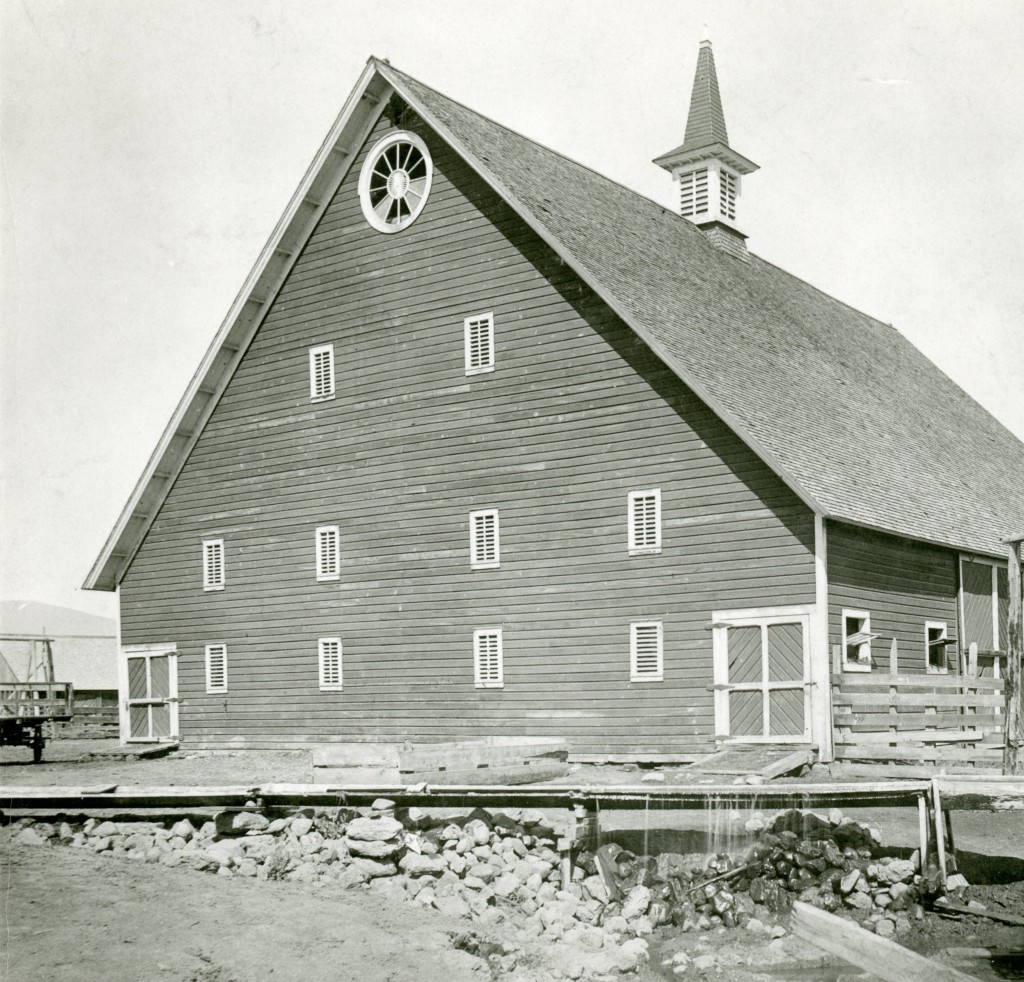
High Rock Ranch, circa 1910. Courtesy of Madelyn Mapes Dahlstrom
The High Rock Ranch in eastern Honey Lake adjoining the Nevada state line, owes a lot of its existence to the springs. Water in the desert makes a big difference.
Interesting enough, on February 7, 1862, U. Johnson Tutt laid claim to this remote outpost. Tutt made no improvements and abandoned his claim. In the late 1860s and 1870s, High Rock was a scene of rodeos, not quite the same as our modern day version. During this era, very few ranches had fences. It was customary, especially in the winter months to let their cattle and horses roam in search of feed. Each spring several localities were chosen for sites for round-ups and rodeos, and High Rock was one. Once the stray livestock were herded to a specific location, they were separated and branded. Continue reading High Rock Ranch→
In 1873, the Champlin Brothers: George (1827-1903) and Lester (1848-1907), Tehama County stockmen, incorporated this area for summer range for sheep. George Champlin, a ‘49er, was associated with Leland Stanford, via Stanford’s attorney, Ariel Lathrop, who happened to be Stanford’s brother-in-law, with the Vina, Tehama County ranch. In May-June 1899, Champlin and his partner, John Boggs, sold their Lassen County property to Jane Lathrop Stanford for $8,000, who immediately transferred the property to the Stanford University.