Tag Archives: Plumas County

The Almanor Post Office

Plumas Pines
The Almanor Post Office was located inside the Plumas Pines Resort

In 1932 Adelaide and Fred Smith established the Plumas Pines Resort on the west shore of Lake Almanor, located between the Lake Almanor and the relocated Prattville Cemetery. On July 15, 1932, Adelaide became the postmaster of the newly created Almanor Post Office. The post office was seasonal in nature, only open during the summer, i.e. May 1 to September 30.. It should be noted the Chester Post Office originally was a seasonal post office.

In September 1951, Adelaide Smith informed the postal authorities and the public that she would retire as the Almanor Postmaster effective September 30. It should be noted that her husband Fred had passed away in 1946, but she kept the resort running. In the spring of 1950, she sold the Plumas Pines Resort to V.Y. Briggs.

Of a final footnote, the following year on June 16, 1952, the Canyon Dam Post Office opened with Emmett W. Bishop, serving as first postmaster.
Donate

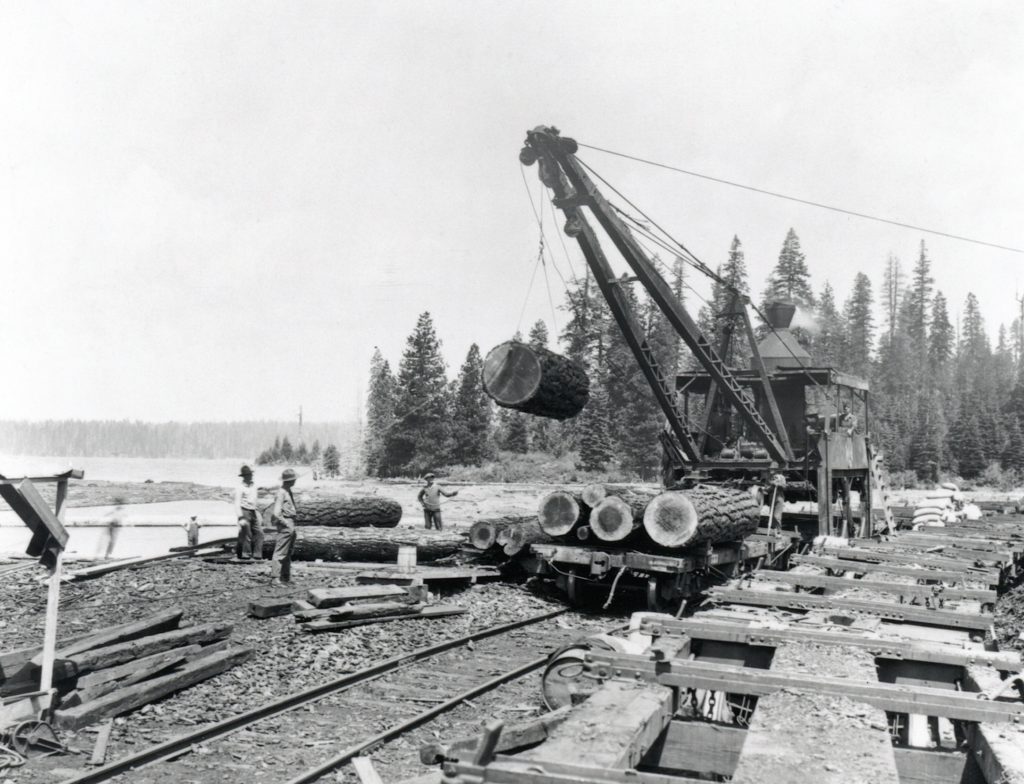
A Different kind of Log Reload Station

Reloading logs at Camp 14, Lake Almanor—Minnesota Historical Society

One of the challenges that Great Western Power Company encountered building the dam that created Lake Almanor was the removal of pine timber. They estimated between Almanor and other other reservoir site of Butt Valley that there was 200 million board feet of timber. In 1911, Great Western contacted the Red River Lumber Company who at that time still had not decided where they would construct its first mill. In July 1913, after much wrangling the two reached an agreement. Great Western would pay RedRiver one dollar per thousand board feet of pine timber removed—approximately $200,000. Red River estimated the cost at $500,000.

With the agreement, and time being of the essence as the dam would be complete and the flooding to create Lake Almanor would begin by the spring of 1914. That fall Red River put its loggers at a frantic pace to fall some 80 million board feet of timber, which would be subjected to initial flooding.

In the spring of 1914, Red River using a gasoline launch boat, would float the timber to the east side of the newly created lake by Big Springs. From there the logs were reloaded onto railroad cars and shipped to Westwood for milling. They would repeat a similar procedure in 1924 at Butt Valley and again in 1926 when Lake Almanor was enlarged.

Support

Logging the Peninsula

Red River logging map—Moss VanBlaircom

In 1916, after the Red River Lumber Company met its initial contractual obligation with Great Western Power Company to harvest timber for the Lake Almanor reservoir site, they began logging their lands to the west of Westwood.* Red River focused harvesting all the timber between Westwood and Chester, which included the Lake Almanor peninsula. In 1920/21 Red River had logging spurs going in north/south direction—the northerly one along Bailey Creek, the other south to the Peninsula. The latter, Red River established a sole logging camp No. 29.  The peninsula was unique, especially towards the lower end was forested with fir—not pine. The fir at that time was considered to have no value whatsoever, even to use as fuel for the locomotives. By 1922, Red River’s mission accomplished for that area met, and their main line rails made it to its intended destination on the south side of Chester.

*Red River received a reprieve from Great Western, since that company scaled back the initial flooding of the reservoir site by half.

Support

Lake Earl versus Lake Almanor

Lake Almanor, 1927.

While some of the more astute readers probably have read or heard about how Lake Almanor was named, many may not be aware that it was not the original designation of the reservoir that flooded what was originally known as Big Meadows.

Julius Howells was a civil engineer who initially did work in the Feather River country. When hydroelectric power was coming to the forefront in the 1890s, he became part of that movement. In 1901, two things happened. Howells went back to examine the upper watershed of the North Fork of the Feather River, known then as Big Meadows. Howells also affiliated with well known engineer James Dix Schuyler of Los Angeles. When Howells met with Schuyler he provided with his findings of developing a hydroelectric system of the Feather River. Schuyler introduced Howells to Edwin Earl, who had done so well financially in the citrus packing industry, was branching out to invest other endeavors.  Edwin Earl along with his brother Guy were impressed and created the Great Western Power Company to make Howells’ project a reality. In 1902, Howells officially recording was for the creation of a new reservoir to be named Lake Earl. It would be twelve years before the lake would be created and the initial name had been abandoned. It would be christened Lake Almanor for Guy Earl’s three daughters. Years later, Alice Earl Wilder recalled the origin of the name Lake Almanor:

”Mr. Julius Howells was a welcome guest in our home who said Children, call me Uncle Julius. He asked my father to name the new lake. My father and mother spent many hours finding a name they liked. It had to have a name pleasing to the ear it had to be readily pronounced, spelled and easily read. They did not want a foreign name and were not fond of surnames. They wanted to name it after their four children, Alice, Martha, Elinore and Guy. Many combinations of these names were attempted. It was hard tom get ‘Guy’ in. Finally my father settled for a name that was simple and musical and of which three of the four children would be part—and also in the right order—eldest, next eldest and youngest. The lake was named Almanor. The AL for Alice, the MA for  Martha and the Nor for Elinore.” 

For the record, there are certain early maps that indicate the spelling of the lake with an “e” at the end—Almanore.

Support

Where Are We—Antelope Lake

Antelope Lake, January 26, 2020

Antelope Lake in Plumas County is a popular recreational spot for a number of Honey Lake Valley residents, as well as nearby Nevadans. It is part of the State Water Project of the California Department of Water Resources. The project’s original intent was to provide water to Southern California to augment that of the Colorado River. The State Water Project has 21 dams and over 700 miles of canals, pipelines and tunnels.

Antelope Lake is part of the project. The 113 foot tall earthen dam was constructed in 1964. It has a surface area of 931 acres with a maximum capacity of 47,466 acre feet.

Tim

Family Opinions

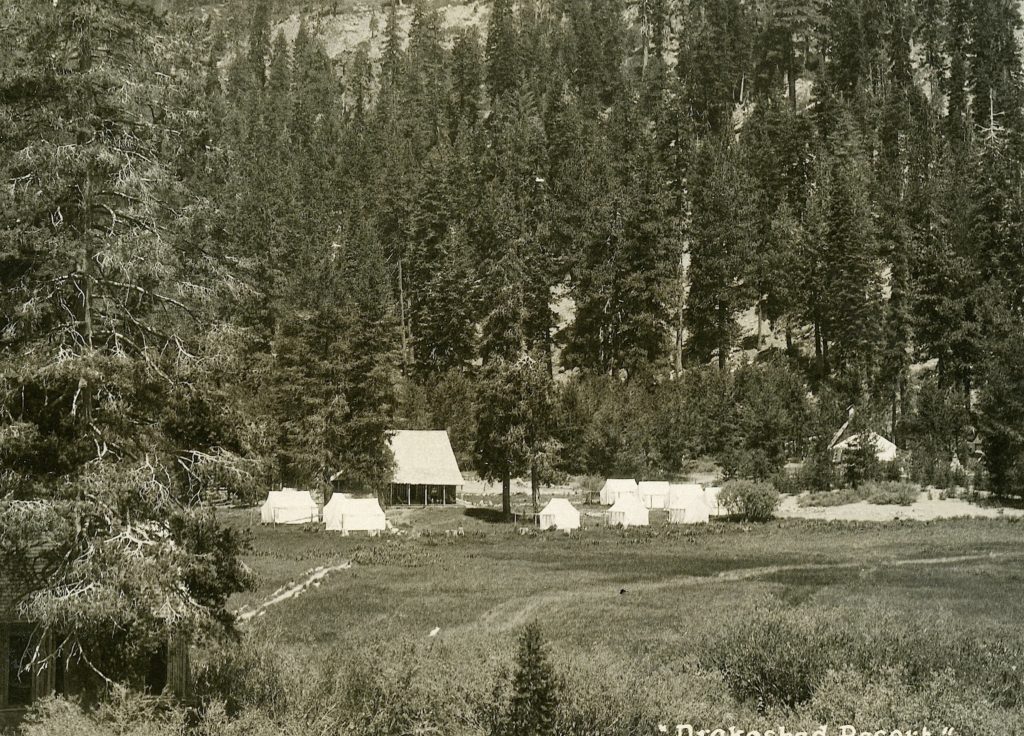
Drakesbad, circa 1930. Courtesy of the Sifford Collection

Many a soul has experienced over time criticism from family or friends over a purchase or taking a new direction in life. This scenario played out at Drake’s Springs.

In June 1900, a Susanville school teacher, Alexander Sifford, at the urging friends, went to Drakes Springs for the health benefits of the hot springs. The experience was more than Sifford ever dreamed of.  Before he returned to Susanville, Sifford entered into an agreement to purchase Drakes Springs.

When Tom Sifford, Alex’s brother, heard the news he thought his brother was just plain crazy for buying the remote mountain property for $1,000. Because of Tom’s initial reaction, Alex did not divulge the entire financial transaction. The $1,000 was a down payment. Alexander Sifford paid $6,000 for Drakes Springs, with annual payments of $1,000.

Alex Sifford, along with his wife, Ida, and two children, Pearl and Roy would transform the place into Drakesbad and continue to operate it until the 1950s when it was finally sold to Lassen Volcanic National Park. As for Tom Sifford, it would be a decade later before he made his initial visit to Drakes Springs.

Support

Before Drakesbad

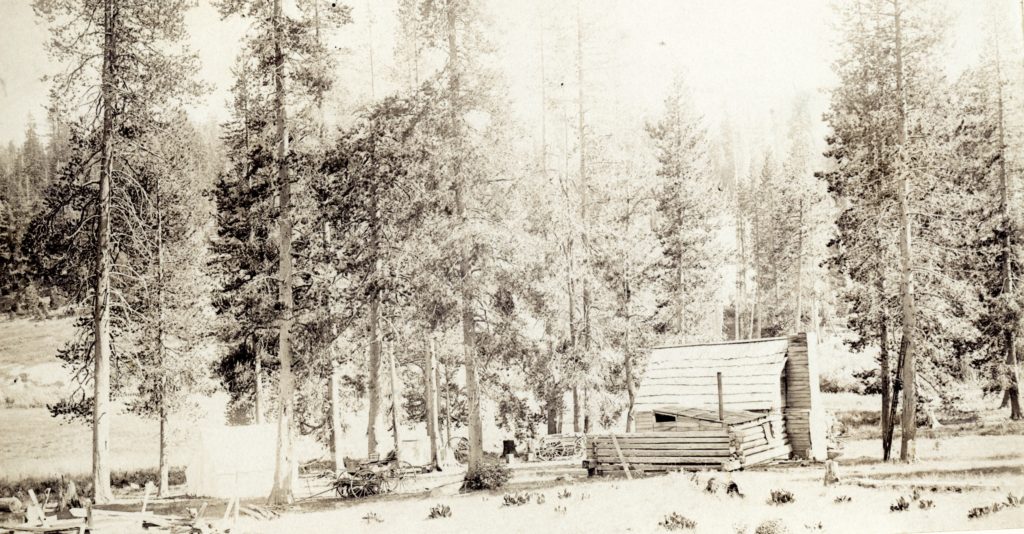
Drake’s Springs, 1887–Sifford Collection

For those not familiar with Drakesbad it is a “historic guest ranch” located in the upper end of Warner Valley in Lassen Volcanic National Park. More about this in the months to come.

Drakesbad contains a number of hydro-thermal features such as Boiling Springs Lake and Devils Kitchen. It was the hot springs at Drakesbad proper that garnered a lot of attention. The first person to locate there was Thomas Malgin, a sheepman. In 1875 Malgin constructed a primitive bath house utilizing  the hot springs. When time permitted he would be a tour guide for visitors to take them to points of interest, including Cinder Cone.

In 1880, Malgin moved on and abandoned the place. In 1885, E.R. Drake moved in. Drake had been in the region since the 1850s. He was a jack-of-trades—miner, guide, fur trapper, saloon keeper, etc.

Drake was originally a squatter. In 1887, Quincy resident, F.B. Whiting purchased Malgin’s 80 acres at a Plumas County delinquent tax sale for $8.11. In 1888, Drake paid Whiting $50 for the property. In time, Drake would file for 320 acres of government land patents surrounding his property, eventually owning 400 acres.

In 1890, the industrious Drake transformed his modest log cabin into a small lodge, that would be enjoyed by numerous visitors decades to come. In time, his place simply became known as Drakes Springs.

There were two drawbacks that hampered the resort’s potential, though it was not an issue for Drake. These were poor road conditions and a short season. For instance the trip from Susanville to Drakes Springs was a two-day journey. The other is that the location experiences heavy snowfall. Thus, the operation was basically what we would refer to today as one from Memorial Day to Labor Day.

Support

Lassen Peak Eruptions of 1914

Lassen Peak eruption, June 14, 1914. Courtesy of Dolores Gasperoni

On May 30, 1914 Lassen Peak’s long awaited volcanic eruption made its debut. For some it was not unexpected from the many frequent ‘rumblings” around the region. On Sunday June 14, 1914 the peak had its most dramatic eruption to date. An ashen plume of smoke was sent some 2,500 feet skyward.

Of course, there were lots of theories as to what was the cause of the eruptions. One of the most interesting came from the residents of Chester and Big Meadows—the latter being transformed into Lake Almanor. Some were under the impression that the filling of Lake Almanor that spring triggered the eruptions.

Whatever the case may be, activity did not slow down with 110 eruptions recorded by the end of the year. One thing that observers and scientists alike found perplexing was the lack of lava or incendiary evidence. That would change in 1915.

Support


Johnsville, Plumas County

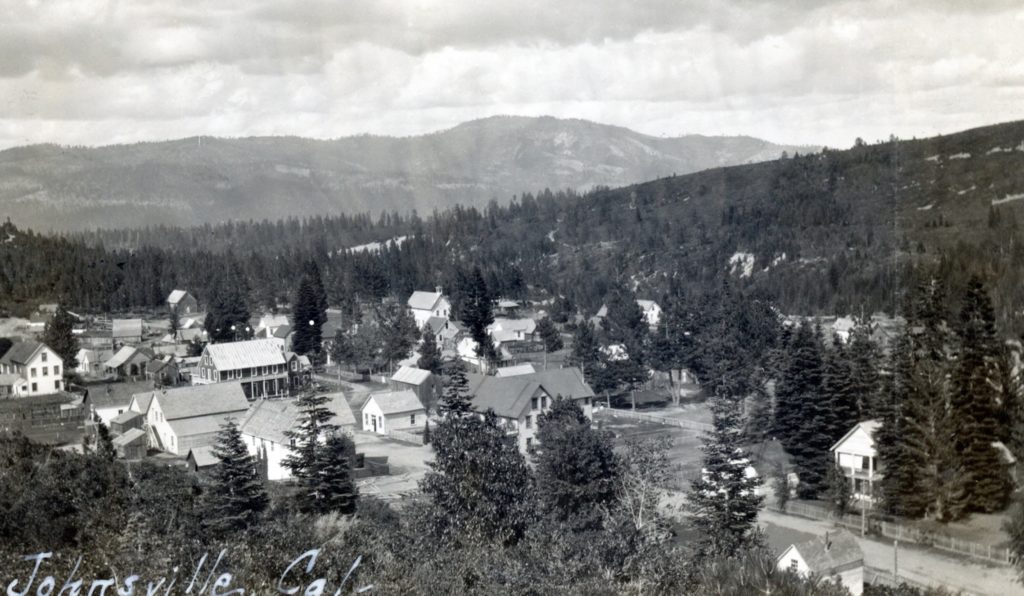
Johnsville, Plumas County, 1911—-Sifford Collection

In keeping with yesterday’s topic of exploring, one may want to include the former mining community of Johnsville, Plumas County, near Graeagle. It is adjacent to the Plumas Eureka State Park that was established in 1959.

Johnsville came to the forefront in 1851 with the discovery of the Eureka quartz vein. After the early 1900s mining activity fluctuated like so many other mining communities. The last of mining came to an end during World War II.

It is well worth the trip and for the adventurous minded you could make trip via Milford grade to Beckwourth.

Tim,

The Roop Land Register

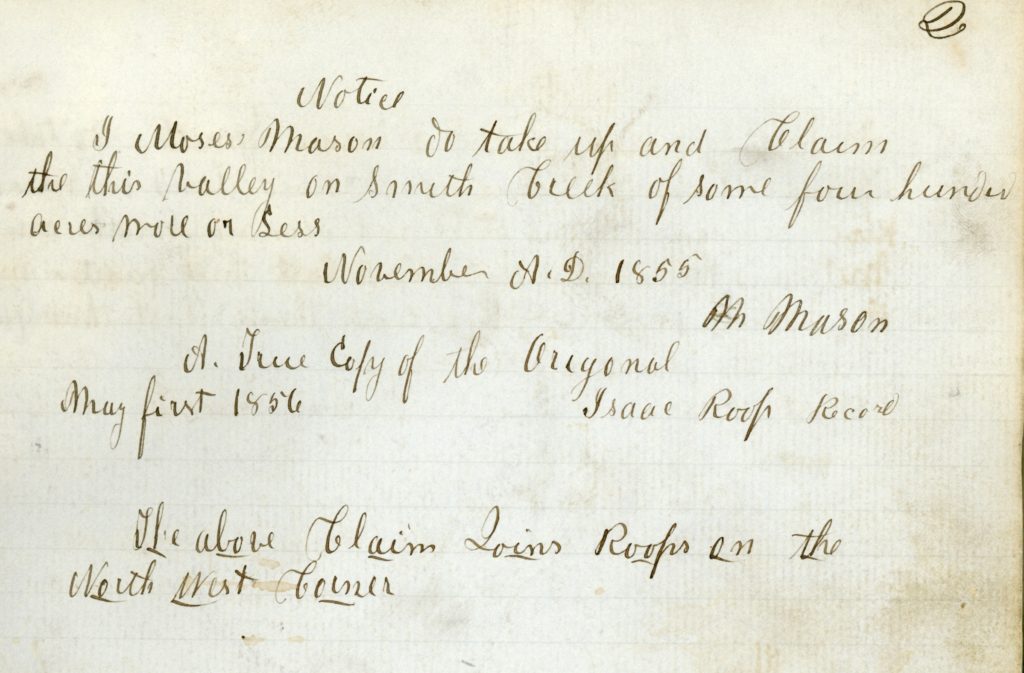
Moses Mason was the second claim recorded in Roop’s Land Register. He settled on present day Susanville Ranch Park and referred to Piute Creek as Smith’s Creek.

In the spring of 1856, with settlers arriving in the Honey Lake Valley they realized they needed to form some type of self-government. They did not believe they were part of California and did not want to be a part of the Utah Territory, there was no Nevada then. On April 26, 1856 a group of twenty-men assembled to form the Territory of Nataqua.

As to land matters, any male twenty-one years or older could claim 640 acres of land to be recorded with the Recorder, which Isaac Roop assumed that role. A number of claims had vague descriptions. Whatever, the case may be, it worked for them. In 1857, some individuals began documenting their claims or the sale of such in the form of a deed with the Plumas County Recorder. By 1859, a few hardy souls ventured all the way to Marysville to file a claim with the United States Government Land Office, the nearest one available. By 1861, the Roop Land Register was rarely used.

When Lassen County was formed in 1864, the original County Board of Supervisors did something unique. They paid Plumas County to transcribe all land transactions of Honey Lake and Long Valleys prior to the formation of the county.  This is why Book A. Deeds, Lassen County starts in 1857.

Subscribe