Tag Archives: NCO Railroad

The Johnstone Letters

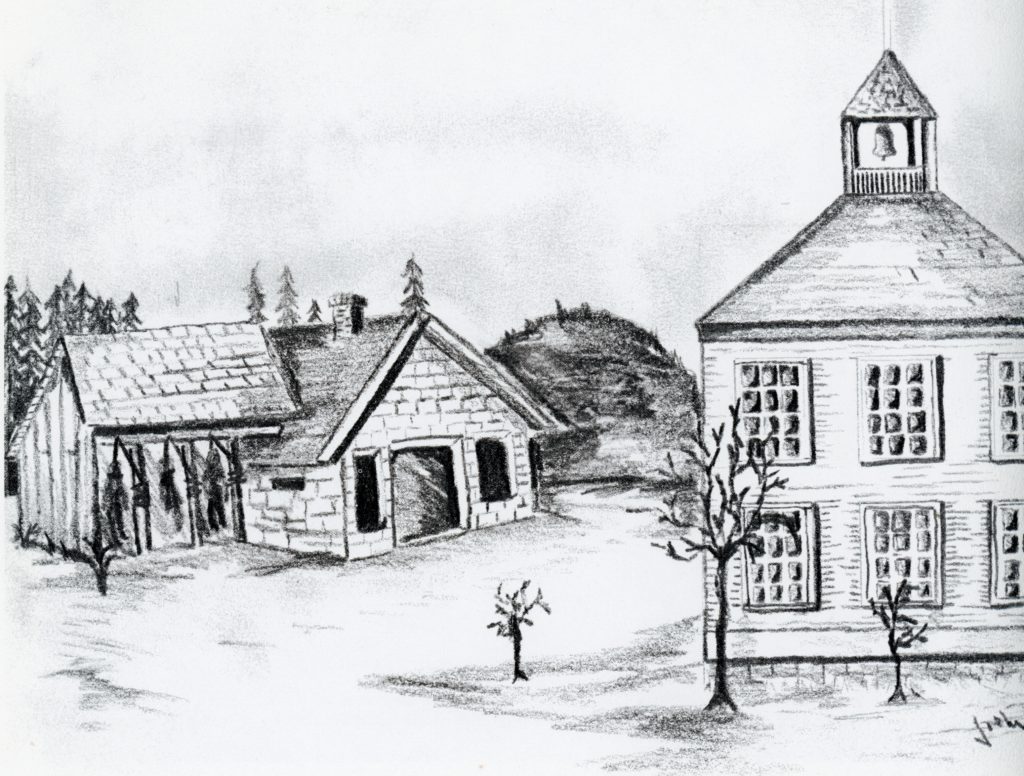
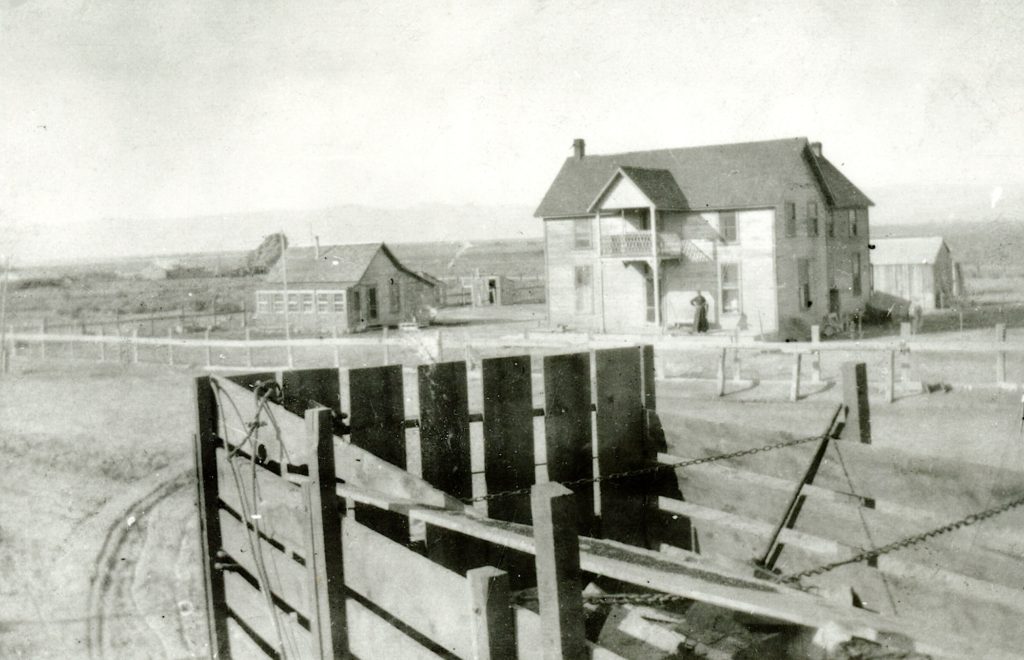
I.W. “Doc” Smith’s, Hot Springs Hotel, circa 1907, north of Wendel

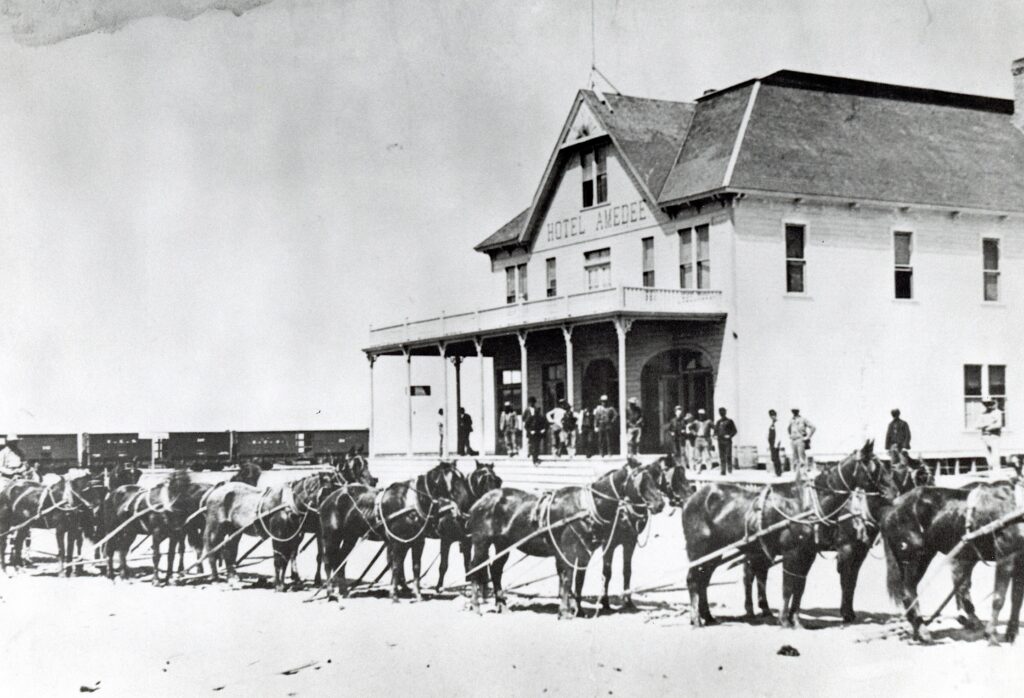
Earlier this year, a friend sent me a copy of a 1890 letter between the NCO Railway and Cedarville merchant, T.H. Johnstone about a business proposal at Liegan. That triggered a memory. In 1982, a paper dealer from Redding contacted me about a collection of  letters dating from the 1890s to the early 1900s between T.H. Johnstone, and his brother Samuel A. Johnstone. Sam Johnstone came to Amedee  in 1893, and would later the become owner the Amedee Hotel from 1901 to 1907. The letters opened a proverbial pandora box, with topics such as the tragic death of Maud Bentel and the death Cora Johnstone, the first person interred in the Amedee Cemetery. Below, a is a 1899 letter about the NCO and  extending its line northward.

April 25, 1899 – T.H. Johnstone, Cedarville,

Dear Tom:  Are you having any maple sugar this spring, if so can I have some of it, 2 or 3 bricks for my own use. Well Railroad business is somewhat a standstill. Mr. Fulton has resigned his position taking effect May 1st. Do not know who will be his successor, think Ed Smith will. Smith is the head engineer on the. road is a fine man, has got charge of all trains. None think Amedee will be moved to Doc Smith’s place, that is at the foot of the hill where those warm springs are. They have built a side track there and level it up nice. Also built  water tank that hold 42,000 gallons of water. Mr. Gest calls the place Smith. They expect to move the shipping corrals up there for fall shipping of stock and think that the depot for Honey Lake merchandise will be there, but do not know yet as people are guessing at most of it. Smith told me if he had anything to do with it after Fulton. left, he would give me all the information he could. Are not doing much now as they are out of steel and will be summer time before they can get any.  Yours Respectfully Sam.

Never miss a story, click here.
 

The NCO’s Slow Demise

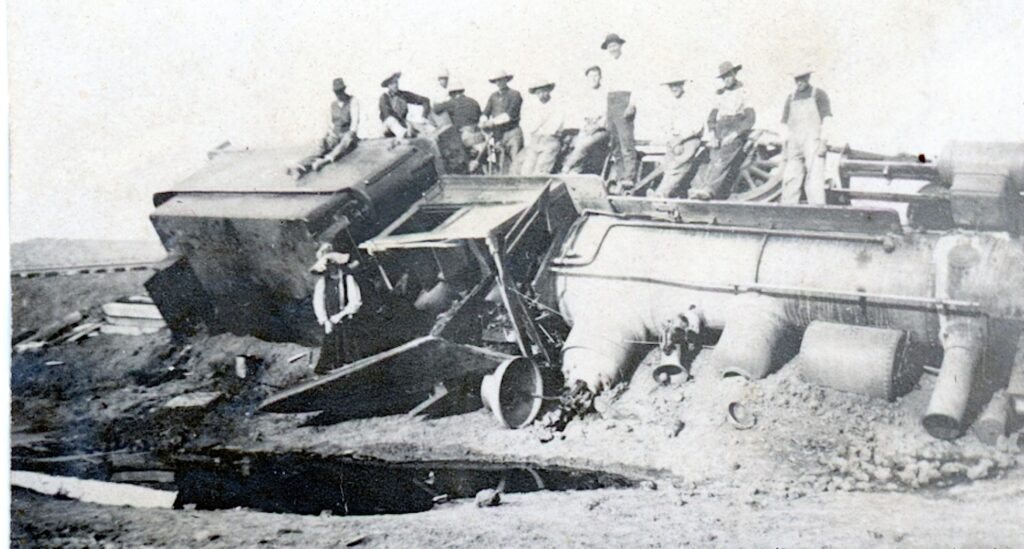
One of many NCO wrecks

The Nevada-California-Oregon Railway, the nation’s longest narrow gauge railroad of the 20th century had an illustrious history, depending on your viewpoint. From 1884 to 1925, the NCO was owned by the Moran family, New York bankers. Originating from Reno, Nevada its goal was the final destination  to The Dalles, Oregon on the Columbia River. It took the railroad 32 years just enter in Oregon, at Lakeview, the southern portion of that state, and  it did not go any farther. In 1914, the new general manager, Ramsey Cox,  remained optimistic of the NCO’s future and times were good. It did not last long. Three years later, the NCO sold a 63 mile segment from Hackstaff  (Herlong) to Reno to the Western Pacific.

In 1921, the NCO attempted to abandon  the railroad, but State Railroad Commission did not approve it. The NCO  limped along, as its 159 mile railroad went from to nowhere to nowhere. Eventually, the NCO had a suitor in the name of Southern Pacific Railroad  On April 30, 1925,  an agreement was reached wherein the Southern Pacific acquired the NCO. It was not publicly disclosed as to the purchase, price. It was noted the transfer included stocks and bonds, but again no valuation. It was not until 1926, the Southern Pacific gained physical control of the NCO. In 1927, the railroad bed was converted to standard gauge, and the narrow gauge railroad was officially over. However, the Moran’s operated the NCO as a shell company and it finally ceased in the fall of 1929.

Support by subscribing.


P.S. I did locate the Agreement of Sale between the NCO & Southern Pacific and will provide that information in forthcoming post.

Is Some Railroad, Sure

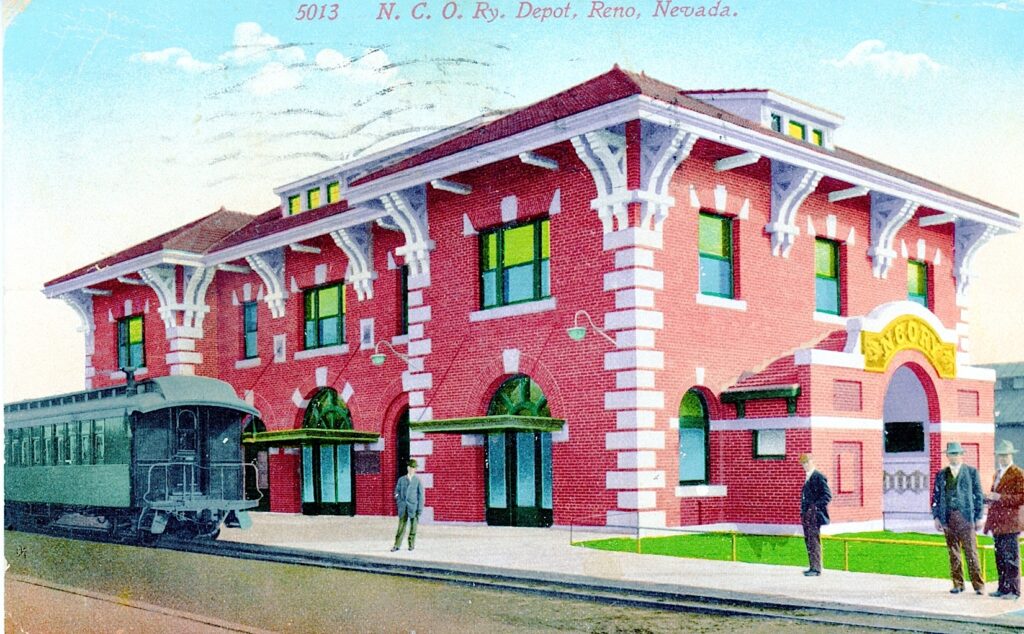
NCO Depot, Reno, Nevada circa 1911

In December, I wrote that I would reading the Lassen Advocate for 1898 and 1914. From time to time I will publish extracts that it may be of interest.

Lassen Advocate 2 January 1914 5;4 – Is Some Railroad, Sure. For a railroad that has been running trains for twenty-eight or thirty years, the NCO railroad has a “peacherino” as the following from the Reno Journal of December 27 will attest.

“Traveling at a rate of about twenty miles per hour, the NCO passenger train due in Christmas evening was wrecked that afternoon at Chat, a small station situated one mile south of Plumas Junction.

“Fortunately the wreck did not cause injury to the train hands or passengers, excepting slight hurts by fireman Bert Pratt, who sprained a leg where he jumped from the engine.

“The wreck was apparently caused by a spreading rail and the engine overturned, after plowing up the frozen ground to a depth of four feet distance of a car length.

“The mail car was partially overturned although the remaining coaches to the train remained on the track. The wreck occurred at 5:05 o’clock Thursday afternoon and the passengers reached Reno 25 hours late.”

It should be noted that Mother Nature played on a role. The Christmas Eve storm dumped 3 1/2 feet in Susanville. Reno is the banana belt” so to speak in terms of weather. Due to rain shadow effect of its location, it is much drier than other east slope communities of the region.

Tim

An NCO Critic

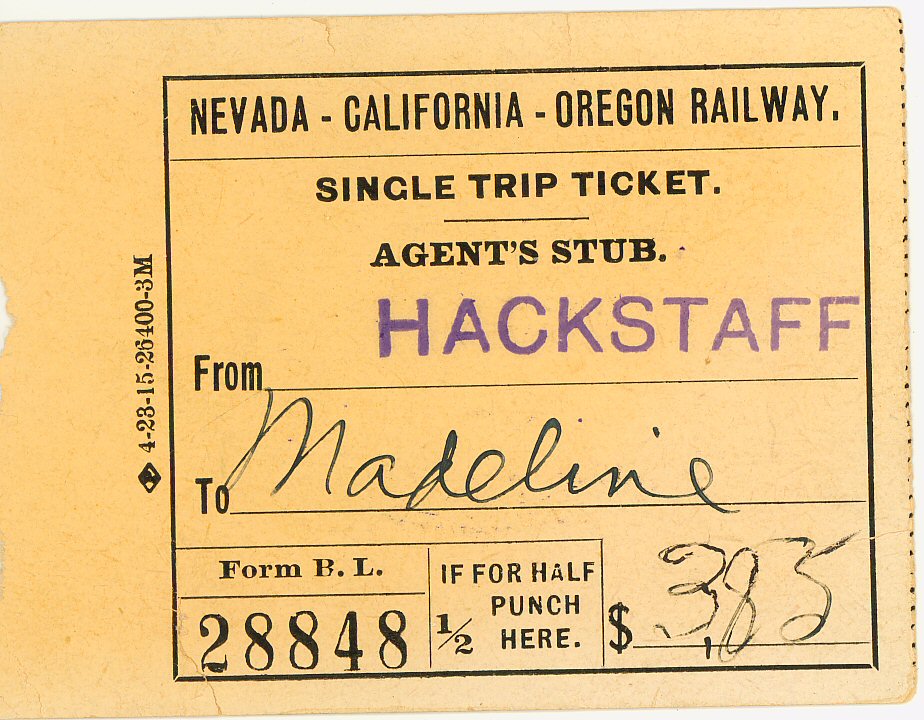
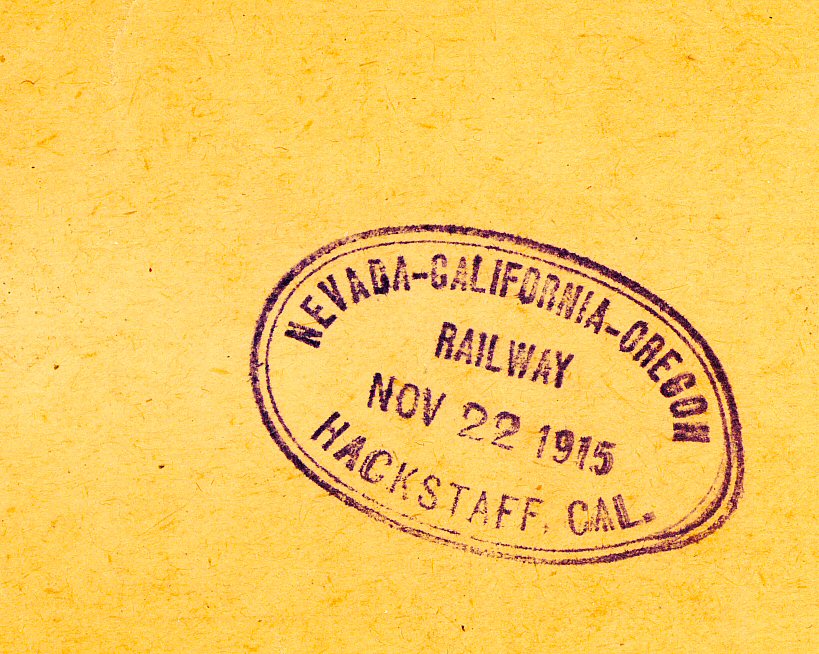
A November 22, 1915 NCO ticket stub. Courtesy of Dorothy Capezzoli

It is the beginning of April and I just happened to be wearing my  favorite cranky pants. I have been dealing with a critic(s) about the Nevada-California-Oregon Railway (NCO). who insinuated that my knowledge only pertained to Lassen County. It’s far from the truth,. People who have been acquainted with my research over the decades know that the said criticism is erroneous .

However, the truth be known Lassen County played a substantial role in the NCO’s history. When the NCO finally reached  Lakeview, Oregon in 1912, the length of the narrow gauge railroad was 241 miles. Over the half that mileage, 124 miles was in Lassen County. Over the railroad’s troubled existence, it operated in Lassen for 43 years.*. Translation the railroad operated in Lassen County longer than any other jurisdiction. While, Sierra County had the shortest trackage within its territory, the NCO’s presence in that county was 35 years, far greater than Modoc County of 21 years.. Enough said.

Tim

*I arbitrarily use 1927 as the end date of NCO, since that is when the line was converted to standard gauge.

Colgate Toothpaste & A Wendel Connection

Highway directional sign to Wendel

What does Colgate toothpaste and the former railroad community of Wendel have in common? Not much, but a lot.

This is one of those quirky tales  that involves an interesting inquiry, those I have numerous to draw from.  Certain instances such questions can be rather confusing, because the person making such an inquiry is actually clue less of the topic.

In 1992, I received a call from Germany. The caller was attempting to make some initial plans for her boss to visit Wendel, Lassen County. Some of the questions left me perplexed. The first, I could handle question about the nearest international airport, though caller seemed dismayed that Wendel did not have one. The next question, I knew I was entering the “twilight  light zone” wanting to make hotel arrangements at the Holiday Inn in Wendel.

Wendel Store, circa 1925. Courtesy of Alda Riesenman

In due time, I was connected to the inquirer-in-chief, Armin de Wendel. He is a part of the Colgate family The family were quite successful with their toothpaste enterprise and were prominent in New York City society. The family were acquainted with the Morans, also New York City residents, and the owners the Nevada-California-Oregon Railway. The Morans persuaded the Wendels into becoming major bondholders for the NCO. The Moran’s in turn honored the family naming a railroad station after them.

When I explained to Armin Wendel the realities, that Wendel was not thriving metropolis he envisioned, and after he received my photographs, he soon lost interest and cancelled travel plans to Wendel.

Subscribe


My Dinner With E.V. Spencer

E.V. Spencer—Ivajean Wheeler

Ephraim Van Buren Spencer (1836 -1904) was a fascinating individual.  In his 1906 biography, as a testament this is the beginning sentence, “No name is more intimately associated with the history of Lassen County than that of Judge Spencer.”  I am going highlight four aspects of his life.

Roop's Mill
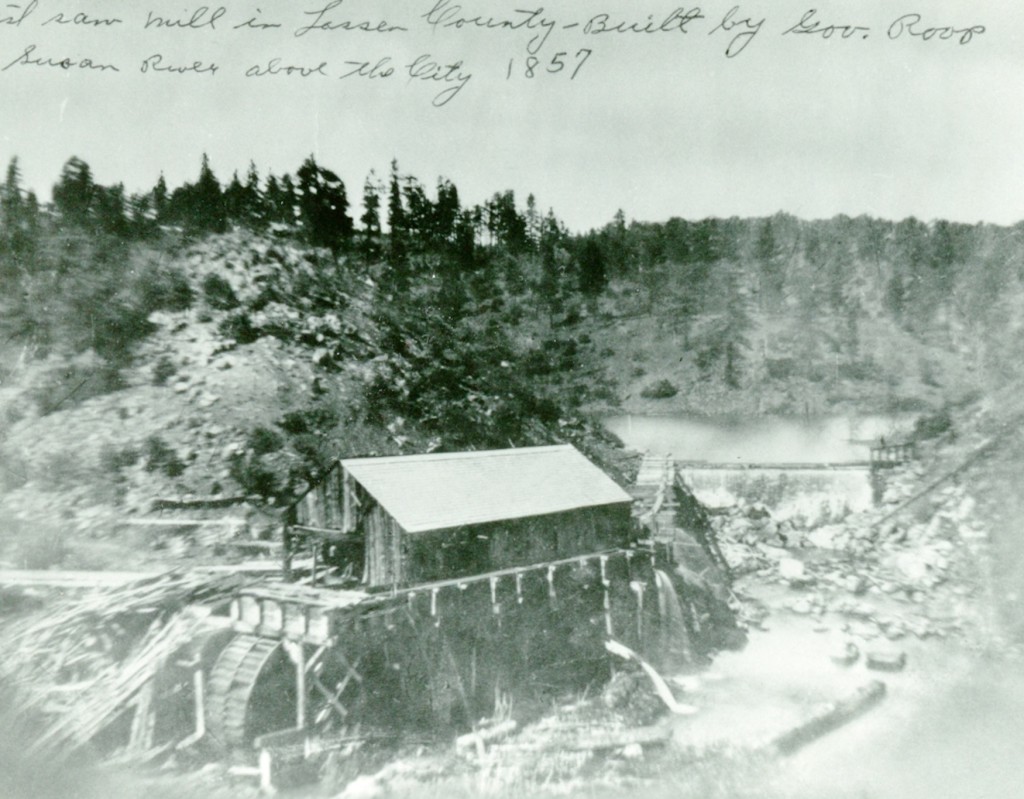
Roop’s mill taken in the early 1860s

The Lumberman. In 1859, E.V. and his brother, Luther Spencer, settled in Susanville. An opportunity arose, and they purchased the Roop Sawmill on the Susan River, just below Hobo Camp. Very little known as to mill’s operation. It should be noted that it burned down in 1868. What really intrigued me was one of the mill’s employee-Lemericus Wyatt. In April 1859, Wyatt along with Edward Clapper and Peter Lassen were on a prospecting trip in the Black Rock Desert. There was an early morning ambush that claimed the lives of Clapper and Lassen, and Wyatt escaped. Wyatt confided to E.V. Spencer what happened.

An artist sketch of the lynching of Holden Dick and Mexican Ben.

The Attorney. Spencer was a sawyer at the mill. He suffered a major arm injury that resulted in a career change. He became a lawyer. In 1864, he was elected the first Lassen County District Attorney. He only served one term. He was proud of the crackdown of gambling, and while it subsided, it never went away. As an attorney he was noted for his eloquent speaking abilities. He had an illustrious career as an attorney. One of his clients was the infamous Holden Dick who was accused of the gruesome murder of Samuel Shaw in 1883. Thus, the legend of the Holden Dick Mine was born. It was purported that Dick gave Spencer a map to the mine’s location.  A bit of trivia, Dick’s first name came from Thomas Holden, who was Spencer’s  wife’s relations..

The Assemblyman. In 1894, Spencer was elected to the California Assembly.  While he only served one term, he was admired by his colleagues who referred to him the as “Lassen County’s Grand Old Man.” One of his causes was the suffragette movement. He was instrumental in getting Amendment 6 on the ballot in 1896 to approve women’s rights in California, but the measure failed.

The Railroad Man.  Spencer was the probably the strongest advocate to have Susanville serviced by a railroad. It was his contention that Susanville would be just another “sleepy hollow” without one. In 1885, the residents of Susanville raised $500 to send Spencer negotiate with the Morans, the new owners of the Nevada & California Railroad (later to become the NCO). to build the line to Susanville. The Moran’s informed Spencer that they did not have the money to extend the line north. Spencer was optimistic, since the railroad did a preliminary survey along the west side of Honey Lake to Susanville. On March 31, 1887 Edgar Heriot the new general manager of the railroad announced they would commence work of 45 mile extension from Junction House to Brubeck’s Ranch on the east side of Honey Lake. Spencer did not sit idly by about the news of the bypass. It’s an interesting story for another time. In 1899, Spencer lobbied the railroad to build a branch line from Hot Springs (Wendel) to Susanville. It would be a most interesting dinner discussion about Spencer on this topic.

Summation. Spencer’s life was hardly dull. For instance, in the late 1880s his family would vacation at Drake’s Springs, today known as Drakesbad. The seed for creation of Lassen Volcanic National Park was planted via his son-in-law Congressman John Raker.

To Support, Please Donate or Subscribe

A Railroad With Many Names

NCO Freight Depot, Reno, 1905-Marie Gould

The Nevada-California-Oregon Railway (NCO) initially had several names. A reader chastised that an article I wrote and labeled it the NCO, though when in fact it was known as Nevada & Oregon. While guilty as charged, for simplicity I just refer to the railroad as the NCO.

To set the record straight here is origins of the multiple names and nicknames of the said railroad.  Established in 1879, its original name was the Nevada & Oregon Railroad Company. In 1885, the name was changed to the Nevada & California. In 1888, the name was changed to the Nevada-California-Oregon Railway. The former names were still; valid due to unpaid bonds under those names. On January 1, 1893 the Nevada-California-Oregon  (N-C-O) was officially adopted for the railroad properties.

These initials N-C-O became target for criticism of the railroad’s poor service. The N-C-O received such dreadful titles as the Narrow Crooked & Ornery, the Northern California Outrage, Never Comes Over and the Nevada-California Occasional. One of my favorites was peened the J.M. Tremain editor/publisher of Susanville newspaper the Lassen Weekly Mail. Tremain called the N-CO a tri-weekly. “It goes Reno one week and tries to return the next.”

Support by subscribing.

An Open NCO Railroad Question

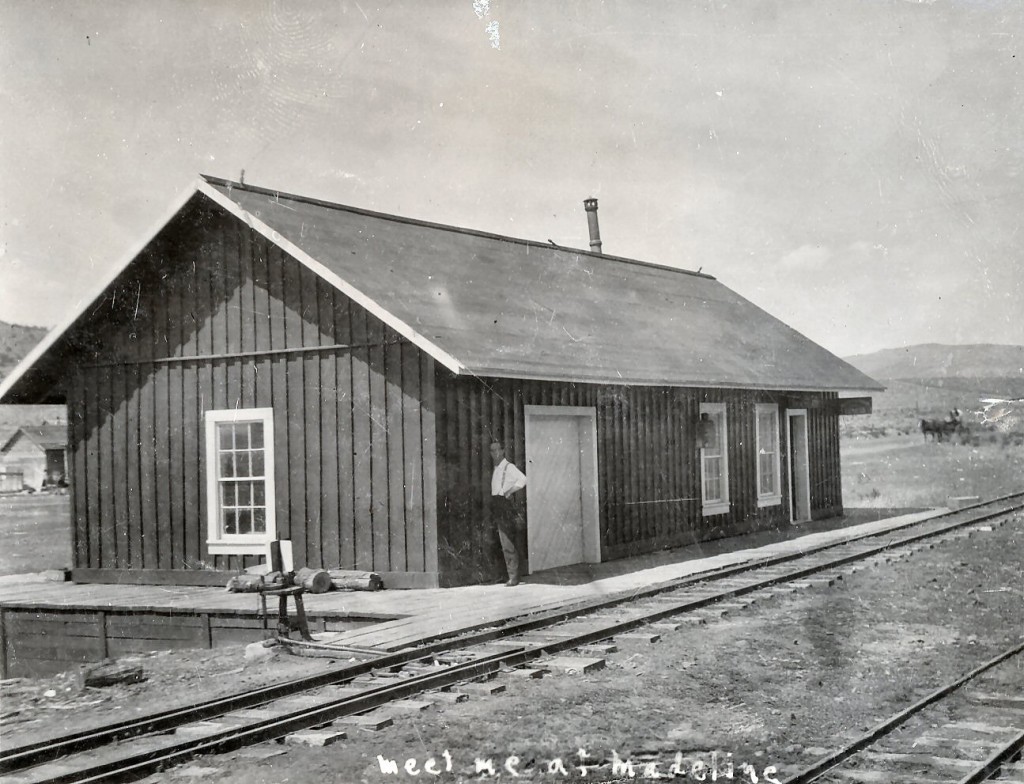
Madeline Depot
NCO Depot, Madeline 1910-Carole Dustrin

For those stuck in the winter doldrums I have a nagging question on my mind. When was the laat NCO train to depart from Wendel?  In 1925, the Southern Pacific acquired the NCO. In July 1927 that company began the standard gauging the NCO at Wendel.

It should be noted that in the summer of 1917 the NCO sold its southern portion of its line, a 64 mile segment, from Rayl (Herlong) to Reno. On January 30, 1918, the last NCO train to depart  from Reno occurred. In 1922, the NCO was granted to abandon sixteen miles between Rayl now known as Hackstaff  to Wendel. The last train on that segment happened on October 31, 1922. Why were these two events well documented, but not Wendel?

Tim

Those January Snowstorms

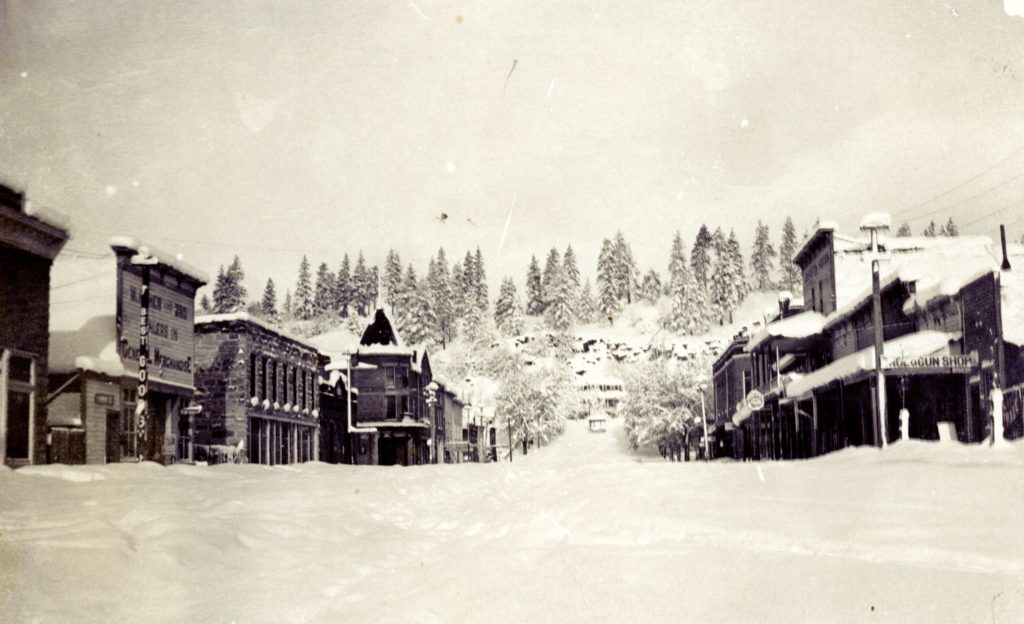
Main Street, Susanville, January, 1907

Typically, the largest snowstorms in this region occur in the month of January.  It was January 1914 that proved to be a record breaker with 93 inches of snowfall that month. It also happen to be a rainy month with  9 inches of rain. In all, the total precipitation for the month was 18.17 inches.

The weather conditions was problematic for the completion of the Fernley & Lassen Railroad to Westwood. Due to the weather whiplash of rain and snow, the soil became saturated and prone mud slides in the Susan River Canyon. Railroad officials, of course, had a lot to worry about, as the construction with the Red River Lumber Company had a completion date to Westwood by. March 1.

In a related railroad matter was the NCO train delays due to frequent wash outs of the track. The US Postal Service had a  contact with the NCO to deliver mail originating from the East. Since the NCO had a poor delivery record of the mail, the Postal Service  by mid-February ordered all mail would be re-routed via the Fernley & Lassen. Many residents of the Honey Lake Valley rejoiced after this announcement, as regular mail delivery would be six days week.

Tim

P.S. – It should noted the other spectrum, there would be dry Januarys in which no snowfall occurred that month. I do know from records searched those rare years occurred in 1893 and 1912. The latter was so mild that baseball games were routinely held.

Before Amedee There Was Liegan

Amedee, 1890s—Grant & Lena Trumbull

In June 1891, E.W. Hayden, editor and publisher of Susanville’s Lassen Advocate made a trip to Amedee, the Nevada-California-Oregon  Railway’s (NCO) new terminus. In his mind, he was prepared to see another wide spot in the road like its predecessor, Liegan, located some ten miles to the south. Liegan was the terminus of the NCO from September 1888 to November1890. It was a remote, desolate location. There is scant documentation about this station. Hayden, before writing about the bustling activity at Amedee, provided this rare glimpse about Liegan.

“Then one is surprised, for most of us expected to see Liegan repeated, that is, a small freight house, a bale of hay, a sack of grain, a post, perhaps several posts to hitch horses to, three of four barrels of water hauled out from Doyle for drinking and domestic uses and a place in which to take meals, and which in the matter construction and value was not up to the average Honey Lake henhouse.

”This about what was comprised in Liegan, the first. Later it was much improved, but Amedee at first sight would cause ‘Old Josh Whitcomb’ to say ‘Well I be goll durned.’”

Then there a published story in which four men from Surprise Valley took the stage to Liegan bound for Reno. After nearly a week being stranded there , the men started out on foot to follow the railroad tracks to Reno. As the story goes “A week at Liegan is enough to drive almost anyone wild.”

Subscribe