Tag Archives: Mining

Big Valley Toll Road


Big Toll Road
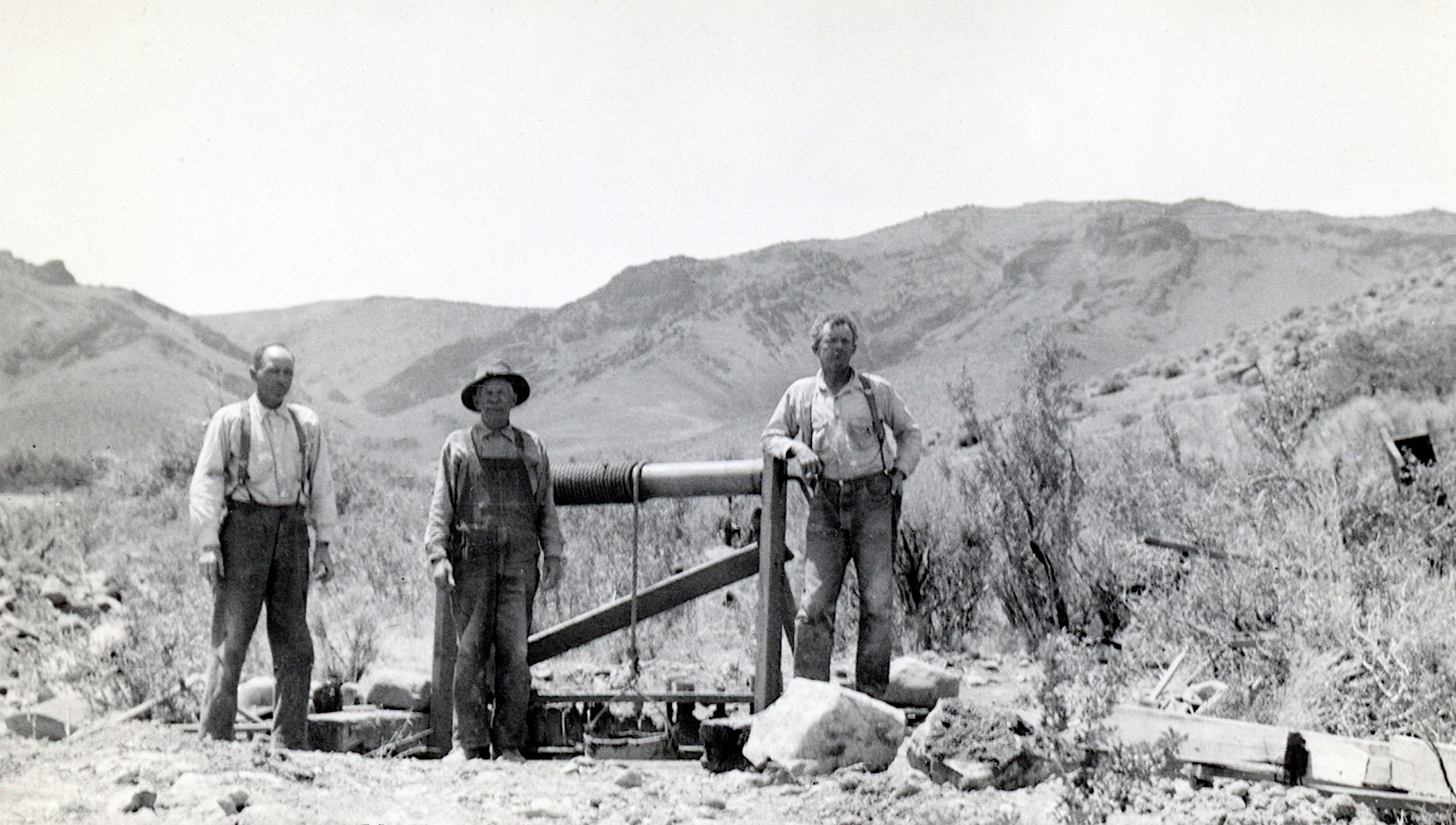
This hand drawn map, was made part of the company’s Articles of Incorporation.

In 1870, when gold was discovered at Hayden Hill, it was only a matter of time for some enterprising entrepreneurs to come up with plan to make money on this new gold rush. In this case it was John Watts, David Watson and Benjamin Neuhaus. On April 24, 1871, they incorporated as the Big Valley Toll Road Company. The road would begin at the Neuhaus’ ranch (Murrer) in Willow Creek Valley, then north along Eagle Lake, Grasshopper Valley to Hayden City, then to Hayden Hill with a terminus near Adin. These “dreamers” hoped to raise $40,000 in stock to finance their endeavor. While the concept on paper had merit, in reality it was doomed to failure, as it was already an established road. In 1875, the Lassen County Board of Supervisors declared the route as a public thoroughfare. Portions of the original route would eventually become part of State Highway 139.
Subscribe and support this site for as little as $4.17 a month.

Hayden Hill Newspapers

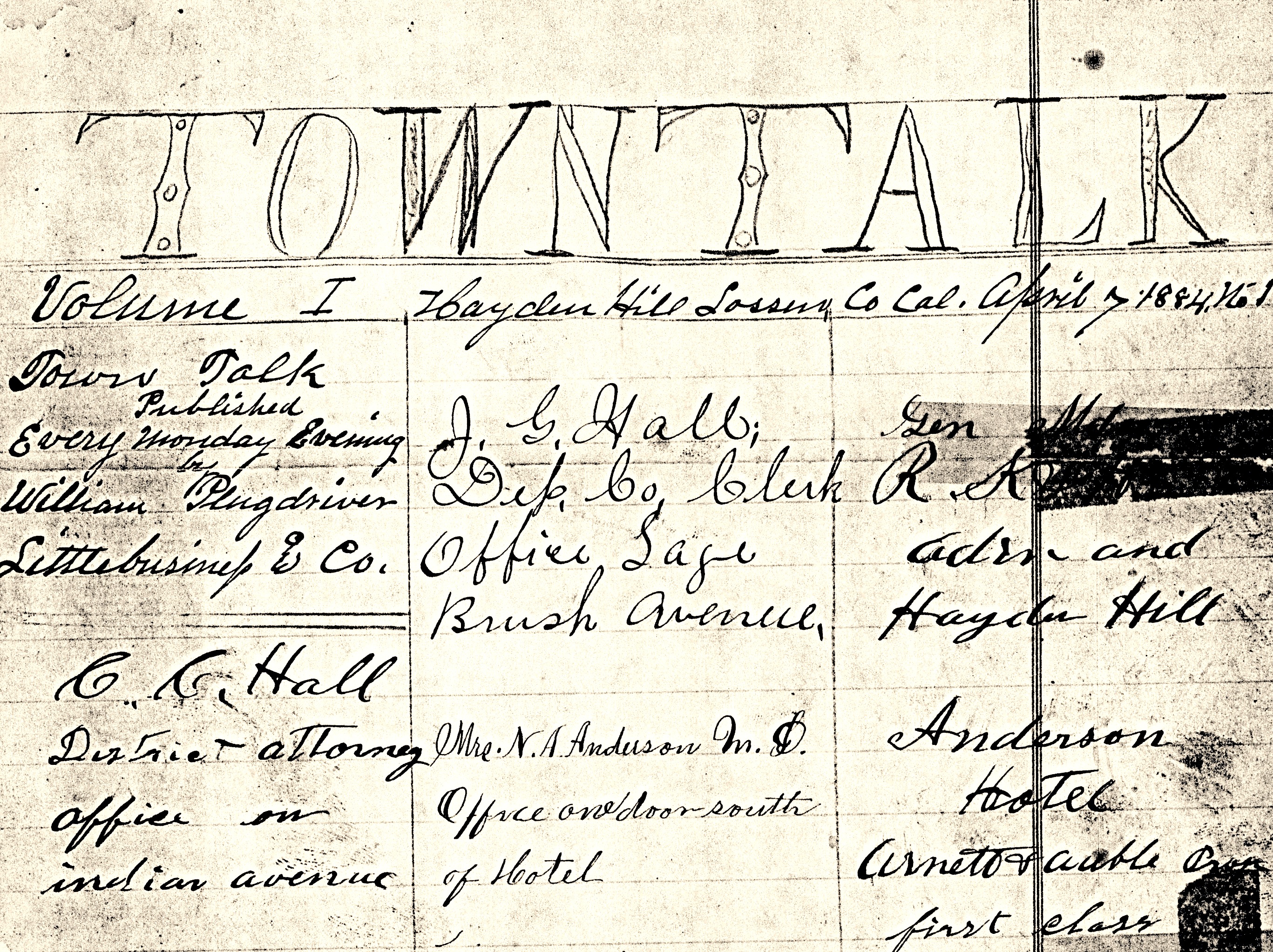
Vol. 1 No. 1 of Town Talk

While I have posted about early journalistic endeavors such as the Richmond Times and the Susanville Reporter, I was surprised to learn that very briefly Hayden Hill had a handwritten newspaper. The first issue was named Town Talk that was published on April 7, 1884. The next issue the name was changed to Talk Town, that was published on April 14, 1884. Continue reading Hayden Hill Newspapers

Amedee Lime Kilns

Amedee Lime Kiln
Amedee Lime Kiln, 1975

In the early 1890s, when the railroad town of Amedee came into prominence, led to many interesting developments. One of these was the discovery of lime deposits, then a key ingredient used in cement. In 1893, a lime kiln was constructed on the hillside above Amedee. However, due to the nation’s economic depression and the NCO Railroad’s refusal to lower freight rates the enterprise abandoned.

In 1913, with another railroad at Amedee and a surging economy, Susanville businessmen fired up the abandoned lime kilns. After over a year in operation, this they discovered was not the most prudent business investment, and once again the kilns were abandoned.

If you don’t succeed the first time, try again and again. In the 1920s, Janesville resident William B. Hail operated the lime kilns. In 1927, he used the lime for construction of the Bigelow Apartments in Susanville. After that it they were finally abandoned once and for all. Hail stated it was due to the poor quality of the lime.

Support this site and Subscribe today!

The Gold Rush of 1907

Mining

The winter of 1906-07 was a fairly went one, though not a record breaker. It was remember most for the brutal month of March. The Honey Lake Valley region witnessed heavy rains and snow that month—12 to 18 inches worth depending where one was located.

All that precipitation brought about a few side effects. First there was a lot of soil erosion. This exposed a lot of minerals never seen before. With a mining bonanza under way throughout Nevada, local prospectors went in search of a new mother lode. Gold was being found in the most unusual places. The Indians panned for gold on Bass Hill in a what is normally a dry ravine that feeds Sugro Reservoir (located across the entrance of the Bass Hill Landfill in case you were not aware it has a name). Gold mining was done at the head of Rice Canyon, as well as Shafffer Mountain. As a matter of fact it was reported that nearly all of Shaffer had been claimed for mining. However, when summer arrived and with no major discoveries, the mining excitement faded as quickly as it had begun.

Support this site and Subscribe today!

Susanville Quarry

Knoch Building
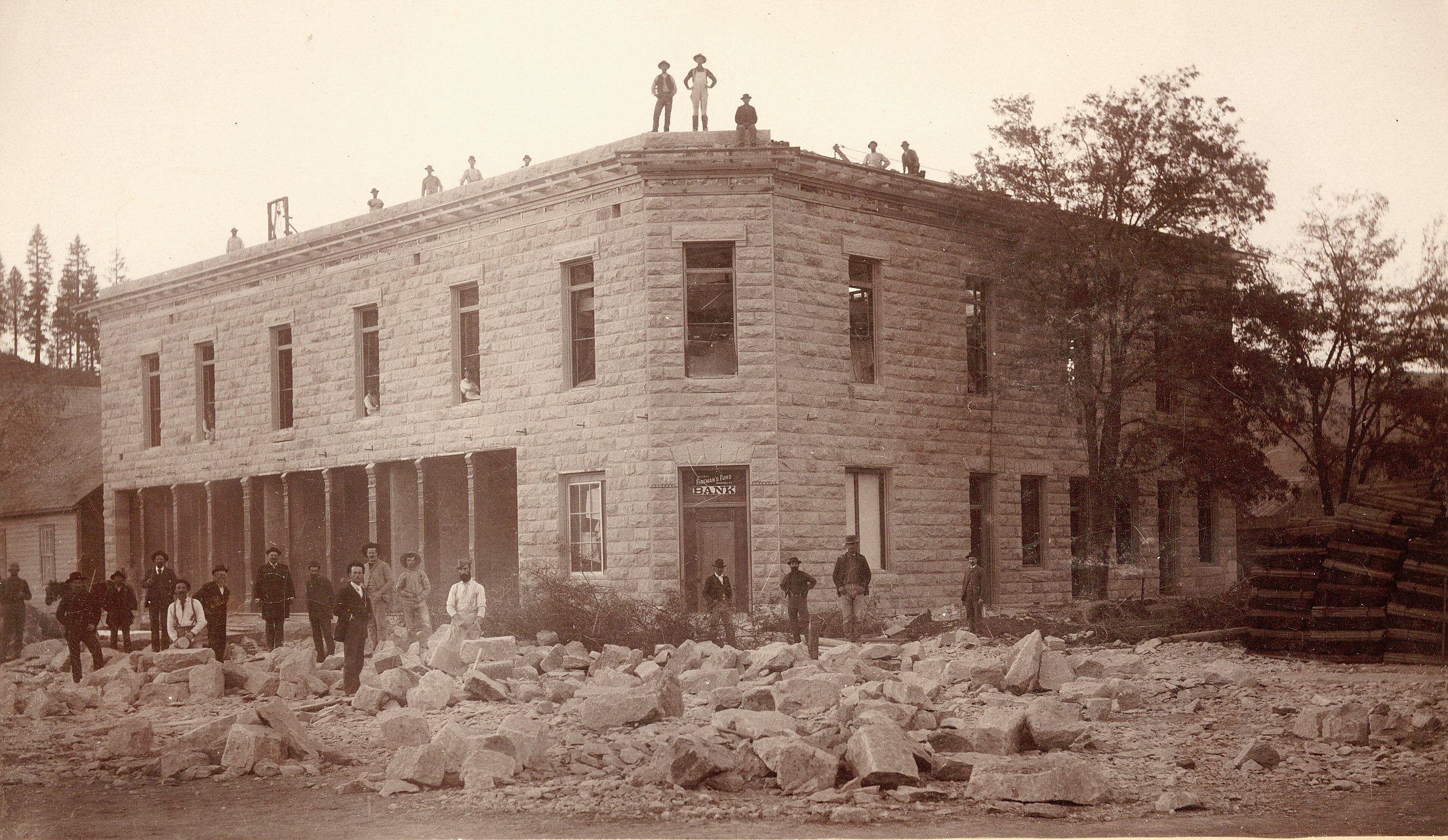
Construction of the $20,000 Masonic Hal in 1893.

In 1860, saw the discovery of rhyolite tuff at the base of Susanville’s Inspiration Point. It is an ideal building material, because it is light weight, and can easily be sculptured. In 1862, H.F. Thompson began the development of a quarry, and hence how Quarry Street is named. Some of its first uses was for headstones, the largest being for the grave of Captain William Weatherlow who died in 1864. In 1863, Miller & Kingsley had the first stone building constructed from the quarry. The last major use of the quarry was in late 1930s to construct the Spalding home on Quarry Street.

Support this site and Subscribe today!


Never Sweats

Unionville306
Unionville, 1880. Courtesy of Nevada Historical Society

An obscure mining term of the early 1860s. To be a Never Sweat was considered to be a non-conformist. In Nevada, for instance, one could hold an interest in a mining claim and not work it. One could wait for others to prove the claim. Should the prospects be favorable, the Never Sweat could recover his interest by paying an advance on the accumulated costs. In 1865, Nevada passed an “Act for the Encouragement of Mining.” That change in laws abolished the practice of a Never Sweat and the term faded into oblivion, with the exception of the bestowment on the Honey Lakers. Continue reading Never Sweats

Mining

Hayden Hill 1894
Hayden Hill, 1894

Besides exploring logging and ranching, from time to time, Lassen has an interesting mining history. Unlike our neighbors to the west, where mining had a major influence on their development, that was not necessarily case in Lassen. However, it was a mining excitement of 1856 along Diamond Mountain that brought the first wave of settlers to the Honey Lake Valley. Many of those gold seekers soon gave up mining and developed other interests in the region. However, the Diamond Mountain Mining District remained active until 1942, when President Roosevelt’s Executive Order curtailed gold mining. The other hot spot for mining was Hayden Hill, 55 miles north of Susanville. It gained in prominence in 1870 and would go through many boom and bust cycles.