Today, we examine Camp Susan, the nearest appearance of a military encampment the town would experience and to say it was short-lived would be understatement. In late August 1864, the 1st Nevada Territorial Infantry, a mobile military unit from Fort Churchill, under the command of Malachi R. Hassett, established a base camp near Susanville. Their mission was to scout the territory from Susanville, north to Surprise Valley and east to the Humboldt mines. In October 1864, the unit was ordered back to Fort Churchill.
There was a noteworthy at the camp. On September 12, 1864, Private Ebenezer Williams died at Camp Susan. Williams, a native of Wales, had just enlisted in February 1864. My records do not indicate a cause of death or burial.
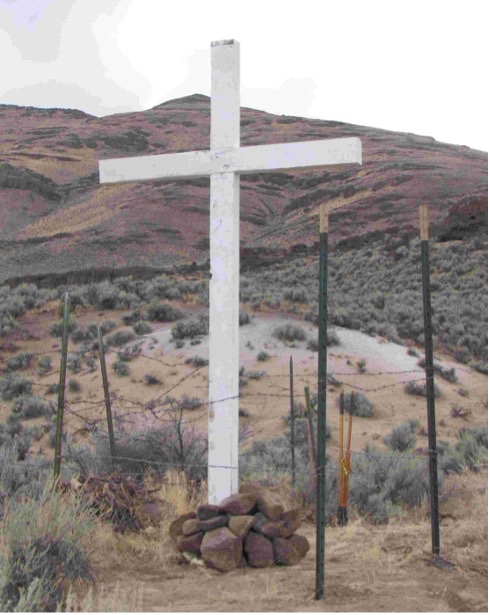
Smoke Creek Cross, October 11, 2025 Courtesy of David Davis
Note: The following information was provided to me by David Davis, who graciously allowed me to share with the readers herewith. We previously explored the Smoke Creek Cemetery. In 1968, a cross was built on the hillside by members of the Lassen County Historical Society. By the early 2000s the foundation of the cross rotted away and the cross toppled over. Here is a history of the topic and the cross replacement.
HISTORY AND MEMORIALS REPORT
October 19, 2025
David A. Davis, General William Passmore Carlin Camp 25 Camp Commander/Historian/Civil War Memorials Officer.
SMOKE CREEK CROSS
October 11, 2025
For background, the following is modified from my report of August 13, 2023: Camp Smoke Creek was located at the old Smoke Creek Station near the Nobles Emigrant Trail. It contains a burial plot that contains the grave of four soldiers:
Pvt. John Smith; Co. C, 2nd CA Cav., d. Jan. 18, 1863, shot by Lt. Williams at Deep Hole
Pvt. Gustavus W. Plass; Co. C, 2nd CA Cav., d. Nov. 9, 1863, typhoid at Smoke Creek
Serg. William McCoy; Co. D, 1st NV Cav., d. Jul. 3, 1864, unknown causes
Pvt. David O’Connell; Co. B, 2nd CC Cav., d. Nov. 17, 1865, Killed by Indians at Pine Forest
Following the history would take some doing. Co. C, 1st Nevada Cavalry was stationed there in late 1863; Co. A, 1st Nevada Infantry was stationed there July through October 1864; and Co. D, 2nd California Cavalry was stationed there July 1865 through April 1866. Co. B, 2nd California Cavalry was mainly stationed at Dun Glen June 1865 through April 1866. They made an incursion into the Black Rock Mountains in the Pine Forest District in November 1865 where O’Connell was killed. It does not say where he was buried. Detachments of other Nevada and California units were probably stationed there or passed through. Deep Hole was a station located about 20 miles east-northeast of Smoke Creek and a Nevada Cavalry detachment was stationed there in April 1865. 2nd Lt. Henry W. Williams of Co. C, stationed at Smoke Creek, shot Smith at Deep Hole and then deserted his command because of it. He was dishonorably discharged Jan. 27 9 days after the shooting.
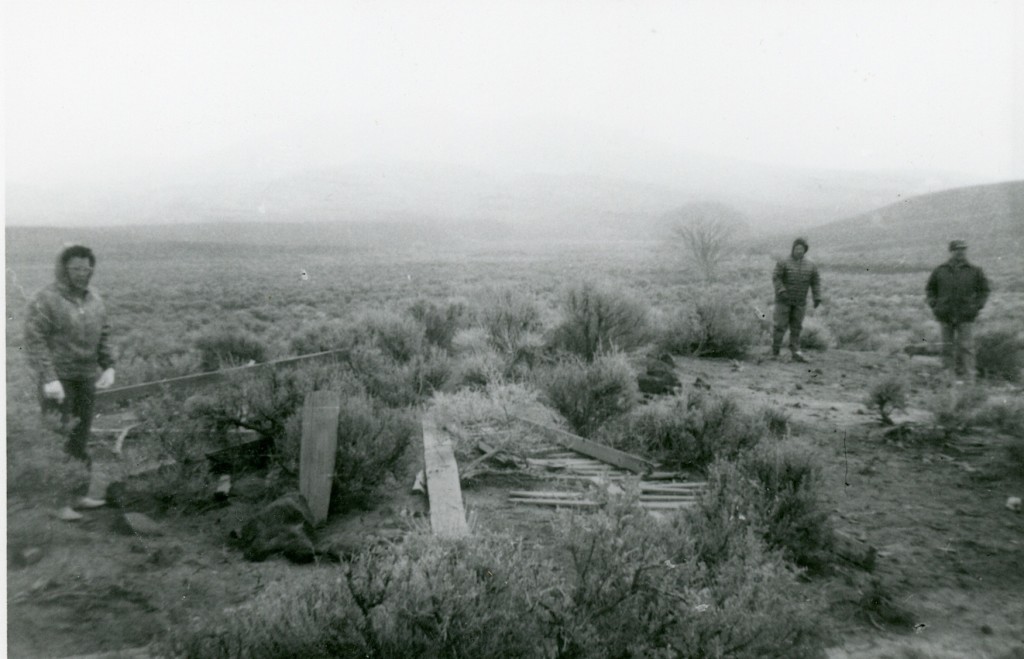
Smoke Creek Cross 1981-Tim Purdy
The Smoke Creek Ranch 7.5′ quad has the ruins and a grave marked. The public land urvey location is T31N, R18E, Sec. 16, SW/4 of the NW/4. The Lassen County Historical Society located the graves in 1964 and placed a large wooden cross there in June 1868. The site is on property owned by Jackrabbit Properties.
In the intervening years, this cross rotted off and fell over. On October 11, Commander David A. Davis, JVC Donn Dalton, Don’s nephews Sonny and Heath Victor, and Jay Carter who helps with restoration work at the Hillside Cemetery made a trip to the site and erected a new cross.
The cross was made by Donn and SVC David Perdue from 4” by 6” redwood boards taken from a demolished deck and painted white. The boards were bolted together on site, and the cross was cemented into the ground with rocks piled around the base. Commander Davis made a temporary metal marker with the Camp name and dated punched into it that was nailed to the cross.
On August 4, 1943, a B-24 Liberator plane crashed near NuBieber, killing all nine on aboard. Not only was this the worst aviation disaster in Lassen County, but it was the largest single fatality accident, too. Details of the crash are scant due to the government’s censure of such events during World War II. According to the Big Valley Gazette, there were over 100 people who witnessed the event, thus the paper quipped over 100 different versions of the event. Some stated that plane exploded high in the air; others said happened just before it crash to the ground. The bodies and the wreckage were scattered over a mile from the crash site. The flight originated at Pocatello, Idaho, with a destination of Chico, California. Those wo lost their lives were: John H. Ballard, Joseph F. Caccavale, Joseph P. DeFrancisci, Elvin L. Griffith, Burton C. Hermann, Robert G. Larsen, Kenneth J. Lovelace, Louis J. Marie and Bruce E. Wright.
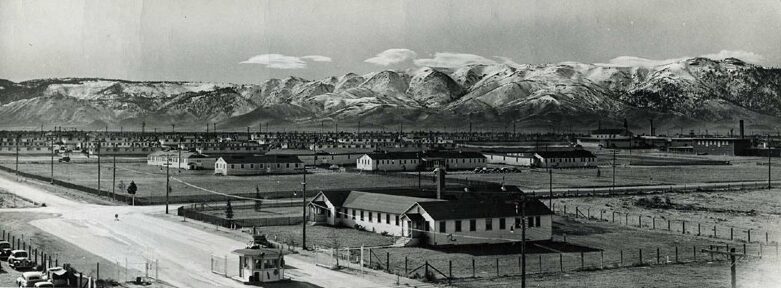
On January 26, 1942, U.S. Representative Harry L. Englebright announced that the War Department had approved the establishment of the Sierra Ordnance Depot. It would be located at Hackstaff, forty miles southeast of Susanville. Hackstaff was a very small station on the Western Pacific Railroad. The ordnance depot, on the other hand, would cover an estimated 25,000 acres sagebrush lands on the eastern side of the Honey Lake Valley. Englebright informed Susanville residents that $20 million had been approved to construct the depot. It would involve the construction of some 1,000 “igloos” for ammunition storage, besides the facilities associated with the depot. Construction would begin immediately.
It was projected that as many as 5,000 people could be involved with the initial construction and operations. A new infrastructure would have to be constructed to accommodate this huge influx of population. Susanvile and the Honey Lake Valley would be heavily impacted by this development, with such issues as housing, schools and roads. The initial reaction was mixed, though Susanville’s business community was more supportive of the project than the agricultural community.
At the February 9, 1942 Susanville City Council meeting, Jack Hill of the Shell Oil Company, informed them of expected problems with the construction of the depot. He said that Susanville would be the initial employment headquarters. The city would shortly be flooded with people seeing employment. Since time was f the essence, Hill suggested that icy become involved in established tent and trailor courts to handle the increase population. After all, with building supplies in demand, this would provide an alternative housing method. Hill warned both the city and county to be prepared for the criminal element, i.e., camp followers found at such construction projects. He said, “You are going to have a very high percentage of non-desirable people arriving with those whose livelihood is made in every conceivable means outside the law. You can combat them if the community is prepared to stop them before they get started. The fastest and easiest way to stop them is to make their activities unprofitable.”
To prepare for the criminal element, a group of local law enforcement officials-the County Sheriff, District Attorney and Chief of Police, paid a visit to Hermiston, Oregon, where a munitions depot had recently been established. Hill was 100 percent correct in his warning. In June 1942, the crime wave swept Susanville and the environs of the Honey Lake Valley. During June 1941, there had had been 31 arrests inside the city. A year later, it has escalated to 103 for the same period. The majority of these offenses were for drunk and disorderly conduct. On one day, June 27, 1942, a record sixteen people were booked into the city jail-a facility that had only 400 square feet of room to house inmates! Over at the county jail just blocks away the situation was just as grim. One alternative solution to alleviate overcrowding the two jails was from the implementation of a special fee. If one had the extra cash, he could pay a fine three times of the existing fine and would not be incarcerated, though it only pertained to misdemeanor offenses.
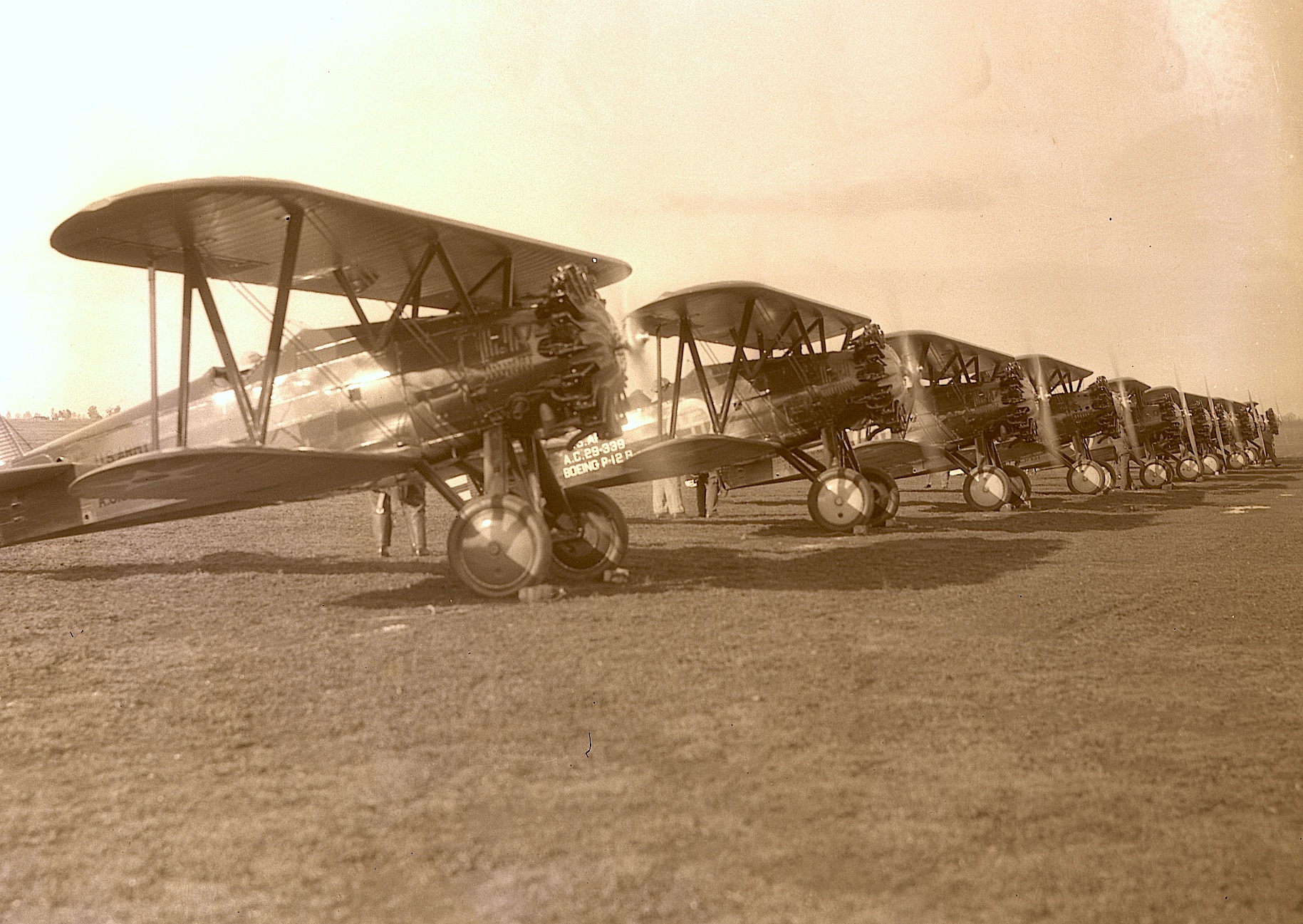
A group of P-12’s pf the 55th Squadron at Mather Field, which would be assigned to Honey Lake.
In the late 1920s the United States Army sought a place where army fliers could train for wartime manuevers and aerial gunnery practice. Susanville attorney, Ben Curler an avid pilot had just the place—Honey Lake. In the spring of 1931, Curler gave Captain Thomas Boland of the Mather Field in Sacramento a tour of the region and it met with the Army’s approval.
In the summer of 1931, supplies and equipment were shipped from Sacramento to the Wales Ranch, about four miles north of Milford. A summer base camp was established and operated for two months.
The following year the camp resumed operations. This consisted of forty-three flyers, thirty-nine pursuit planes, three transports and a squadron of one-hundred men. The Army was pleased with conditions at Honey Lake and it was their intention to make it a permanent summer training camp and the State obliged. Once the Army obtained ownership of the lake, they no longer used it. When the Sierra Ordnance Depot was formed in 1942, it was annexed to the depot. Jere Baker provides a complete account the air field operations at Honey Lake in Untold Stories.
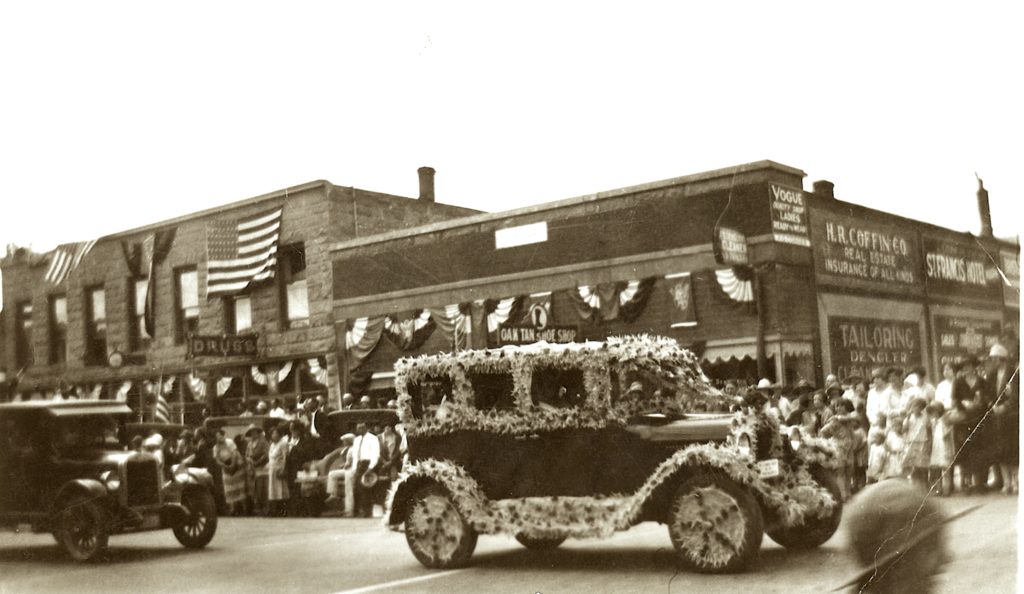
American Legion Parade, Susanville 1926—Margaret Purdy
During August 16-21, 1926, Susanville was a festive place. It was the host of the statewide American Legion Convention. That was a tremendous feat by the local American Legion Post named after Thomas Tucker, a Maidu, and Susanville’s first casualty in World War I.
The community gave the some 3,000 attendees the proverbial red carpet treatment. Buildings were decorated with patriotic bunting or adorned with the American Flag, and some times both. Two parades were held that week. The first one was mid-week in the convention, which featured numerous floats, decorated cars and an assorted lot. There were the Santa Barbara Legionnaires, dubbed the “bathing beauties” with the men wearing gunny sacks, displaying their knobby knees. The second parade was a bit more dignified with the veterans marching down Main Street from the Elks Lodge to the newly constructed Veteran’s Memorial Building.
A 1923 view of Papoose Meadows. Courtesy of Lola Murrer Tanner
This is the first of three versions of the Papoose Meadows Massacre that occurred at Eagle Lake in 1866. During the late 1940s and 1950s Francis Riddell spent considerable time compiling the Ethnohistory of the Honey Lake Paiute. There were still older living Paiutes then, whose parents lived in the area prior to Anglo settlement. Francis spent a lot time with Kitty Joaquin Williams (1864-1954), who provided him with a wealth information, that he was able to preserve. The following is what she relayed to Francis concerning the Papoose Meadows Massacre.
According to Kittie, a band of Paiute, including her father Joaquin, went on a hunting trip to Eagle Lake. Though there is some confusion she also stated they went there to escape the soldiers, who were accompanied by members of the Maidu. Hog-die Jim, Joaquin’s uncle was afraid the soldiers and Maidu would attack them. He advised Joaquin and others to move their camp, but Joaquin felt there was no real danger. Hog-die Jim then took some provisions, and all the horses and left.
The soldiers and Maidu attacked Joaquin’s camp and killed everyone one except a baby in a cradle board, two women who jumped into the lake and swam to safety and Joaquin, too, did the same. However, when Joaquin was in the water he was shot by. soldier, John Mulroney. Joaquin was cared by the others and recovered. He was later known as Old Man Joaquin and spent the rest of this life in the Susanville area and died in 1935 at the age of 99.
Note: It is well documented that there was no military involvement. The soldiers at Camp Smoke Creek, the nearest military outpost were kept very busy with conflicts in Northern Washoe County. I also examined their daily reports, the military kept great records. Also puzzling, is the naming of Mulroney (1856-1930). Mulroney would not have been old enough to participate. He lived most his entire life in the Honey Lake Valley working on various ranches.
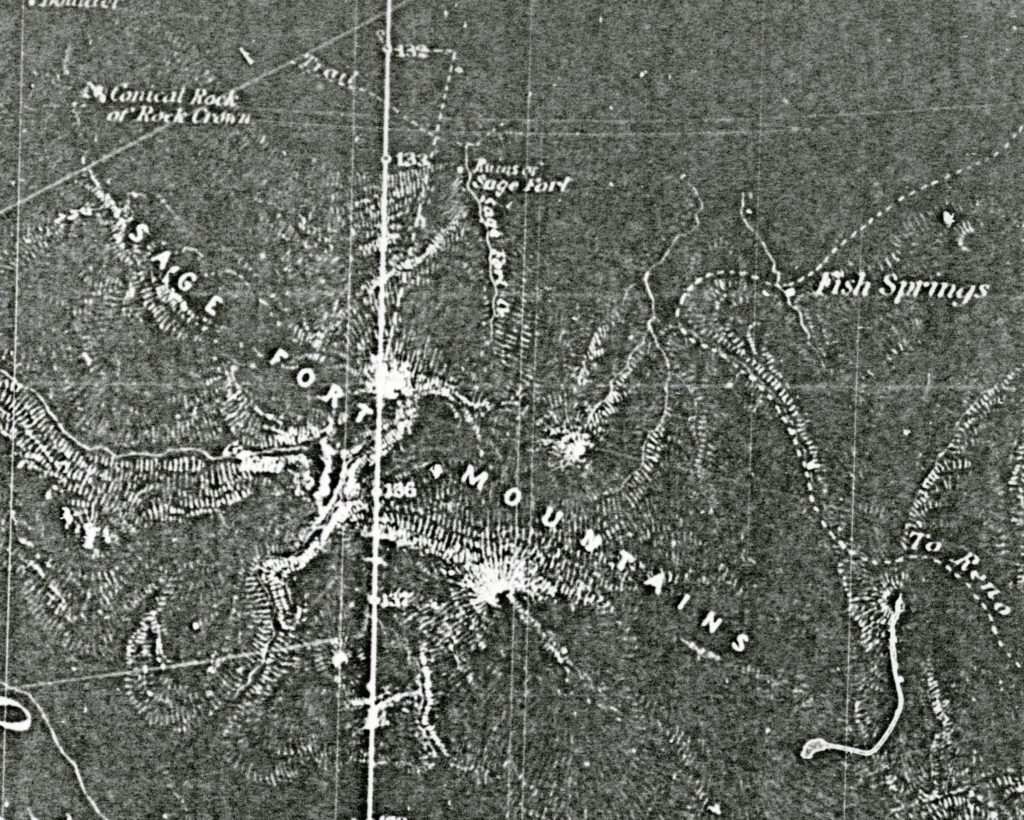
This was an entirely different military encampment from its predecessors of the 1860s. It was never a fort, but a military camp. Military records refer to it as Camp Sage, but fails to provide dates of operation or an exact location, only township and range, the latter of which placed it eastern Honey Lake Valley on the Nevada side. The camp’s sole purpose was a rest stop on the military supply route from Reno, Nevada to Fort Bidwell, California. In June 1872, Perry Jocelyn was in charge of Company D, Nevada Calvary, marched the troops on foot from Reno to Fort Bidwell—a distance of 250 miles. The route went north and east of Reno over the Fort Sage Mountains, to the west side of the Smoke Creek Desert and then criss-crossing the California-Nevada border until it reached Surprise Valley. It was a difficult journey. Jocelyn found that out first hand, on the first day of the seventeen-day march, five soldiers deserted in the middle of the night. An attempt was made to locate them, but they were never apprehended. Unfortunately, Jocelyn’s diary only contained the following notation about the place: “June 2, 1872 – Rev. at 3. First wagon mired within one hundred yards of camp. At 8 o’clock train has not advanced more than one half mile. Cross large hill where it is necessary to double the teams. Newcomb’s ranch just on the other side with lake nearby. Four miles further with still heavier hills, Fort Sage is reached. The whole distance eight miles.”Continue reading Fort Sage, Honey Lake Valley, Nevada→
Soldier’s graves at Smoke Creek, March 15, 1964. Left to Right: Frances Amesbury, Mary Morrill and Gil Morrill. Courtesy of Gil Morrill
One of the interesting endeavors undertaken by the then newly formed Lassen County Historical Society was to locate the soldier graves at the military encampment known as Smoke Creek, just across the Nevada stateline. In 1964, on their first excursion they located it. Over time they decided that something needed to be done as a memorial. In June 1968, they ventured again, this time erecting a large cross on the hillside.
Phil Lord and Bob Amesbury at work putting up the cross, June 1968. Courtesy of Gil Morrill
The small cemetery was established on the hillside across the creek from the camp for the four soldiers who died there while in service. On January 18, 1863, Pvt. John Smith Co C2 Calif Cav died from gunshots at Deep Hole, Nevada, over an argument with his commanding officer Second Lt Henry W. Williams. On November 9, 1863, Pvt. Gustavus W. Platt Co. C2 Calif Cav died of typhoid fever at Smoke Creek. On July 3, 1864, Sergeant William McCoy, age 28, died from an unknown illness. On November 17, 1865, Pvt. David O’Connell Co. B2 Calif. Cav was killed in action at the Pine Forest battle near Black Rock.
The camp was located near the cottonwood trees seen in the distance. It is located on private property and is now fenced off.
During the 1860s, the United States Military had a major presence in the region, with numerous military camps scattered around the Honey Lake Valley and Northwestern Nevada—one of which was Camp Smoke Creek just over the stateline in Nevada.
Its origins began on November 9, 1862, when Nevada Territorial Governor James W. Nye wrote to Brigadier General George Wright, Commander of the Department of the Pacific, and requested a Company of troops to protects the emigrants from the Indians along the Honey Lake-Humboldt Road. On November 14, 1862, the troops were dispatched. On December 15, 1862, Second Lt. Henry W. Williams arrived at Smoke Creek with twenty-five men and forty days of rations. On March 28, 1864, First Lt. Oscar Jewett, then in command, received orders from Fort Churchill to abandon the camp and to remove all valuable property from the camp as was possible. Continue reading Camp Smoke Creek→