Tag Archives: Honey Lake Valley

Milford’s Potato War

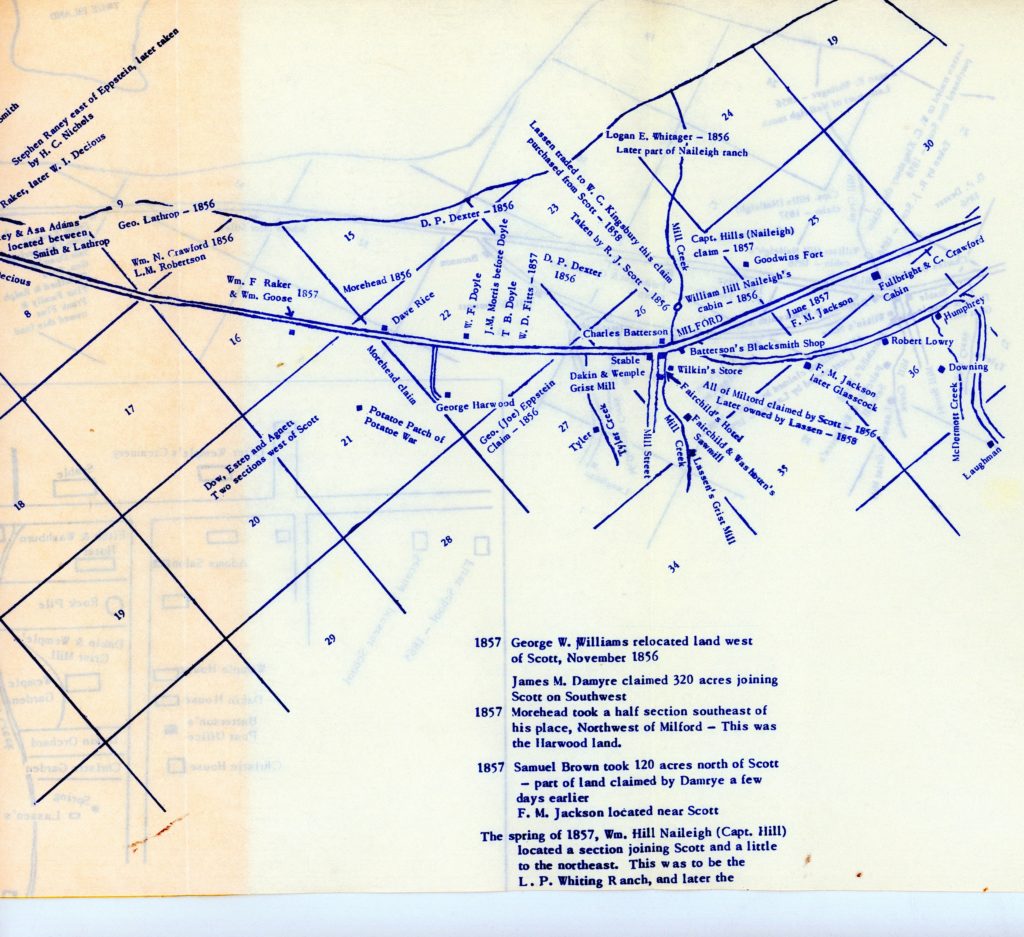
Claude Wemple's historical map of the Milford region, shows not only the location of the Potato War, but numerous other sites.
Claude Wemple’s historical map of the Milford region, shows not only the location of the Potato War, but numerous other sites.

Who knew that the almighty spud would be the cause of conflict? It all began in October 1857 when a band of Washo Indians visited William Morehead’s potato patch, some two miles northwest of Milford. When confronted by Morehead and others the Washo became belligerent and this did not go over well with the residents of the Milford district. The locals received re-enforcements from the California state arsenal, volunteer fighters from Sierra Valley, and a band of Piutes. During the skirmish several Washo were killed and many wounded. In the aftermath, the Washo withdrew from the lower end of Honey Lake Valley and never ventured north of Long Valley. Again, the residents petitioned for a permanent military fort after the Potato War, only to be ignored, again and again.
Spread the word, and encourage a friend to subscribe.

Missouri Bend School

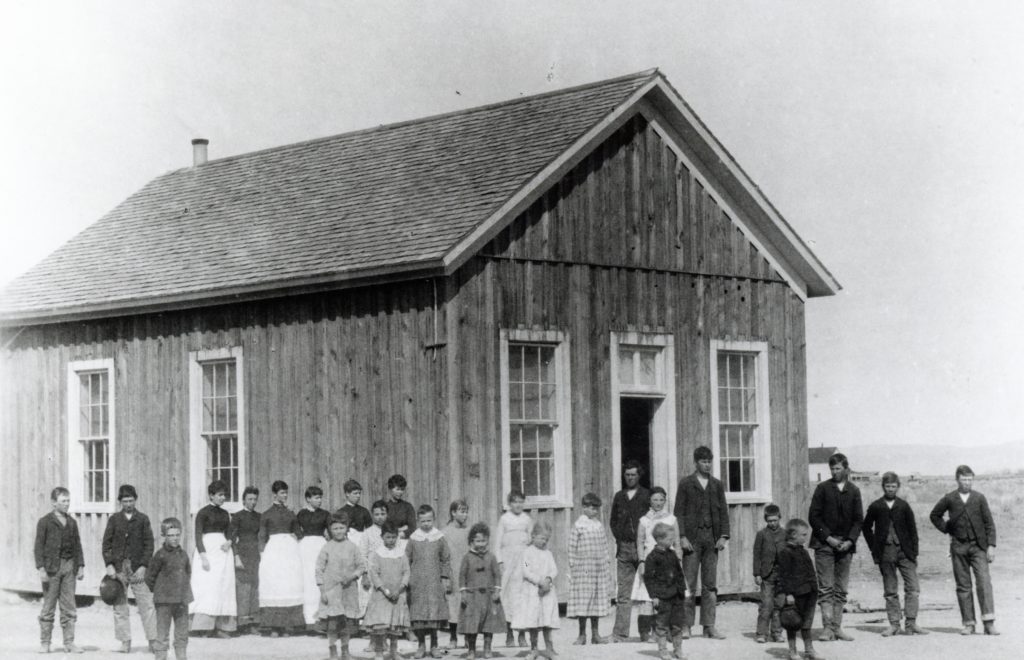
Missouri Bend School, 1886. Courtesy of Philip S. Hall

The school district was established on February 3, 1879 from the eastern portions of Janesville and Lake School Districts. Shortly thereafter, the residents built a schoolhouse without a bond measure. On May 31, 1884, Leonard Hicks donated the land for the school. On December 17, 1909, voters approved a $1,500 bond measure to construct a larger school. During the early 1950s, voters throughout the County were routinely asked for consolidation of school districts. In 1954, Missouri Bend merged with Janesville. This schoolhouse remains, and for awhile it was used as a private school, but now sits empty.

Never miss a story, click here to subscribe.

Hackstaff – Lassen County

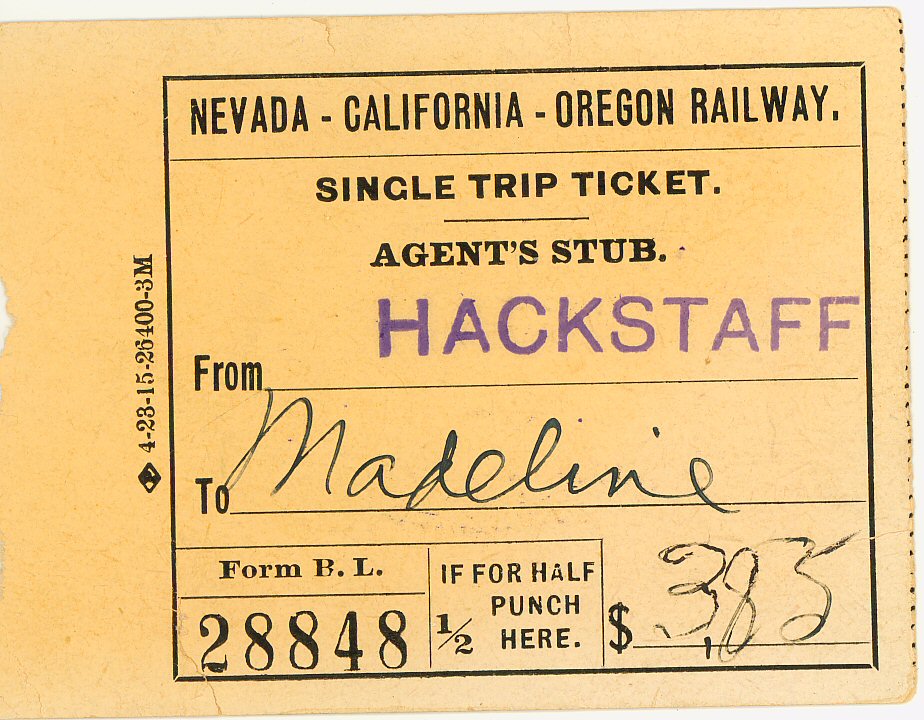
Courtesy of Dorothy Capezzoli

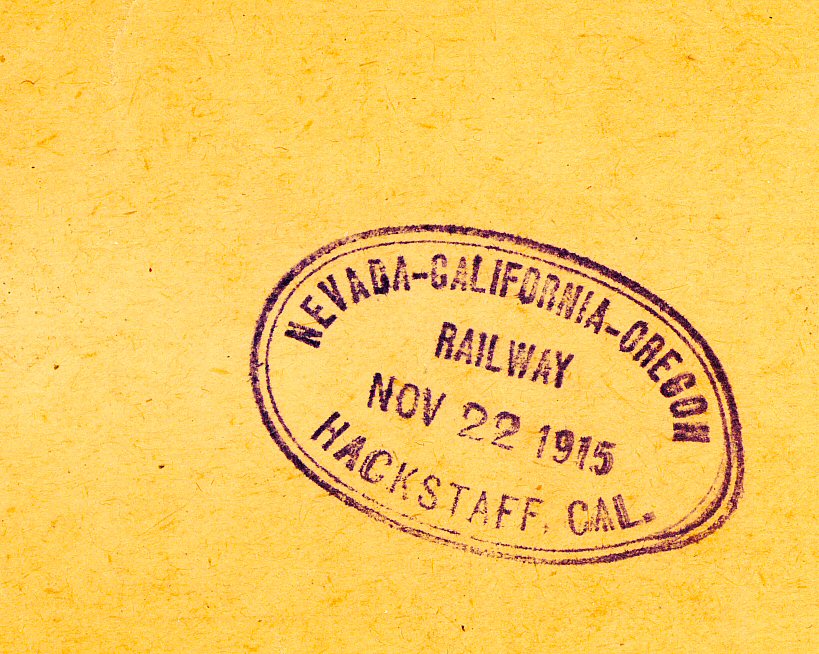
Known today as Herlong, and was the one-time junction of Nevada-California-Oregon (NCO) and Western Pacific (WP) railroads. In 1915, Stanley G. Rayl arrived on the scene. When Rayl petitioned to establish a post office, he proposed the name Rayl—the NCO opposed it. Charles Moran, President of the NCO, wanted the post office named Hackstaff—in honor of his mother-in-law, Clara Hackstaff Adams. After five months, the Postmaster General decided upon the name of Rayl, instead of Hackstaff. This delighted Robert M. Cook, editor and publisher of the Lassen Weekly Mail, Cook wrote: “ The NCO wanted a monument to an uncle of the wife of Moran, the New York capitalist behind the NCO. Hackstaff was never in Lassen County and no one here knows anything about him.” When Rayl left in 1921, he assigned the postmaster duties to Cyrus Helman. Those two men had a disagreement and fought that battle in court. In the end, the Rayl post office closed. On March 18, 1922, the Hackstaff Post Office was established with Helman as postmaster. It did not last long and the post office closed on December 30, 1922. In 1927, Hackstaff’s meager population was wiped out when the WP moved its section crew to Doyle. The location continued to be known as Hackstaff until the Sierra Army Ordinance Depot was established in 1942.

Ticketb
Reverse of the ticket stub.

Spread the word, encourage a friend to subscribe.

Dixon’s Eagle Lake Scheme

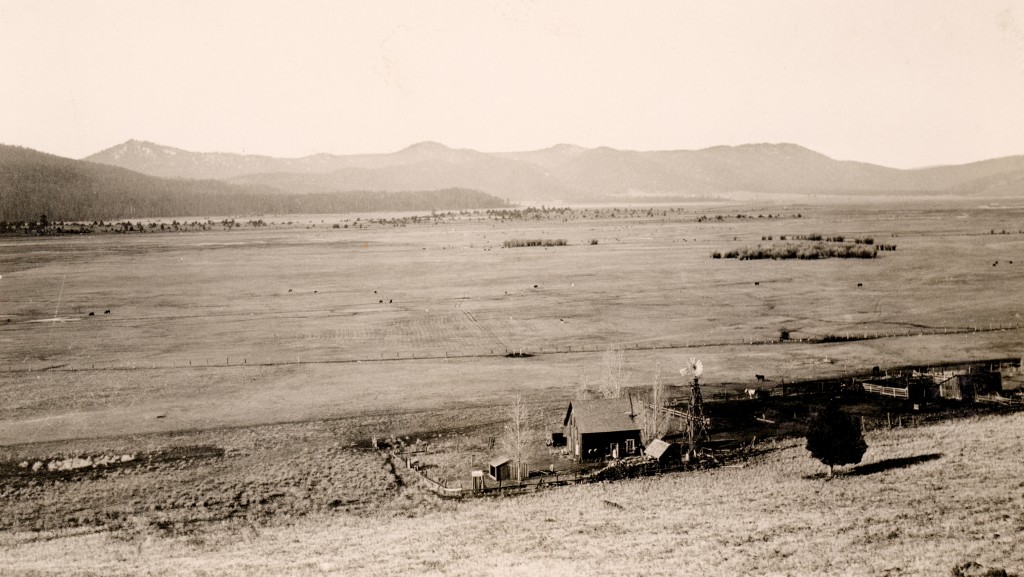
Lower portion of Willow Creek Valley, parts would have been flooded by the dam project, 1926. Courtesy of Lola L. Tanner
Lower portion of Willow Creek Valley (1926) , a portion  would have been flooded by Dixon’s dam project..  The government said no, stating it was impractical, since the water supply was not adequate  to fill the reservoir. Courtesy of Lola L. Tanner

A.F. “Frank” Dixon was the tenth person to tackle the tapping of Eagle Lake for irrigation in the Honey Lake Valley. Like those before and after him there were numerous obstacles to overcome. For every new enterprise, they had to become more creative, since the previous ones in many cases still had valid claims. Even so, it was not a deterrent.

One asset that Dixon possessed was during the 1890s  he served as Register of the Government Land Office in Susanville. Thus, he knew the procedures for obtaining rights-of-way across government land. However, what caught Dixon off guard is when he filed for his tunnel right-of-way across government land, the government did something they had never requested any one prior–an environmental analysis.  The government was concerned what damages would occur if the lake should be tapped.

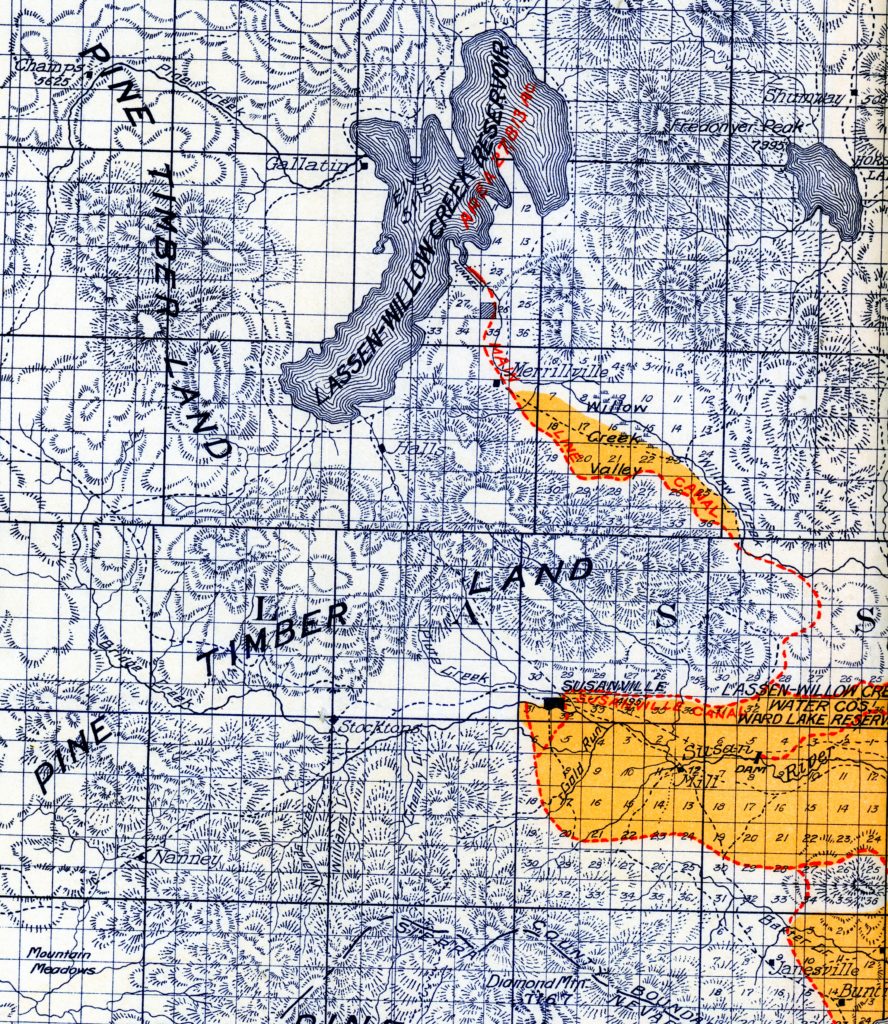
Partial map of Lassen-Willow Water Company's proposed project. Courtesy of Betty Barry Deal
Partial map of Lassen-Willow Water Company’s proposed project. Courtesy of Betty Barry Deal

The other situation, was Dixon was not alone in his conquest. It should be noted that Dixon filed for his right-of-way in December 1904. In the summer of 1905, the newly formed Lassen-Willow Creek Water Company, filed for a tunnel right-of-way, that was identical to Dixon’s.  Litigation ensued. In 1906, a gold discovery on the eastern edge of the Black Rock Desert lured Dixon away. Dixon would never learn of the outcome, he died in 1908. While Lassen-Willow Creek won in court, their enthusiasm fizzled and in 1910 sold their project to E.N. Prouty for $900.

Spread the word, and encourage a friend to subscribe.

Herlong Junction

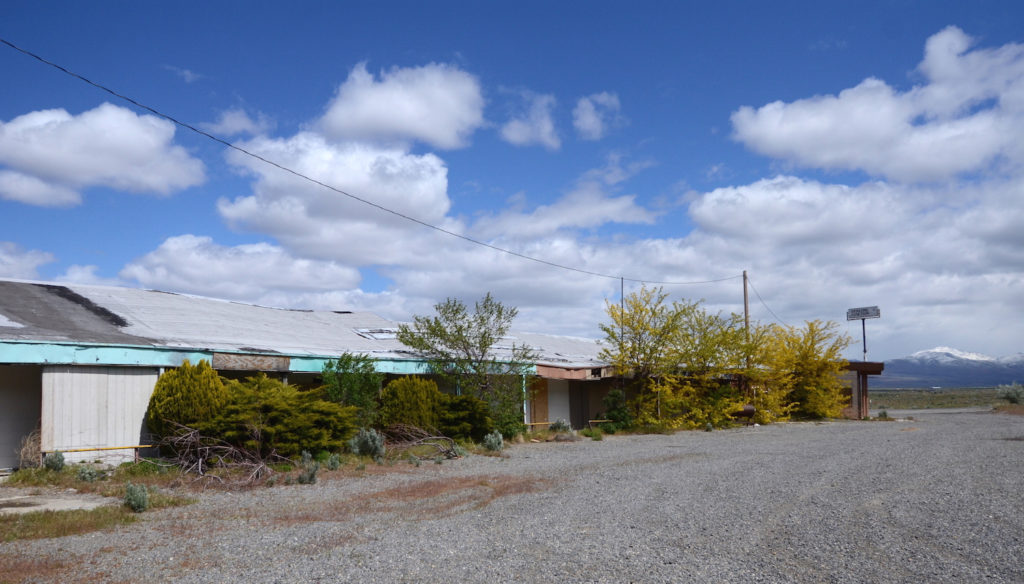
Herlong Junction, April 2016. Courtesy of Oliver Grosz
Herlong Junction, April 25, 2016. Courtesy of Oliver Grosz

Sometimes what appears a simple research project, becomes a challenging one. Herlong Junction is a perfect example.  Prior to the establishment of Herlong nothing existed on this segment of the highway. Yet, when the nearby Sierra Army Depot was established in 1942, it provided entreprenauers with possibilities.

The first to arrive on the scene was Ray and Connie Langley. On February 6, 1948, they purchased a small parcel from Zoa Clayburg. As the story goes, they had a restaurant at Milford and wanted to move the building to this location, however the highway officials would not give them a permit. It was one of those mysterious in the middle of night happenings, that somehow the building transported itself to the new location, and thus the establishment of The Mark.

Before you knew it, on the opposite side of the highway a new building appeared. This consisted of an outpost of Susanville’s Royal Grocery, along with a restaurant. While Royal Grocery no longer exists, its successor does, namely Idaho Grocery.

A lot of changes have occurred over the years, and while the businesses on the east side of the highway have shuttered, The Mark continues on.

In the meantime, I will work on researching this further, and will provide updates on my findings.

Never miss a story, subscribe for as a little as five dollars month. To learn more, click here.


Honey Lake Boating

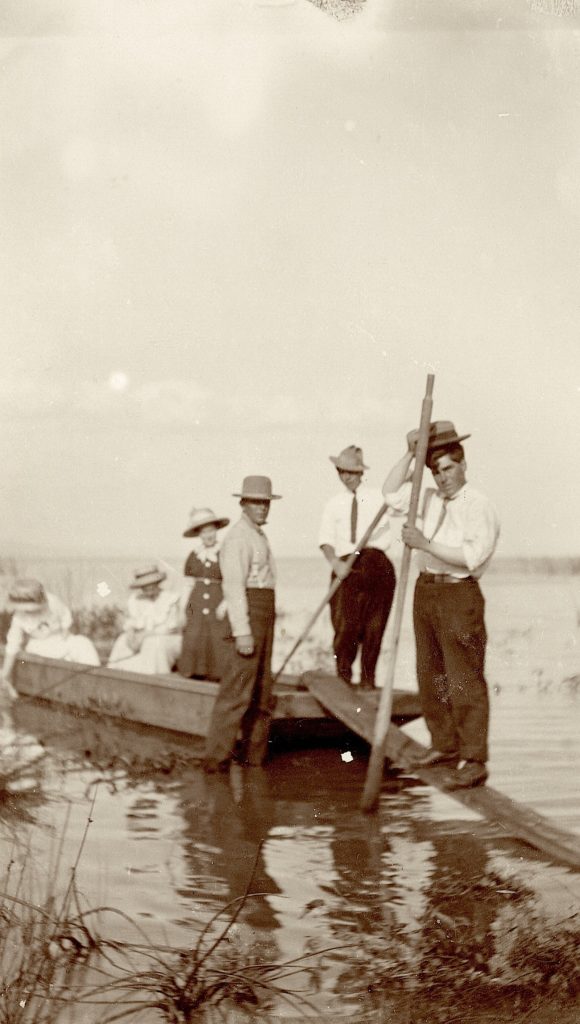
Ready to launch near Milford, 1905. Courtesy of Marge C. Foster

While “Godzilla El Nino” winter of 2015-16 somewhat fizzled in Northeastern California there was enough precipitation that Honey Lake received some water, however, it is all gone now.

Prior to 1916, when Honey Lake was full, and it was for long periods of time, it provided a recreational outlet for those who resided near the lake.  Various residents had small boats for pleasure outings. It should be noted that there were also commercial boat enterprises on the lake as well, and that is topic for another day.

Those who have spent anytime around Honey Lake know how windy it can be. For some boaters this created an interesting hazard.  Fortunately, the Lassen Weekly Mail of April 9, 1915, chronicled one of these encounters: “ A party from Honey Island consisting of Henry Baughman, W.F Snare, and Alex Norwood were in Susanville yesterday. They made the passage from the Island to the mainland in a rowboat and report a very stormy passage. The waves were so high that the bottom of the lake was often exposed and the boat left stranded on the bottom. The party had to wait each time until the wave came back and floated the boat.”

Never miss a story, click here to subscribe.

Great Basin Architecture

Smoke Creek Desert, 1996.

There are anniversaries, and then there are anniversaries. It was a year ago, today, when I broke my hip and became a Nevada resident for six weeks.

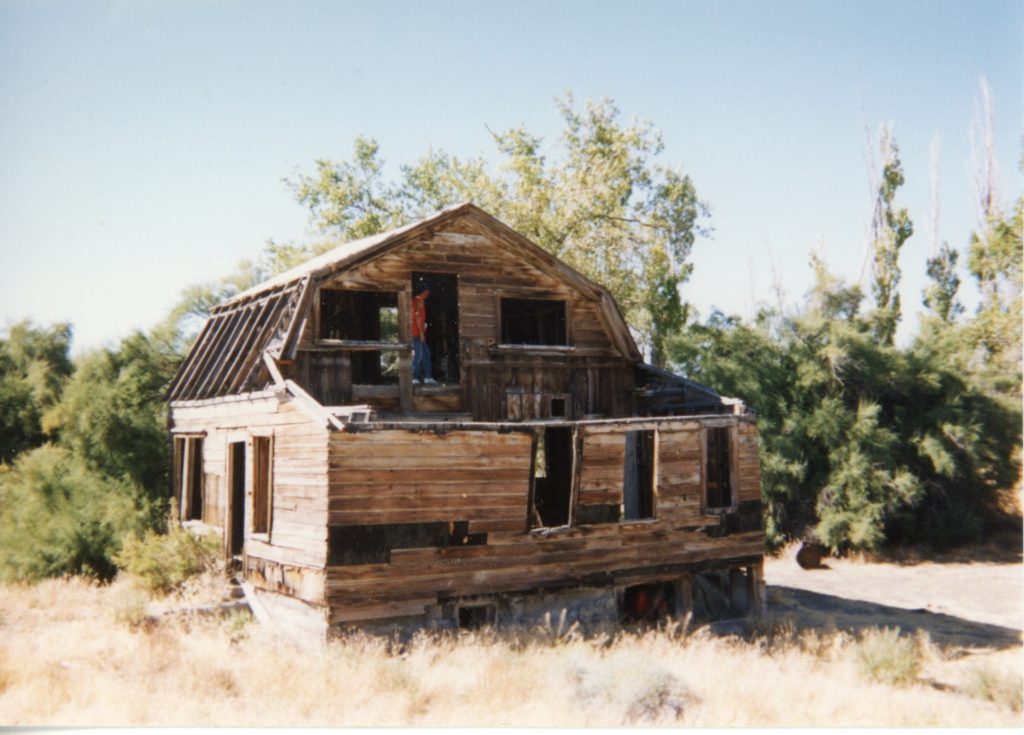
Some may remember back in the early 1990s, the Bureau of Land Management (BLM) and myself hosted prehistoric/historic tours.  However, there were always issues as to historic sites, and BLM always said no.  One of those was Great Basin Architecture of abandoned ranches and homesteads, and they said h-ll no. Since BLM staff were paid, and I was a volunteer and after three years, I decided I had enough. Continue reading Great Basin Architecture

Lonely Graves – Joseph B. Todd

Todd's grave, September 9, 1979
Todd’s grave, September 9, 1979

This grave was briefly mentioned during the St. Patrick’s Cemetery Tour, as his sister Matilda Todd Montgomery  grave was the start of the tour.

Joseph Bellas Todd was born October 16, 1828 at Anterim County, Ireland, and shortly thereafter the family migrated to Philadelphia, Pennsylvania. In 1857, he became the first member of his family to locate Honey Lake Valley and located on a small parcel near Richmond. In the next few years, his  four sisters–Matilda Montgomery, Margaret Streshley, Mary Drake, Sarah Emerson Hosselkus and one brother, John would make their homes there as well.

A confirmed bachelor, Joe Todd remained on his small ranch for next fifty-one years. At the age of 80, he moved to Susanville to reside with his nephew Charlie Emerson. When he died on October 21, 1910, his last request that he be buried on his beloved homestead, and the family obliged.

Never miss a story, click here to subscribe.

Lassen County – McCoy Flat Reservoir

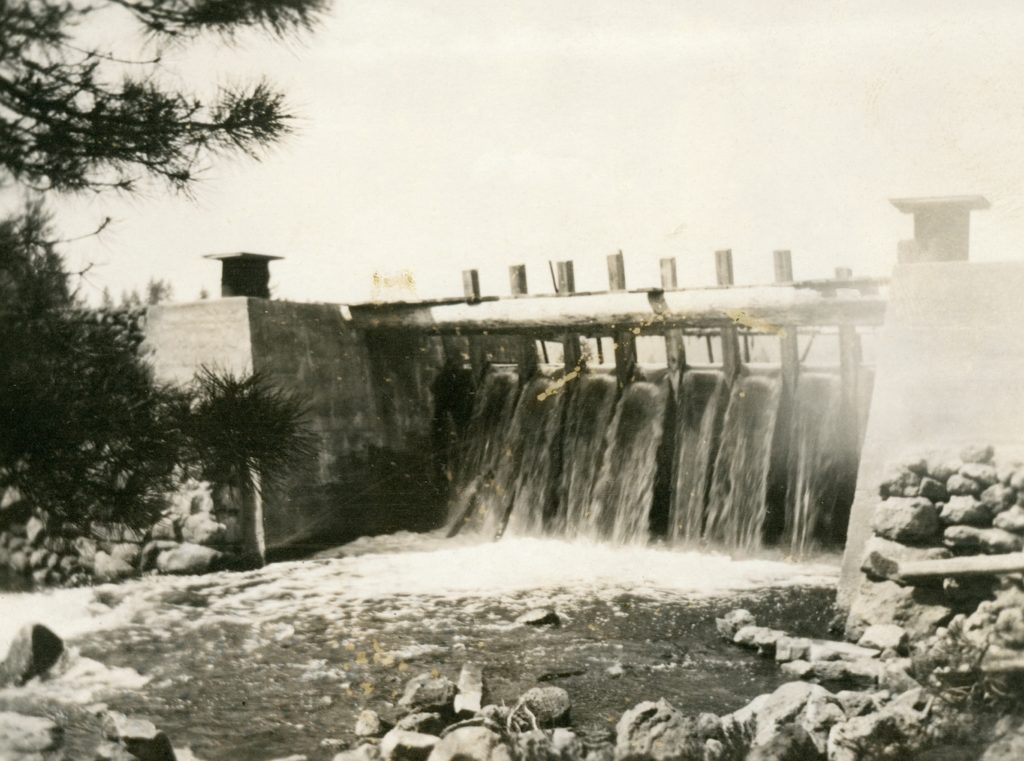
McCoy Flat Reservoir dam, 1915. Courtesy of Alphozene Terrill, granddaughter of Ben H. Leavitt
McCoy Flat Reservoir dam, 1915. Courtesy of Alphozene (Perry) Terrill, granddaughter of Ben H. Leavitt

In 1875, Benjamin H. Leavitt constructed the first reservoir on the Susan River watershed, which was named after him Leavitt Lake. Leavitt, of course, had dream of much larger irrigation system, however he was stymied by the lack of financial capital.

In the late 1880s, numerous reclamation projects of the Honey Lake Valley had been proposed. This, of course, attracted a lot of attention. In 1888, Clinton Hutchinson arrived in Lassen County from Kansas with money to invest. Hutchinson and Leavitt formed a partnership and a Susan River irrigation system became a reality. In 1889, they built two reservoirs in the mountains west of Susanville,  known today as Hogs Flat and McCoy Flat. In addition, they enlarged the capacity of Leavitt Lake.  For the next sixteen years, this system would go through numerous owners until in 1905 it was reincarnated as the Lassen Irrigation District.

Never miss a story, click here to subscribe.

A Belfast Revival?

The Belfast District. Courtesy of Bernard McCallister

In the 1870s, Captain C.A. Merrill began work on tapping Eagle Lake for irrigation in the Honey Lake Valley. Where Willow Creek enters the Honey Lake Valley he envisioned a great city there, he named Belfast. In the 1880s, he declared Belfast was destined to become a great commercial center, a city initially serving 25,000 people.  One of his many proposals was the establishment of a lumber mill there. The source of timber was the Eagle Lake basin, which the logs would be floated across the lake and down a flume to Belfast.  However, not much ever materialized.

In 1912, the Red River Lumber Company was in a hurry to establish a lumber mill in Lassen County. Fletcher Walker liked the Mountain Meadows location. No one else did.The problem was the winter weather was not conducive for much. Clinton Walker suggested Belfast, it had ample water, far removed from other communities and the future employees could even grow gardens. However, family patriarch, T.B. Walker,  nixed that idea, as  it was too far removed from the timber, thus added costs to transport logs to the mill. T.B. Walker was not keen on the Mountain Meadows site, but when Fletcher stated he would leave the company if Mountain Meadows was not selected. So much for a Belfast revival, and the town of Westwood was created over a temper tantrum.

Never miss a story, click here to subscribe and support.