William K. Medlin’s book published in 1997 is an interesting tome about Lassen Volcanic National Park. It is a combination of the park’s history and his philosophical belief. In his Preface, Medlin writes, “The reader is invited to trace this thread, and weighing the evidence scattered across its pages, to decide whether the story is telling the truth.” However, when writing about the events leading to the creation of the park, Medlin writes: “Armed with this advantage, Raker finally gained top political support in Washington for his national park proposal. On August 9, 1916, President Woodrow Wilson signed the bill creating Lassen Volcanic National Park. Raker, who died that same year, had garnered strong support both in Washington and in Northern California for final effort.” It should be duly noted for the record that Congressman Raker died a decade later in 1926, and not 1916
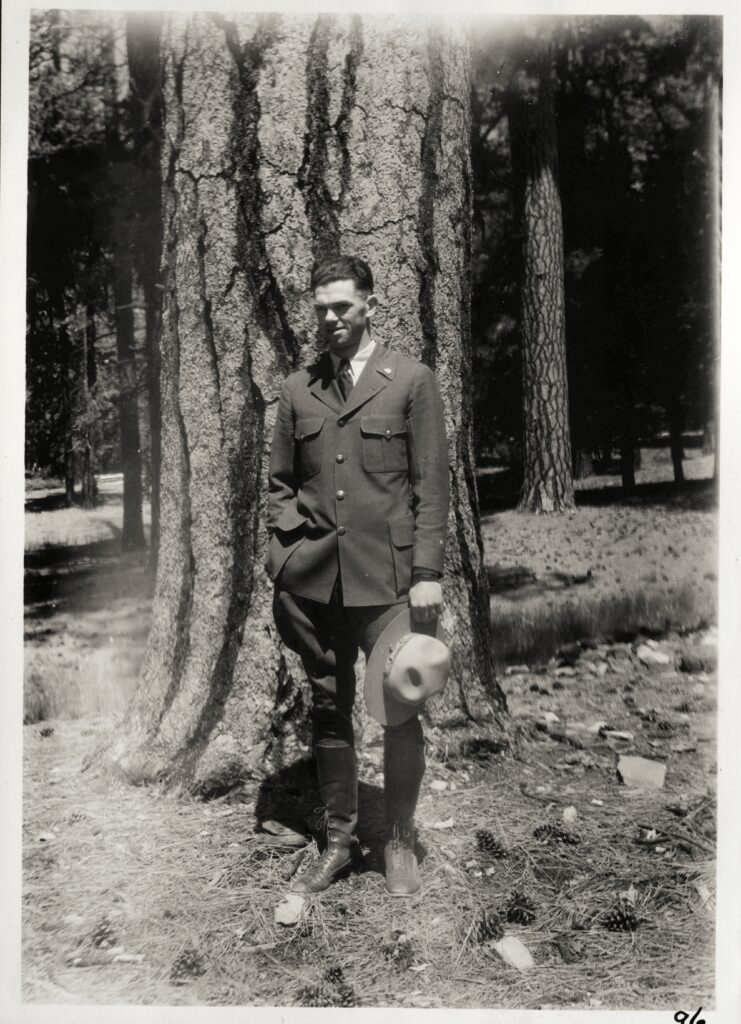
When it comes to Lynne Walker Collins, Lassen’s first ranger and later its first park superintendent, Medlin writes disparaging about him. However, in Acknowledgements Medlin heaps praise on Collins hard work. There is no doubt that Collins was very dedicated and worked tirelessly for the park. Collins also had the difficult task dealing with the private land owners in park—Sifford, Snell, Supan. In 1935, in a srange turn of events, Collins was abruptly terminated, thus ending his career.
Tim
Lynne Walker Collins was my father’s older brother. He went by Walker to distinguish himself from their father, my grandfather, who was also named Lynne. Walker was the first ranger at Lassen and he hired my father, George, for a few summers as some kind of seasonal aid to help with planning and design and PR. Dad had a very broad suite of talents evident in his youth. He wrote and illustrated “Lassen Glimpses,” which might be the first visitors brochure for the Park. He has much to do with the design of trails and signage and the old museum and even the construction of the old lookout on Brokeoff. Walker and my dad were well known and respected regionally through my uncle’s freight business. They carried materials and supplies by wagon between Redding, Red Bluff, Mineral, Susanville and everywhere in between. It didn’t hurt their standing in the region that their mother’s family were the Walkers of St Paul Minnesota who owned the Red River Lumber Co and built the town of Westwood to take as much ponderosa and sugar pine out of that country as possible. The Walkers set up my grandparents with a little land in Corning, about which I have heard lots of stories. But their two children, Walker and George, wanted nothing to do with the timber industry and instead helped pioneer natural resource conservation during the early part of the last century.
My dad went on to Grand Canyon as a ranger and then to the USNPS regional office in Santa Fe as some kind of manager and then to DC as Deputy Undersecretary of Interior charged with locating and planning new parks and monuments throughout the U.S., but principally in Alaska and the coterminous western states. He’s credited with ANWR, Point Reyes NS, Great Basin NP. He was involved with many USNPS plans from Hawaii to Puerto Rico. His oral history, “The Art and Politics of Park Planning and Preservation 1920-1979”, produced by the Bancroft Library, is available online.
My brother, Walker, was named for dad’s brother, but we never saw much of our uncle. By the time I was born, in 1950, my iatentd and older siblings had moved from Toyon to Dan Anselmo, so dad could be closer to his USNPS office in SF. Uncle Walker and his wife lived nearby, in Petaluma, but they never visited us and we only visited them once or twice a year. They had no kids. He grew apples and owned a feed store and had other interests about which I knew nothing. Dad never talked about his brother’s career except to say he was fired from the USNPS for doing the right thing the wrong way and was later exonerated by Congress but too late to save his career in government. He had political enemies. My dad was evidently more politically astute.
I’ll have to get Merlin’s book. I expect it’s a combo of fact and fiction. But I’ll read it with an open mind.