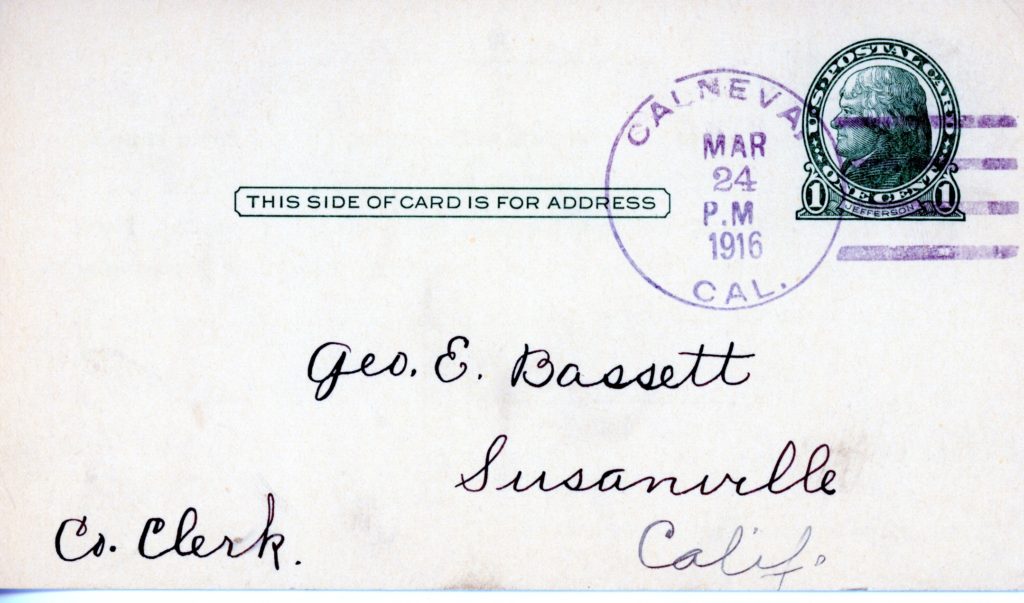
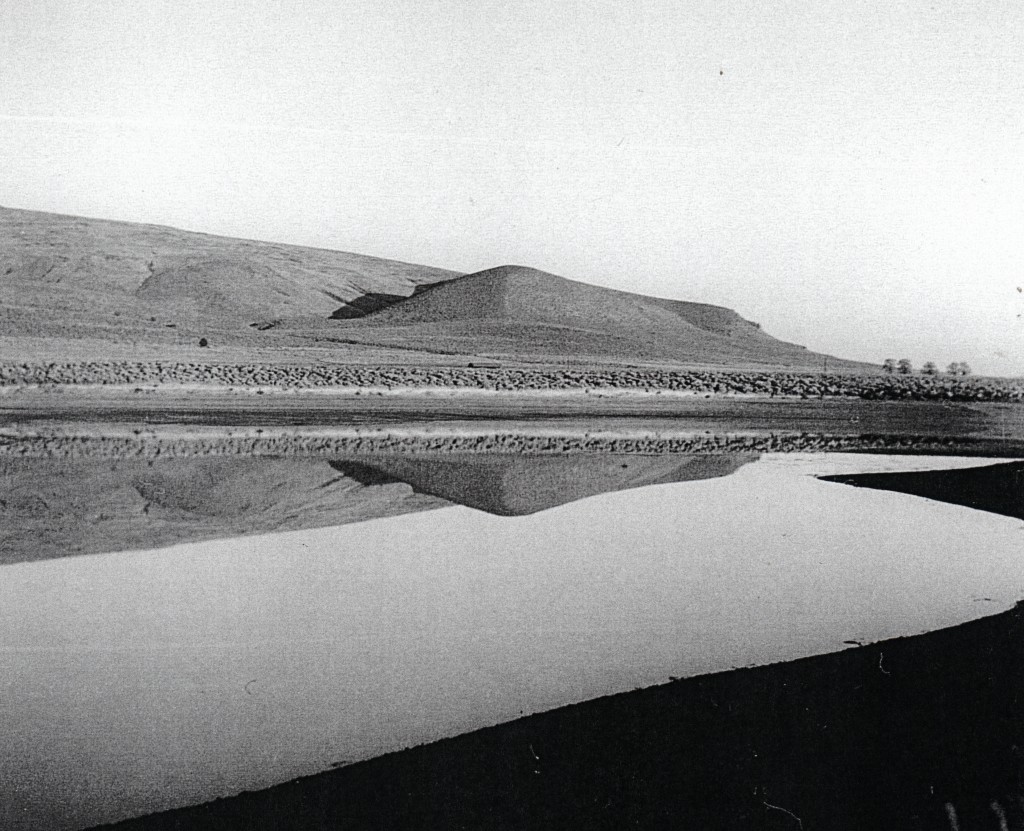
Calneva located in eastern Honey Lake Valley near the state borderline, was a small station on the Western Pacific Railroad. The station operated from 1910-1921. The Calneva Post Office was established on July 8, 1911, with Charles Ammons, as first postmaster. The post office closed briefly during 1919-20. On November 30, 1933, it was discontinued, its operations moved to Flanigan, Nevada. It is interesting to note that Calneva was located six miles east of Herlong and six miles south of Flanigan. However, when the post office closed it would be several years before Herlong was established.
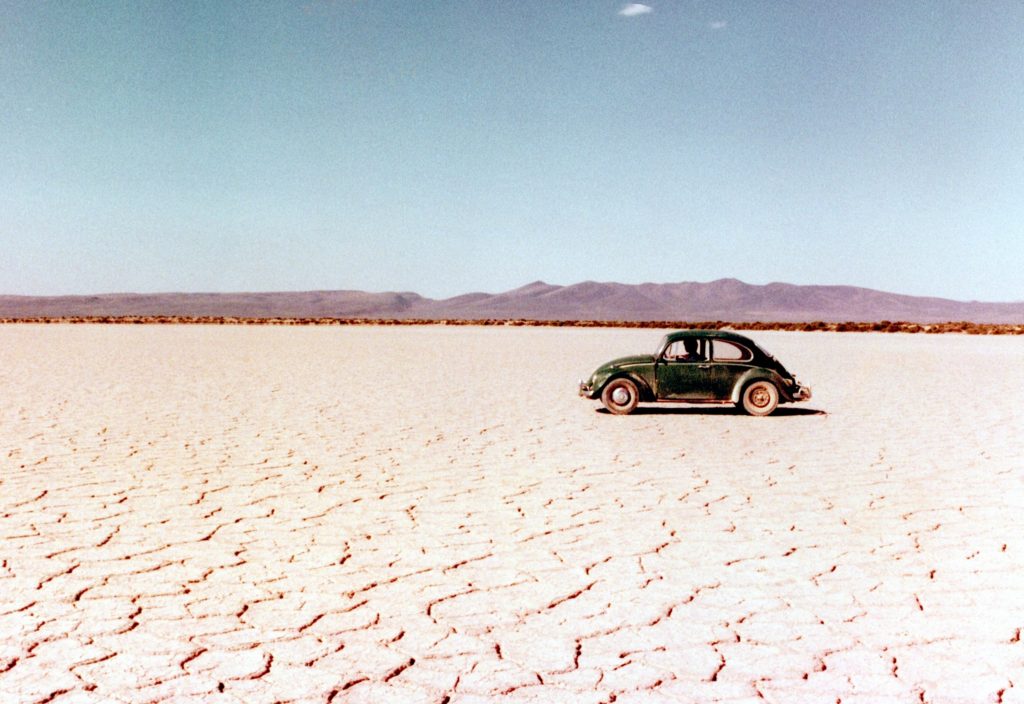
The 1982 expedition in search of Nowhere at Calneva Lake.
During the 1880s and 1890s the residents of Susanville struggled with the issue of a much needed public hall. The Methodist Church was used for many public functions, including the annual community Christmas tree. On Decoration (Memorial) Day of 1898, after special ceremonies were held at the Susanville Cemetery, further presentations were then conducted at the Methodist Church. This time, church could not accommodate all those who attended. It was proposed that the community raise funds to enlarge the church. It gained momentum for awhile. Then on the evening of August 9, 1898 disaster struck when Susanville’s most prominent structure the Masonic Temple (better known today as the Knoch building) caught fire and the building entirely gutted. In the end, the Methodist Church was remodeled in the late fall of 1898, that allowed for extra seating, but the building was not enlarged.
In February 1899, the Susanville Town Hall Association was incorporated. It, too, was derailed by a fire the following year, but that event led to the formation of the City of Susanville.
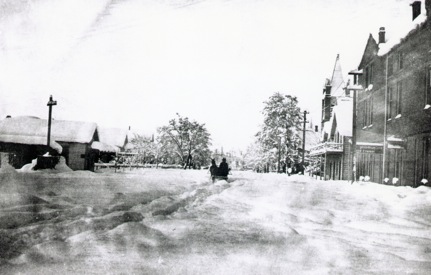
South Lassen Street, Susanville, March 1907 – Courtesy of Gil Morrill
There were several topics in the local news for March 1924. One was a constant raiding of bootleg joints during prohibition. Then, Lassen County issued a quarantine, not for humans, but livestock due to an outbreak of Hoof and Mouth disease in other parts of the State.
It was on March 24, 1924 that a snowstorm dumped 18 inches of snow in Susanville and a similar amount in Westwood. It melted rapidly. Such storms are not uncommon. What made this event remarkable, was it was the only storm for the winter of 1923-24, one of the driest since Anglo settlement.
Note: I am not sure what Big Valley received, because a portion of those archives are off site and currently not easy for me to access.
Spread the word, and encourage a friend to subscribe
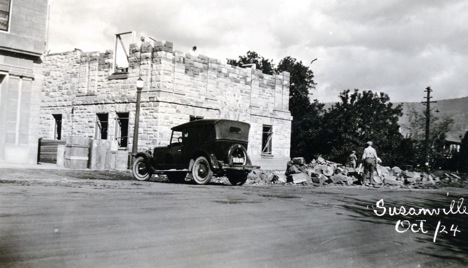
The Masonic Temple under construction, October, 1924. Thank you Uncle Boyd, whoever you are.
In November, 1921, the Lassen Lodge No.149, F.&A.M. found themselves once again homeless due to fire. In 1917, the Mason’s acquired the Native Sons of the Golden West two-story wooden hall adjacent to the City Fire Hall on the corner of Lassen & Nevada Streets. It was those two structures that were destroyed in the November blaze. Finances hindered the Masons, but it did not stop plans for a replacement.
On July 19, 1924, the Mason’s entered into a contract with T.J. Rees of Fallon, Nevada to construct a new lodge. The two-story native stone building carried a price tag of $35,000. It was agreed to have the building completed by January 1, 1925. However, that did not quite happen, and it was not until June 12, 1925 when the Masonic Temple was dedicated.
There are two interesting side-line notes. The Masonic Temple was the last major native stone building constructed in Susanville. When Rees completed the building, he found himself a new job constructing the Hotel Mt. Lassen.
Spread the word, and encourage a friend to subscribe.
Ward Lake, located about two miles northwest of Litchfield is a man made creation. It was built to store the storm waters of Secret Creek. The first dam was washed out in 1890. A second dam was built two years later. In January 1892, work began using Fresno scrapers to move the earth. In doing so an skeleton was exhumed and believed to be an Indian medicine man. It had been well preserved. It was noted there was a necklace, balls of war paint, beads, a spear head an a knife shaped flint. In addition, what appeared to be two pieces of a deer’s leg with numerous notches. What made this unique were the items found with the skeleton. There had been reports from time to time from farmers while plowing fields to come across skeletal remains, and nothing else.
This article, originally appeared two years ago. However with current coronavirus pandemic, I thought it would be worthwhile to bring, after all for some readers this will be a new material, thus a special Tuesday feature, with an end note not in the original article.
One hundred years ago witnessed the worldwide flu pandemic. It caught many by surprise, and Lassen County, like so many others were not prepared how quickly it spread, nor how deadly it was. In early October 1918 the flu made its presence in the communities of Susanville and Westwood. On October 10, forty-year-old Lassen County Surveyor, Thad McKay, became the first victim. A week later, Dr. F.H. Shanks, Lassen County Health Officer issued a statement that yes, the flu was prominent, but a mild one, and citizens to take the necessary precautions of any health crisis. Everything changed quickly with the death of Stephen F. Watson on October 17, shortly followed by two more members of the Watson family. By early November there were over 300 cases of flu in Susanville, roughly one-third of the town’s population. On November 11, 1918, the City held a special session and ordered the closure of the town’s saloons and other public gathering places. The ban was not lifted until November 20, after a decrease in new flu cases.
It is difficult to determine how many Lassen County residents died from the flu. This is due in part many deaths were not recorded with the Lassen County Recorder. If pressed, I would estimate that nearly 100 deaths occurred in Lassen County that were attributed to the flu during 1918-19.
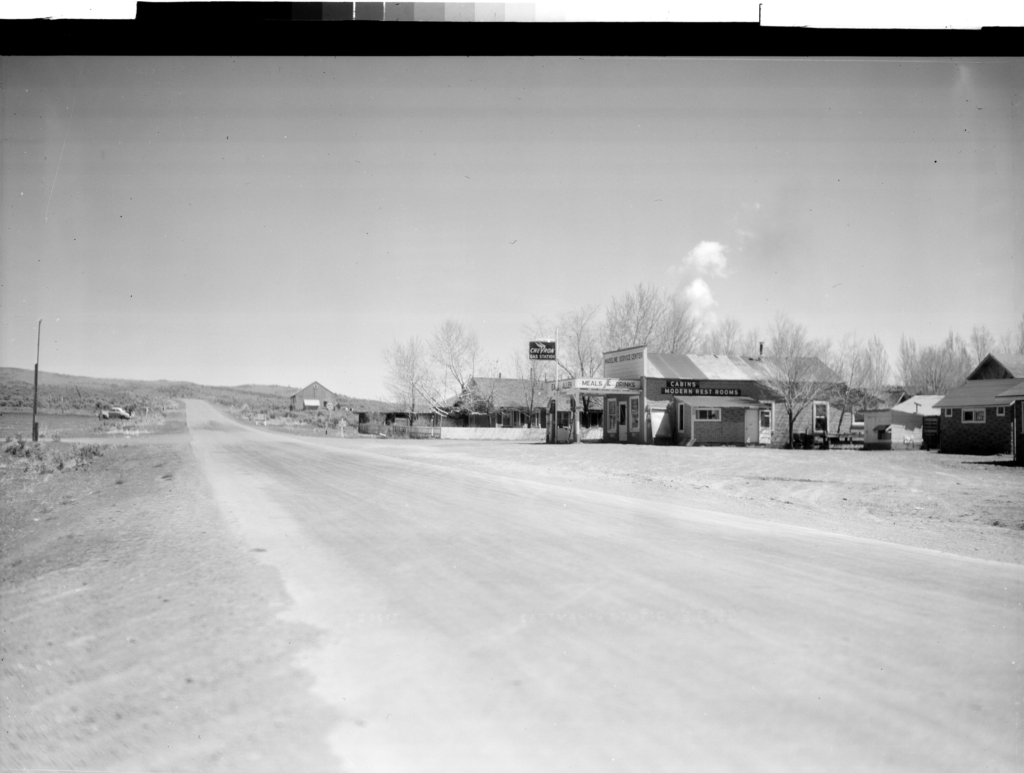
Madeline, Lassen County, 1948–Eastman Collection, U.C. Davis
In the late 1920s, the Southern Pacific Railroad was in a disarray locally, while they fought against the Western Pacific/Great Northern’s Inside Gateway link between Keddie and Klamath Falls. The Southern Pacific had a monopoly on the region and were in a constant flux to combat its proposed competition.
Take for instance in 1929, Southern Pacific greatly reduced its freight rates on timber products. In November 1929, Southern Pacific sent a survey crew out east of the town of Madeline. The surveyors job was to locate a possible line from Madeline eastward through Red Rock Valley and Tuledad Canyon with the ultimate goal towards Gerlach. This officials concluded that this 72 mile route, would save 120 miles to the Klamath Basin. Of course, it was never built, and in 1930 the ICC approved the competitor’s route.
A view of Susanville’s Memorial Park from Main Street, 1947
The creation of a municipal park was fraught with numerous hurdles. Actually, the park movement began long before the creation of the City of Susanville.
By the 1920s, the ideal location for a park was the meadow land east of Weatherlow Street to Grand Avenue with Main and North Streets rounding out the boundaries. This was problematic for the City of Susanville, since it was outside the city limits. A proposed City and Lassen County Park District seemed a like a solution. Besides the city, the district would encompass subdivisions to the east such as Halltown, Milwood Tract and Lassen Townsite. It was met with fierce opposition by county officials. At the December 1929 Lassen County Board of Supervisors, the matter went to a sound defeat of 4 to 1.
The City never gave up, and when the property was annexed to the City in 1947, the park became a reality.
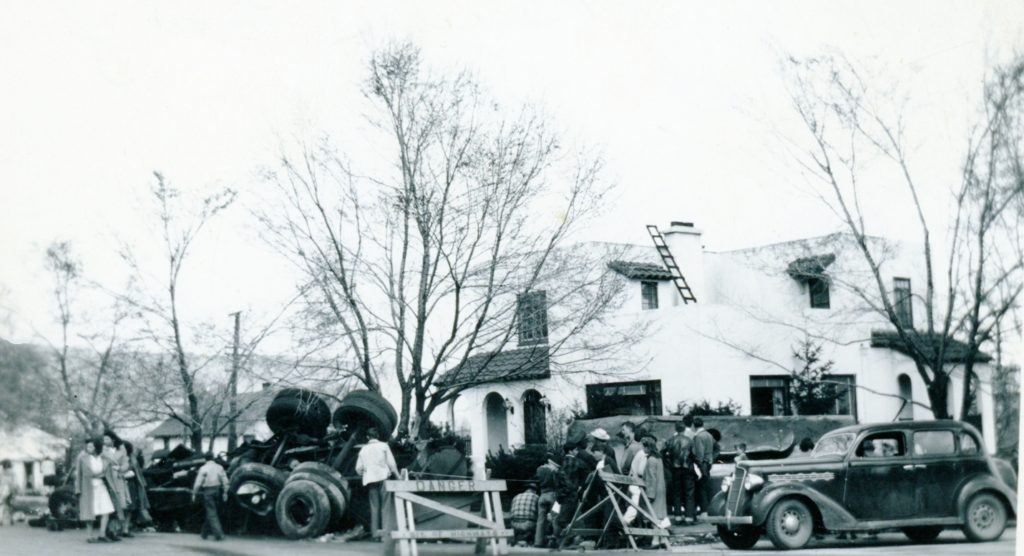
The wreck of April 24, 1944 at Pine and Cottage Streets.
One never know how scenarios may turn out. A perfect example was when an oil truck over turned at the west entrance of Susanville near noon time on April 24, 1944. Fortunately, the driver, 27 year-old Hayward resident, Donald Fedick, escaped without injuries. The truck and fuel tank were totaled, a loss estimated at $12,000. The fuel tank spewed forth 6,000 gallons of fuel oil down the gutters of Susanville. Consider it a miracle, especially when one takes into consideration how prevalent smoking was then, that a stray match or cigarette was not tossed into the gutter setting off a massive blaze.
Established in 1917, Sacred Heart Church’s St. Patrick’s Dinner is the longest continuous event in Lassen County. Of course, anything that has staying power for over a century has undergone changes. A case point is that a number of different church organizations that has sponsored it over the years. In 1955, it was the Catholic Ladies Altar Society who were in charge. That year, it was held on Sunday March 13 at the Lassen County Fairgrounds. The menu was a Italian style dinner, as in previous years, that included appetizers, salami, Italian peppers, olives—a dinner of spaghetti, roast beef, tossed salad, cake and ice cream.