 This article was written by Don Vetter and appeared in the Reno Gazette-Journal on August 26, 1988
Fish Springs Ranch – Franklyn Jeans thinks he knows what can solve Washoe County’s water problems. And he owns it.
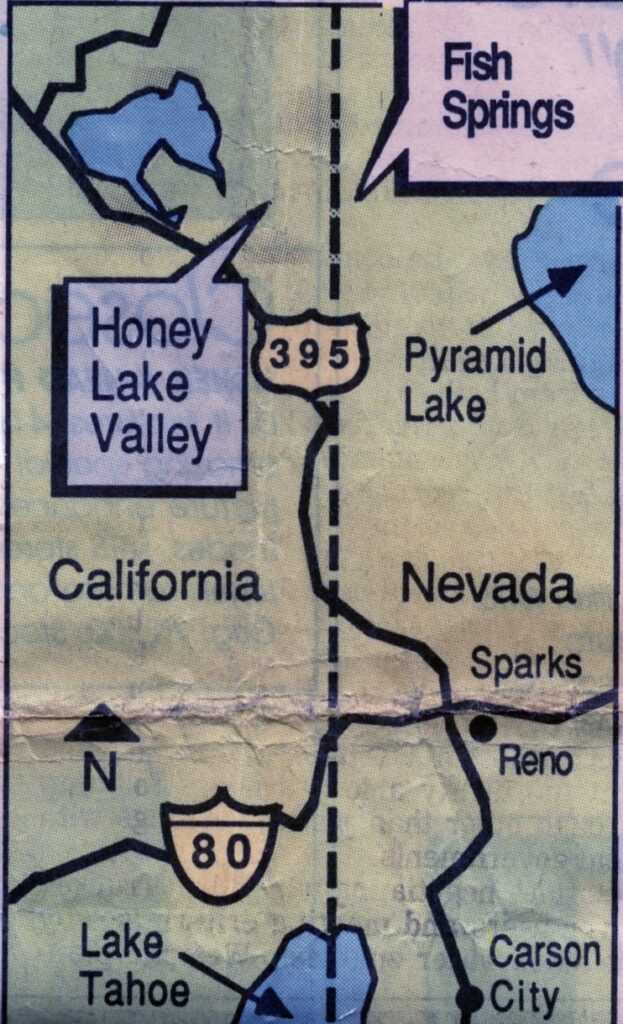
It’s a green, yellow and brown checkerboard in east Honey Lake Valley, about 40 miles northwest of Reno as the crow flies. Beneath the pastures and alfalfa fields of his 550 square mile ranch is a cache of water that Jeans says could be piped the Truckee Meadows and north valleys.
For a price. About $87 million.
Jeans, a 47 year old rancher-lawyer-developer, says this water could be pumped into Spanish Springs or Lemmon Valley, both suffer from over-pumped groundwater tables. Or, his water could stretch the Reno-Sparks drought year water reserve to handle growth well into the next century.
His water import plan looks promising to Washoe County commissioners. On Tuesday they agreed to let Jeans go forward with his own $2 million feasibility study of environmental, hydrological and engineering details for the plan.
And the county previously purchased a $2.5 million option on his water rights. If Jeans’ feasibility study is convincing, the county plans to build the pipeline with him.
If not, and the county backs out, Jeans says he’ll find investors and build project himself.
Still, the road to Jeans’ ranch isn’t quite paved with gold.
Honey Lake Valley straddles the California Nevada border, and Lassen County officials have cried foul at early attempts to remove the water. They fear a massive pumping project could dry up the California side of the basin.
Pumping also raises environmental questions about its effect on wildlife in Honey Lake Valley and along the pipeline’s proposed route.
As the road to Jeans’ ranch snakes around Turtle Mountain north of Doyle, Calif., it yields a breathtaking view and his offer of an ambitious future.
“What we are doing is essentially paving the way for what will be done throughout the Western United States,” he says. “The emphasis from agriculture to municipal and industrial is the environmentally intelligent thing to do. Washoe County is on the forefront of what will be occurring for the next 50 to 100 years.”
Jeans says his plans are environmentally sound: The water basin will not be overdrawn by the pumping: it will be replenished by the annual spring recharge.
Presently, five massive diesel driven pumps suck to 3,000 gallons a minute from the deep rock aquifer into a sprinkler system that irrigates Jeans’ alfalfa fields around the clock.
In 1983 Jeans and Reno doctor Harry Browne bought the Fish Springs Ranch for about $2 million. They planned to graze about 1,000 head of cattle and raise 600 acres of hay on the ranch that once served as a watering stop for the stage coach between Reno and Gerlach.
But they needed to find more water. Two years and too many dry holes later, Jeans says he was down to his last $25,000.
“It was do or die.”
The last hole hit-at an astounding flow rate; other wells were drilled nearby, again successfully.
What once was thought to be a 4,000 acre-foot annual yield turn about to be from15,000 to 20,000 acre-feet of water.
A hydrologist hired by Jeans surmised the flows could be attributed to old volcanic formations that transported underground water long distances, probably from outside Honey Lake Valley.
While Jeans’ wells were gushing, Sierra Pacific Power Co was being pushed by the State Public Commission to find more water for the growing Truckee Meadows. The PSC’S staff figured there was enough Truckee River Water too support new growth through 1992.
“After I read their (water resources) report, it was obvious to me they didn’t know about the underground water reservoir at Honey Lake,” Jeans says.
“We owned about 8,000 acre-feet at the time and after a trip to the supermarket, my wife and I stopped under a tree to have a beer. We figured, based on a Truckee River water right, we had several million dollars worth.”
In summer 1986, Jeans says he approached the utility with a plan to import the water to Reno-Sparks. He says the company initially appeared receptive.
But as the talks continued, Sierra Pacific began to balk, he says, blaming volatile political and economic ramifications of gong through with the pipeline plan.
Sierra Pacific officials were concerned the PSC would not allow them coincide the plan on the company’s rate base, Jeans says. That would prevent the company from getting investment money for the project from increased customer billings and instead would require stockholders to take the financial risk.
In June 1987 the company’s intuition proved correct: The PSC ruled against putting water right purchases for future use into the rate base for similar plan in Warm Springs Valley, north of Spanish Springs.
“(Sierra Pacific) didn’t want to put stockholders at risk,” Jeans says.
Bob Firth, manager of water resources for Westpac, which now is the utility’s water division, says the company dropped negotiations with Jeans because it questioned the amount of water at Fish Springs Ranch and the asking price. “We are not convinced that the 20,000-acre feet was even available. And it appeared that it was not the most cost effective water alternative.
Jeans put more money into studies of his new-found water, and began to formulate plans.
To be continued.