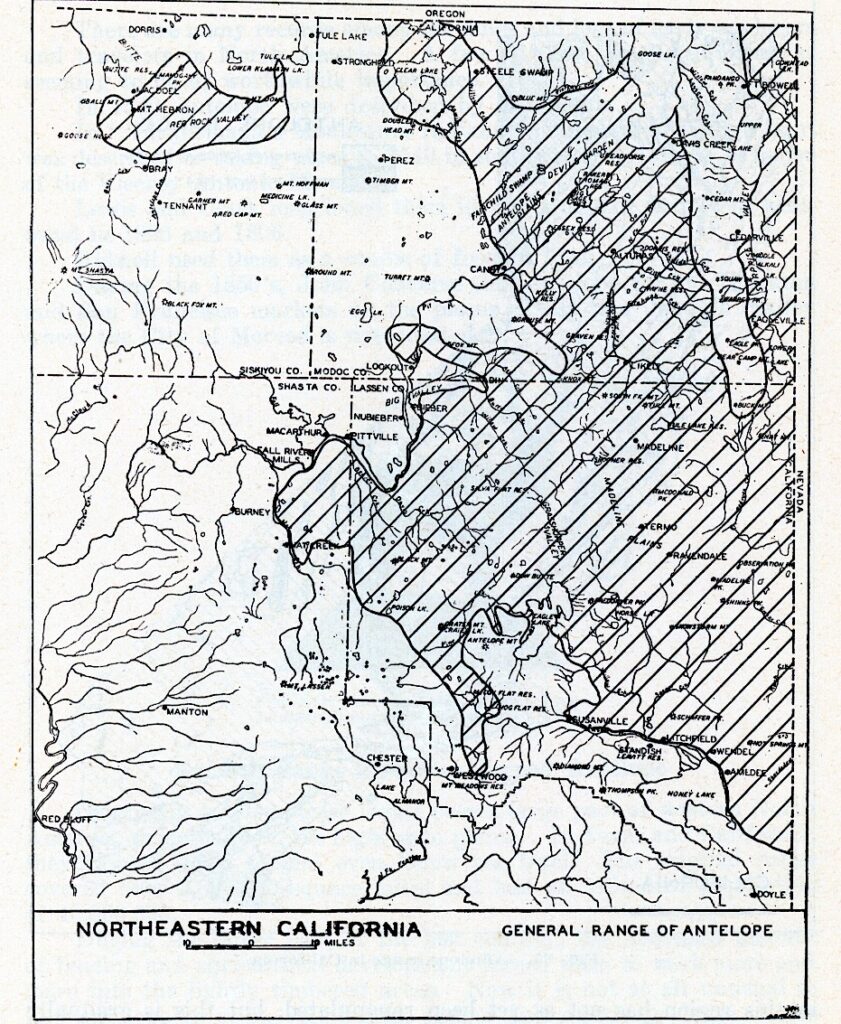
Prior to the 1849 California Gold Rush the pronghorn antelope could be spotted throughout most of California, especially in the Sacramento and San Joaquin Valleys. Fencing and agricultural development in those regions forced them of that habitat. By 1920, some thought the antelope were on the verge of extinction with a population of 13,000 in North America. One of the largest concentrations of antelope were located in Lassen and Modoc Counties. .

Antelope are noted for their speed. They are latest mammal in the Western Hemisphere. They are also known for their curiosity. In 1944, Donald C. McLean of the California Fish and Game wrote: “On the Madeline Plains east of Ravendale, four antelope does ran along beside the car for about one-half mile at 42 miles an hour, suddenly put on a burst of speed and tossed directly in front, then raced along just ahead of the car for another one-half mile at about the same speed when they crossed over in front again and stopped about 100 yards from the road. These animals were certainly not particularly frightened. In fact, I think it was curiosity and the joy of a race that prompted them to stay the car for such a distance.”
In McClean’s report he noted that there was 4,504 antelope in Lassen County. The largest concentration was in the Skedaddle Mountain country. In Modoc, the count was 1,167. McClean’s report included a detailed account of census methods. The first two paragraphs are rather informative.
“Formerly antelope were estimated or counted by crews of picked men working from horseback or on foot. About six or seven generally made up a crew, working in twos orthrees in most areas. Occasionally, however, all joined to form one crew in places where large numbers of antelope in a limited area had to be counted one time to avoid the possible duplication that might occur if they were not all counted in one day. Because of soft ground and rocky terrain, most of the counting had to be done on foot. In order to count the two counties, Modoc and Lassen, properly each man of a six-man crew had to walk or ride about 600 miles–about 26 days of effort per man.
“The extensive use of the airplane was started in the late winter of 1941-42. This first airplane census was carried under the Federal Aid in Wildlife Restoration Act as part of Project California 12-R, “Aerial Survey of Big Game in Northeastern California and in the Owens Valley.” James D. Stokes of the Division of Fish and Game was the observer and. A.L. Reese the pilot during the 1941-42 survey. The 1943 and 1944 censuses were made with regular Division of Fish and Game funds, with D.D. McLean as observer and John Allen as pilot. This method is far superior to the old from the standpoint of speed, accuracy and expense.”
Support by subscribing.